



By Kai Curry
NORTHWEST ASIAN WEEKLY
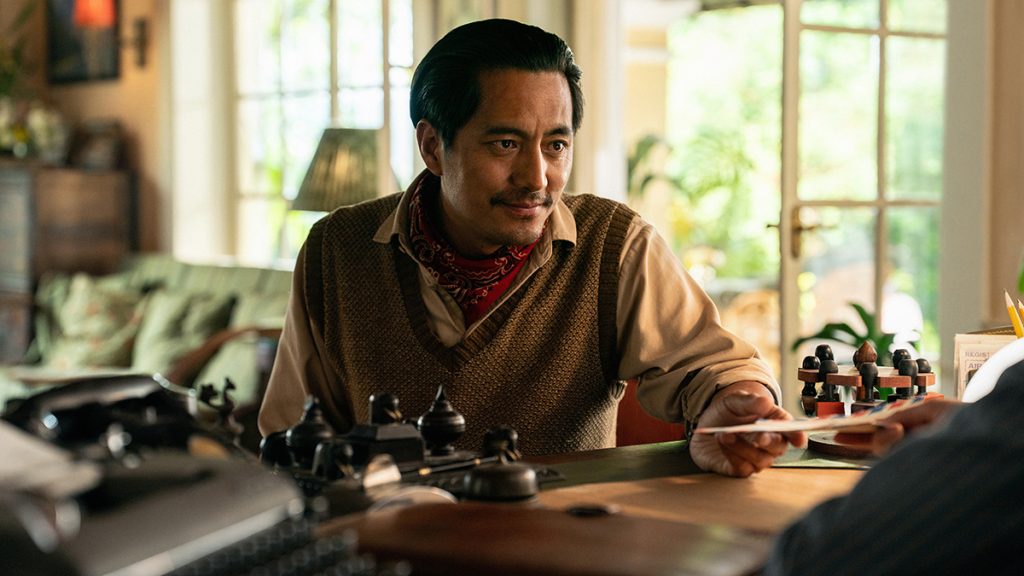
Genden Phuntsok as Tenzing Norgay. Courtesy of AppleTV.
Tenzing Norgay was part of a climbing duo who was the first to summit Mount Everest—ever. The movie, “Tenzing,” tells his story, starting from when Nepalese-Indian Tenzing was a young boy “with the mountain in his eyes,” to a person who would go down for all time as having achieved what seemed impossible.
Norgay’s own son, Norbu Tenzing, served as executive producer on the film. Norbu is also the vice president of the American Himalayan Foundation. The San Francisco-based organization lends aid to the hundreds of thousands of sherpas—the traditional name for Everest guides, but who are their own distinct ethnic group—who help other people visit the mountain every year.
The film explores prejudice in multiple, overlapping ways, and shows that it didn’t, and still doesn’t, only exist between people of different races and cultures.
The film depicts three Tenzings—very young, young, and adult Tenzing—but it doesn’t do so in a linear fashion. Each appears in a significant portion of the story.
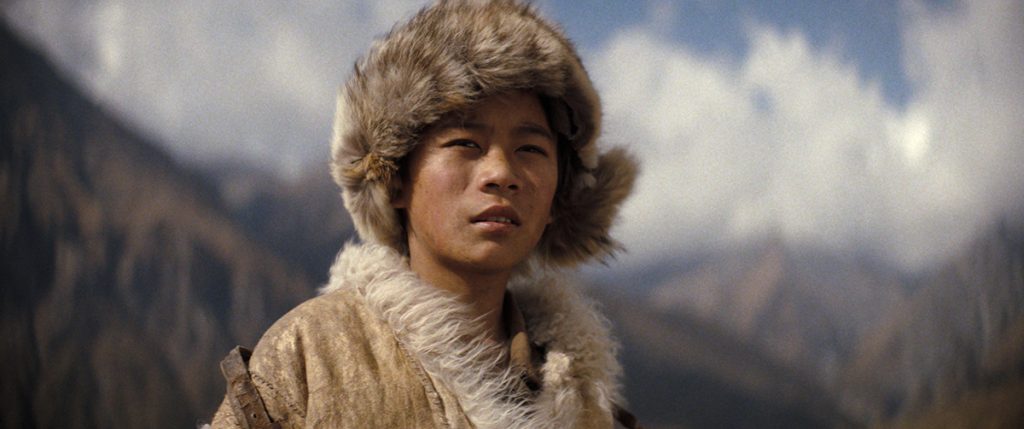
Samdrup Dorje Lama in his film debut as the child Tenzing. Courtesy of AppleTV.
The film introduces us to a very young Tenzing, played by Samdrup Dorje Lama, a young Tibetan actor making his film debut. We see him as a Tibetan yak herder, whose family loses their livelihood due to a plague among the livestock. Their landlord kicks them out, telling them, “I let you live here because you were my herders. No more yaks to herd. No more place to live.” (Tenzing’s actual birthplace is not verified.)
In the movie, his family moves to Nepal to find work. This equates to young Tenzing spending his days digging up potatoes. Tenzing is frequently called an “outsider.” It becomes an obstacle more than once: when he wants to marry a girl from another ethnicity, whose name is “Dawa” (Tibetan actress Thinley Lhamo); and when he wants to join his first expedition as a young man (Tibetan actor Tenzin Dalha).
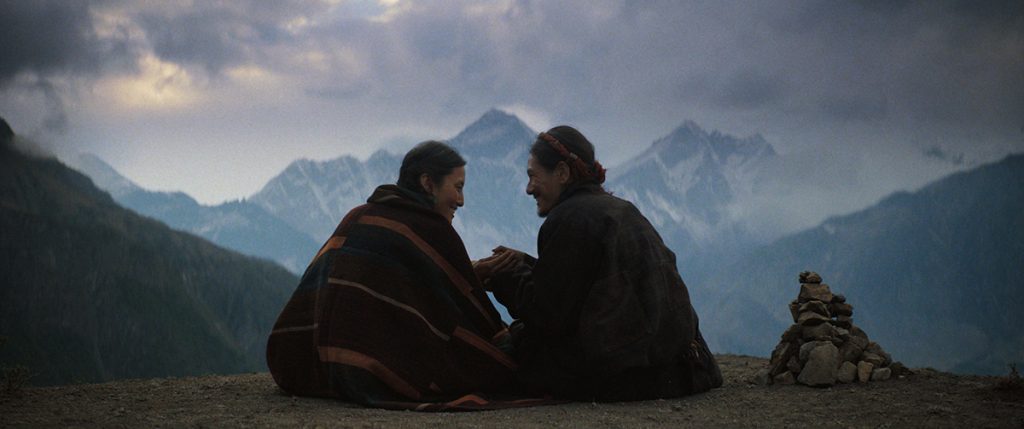
Thinley Lhamo (l) as Tenzing’s love interest, Dawa, and Tenzin Dalha (r) as the young Tenzing. Courtesy of AppleTV.
It’s 1953, by the time Tenzing and New Zealand climbing partner Edmund Hillary link up. Nowadays, the number of climbers who reach the summit every year can spill into the hundreds, depending on the weather. But before Tenzing and Hillary, no one had yet reached it.
Tenzing and Hillary were part of a British expedition. In the early days of mountaineering, only one country per year received permission to try to reach Mount Everest’s peak. European countries vied for the glory and the challenge.
But for most sherpas, it was just a job—a really, really, really hard job.
Apart from Tenzing, few sherpas have been given recognition for reaching Everest’s summit, even to this day. One well-known sherpa who has received recognition is Kami Rita Sherpa, who is said to have summited the mountain more than 30 times.
There’s a difference between climbing close to the top, carrying all of the “official” climbers’ gear, and actually climbing the last grueling “summit push,” an official mountain climbing term referring to the final, demanding leg of a climb. When Tenzing and Hillary summited the mountain, only one pair of “official” climbers was allowed to go to the summit. No sherpas received recognition as official climbers. But they carried all the gear.
Okay, so, enough beating around the bush: there was, and still is, a lot of prejudice in the world of high altitude, or expedition, mountain climbing. There were deliberate, discriminatory practices that kept sherpas from claiming any acknowledgement of their climbing feats. What made Tenzing special was that he was given, at long last, official permission to be part of the climbing team in that year. But he wore two hats. He was also the leader of the sherpas for the duration.
In the movie, this results in some very frustrating juggling of hats for Tenzing (Genden Phuntsok), as the expedition leader, Colonel John Hunt (Willem Dafoe), decides where Tenzing will be most useful that day.
By the way, Tenzing didn’t receive this unheard-of permission in 1953 out of nowhere. He had proven himself on six previous expeditions. In the film, he calls himself “Mr. Amazing.” Though the epithet is apocryphal—there is no evidence he ever called himself this—he was known for having a charismatic personality.
But what is true is that Tenzing had wanted to “meet” the goddess of the mountain since he was a child. In the sacred Tibetan language, Everest is called “Chomolungma.”
In Tibetan, Chomolungma means “Mother Goddess of the World.” The mountain is a living goddess and sacred mother. Throughout history, it is common practice to associate mountain peaks with the gods—and this movie shows the viewer why.
The movie explains that mountains are not to be trifled with. On their own, the locals might not have ever climbed Chomolungma, or not tried for many more years. The mountain is blessed and she can become angry. She is the bones and humans are the blood, the movie explains. Climbing the mountain is very traumatic for some of the sherpas. They do not like the attitude of the white climbers, who see the mountain only as something to conquer.
Even some of the white climbers are not spared the slings and arrows of prejudice.
Though later dubbed “Sir” Edmund Hillary, at the time Tenzing and Hillary summited the mountain, New Zealand had only nine years earlier gained its independence from Great Britain. In the movie, the English climbers relentlessly tease Hillary (Tom Hiddleston). Politics comes into play more than once.
Yet, amidst all this prejudice and discrimination, the film also shows us that surmounting these challenges—summitting these peaks together—can lead to beautiful and amazing things.
“Tenzing” is streaming on AppleTV.
Kai can be reached at newstips@nwasianweekly.com.
Leave a Reply