



By James Tabafunda
NORTHWEST ASIAN WEEKLY
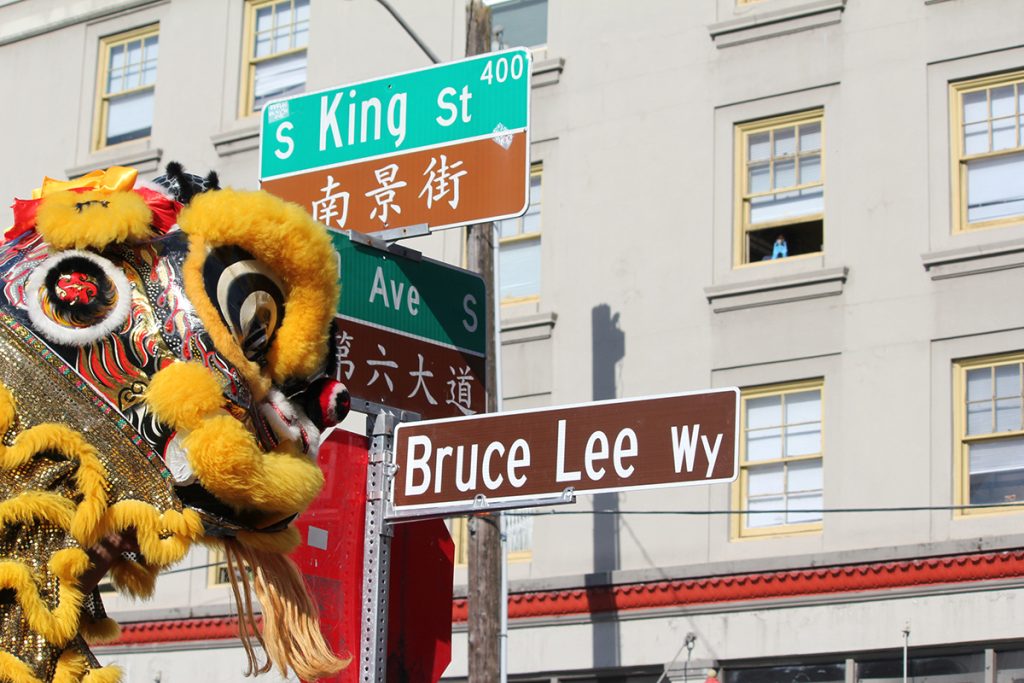
Bruce Lee Way street sign at the intersection of South King Street and Sixth Avenue South. Photo by James Tabafunda.
After many years of community effort, international Asian American icon Bruce Lee now has an official honorary street designation: Bruce Lee Way.
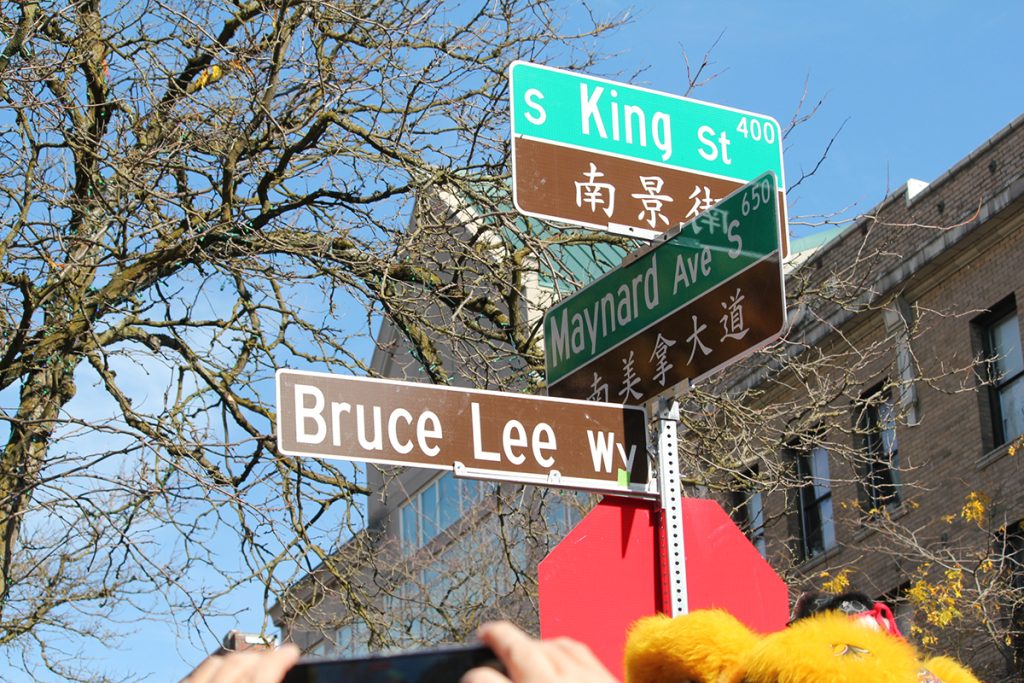
Bruce Lee Way street sign at the intersection of South King Street and Maynard Avenue South. Photo by James Tabafunda.
The honorary street signs sit in the Chinatown–International District (CID) on South King Street at Maynard Avenue South, at the eastern end of the designated one-block stretch, and at Sixth Avenue South, at its western end.
Seattle last made an honorary designation in 2023, honoring community leader Cheryl Chow. The city installed street signs on South Mount Baker Boulevard between 31st Avenue South and 32nd Avenue South designating the stretch as Cheryl Chow Boulevard. Chow spent 40 years mentoring thousands of girls and young women in leadership and Chinese culture in the Seattle Chinese Girls Drill team.
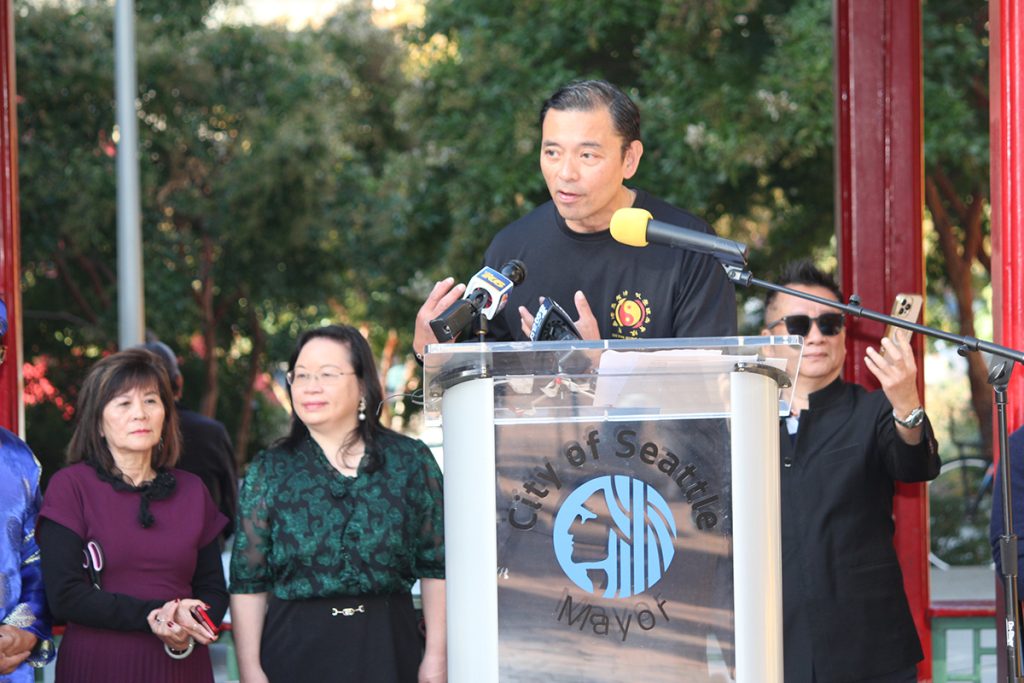
Jun Fan Gung Fu Academy co-founder Abe Santos. Photo by James Tabafunda.
“Today, we are not simply dedicating street signs,” dedication organizer Abe Santos told the crowd on Oct. 16, during the dedication ceremony. “We are honoring an important part of Seattle’s history.”
Santos co-founded Jun Fan Gung Fu Academy, a martial arts school dedicated to preserving Lee’s Jun Fan Gung Fu and Jeet Kune Do.
The tribute recognized the martial artist and actor’s lasting connection to the city where he studied, taught martial arts, and met his future wife.
The crowd erupted in applause and cheers at the Maynard Avenue South as a fuchsia cloth was pulled down to reveal the first Bruce Lee Way sign.
Yellow lion dancers from the Seattle Shaolin Kungfu Academy performed near the intersection to the rhythm of drums and gongs as attendees gathered around the newly revealed marker.
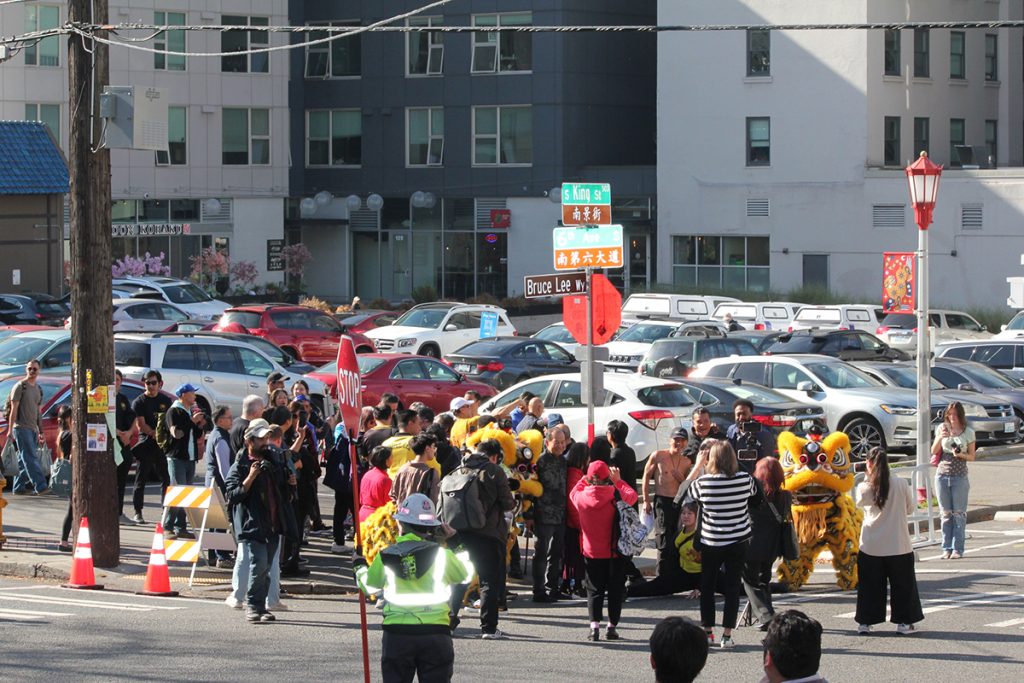
Dedication attendees at the intersection of South King Street and Sixth Avenue South. Photo by James Tabafunda.
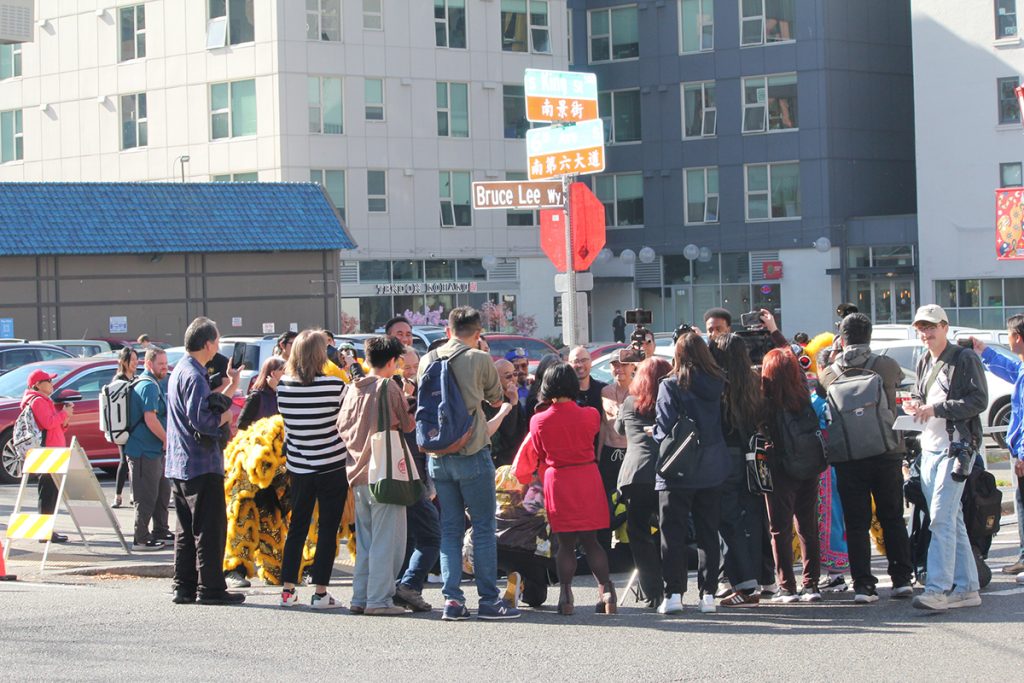
Dedication attendees at the intersection of South King Street and Sixth Avenue South. Photo by James Tabafunda.
The crowd then walked west along South King Street to Sixth Avenue South, where applause and cheers followed the unveiling of the second Bruce Lee Way sign.
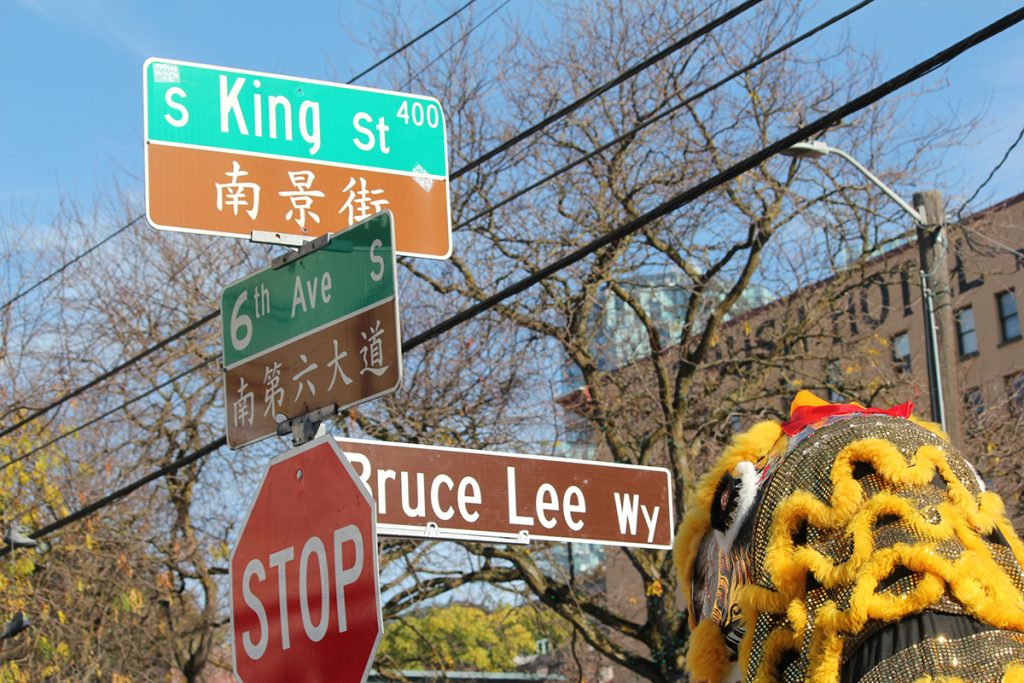
Bruce Lee Way street sign at the intersection of South King Street and Sixth Avenue South. Photo by James Tabafunda.
Lee’s daughter celebrates
Shannon Lee, Bruce Lee’s daughter and the owner and chief executive officer of Bruce Lee Enterprises, joined city officials, former students, martial artists, and community supporters for the dedication at Hing Hay Park in the CID. More than 100 people gathered to turn the park into both a civic ceremony and a community celebration.
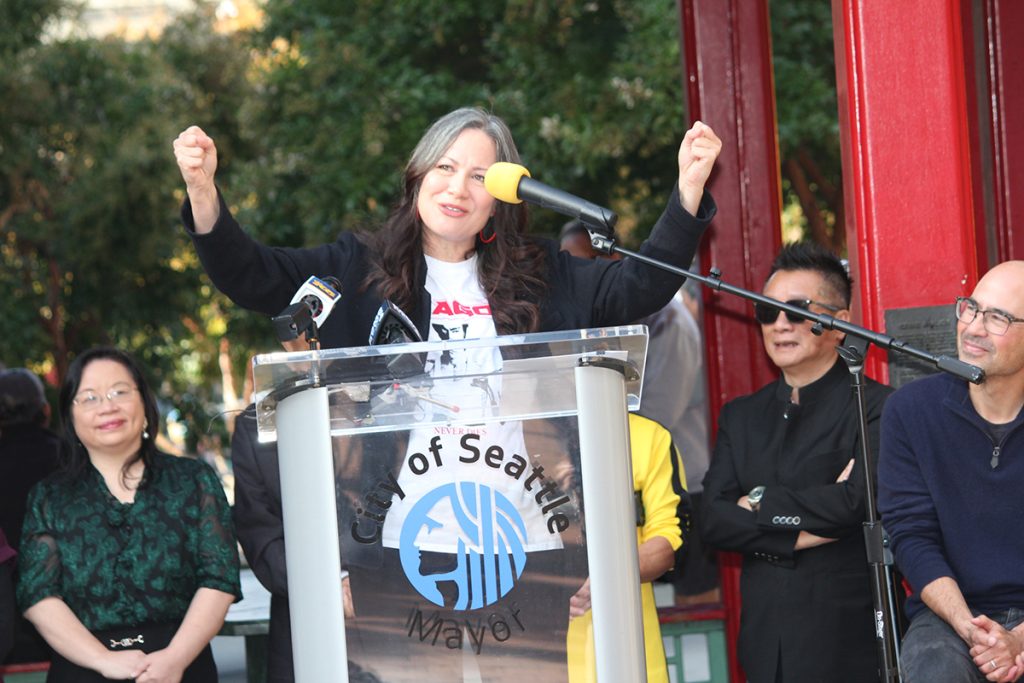
Shannon Lee, Bruce Lee’s daughter and the owner and chief executive officer of Bruce Lee Enterprises. Photo by James Tabafunda.
“I just want to say I just love how Seattle turns out,” she said. “It’s so heartwarming and exciting to see so many people here, so thank you. Thank you all for being here.”
Lee then thanked Santos, city leaders, and the residents and organizations that backed the campaign. She also expressed gratitude on behalf of her mother, Linda Lee Cadwell, who was unable to attend.
“You know what I think is really special about this?” she said. “This was his neighborhood. This was his stomping grounds. Fifty-three years later, we’re still inspired. We’re still celebrating … I’m just thrilled that people will see his name on this sign for time immemorial.”
Community-led campaign includes many supporters
Santos began the effort for the designation about two years ago. His proposal drew support from neighborhood residents, businesses, cultural groups, and others seeking a permanent public marker of Lee’s connection to Seattle.
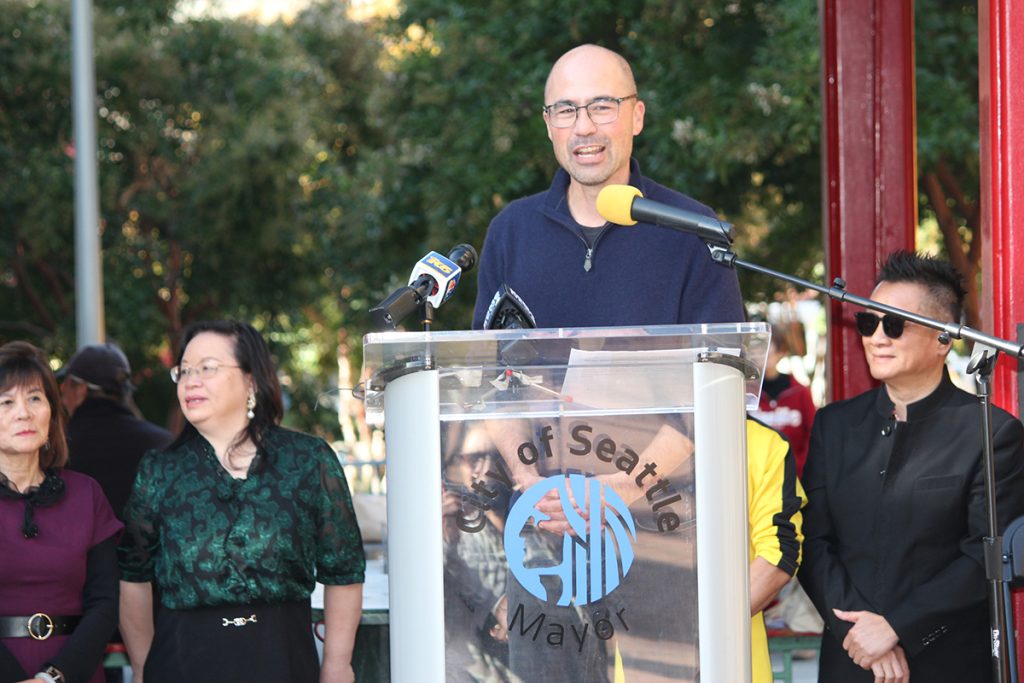
Seattle City Councilmember Eddie Lin. Photo by James Tabafunda.
City Councilmember Eddie Lin sponsored Resolution 32220. Lin’s chief of staff, Stephanie Velasco, worked with Santos on the legislative process necessary to move the proposal toward a council vote. The city council unanimously approved the resolution with a 9-0 vote on Sept. 22, formally authorizing the honorary name about three weeks before the unveiling.
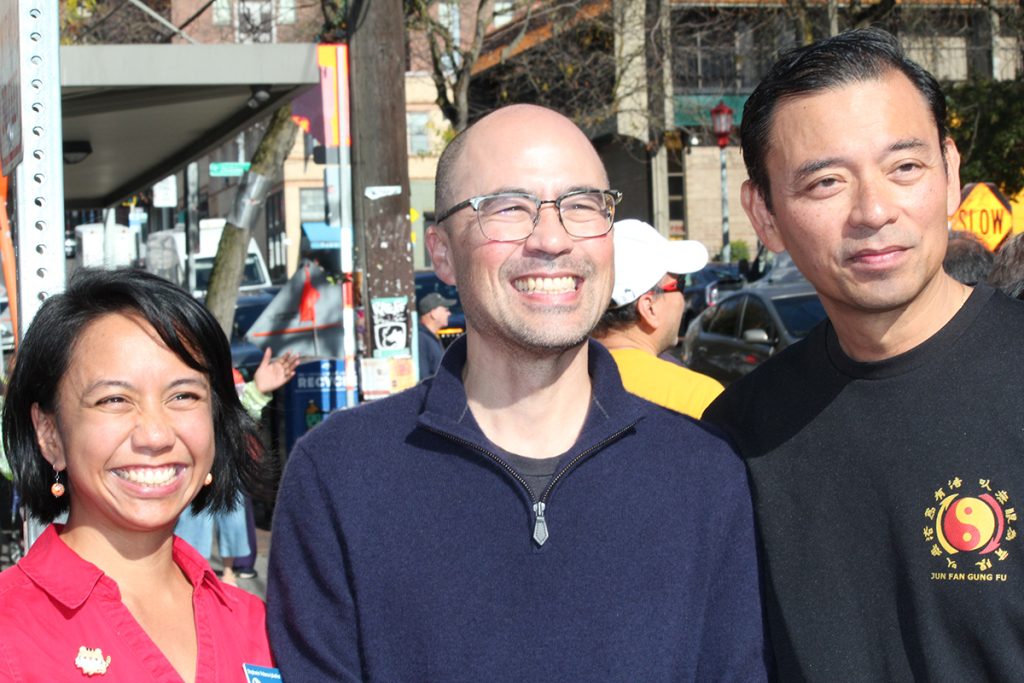
(From left:) Stephanie Velasco, Eddie Lin, and Abe Santos. Photo by James Tabafunda.
The measure identified the segment in the heart of the CID, alongside Hing Hay Park and near the Wing Luke Museum, rather than applying the name to all of South King Street. That distinction leaves the street’s official name and postal addresses unchanged, while allowing the commemorative signs to mark Lee’s association with the CID.
Lin described the dedication as the most rewarding day of his first 10 months on the council. He also connected Lee’s example to his childhood as a mixed-race Chinese American in Durham, North Carolina, where he said he had few Asian American role models and felt pressure to assimilate.
Lee’s example conveyed inner strength, not “how big you were,” Lin said. He credited Lee’s unconventional thinking and pride in his heritage with inspiring audiences far beyond martial arts.
“I’m so proud that Seattle got to play a small role in his life,” Lin said. The street designation, he added, was one step toward recognizing a legacy that continues in the city.
Bruce Lee Way Day
The ceremony also gave the recognition a date on Seattle’s civic calendar. Deputy Mayor Brian Surratt read a proclamation signed by Mayor Katie Wilson declaring Oct. 16 as Bruce Lee Way Day.
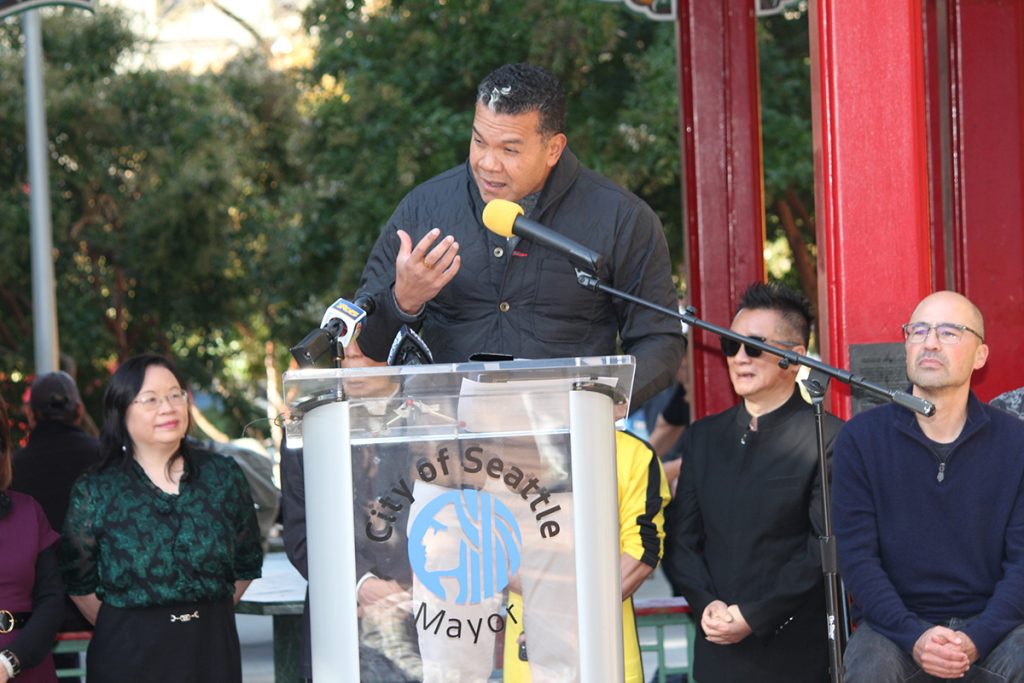
Deputy Mayor Brian Surratt. Photo by James Tabafunda.
Surratt said Lee’s reach crossed racial, cultural, and national lines. The deputy mayor, who was born in South Korea to a Korean mother and Black father, said, “Every time we moved, I had one poster that I carried with me. One poster. It was Bruce Lee.”
The proclamation called Lee a martial artist, teacher, philosopher, actor, and cultural icon whose time in Seattle helped shape his life and legacy. It also cited discipline, perseverance, self-improvement, innovation, and cross-cultural understanding among the values that resonate with people of all backgrounds.
“Seattle remains uniquely connected to Bruce Lee’s legacy as a city that played a pivotal role in his personal and professional journey,” Surratt read from the proclamation.
Seattle shaped Lee’s path
Lee arrived in Seattle in 1959 at age 18, years before international fame. Born in San Francisco and raised in Hong Kong, he returned to the U.S. to make Seattle his home.
He worked as a waiter and lived at Ruby Chow’s restaurant at 1122 Jefferson St. in the First Hill neighborhood. Ruby and Ping Chow opened the restaurant in 1948, creating a highly regarded gathering location outside the CID for diners, politicians, and celebrities. The original building no longer stands.
Lee attended Edison Technical School, earned his high-school diploma and enrolled at the University of Washington in 1961. University records and Seattle histories place him at the school through 1964, taking courses that included drama, philosophy, and psychology.
While living in Seattle, Lee opened the Jun Fan Gung Fu Institute and taught students from different ethnic backgrounds at a time when many martial arts instructors limited whom they would accept. He taught in both the University District and the CID.
Lee’s approach to martial arts emphasized directness, simplicity, and personal freedom. In 1967, while still in Seattle, he began using the term jeet kune do, which translates as “the way of the intercepting fist.”
Bruce Lee’s years in Seattle preceded the television and movie career that made him an international cultural figure. He played Kato in ABC’s “The Green Hornet,” which aired for one season from 1966 to 1967. His five highest-grossing movies, based on estimated worldwide box-office receipts, were “Enter the Dragon,” “The Way of the Dragon,” “The Chinese Connection,” “Game of Death,” and “The Big Boss.”
Lee died in Hong Kong in 1973 at age 32. He was buried in Seattle’s Lake View Cemetery.
Bruce Lee Way as a permanent public reminder
“I believe future generations must understand not only what Bruce Lee became, but also where his journey began,” Santos said. “This street sign is more than a tribute to the past. It’s an inspiration to the future. I hope that when people walk down the street and see Bruce Lee Way, they’ll be inspired to learn about the man behind the legend, the young man who came to Seattle.”
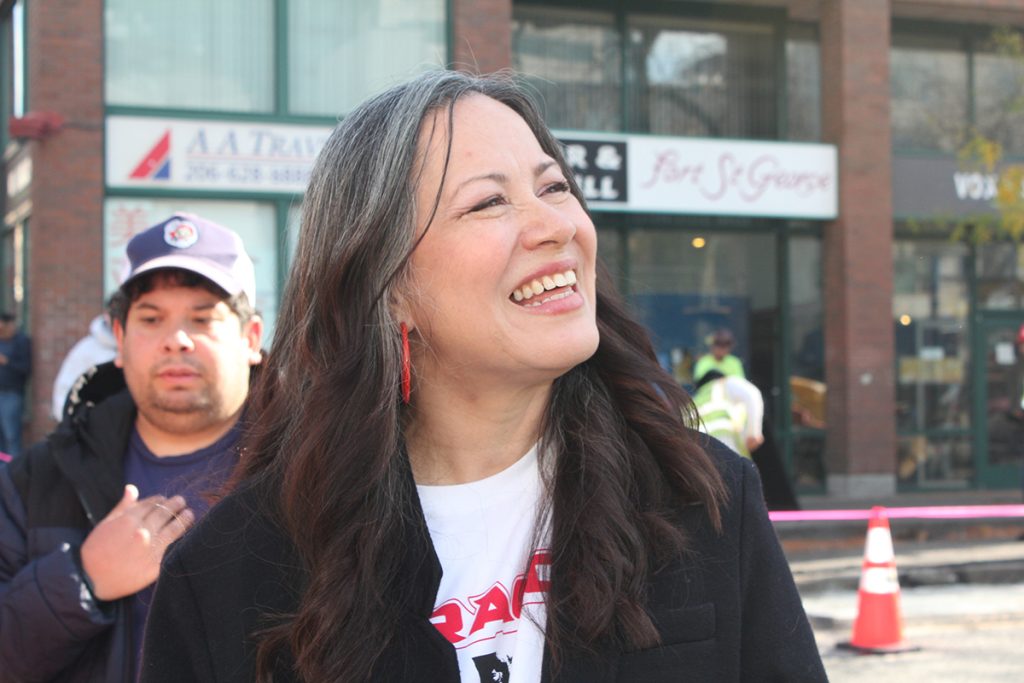
Shannon Lee, Bruce Lee’s daughter and the owner and chief executive officer of Bruce Lee Enterprises. Photo by James Tabafunda.
Shannon Lee made a similar point: “Now, we actually have his name, and you can see it,” she said. “You go ‘Bruce Lee Way’ … because it was his way. His way was so unique in the world. It’s left this resonant mark.”
She also pointed attendees to the Bruce Lee exhibit at the Wing Luke Museum, a short walk from the park. The museum has created exhibitions about Lee’s life, his years in Seattle, and the influence of his ideas beyond martial arts and movies.
Cost and the next tribute
A city council fiscal document estimates that manufacturing and installation of the street signs would cost $2,500.
A GoFundMe fundraiser, titled “Honor Bruce Lee with a Street Name in Seattle,” was organized by Sophia Chang on Santos’ behalf, however, set a $7,000 goal for street signs and installation. It has raised $2,706 from 36 donations as of Oct. 19.
For Santos, the new signs are not intended to be the last public tribute. He said the community is working through another process for a bronze statue already cast for the CID. A final installation date has not been announced.
“The statue has already been built,” he said. “We just need a place to find a home for it.”
For more information on Bruce Lee Way, go to www.gofundme.com/f/honor-bruce-lee-with-a-street-name-in-seattle.
Leave a Reply