



By Madison Morgan
NORTHWEST ASIAN WEEKLY
Nearly 80 attendees packed the Wing Luke Museum’s Ford Foundation Community Hall to listen to four candidates for the Washington State 37th Legislative District outline their competing visions on everything from budget priorities to immigrant protections to health care access, during the 14th annual Asian American, Native Hawaiian, and Pacific Islander (A&NH/PI) General Election Candidate Forum on Oct. 20.
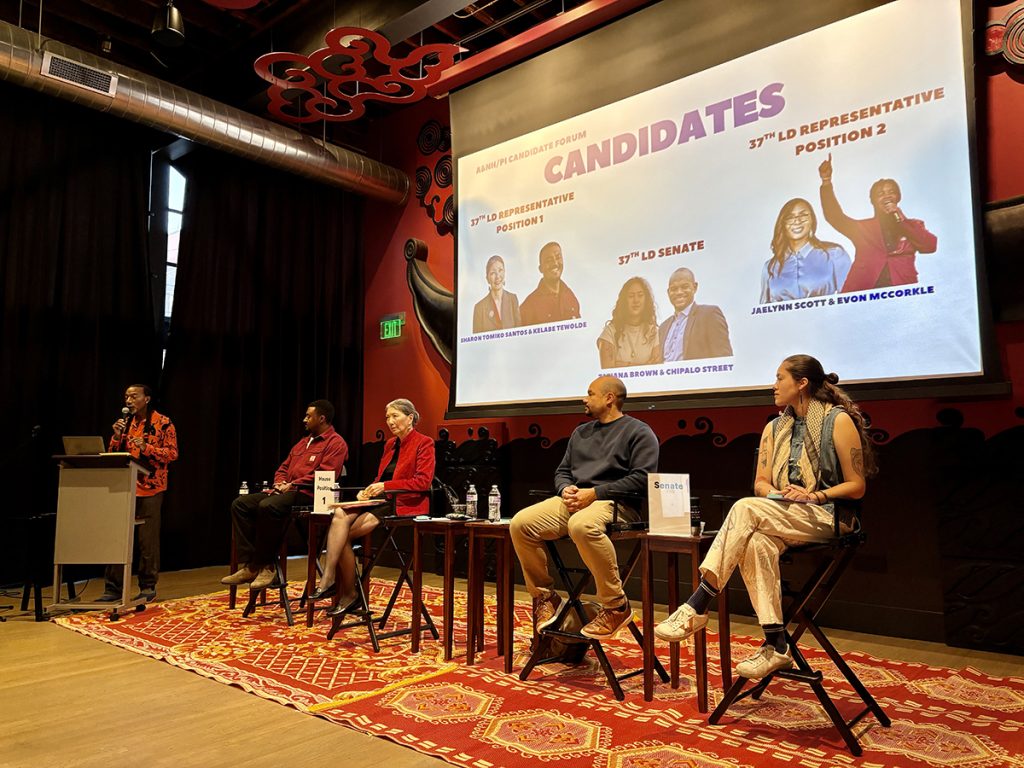
South Seattle Emerald Managing Editor and forum moderator Rosette Royale introduces candidates at the Oct. 20, 2026 Asian American, Native Hawaiian, and Pacific Islander General Election Candidate Forum. Photo by Madison Morgan.
The forum featured competitive races in both House and Senate positions for the 37th Legislative District, which encompasses Seattle’s Chinatown-International District (CID), Beacon Hill, SODO, Georgetown, and parts of West Seattle.
South Seattle Emerald editor Rosette Royale moderated the 90-minute event, which was sponsored by the Wing Luke Museum, Asian Counseling and Referral Service (ACRS), Refugee Women’s Alliance, Chinese Information and Service Center, South Seattle Emerald, and InterIm Community Development Association. An interpreter provided Cantonese interpretation in the nearby Tateuchi Story Theatre.
In the House Position 1 race, Kelabe Tewolde, an educator at Rainier Scholars, is challenging incumbent Rep. Sharon Tomiko Santos, who has represented the 37th district since 1998.
Tewolde described himself as “a son of an immigrant” who grew up in a single-parent household, whereas Santos told attendees she is “a product of the 37th Legislative District, having been raised [there].”
In the Senate race, Rep. Chipalo Street, who has served in the House for four years, seeks to move to the upper chamber. Street faces Tatiana Brown, co-chair of the state’s Environmental Justice Council, who said she is running to become “the youngest woman ever elected to state Senate in Washington.”
The forum originally included House Position 2 candidates Jaelynn Scott and Evan McCorkle, but both were unable to attend.
Budget and revenue
The first question candidates answered regarded the state budget: “As a state legislator, what are your top budget priorities, and what will you prioritize protecting from cuts?”
Santos said that her emphasis would be on protecting vulnerable populations, and “taking care of our fundamental human needs—things like shelter, things like food, things like health—those are critical.
“And I would probably amend this question to not talk about what I will prioritize in terms of protecting from cuts, but who,” she continued. “And the who I would prioritize are our elderly immigrants and refugees and our youngest members of our community.”
Street pointed to his legislative record on progressive revenue, including the Millionaires Tax, and proposed temporary taxes on large banks and raising the cap on the Advanced Computing surcharge to address the state’s projected $500 million deficit.
Street also noted his work protecting food assistance when federal cuts threatened immigrant and refugee communities.
“[These are] exactly the types of things I’ve been doing consistently throughout my career in the legislature—making sure that when we look at our budget, we prioritize the people of the 37th,” he said.
Regarding a state-wide moratorium on data center construction, three candidates said yes. Santos declined to answer the question.
Protecting immigrants
When asked how the legislature can better protect immigrant communities from federal enforcement, Brown and Tewolde both pointed to surveillance as a key vulnerability, though they emphasized different aspects of the problem.
Brown highlighted surveillance concerns in the CID, where automated license plate readers and Flock cameras have expanded. The latest count shows that there are 20 Flock cameras in the CID, about one per block. Brown also noted that AI-based facial recognition systems struggle with accurate identification on Asian and Black faces, increasing the risk of false matches.
“This growing web of surveillance makes our communities more vulnerable,” Brown said. “There are so many of our community members and loved ones that are currently sitting in the detention center in Tacoma, and this is where the legislature really needs to pick up the responsibility.”
Tewolde described community-led efforts to monitor for ICE activity, citing a specific program in Beacon Hill where neighbors organize watches during vulnerable times.
“We are protecting our neighbors at drop-off and pick-up times, because those are the most vulnerable times for families that are dropping their kids off at school,” he said.
Health care access
Candidates also addressed the estimated 11,000 immigrants in Washington losing Medicaid eligibility under federal cuts.
Brown drew on her background in public health and her personal connection to the issue, describing how her grandmother navigated the health care system in a language she didn’t speak. She noted that roughly 40% of those losing coverage are in King County, with another wave expected in January as administrative burdens force more residents off their plans.
Brown said that there needs to be an increased investment in multilingual support and community organizations that help residents enroll, such as ACRS.
“There needs to be investment in organizations … [that are] trying to get our neighbors signed up and make sure that our aunties and our elders are staying on their health care,” Brown said.
Street pointed to Apple Health expansion as a critical buffer, noting the 11,000 figure likely underestimates the actual impact because it doesn’t account for residents who will lose coverage due to paperwork requirements, rather than eligibility changes. He said the governor’s office is currently working on an auto-enrollment system to reduce administrative barriers.
“We need to make sure that we prioritize programs like that, even if it costs extra money,” Brown said.
Housing and education
Tewolde and Santos faced questions on affordable housing and inclusive history education, two issues with direct stakes for families in the 37th district.
On affordable housing, Tewolde pointed to HB 1217, the 2025 rent stabilization bill, as a key divergence.
“I believe that HB 1217 was really important as someone that is a renter that has moved four times in the last six years,” he said, noting Santos was the only representative to vote against the measure. He called for lowering the 10% threshold and expanding social housing to cap rent at 30% of income.
Santos said she co-sponsored similar legislation in the previous biennium, but that her opposition to HB 1217 stemmed from concerns about distinguishing between investor-owned landlords and smaller mom-and-pop landlords throughout the district.
“Preventing displacement is the most important strategy for keeping people housed,” Santos said, adding that protections should also address rents determined by AI algorithms.
On inclusive history education, Tewolde drew on his experience as an educator at Rainier Scholars.
“I’ve seen it in my own work with my Black and Brown kids at Rainier Scholars,” Tewolde said. “We teach the civil rights period and the way our students light up learning about their history—it’s incredible.”
Santos agreed on the importance of an inclusive curriculum, but stressed that educators need preparation before teaching these histories. She noted that not all teachers grew up in the 37th district and may not be familiar with local history.
“Our first job, I think, is to make sure that our educators do not do harm by sharing information inappropriately,” she said.
Quick-fire policy round
During the quick-fire round, all candidates responded to a series of yes-or-no questions.
All four candidates answered “yes” when asked whether they support suspending Department of Licensing data access from federal agencies engaged in immigration enforcement. They also unanimously supported Apple Health expansion, funding for the Housing Trust Fund Program, and using state funds to maintain health coverage for immigrants who lose coverage under federal cuts.
Accountability to constituents
In their closing remarks, all four candidates addressed how they would remain accountable to constituents.
Tewolde described bringing elected officials to Rainier Scholars, where students were able to ask tough questions. According to Tewolde, he’s hosted workshops featuring Senator Rebecca Saldaña and City Council members Eddie Lin and Joy Hollingsworth.
“Accountability is a conversation,” he said. “It isn’t a punishment.”
Santos pointed to her legislative record creating community decision-making bodies, including the Health Equity Council and the Educational Opportunity Gap Oversight and Accountability Committee.
“I believe that the work that I’ve been championing in the legislature over the last several years has been creating places where our communities are making the decisions,” Santos said.
Street said he engages with community groups to understand district priorities, but also works directly with individual constituents on specific legislation.
“Every session, or at least every term, I’ve taken specific bills from specific constituents and worked with them to turn those bills into law,” Street said.
Brown drew on her three years as co-chair of the state’s Environmental Justice Council, where she implemented the Healthy Environment for All Act.
“The most successful and impactful laws are ones that are written in coalition and led by community,” Brown said.
Civic engagement beyond voting
Organizers emphasized that civic engagement extends beyond Election Day, and noted that the forum’s 14-year run demonstrates sustained community demand for candidate accountability.
“Voting is so important, but voting is also kind of the least you can do as an active citizen,” said Wren Wheeler, Wing Luke’s civic engagement specialist. “You can listen in on a committee hearing in Olympia from the comfort of your sofa.”
Wheeler encouraged voters to track legislation and contact representatives throughout the session. For voters concerned about safety at polling places, Wheeler recommended making a plan in advance.
“Go with a friend, go with family, go in a group,” she said.
Voters can find more information about the Nov. 3 elections at vote.wa.gov.
Leave a Reply