



By Madison Morgan
NORTHWEST ASIAN WEEKLY
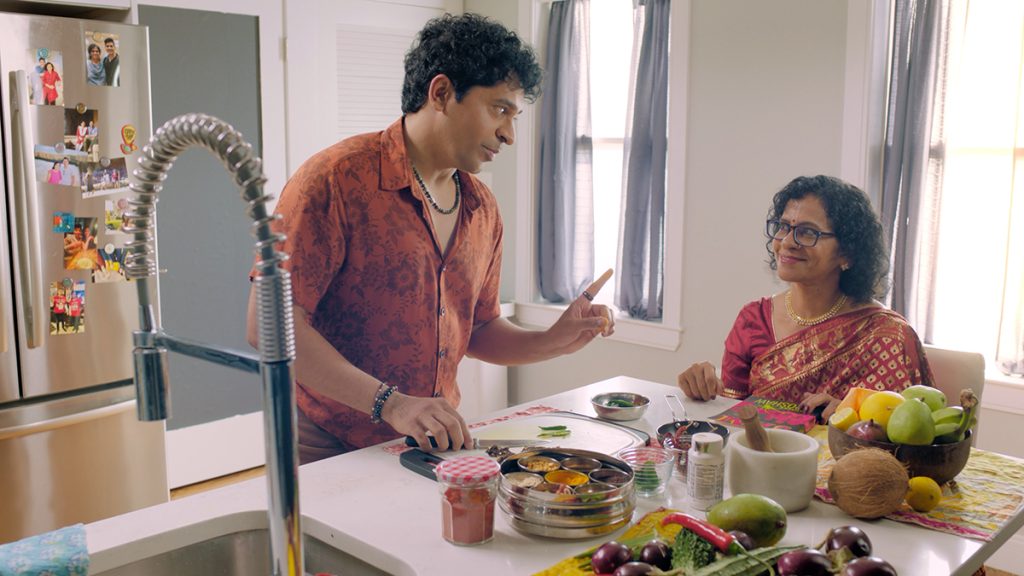
Sriram Emani’s character in the short film “Jam Boy” attempts to make tamarind rice while speaking to his mother, played by Emani’s actual mother. Photo courtesy of Sriram Emani.
The plastic poncho goes on before the stove turns on. In his own kitchen, in work clothes, the coder wraps himself in plastic so the smell of spices won’t cling to him before tomorrow’s meeting.
This is the world of “Jam Boy,” Sriram Emani’s 22-minute short film about an immigrant coder trapped in a system that extracts his labor while demanding he leave everything else behind.
“It’s your food and culture that make your brain,” Emani, who produced, wrote, and starred in the film, said. “And how is it that you want one but not the other? They come as a package.”
A decade of decisions
For one Seattle mother, that bargain meant not being able to say goodbye to three of her grandparents.
“I make decisions every day for the visa,” she said. “The things that can never come back.”
According to the mother, who asked to remain anonymous, the first death hit hardest. She had just applied for her H-1B visa in 2013, and leaving the country meant losing the application. So she stayed in her room for two days and cried while her family buried her grandmother in India.
When she was finally able to visit India years later, her other grandmother joked that she wouldn’t be able to make it back for her funeral either—it turned out to be true.
“Those are the biggest regrets of my life,” she said.
Even now, with an approved H-1B, travel remains impossible. Visa stamping backlogs in India mean leaving the U.S. could keep her outside of the United States for months, separated from her family.
“For people living outside of the country, it all looks very dreamy, and it’s never real until you get here,” she said. “I thought it would be an easy process, but once I came in, I got to know the reality of it.”
Fifteen years after arriving in the United States, Emani still describes the immigration process as a system designed to keep people waiting without answers.
“All of this until you get the green card is a complete black box of uncertainty,” Emani said. “No immigration lawyer, no matter how much money you give them, can give you a guarantee of any sort.”
A Microsoft employee who came to the United States in 2019 described the perpetual anxiety of having legal status tied directly to employment. He said something as small as taking a birthday off triggers fears about seeming replaceable.
“It feels like you are intentionally being made to feel like you are temporary,” he said, adding that “Starting a family, buying a home … none of it feels stable, and it can be taken away at any moment, for no fault of yours.”
That instability became policy on Oct. 8—the Trump administration announced it is suspending Microsoft from the Program Electronic Review Management program, which allows companies to apply for green cards for H-1B workers. Vice President JD Vance accused the company of replacing American workers with “foreign indentured servants.”
“For someone navigating years of immigration uncertainty, a company like Microsoft can represent an anchor, with the resources and an established process to sponsor a future in this country. When even that path is suspended, the uncertainty reaches into the very place they turned to for security,” Emani said, emphasizing that now, more than ever, the central themes in “Jam Boy” feel “startlingly timely and necessary.”
More than a name
The film’s sharpest moments cut toward identity itself. In one scene, the protagonist encounters a coworker who now goes by Kevin, having abandoned his birth name. Emani’s character pushes back: “Those who named you are there—your life is not meant to be limited to this desk that you’re chained at.”
Emani compares identity to a Rubik’s Cube, where the center piece never changes. Solving it requires that center to stay constant.
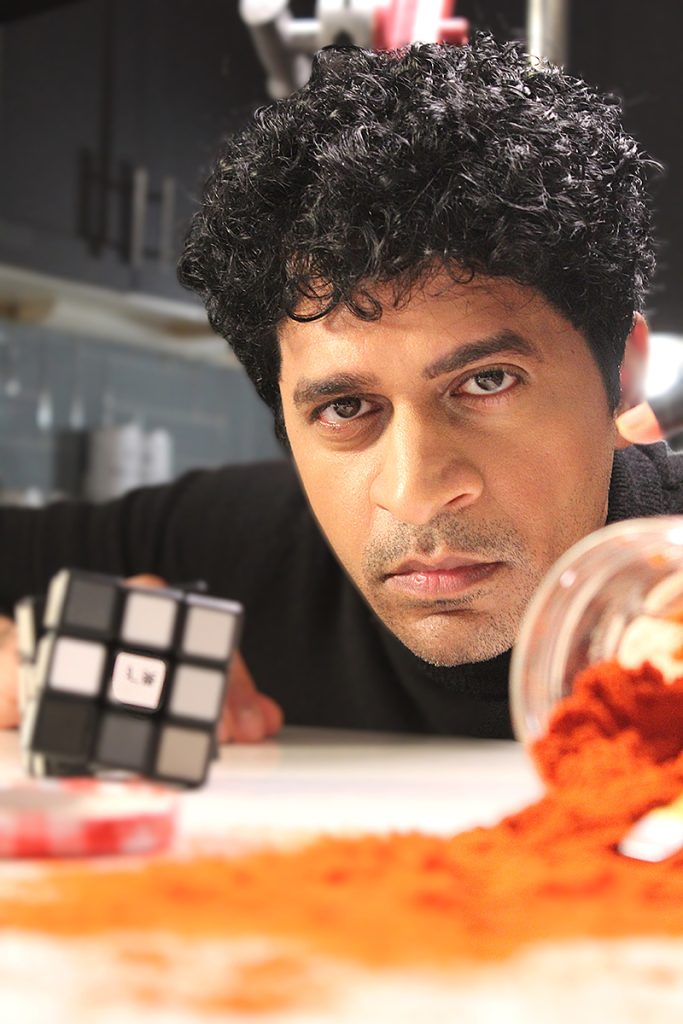
Sriram Emani poses with a Rubik’s Cube and Indian spices, both important metaphors in his short film “Jam Boy.” According to Emani, the film’s title is inspired by the colonial-era term Jam Boy. Photo courtesy of Sriram Emani.
“A name is probably one of the first stories that has ever been told about you before you can even speak,” Emani said. “To suddenly change it because a Starbucks barista cannot spell it—it’s a dissociative identity element. It doesn’t feel like me anymore.”
For the Seattle mother, resisting that pressure meant accepting herself first—then passing that acceptance to her children.
“I grew to accept myself and my identity,” she said. “Take it or leave it. I am very proud of my identity.”
She teaches them their heritage language, music, and dance, and found community through groups like Brown Girls and Brown Moms.
“I don’t want my kid to feel ashamed of anything that she is or she’s born with,” she said. “I want her to feel proud of what she is.”
Beyond the short film
Since its February 2026 release, “Jam Boy” has been screened at 15 festivals, winning Best Film at the D.C. International Film Festival and Best Writing at the Bridgeport Film Festival. The international premiere takes place Oct. 13 in Toronto at the International Film Festival of South Asia.
The short film is a proof of concept for a feature-length version. The script advanced to round two of the Sundance Feature Development program last year, and Emani has been accepted into additional feature writing labs.
“This is very much going to become a full-fledged feature film,” Emani said.
After the festival run concludes, the short will be available online at jamboyfilm.com. Emani plans to continue engaging with audiences across multiple cities, sharing stories, and raising awareness about immigration experiences.
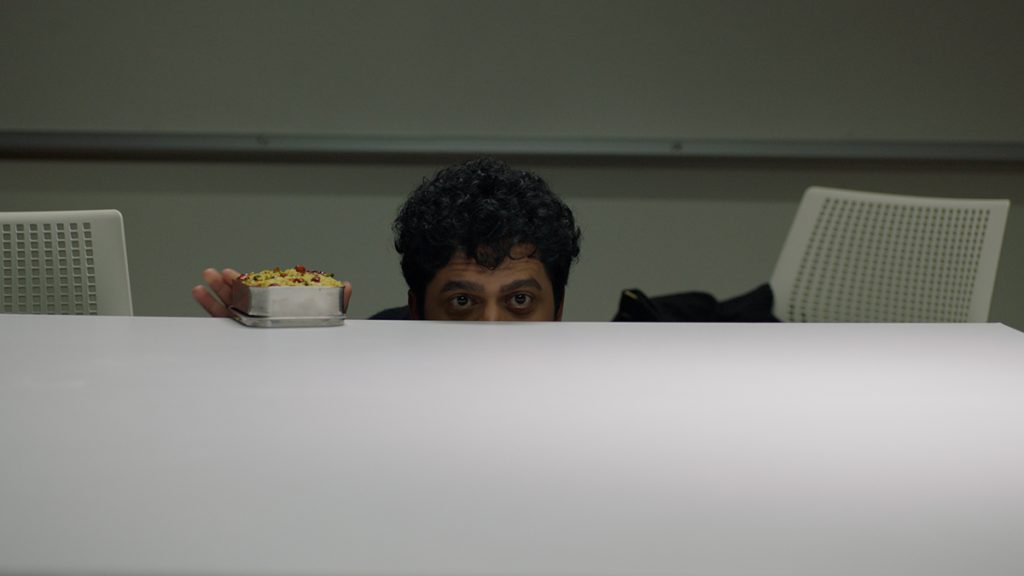
Sriram Emani’s character secretly eats tamarind rice during a scene in the short film “Jam Boy.” Emani had been working on the idea for “Jam Boy” since 2011, when he first immigrated to the United States. Photo courtesy of Sriram Emani.
“I want ‘Jam Boy’ to be something that is for anyone, regardless of culture, ethnicity, geography, patriotism, [for anyone] who has ever put anything off for later that means a lot to them … time is not always playing ball with you the way you expect it to,” Emani said. “It keeps going on regardless. And this illusion or this cycle that you’re in, you have to get out of that and live your life today.”
According to Emani, he hopes to bring “Jam Boy” to Seattle during the Social Justice Film Festival in June 2027.
Leave a Reply