


By Carolyn Bick
NORTHWEST ASIAN WEEKLY
In Indigenous Korean culture, when a person dies, they travel for 49 days through the Underworld. They aren’t in some sort of limbo or purgatory, nor are they immediately reincarnated.
An integral person in this death process is the mudang, whose role can be closely paralleled with the role of the more widely known shaman. Mudang are usually women, and families call them in if the need arises, after a loved one has died.
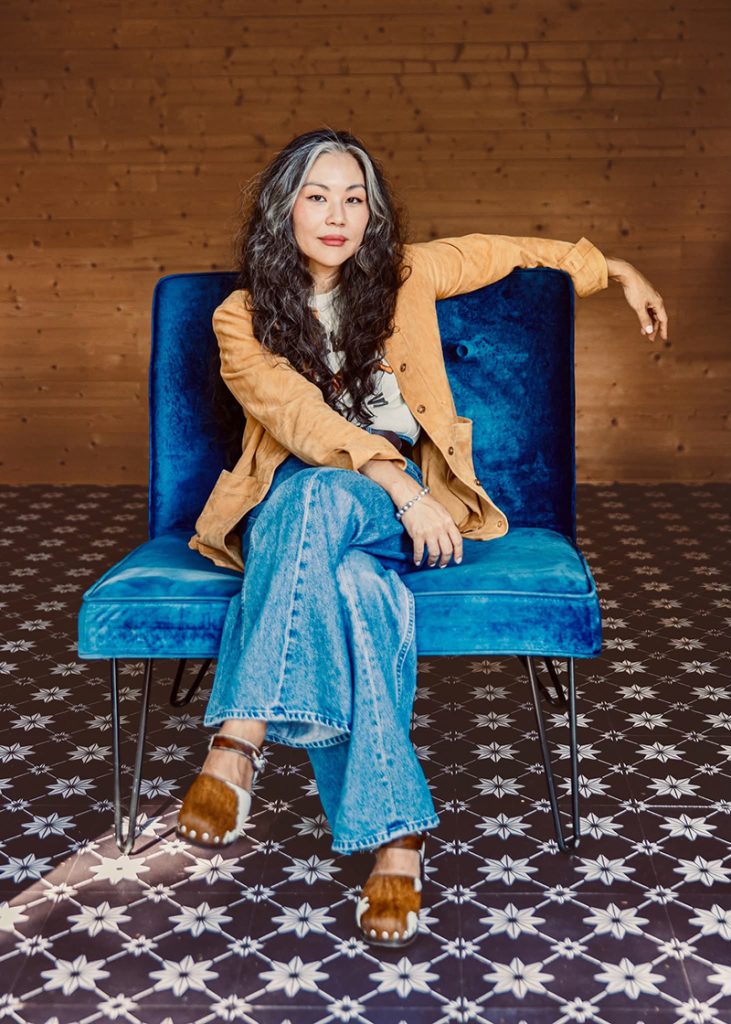
Dr. Christine Hong
But modern technology may be at risk of upsetting these traditions, as some South Koreans have been turning to AI to “speak” with realistic, AI-generated videos of their dead loved ones. Dr. Christine Hong worries that these videos might tempt families to skip over including a mudang in their grieving rituals altogether.
“I can see how, through AI, people are skipping that step of using a mediator and AI becomes the mediator instead. … We’re still practicing that spiritual practice, but we’re almost excluding the actual spiritual mediator,” said Hong, whose upcoming book, “Waking Up Ghosts: Making Peace with Ancestors,” discusses Korean ancestry, faith, and inherited healing work. “I think there’s a little bit of a dangerous thing in that, because we’re almost assuming that we can take the place of the person that’s actually been doing that for thousands of years. It feels a little bit presumptuous that we can program something to do that, or we can actually put our own words into the mouths of actual spirits.”
Jesa and Gut
During the first 49 days after a loved one’s death, a Korean family will hold space for grief in all forms, and will wear the colors of mourning to symbolize that the deceased is still traveling through the Underworld, Hong said.
“It’s really across the river. It’s across this bridge. And during that time, they are facing … a movie of how they live their life. They’re facing the trials and tribulations of how they lived their life without any filter, so they’re able to see without any distraction whether they lived a good life or bad life and anything in between,” she explained. “There’s no judgment at this time. It’s just like the way things were.”
Families will hold a Jesa, the first ceremony a year after after a death, wherein families will set a full memorial table for them that includes their nameplate, their favorite foods, and their photograph. During Jesa, families will remember the deceased, and call them to the table for the first time, so that they can feed their spirit and tell stories about their lives.
“It’s almost like the first reunion that we have with them in their spirit form and in our physical form as a family … and it’s the first time that we’re speaking together in that way, in this new format of a family. We’re still family. We’re still in communion together and community together, but now in this different embodiment,” Hong explained. But, often, families feel they have left things unsaid—perhaps they did not end things well with the deceased, the last time they spoke, or they are having repeated dreams about the person, or things just haven’t been going well or right since that person’s passing. “That’s when we feel like we need to call somebody that can translate for us what’s been going on.”
It would be at this point that the family would call in a mudang to perform another ceremony, called Gut, where a mudang unknots the sorrow and difficulties between the living and the dead.
“It’s a ceremony that can traditionally only be done by our shamans … between the spirit world and the human world, between our ancestors and us. The shaman is the facilitator of that. And often, we have to do it multiple times,” Hong said. “It requires the family members, the spirit and the shaman, and sometimes even witnesses. And it’s storytelling. The spirit gets to tell their side of the story. We get to tell our side of the story. Sometimes there’s drinking involved. There’s eating involved. It’s literally just getting together and telling all of our stories without any filter. So everyone’s story is heard. So there’s some reconciliation … [and] things that we haven’t been able to say when we were all in our bodies.”
“Something that requires feeding”
Mudang Jennifer Kim, a New York-based mudang, said that storytelling is a fundamental healing vehicle, both for living family members and dead loved ones, and that she can understand why some mourners may turn to AI for comfort. It can keep the story going, in a way.
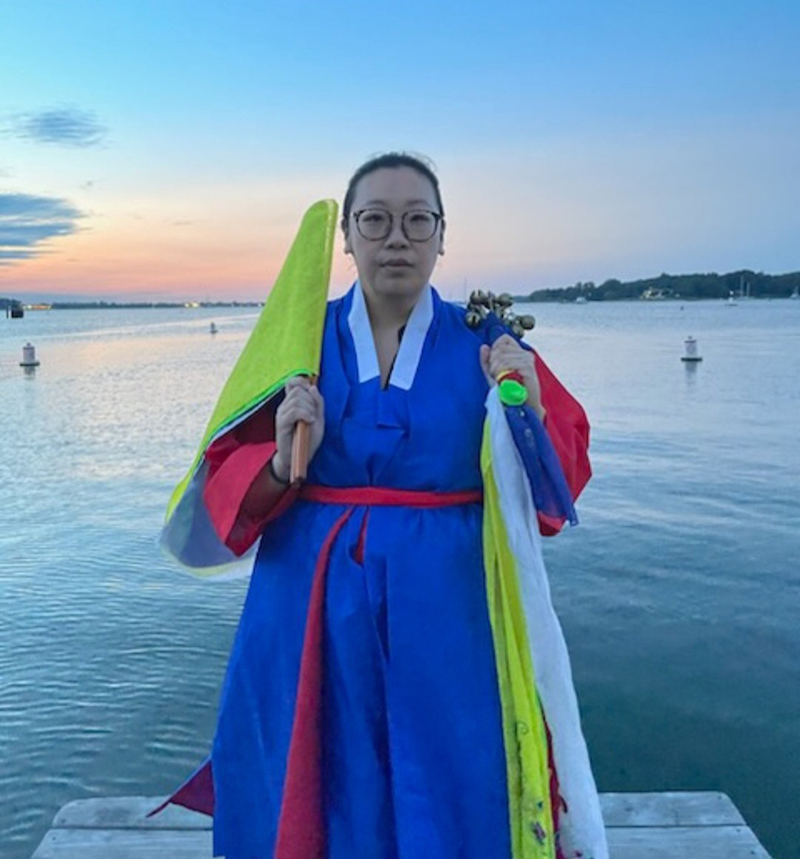
Mudang Jenn Kim
“I think it’s perfectly normal, in a way, or understandable that people are looking to different tools, and different methods and practices to process their grief [is] always a lot to process,” Kim said.
But this could keep a person stuck, she said. The point of these ceremonies is to address the grief and complicated feelings of the living and the dead. Life, Kim said, requires motion and flow. So does death. So, when a person or an energy is stuck in this way, it can create real problems, because it is not in motion—“it’s not really breathing, or living, or in flow, because harmony requires motions of flow.”
Kim believes that these AI-generated images don’t allow for people to move on, because “it’s not just a one-time moment, or one-time transaction, or one-time interaction. Matter of fact, it’s something that requires people to feed into, whether it’s our grief, our emotion, our prompts. It’s something that requires feeding.”
“And so therefore, [AI videos of the dead] can keep us trapped in a way, because it’s something that we keep coming back to,” she continued. “And because it’s something that we keep coming back to, and re-instigating, so to speak, it doesn’t allow the energies of our grief to actually move, which I think could be harmful.”
Moreover, such videos may literally create new spirits with hunger of their own, as AI is an “empty” space. Empty space can be dangerous, because just about anyone or anything can crawl in. During death rituals, mudang will specifically call in the Hon, or soul, of a person—“but when it comes to AI … you don’t know what you’re creating. You don’t even know what kind of energy is being held in that shell, so to speak.”
“And so this is where we say it could bring in the wrong kind of energy, or it could also … trigger a person’s mental unwellness,” she said. “I feel like when people are using AI in this way—where it’s not something is not being used as a tool to help them move on, and is being used as a tool to help them keep stuck into this pattern or into this dynamic of feeding AI information and energy— … it’s an energy that stays trapped in this AI world that’s always waiting for you to come back … because it needs to keep the conversation going.”
“It actually disrupts cycles—cycles of nature, cycles of time,” she continued. “And so, because it’s disruptive of how the natural cycles flow, it can become an issue.”
Kim said she is not sure whether a more modern aversion to death is at play in people’s decisions to turn to AI for videos of their deceased loved ones. Regardless, she does feel that it would be good for people to turn to their cultures and roots to develop a better, healthier relationship with death that is not rooted in fear.
“That fear really stems from not knowing and not understanding. I feel that if there has been more programming or even more education or more access for people to actually explore their dynamics, their relationship with death, or even their fear, that could probably provide better tools than doing that with AI,” she said. “Because AI has no guardrails. … There’s no system in place that safeguards the person in their interaction with AI. And that’s what I feel like rituals and ceremonies or even art practices can bring in is to make sure these structures in which people are interacting can be done in a more healthier way.”
A tool, not a replacement
As cautious as she is about AI, Kim said that she feels it could be a useful tool to help unravel the complexities of grieving. She also noted that mudangs and other Korean shamans are not, as a rule, technology-averse.
“Mudangs and shamans were one of the first people in Korea to embrace technology, even going back to when the internet was created,” she said. “Mudangs and shamans were kind of like the old school influencers that were using the tools of digital online space. … The technologies that are used in our rituals, the technologies that are used in our philosophy and spiritual practice—there is a space to bring that together, maybe through programming, maybe through coding, in the digital space. I think there is a way to work with it because, in history, mudangs have been very open when working with digital tools and internet space.”
Kim said that she thinks that there could be a way to create a protected virtual shamanic space that would neither create an entirely new spirit, nor invite in unknowns.
“If there is a way to bring in the programming along with the ritual technologies that mudangs hold, then there can be a way to do something at least to create a safe space or a safe room where there is dynamic or dialogue,” Kim said. “But without that kind of structure, or enclosure, where it’s like a free- for- all, and any kind of energy can come in—I think that’s where the risk is.”