



By Kai Curry
NORTHWEST ASIAN WEEKLY
Model, actress, and television personality Anna Nicole Smith was known for many things, including her resemblance to Marilyn Monroe. Perhaps, if her interviews are to be believed, Smith herself saw and supported that resemblance.
When Smith was found dead in a Florida hotel in 2007, Smith’s doctor, Sandeep Kapoor, was blamed as one of three in a conspiracy that led to Smith’s death. Authorities ultimately ruled her death an accidental overdose, attributing it to “combined drug intoxication.” They noted that the powerful sleeping medication, chloral hydrate, was the “major component” of the cocktail that killed her, but did not believe Smith had committed suicide.
But there was more to the case than a simple overdose. Smith’s final years were complicated and marked by loss, financial troubles, and mental health challenges, making her ultimate death a convoluted mystery. The public may never know what really happened to her.
A new film, “Trust Me, I’m a Doctor,” starring Indian American actor, writer, and former Obama White House liaison Kal Penn in the role of Kapoor, tells a part of that story from one perspective. The movie—which is in limited release in local theatres—is based on Kapoor’s memoir of the same name.
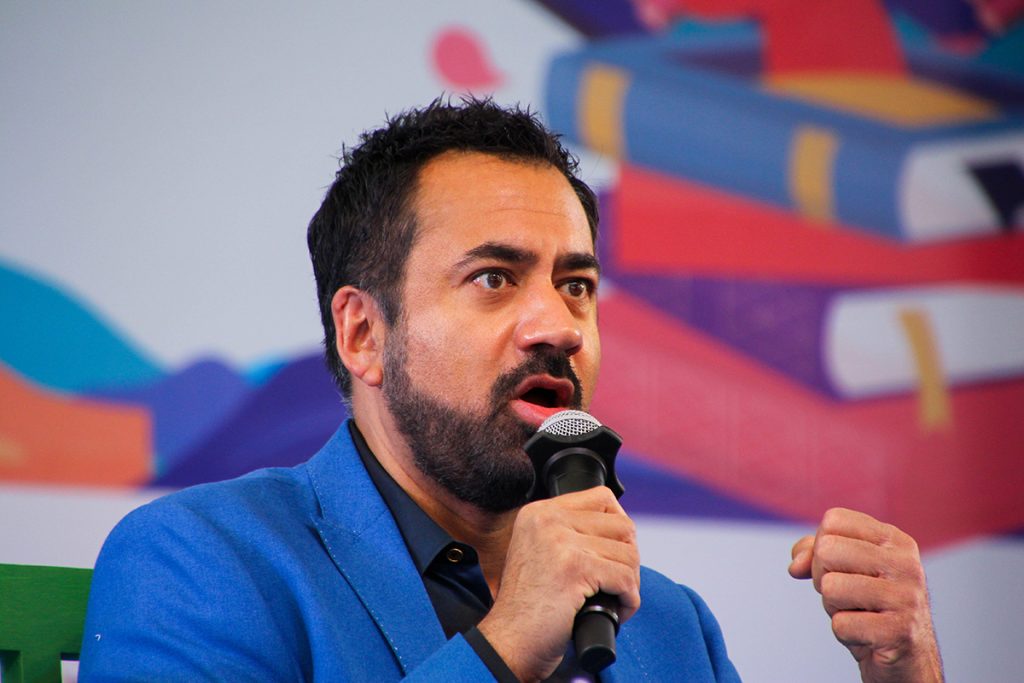
Kal Penn, actor, at the 2025 Jaipur Literature Festival in Jaipur, India. Via Wikimedia Commons. Photo by: Sriya Sarkar.
The film does a good job of making what could be a very dry “trial movie” interesting and fast-paced. It does this in large part through the use of Penn/Kapoor’s chummy narration—as if he is talking to the audience—and his frequent breaking of the fourth wall, including looking directly at the audience. There are also jokes like, “The other lawyers did a bunch of stuff, too, but we don’t have time for that.”
Kapoor became Smith’s doctor by way of purchasing her prior doctor’s practice. In the movie, Kapoor meets Smith, after her previous doctor has already prescribed her methadone, a drug associated with heroin, and one that Kapoor is later accused of over-prescribing to her.
Smith’s former doctor also tells Kapoor that using fake names is perfectly normal when it comes to celebrity patients. Smith is there under an assumed name (Anna Nicole wasn’t her real name, either—her birth name was Vickie Lynn).
These two items will come back to haunt Kapoor later, when he is accused of fraud related to Smith’s death. He is also accused of having crossed doctor-patient lines, and of having sexual relations with her.
Kapoor is portrayed as a quiet, private man. Being in the spotlight, and having to defend himself, is very difficult for him. He doesn’t have a lawyer (but he eventually gets one named Ellyn Garofalo, played by the lovely Linda Hamilton). He doesn’t have a PR team. He is in all ways not ready for what both Hollywood and real-world politics have to throw at him. (The film implies that, in the real world, certain people running for office in the state of California would like to use this trial as a big win for their campaign.)
Kapoor is also gay, but has not told anyone. It’s the biggest reason he could not have had sexual relations with Smith.
Prosecutors mainly draw their evidence from an episode early in Kapoor’s and Smith’s acquaintance, when Kapoor went with Smith to a gay pride parade and partied with her later that night. It appears damning. Kapoor even wrote about it in his journals, which were confiscated for use in the trial. Kapoor is forced to reveal his sexuality, in order to get rid of the more extreme elements of this particular accusation.
Penn does a magnificent job in the role. His performance as Kapoor is arresting and convincing.
Equally impressive are the two actors who play Kapoor’s parents.
Well-known actor Dhirendra—who has Gujarati heritage—plays Kapoor’s father. Ronica Sajnani plays Kapoor’s mother. Sajnani has a fantastic scene where she tells her son she is convinced that this is all happening because of a curse put upon her when someone thought she stole a necklace.
“But you didn’t steal the necklace,” Kapoor objects.
One of the best scenes in the movie, though, is when Kapoor and his father are sitting together several months into what ended up being a years-long ordeal (the court did not reach a final decision until 2010). Kapoor’s father bemoans the fact that Kapoor won’t open up and talk to him.
Kapoor lashes out, bitterly asking his father what he wants to know—if he’s a liar? If he’s a fraud?
“I lie to everyone,” Kapoor says, hurt. He even lies to his patients, he says—though later in the movie, we see that these are most likely “white lies” to soothe patients’ feelings.
His father stands up, regal and vulnerable at the same time. “You are not a liar. You are not a fraud,” he says to his son. “You are a human being.”
When Kapoor tries to pull the “you couldn’t understand what I’m going through” line, explaining how devastated he is at the thought of separation from his sons if he goes to prison (Kapoor has two adopted children), his father says, “I’m going to lose my son, too!”
It’s also at this moment that Kapoor directly tells his father that he’s gay. They have been circling around the topic throughout the movie. In a way, this eases the tension that has been building up, and is completely contrary to what Kapoor thinks his dad will do. Kapoor, Sr., says, “Do you have a boyfriend? You should have a boyfriend.” Interactions like these elevate the movie further.
Anna Nicole Smith, Kapoor, and the other two accused conspirators were, for years, well-known to television viewers in the U.S., through the lens of celebrity, speculation, and scandal. This movie revives the story and gives a fresh perspective that contrasts with certain trash-talking outlets, and highlights how those outlets’ reportage and myopic views could impact such a high visibility trial.
In the movie, Kapoor claims to enjoy his return to the quiet life after the trial. At the very end of the movie, a media outlet offers him an interview related to the death of Michael Jackson. Jackson’s doctor is being implicated in the King of Pop’s death.
“We figured you know something about it,” they say.
Penn/Kapoor looks knowingly at the camera.
Kai can be reached at newstips@nwasianweekly.com.
Leave a Reply