



By Carolyn Bick
NORTHWEST ASIAN WEEKLY
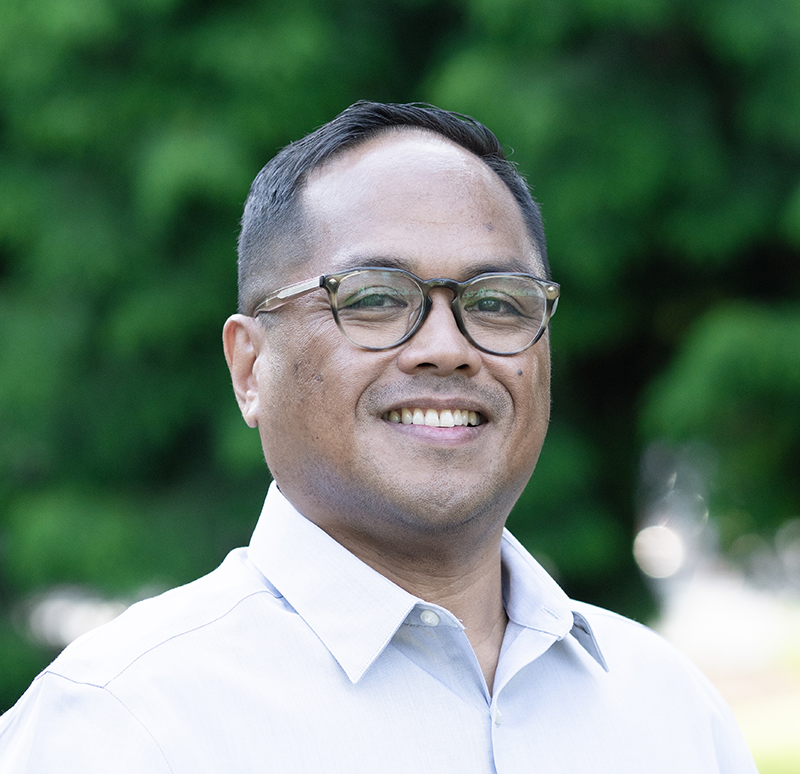
Edwin Obras
For the past 18 years, Edwin Obras has worked for the City of Seattle’s Human Services Department. He currently serves as the department’s interim division director for its Safe & Thriving Communities division. But the Filipino immigrant and Beacon Hill resident also holds another post: representative for Washington’s 33rd Legislative District, a post the King County Council appointed him to in December 2024. Obras is running to keep his seat this November.
During his time in the Legislature, Obras has spearheaded six bills that have been signed into law, including one that makes it a crime to impersonate a federal immigration agent. In an interview with the Northwest Asian Weekly, Obras said that as proud as he is of that law, he sees many problems that Asian American and Pacific Islander communities face, including unrelenting attacks from the federal government, the skyrocketing cost of living, and security in voting.
Northwest Asian Weekly
Tell me about your background. Where did you grow up and who were the biggest influences in your life?
Edwin Obras
I’m an immigrant. I came here from the Philippines when I was a year-and-a-half old. My grandfather was in World War II, which meant he became a U.S. citizen as a Philippine scout.
I grew up on Beacon Hill and spent my formative years being around such a really diverse environment. I have a very big family. There are five of us kids. I would say the biggest influences in my life are my parents and a couple of women who were instrumental in kind of where I am at today. Dolores Sibonga—who I saw as a very young child [and] who got my dad to get excited about politics and vote for—kind of opened those doors and the possibilities for me.
But it was really Velma Veloria who was my biggest influence in politics. We walked through those doors that Dolores opened up. Velma really held that door open for me as a young college student going to [University of Washington], who was a little active on campus, campus political activity. But when I saw somebody who ran, who looked like me, who came from the same part of the Philippines as me, and who was actually less than a mile away from me—it was not only a reason to get excited, but a reason to support somebody who was willing to step up in a way that no one has in the past in terms of the state legislature.
Velma’s a pioneer. She’s the first Asian American woman to hold office in Olympia [and the] first Filipino American in the state as well. I was a super-volunteer when she first ran in 1992 and that carried into her re-election. Two years later, I became her campaign manager and I got to see really the inner workings of how a campaign is run. Since then, I’ve worked primarily in community, around the needs of community, whether it’s nonprofit or, currently, in the city of Seattle in the Human Services Department.
NWAW
Why did you decide to stay in politics or political life?
Obras
The work that I’ve done over the past 25, almost 30 years now, has always been political in terms of advocacy, funding for things that I care about. I’ve worked around homelessness, food insecurity, and youth programs. Currently, I’ve been working in the area of gun violence prevention and intervention.
And so, when you ask why I decided to stay in politics—it’s more or less I haven’t really left, because I see politics as part of my everyday life and identity. Running for office or seeking an appointment initially was not a huge, radical step in another direction, but more like a continuum of the work that I’ve done over the last 28 years now.
NWAW
What have been your key focuses, and what would you say your most notable achievements in these realms are?
Obras
I still work for the city of Seattle as my day job. I’m on leave during a session. So, when I’m in Olympia, I belong to the labor, community safety, and health care committees. And where I’ve been leaning in on the work is really around labor issues and worker protections, including our immigrant workers. I have been trying to ensure that some of our least protected and those that are making the least in our workforce have a way to get those protections, but also have a trajectory so that they’re not stuck in low-wage jobs.
So if that means fees that security guards have to pay or paid by the employer, then I’m pushing for those protections. The Port of Seattle or the airport is a huge employer in my region, and I’m grateful for that. But they also have responsibility to their workers. I want to ensure that those employed by the airport are reaping the benefits that they should around their health care.
One of the reasons why I also ran is because there’s too much at stake with the Trump administration and the federal mandates around immigration and health care. Part of what I want to do is be a voice to protect our communities, particularly immigrant communities. I partnered with the governor in a session to enhance some of those protections … which prohibits not only impersonating a law enforcement officer, whether it be [Immigration and Customs Enforcement] ICE or otherwise, but also acting upon it. … We had something on the books previously about impersonation, but my bill takes it a step further, in that we don’t have to wait for someone to act out on the fact that they’re impersonating somebody.
The mere fact of actually trying to intimidate, [or] use any kind of imagery around the fact that they are portraying themselves as law enforcement was where my bill really enhanced the original bill. [In the original bill,] you had to actually do something first to commit a crime. We’ve had in Washington state and across the country instances of people impersonating ICE officers. And I and the governor really just wanted to protect our communities who have already been under enough stress.
I am just really proud that I was able to partner with the governor on that bill, which does a little bit to help protect folks who are pretending to be ICE officials.
NWAW
Where do you still see gaps that need addressing and why?
Obras
Our economy is in shambles for working families. We continue to see the cost of everything, from groceries to gas to utilities, rise. And I think we came up with a pretty solid plan for a future state … through the passage of the Millionaire’s Tax last year. There’s an expanded working tax credit for families and no tax on certain hygiene products, giving some tax breaks to our small businesses. But that doesn’t take effect until at least 2029 when the tax goes into effect.
So, we need to find out some solutions on how to help folks between now and 2029, which is [several] years out. So what is it that we can do? We are trying our best with the resources to come up with some solutions.
But I think, without a doubt, the affordability crisis is still a gap that needs to be addressed.
NWAW
What have other members of the AAPI community, in particular, told you that they are struggling with the most? And how do you plan to address those struggles if you get reelected?
Obras
Affordability touches every community. I think we really discussed that. I also touched on the immigration piece.
But there’s real fear. Even people I talk to who are going to their immigration swearing-in— they’ve already passed the test and they’re going in for the swearing-in—members of the immigrant community, the AAPI community, are going through life in fear.
We have some local protections. I think I’m going to just go big picture here: Our community needs to mobilize and [we need to] ensure that they are registered, and register to vote and vote when it comes down to it. I don’t exactly know the numbers right off the top of my head about the number of registered AAPI folks who are registered and don’t vote, but if it mirrors what the rest of our electorate looks like, then we need to ensure that access to bilingual materials are continued and are funded. We need to ensure that all languages have translation and for folks to not be intimidated enough [that they don’t] vote. I think we have an obligation to ensure that folks feel safe about voting.
NWAW
As a Filipino American, are you concerned about the Trump administration’s current crackdown on immigrants, including those who have green cards? Is there anything you as a legislator can and would want to do, if re-elected?
Obras
ICE is still indiscriminately just going around and picking folks up. In my district, particularly in Burien, ICE is active all the time.
I do support [Filipino advocacy organization] Tanggol Migrante Movement (TMM) when I can. I’ve written letters of support for some of the folks that have been unlawfully incarcerated. I’m in constant contact with members of TMM to see where I can help voice any of the things that they’re seeing. I’m a member of the MOCC, Members of Color Caucus, as well as the group in Olympia that has their eyes and ears on things related to immigrants and refugees.
And so when I am speaking to community, I’m also bringing those voices to spaces in Olympia. Whenever we’ve had an opportunity to speak to our federal delegation in the past, I’ve been able to provide some information that was passed through community to Representative Congresswoman [Pramila] Jayapal. I want to make sure that voices from community get amplified, particularly to our federal delegation who really lean on us to get them that information.
Trump’s a fascist wannabe. We’re living in a time where you can probably identify some actions that are fascist.
I’m just so thankful for the ability to serve in Olympia because it’s a really scary time. It is a time of uncertainty. It’s a time of chaos, and I want to do my part to ensure that we maintain our democracy, that we value our democratic principles, and that immigrants need to be protected at all costs, given that they have been the target for years now by this administration.