



By Stephen McLean
NORTHWEST ASIAN WEEKLY
As one of the fastest-growing populations in the U.S., for the last several election cycles, Asian Americans and Pacific Islanders (AAPIs) have played an ever-more significant role in determining the outcome of elections.
“In many races over the past decade, AAPIs have served as the margin of victory,” Sunita Sohrabji said, during an Oct. 16 American Community Media (ACoM) briefing ahead of this year’s hotly contested November midterms.
Sohrabji serves as ACoM’s health editor, and hosted the briefing, which focused on insights from a new report by AAPI Data. Sohrabji was joined by several speakers: Karthick Ramakrishnan, founder and director of AAPI Data; Christine Chen, executive director of APIA Vote; Mary Lou Akai Ferguson, executive director of the Asian American Power Network; and Shekar Narasimhan, chairman of AAPI Victory Fund.
Speakers covered key voting issues, such as roadblocks to voter turnout, as well as voter education and engagement funding issues.
Increasing disappointment with Trump administration polices—particularly on immigration enforcement and the economy—is changing AAPI sentiment. But funding cuts, obstacles to institutional voting, language barriers, fears of retribution, and disruptions to early community education undermine actual turnout.
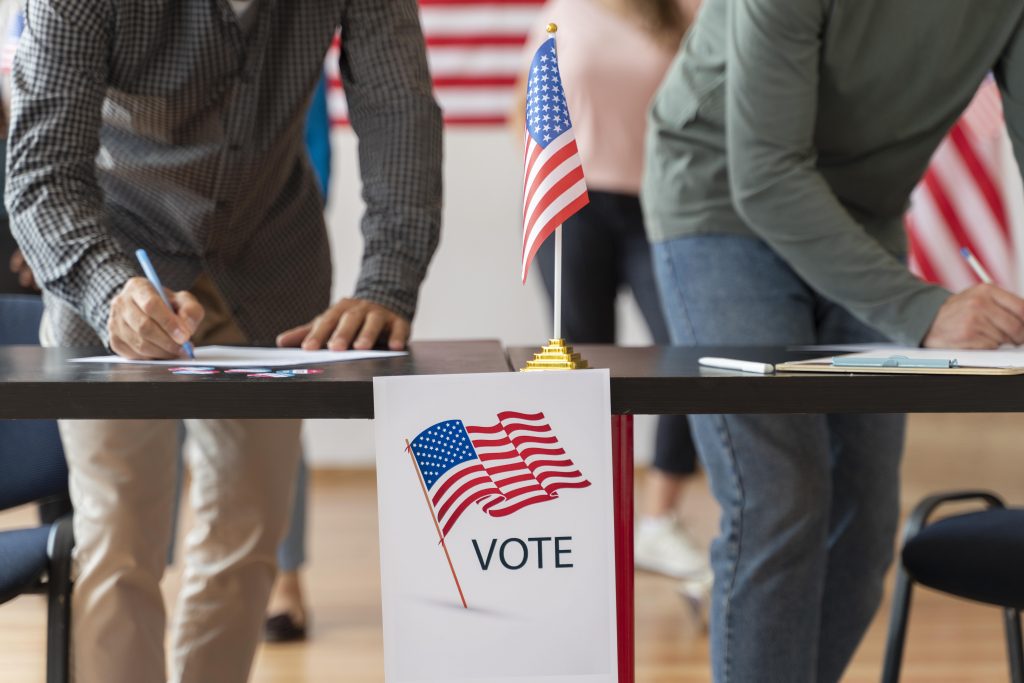
People registering to vote in the U.S.
In 2024, there were 17 million eligible AAPI voters. Of those voters, 56% cast a ballot.
This year, 90% of eligible AAPI voters say they plan to vote. Ramakrishnan added that 64% report they are certain they will vote. Despite the difference between intention and reality, he believes it will still prove to be a historic event.
“All signs are pointing to the kinds of levels of turnout that we saw in 2018, which was a record-setting year for Asian Americans,” he said.
Whatever the number who turn out to vote, immigration will still play a role. For instance, Ramakrishnan noted, AAPI support for immigration dropped 7% from late 2024 to early 2026. This is likely to have some influence at the ballot box.
“What we saw in December 2024, you can consider … maybe a kind of honeymoon period for the Trump administration,” he said. “Our community was split on mass deportations with 38% supporting it. … By February of 2026, that plummeted to 29%, and we saw a change.”
Though AAPI voters are motivated by immigration and the economy, they are also faced with several barriers to voting, speakers said.
“In recent years, some states have made voting more difficult by narrowing identification options, redistricting mail voting and drop boxes, shortening ballot deadlines, changing registration procedures, and limiting assistance or early voting opportunities,” Chen said.
While voter engagement and education optimally takes place well ahead of elections, Ferguson said that it has been much lower this year than in previous years. She said that funding for education and engagement stands at half of what it was in 2022.
Some of this, she continued, is due to “fear of political retribution. So, dollars are not moving to the communities on the ground. And there are many other reasons for this. But what we’re seeing is that it’s cutting the programs that we need the most to reach out to the voters who need outreach the most.”
Among the programs cut due to funding gaps are early political education programs, community organizer hires, and micro-influencer engagement programs.
But despite barriers and perceptions about whether their vote matters, and despite the disparities between those with intention to vote versus those who turn out, the stakes for this midterm are high. Every speaker in the briefing emphasized how critical community media and community organizations are for voter education. Equally, they said, the community needs to invest time, energy, and support to ensure that as many members of the AAPI community as possible get out and vote.
“This is an existential election,” Narasimhan cautioned. “I think democracies are on the line, and by God, AAPIs should be standing up for democracy.”
Leave a Reply