




By James Tabafunda
NORTHWEST ASIAN WEEKLY
Seattle police made 214 arrests during a recently completed 90-day emphasis patrol around 12th Avenue South and South Jackson Street, a department lieutenant told more than 60 people at an Oct. 14 Chinatown-International District (CID) community safety meeting.
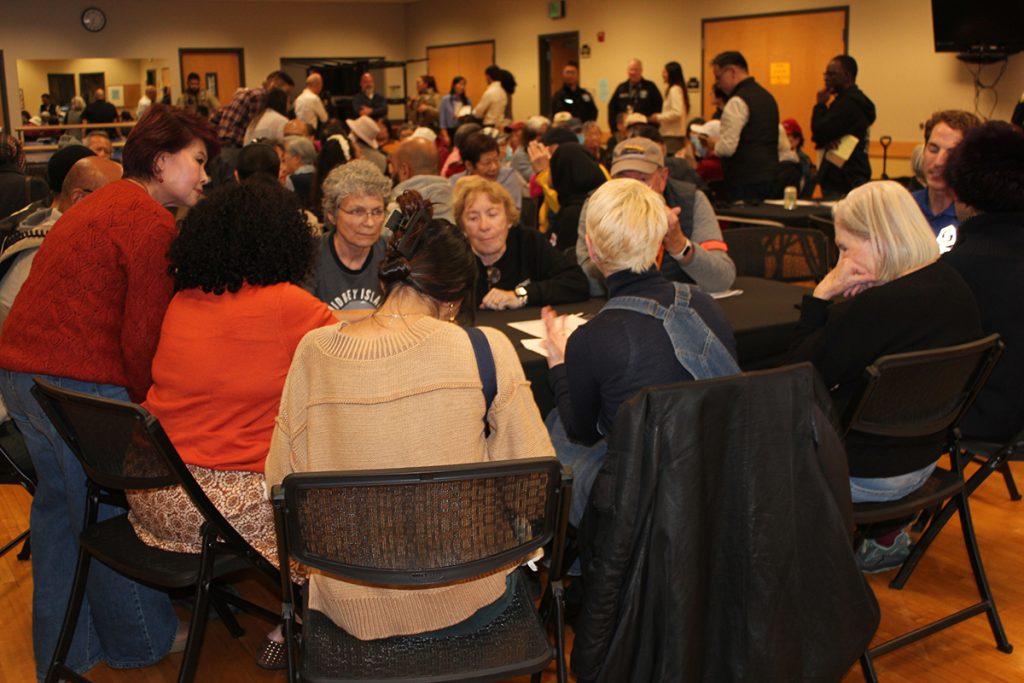
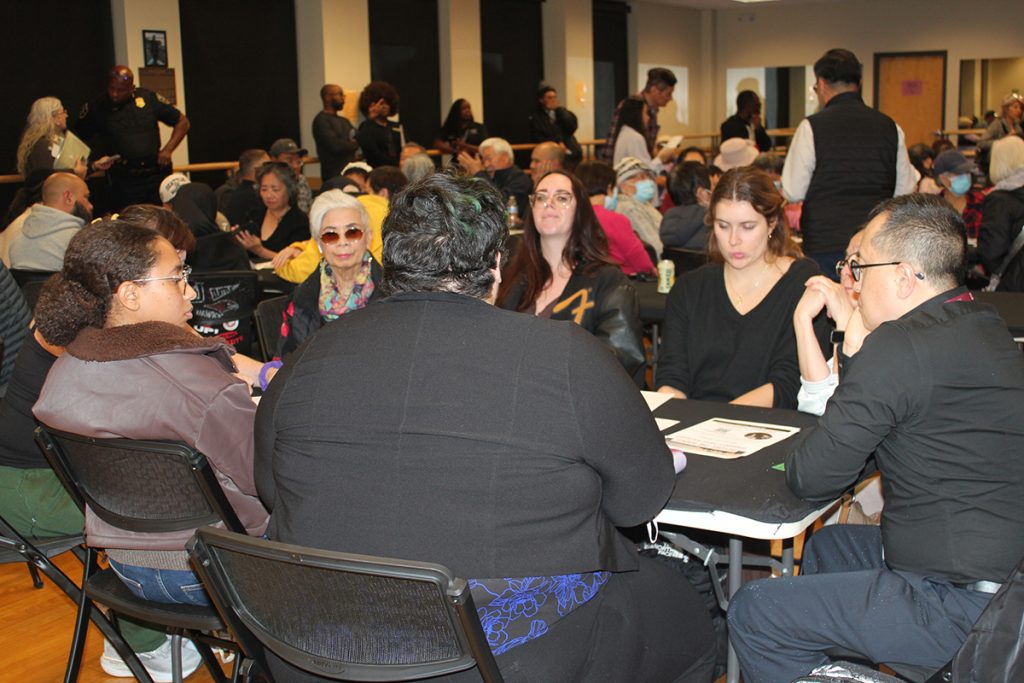
Photo by James Tabafunda
Lt. Sage Farwell, operations lieutenant for the Seattle Police Department (SPD)’s West Precinct, characterized the initiative as an “incredible success,” citing arrests, service referrals, and firearm recoveries. Residents and business advocates, however, said persistent drug activity, theft, disorder, and fear continue to damage daily life and commerce in the neighborhood.
The “Our City, Our Safety: Community Conversation” was held at the International District/Chinatown Community Center and organized by the SPD and the Seattle Department of Neighborhoods (DON). The city had advertised the forum as part of its community-safety program.
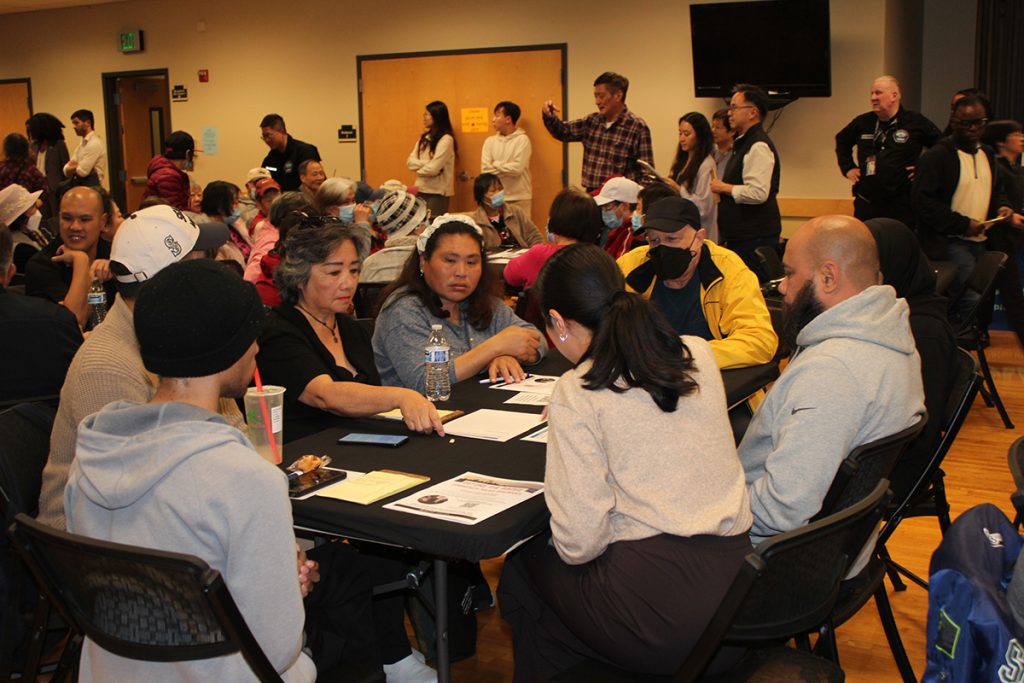
Attendees at “Our City, Our Safety: Community Conversation” meeting (Photo by James Tabafunda)
90-day results
Farwell said the team of four officers and one sergeant was assigned to the Little Saigon area around 12th and Jackson and did not routinely handle 911 calls. During the 90 days, the team responded to 702 calls, including 445 initiated by officers, and made 214 arrests, most involving narcotics or outstanding warrants, he said.
“In addition to that, we’ve recovered four firearms, and we served four search warrants, mainly on vehicles that resulted in narcotics and guns being taken off the street in this neighborhood,” Farwell said.
The patrol began June 3 with a rotating team of one sergeant and four officers, according to a July report. It followed Mayor Katie Wilson’s June announcement that the city would increase police visibility and enforcement around 12th and Jackson while directing $1.1 million toward overdose response, outreach, and other services.
Farwell said the dedicated team had returned to regular patrol duties. SPD planned to replace it with a two-officer car assigned to the area seven days a week, with the officers leaving primarily for high-priority violent-crime calls.
The department is shifting from a larger team working four days a week to a smaller unit providing daily coverage. He said police would continue working with service providers and targeting people accused of exploiting residents experiencing homelessness, addiction, or other crises.
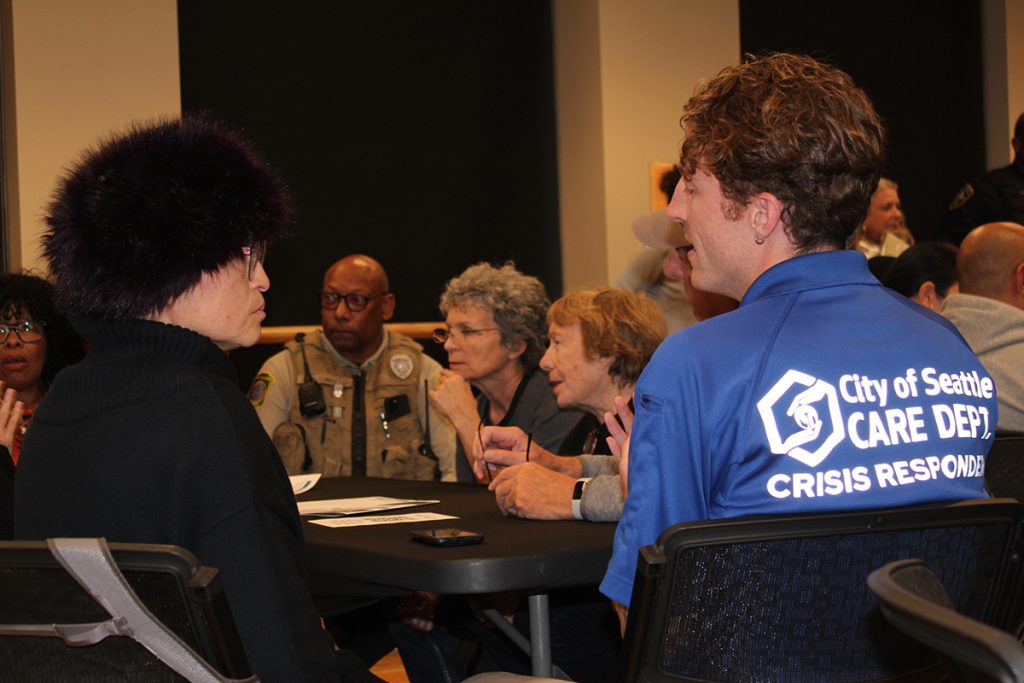
Photo by James Tabafunda
Electronic Benefit Transfer (EBT) trafficking
The forum came amid renewed public attention to alleged EBT trafficking near 12th and Jackson. EBT cards are used to distribute food and cash assistance.
Farwell said future law enforcement would focus on “the people that are initiating and ringleaders of all the EBT fraud,” along with narcotics dealers, suppliers, and people who resell stolen property.
Neither Farwell nor other speakers at the forum accused a particular CID business of participating in EBT fraud. His remarks focused on alleged ringleaders, fences, suppliers, and drug dealers.
Residents seek visibility
Community members were divided among five tables to discuss police response times, property crime, trust, and support for small businesses. Several senior residents, speaking through an interpreter, said they wanted more officers and safety ambassadors visible on neighborhood streets and in parks because some were afraid to travel alone or go out after dark.
Quynh Pham, DON director who reported for one table, said perceptions of police response were rooted in damaged relationships. “If the trust is not there, the perception will consistently still be the same,” she said.
Pham said faster response times alone would not change public confidence unless the city also repaired trust. Her group also discussed how property crime and negative portrayals of the CID affect customer traffic, staffing, and the survival of small businesses.
A resident who identified himself as Jay said he counted six, closed restaurants while walking four blocks from the Fujisada Condominiums to the meeting. He said people lying on or blocking sidewalks contributed to an unwelcoming atmosphere and asked why Seattle’s sit-lie law was not being enforced.
Seattle Municipal Code 15.48.040 generally prohibits sitting or lying on public sidewalks from 7 a.m. to 9 p.m. in designated downtown and neighborhood commercial zones, but provides five exceptions and requires a police warning before a citation.
After the forum, Gary Lee, a former co-chair of the CID Public Safety Council, said the law’s lack of enforcement was “a major problem” for the CID and Pioneer Square.
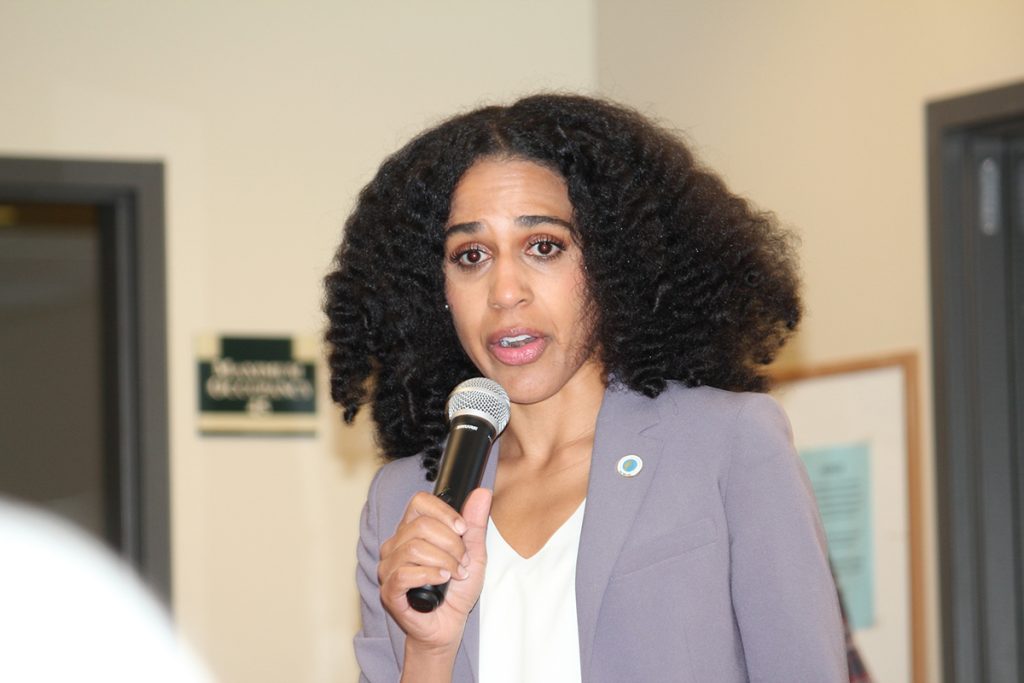
Seattle City Attorney Erika Evans (Photo by James Tabafunda)
Seattle City Attorney Erika Evans sat on Lee’s left side at table number four. “We found out through the discussion that the new city attorney really didn’t know that the city wasn’t enforcing it,” Lee said. “So hopefully, she’s going to look into it, and she’ll change that. Hopefully, she’ll send a memo out to tell people. We need to start enforcing this.”
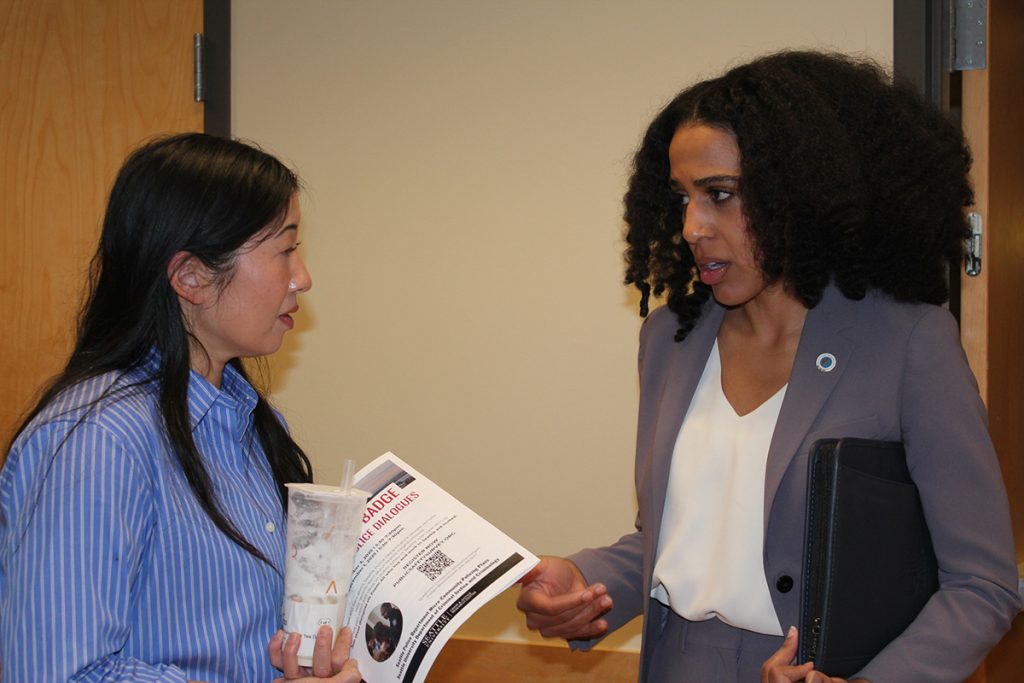
Seattle City Attorney Erika Evans speaks with CID community advocate Tanya Woo (Photo by James Tabafunda)
Policing beyond arrests
Farwell also described an arrest earlier on Oct. 14 after a reported break-in at Diamond Bay Restaurant on Eighth Avenue South. He said witnesses directed SPD officers toward a suspect, whom police found nearby counting money believed to be taken from the restaurant’s cash register. SPD officers booked the suspect into jail on suspicion of burglary.
The account illustrated the immediate response many attendees said they wanted, but the discussion repeatedly returned to lower-level offenses and recurring disorder. One table reported that Vietnamese business owners near 12th and Jackson kept doors locked and struggled with theft and unwanted activity, while participants called for more overnight shelter, housing, and round-the-clock services in addition to law enforcement.
Language access also emerged as a concern. Organizers provided Chinese and Vietnamese interpretation but acknowledged during the forum that they did not have enough interpreters for all attendees who might need help.
Denise Colvin, DON community capacity and safety manager, told residents they could request an interpreter when calling 911 and could also text 911. Seattle’s Community Assisted Response and Engagement (CARE) Department says callers should state the type of emergency and the language they speak, while the city’s text-to-911 system can automatically translate dozens of languages.
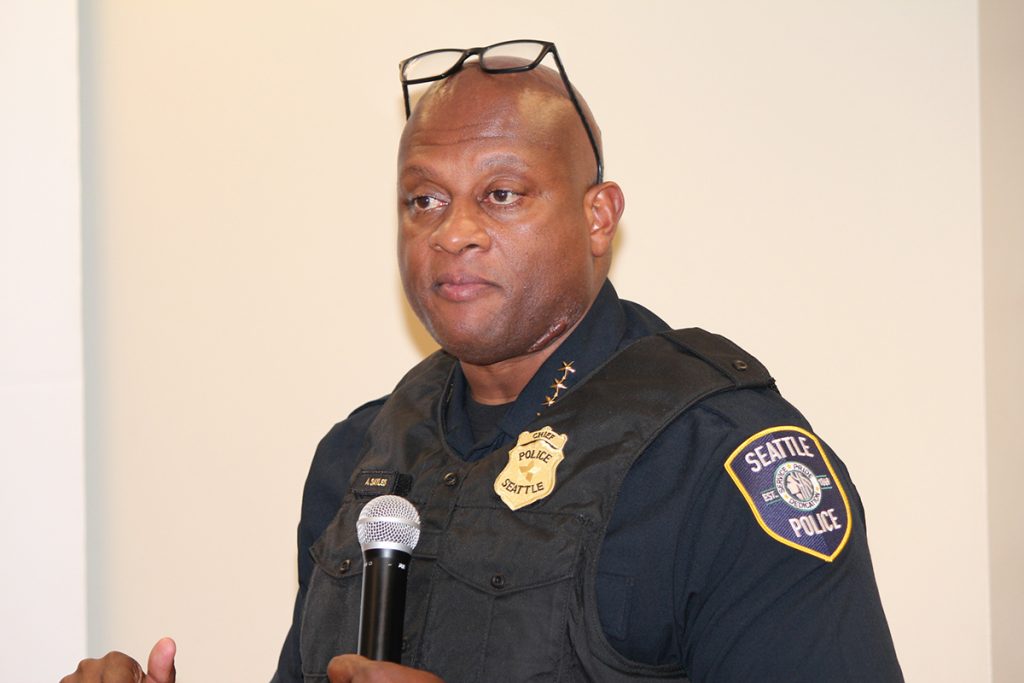
Interim Seattle Police Department Chief Andre Sayles (Photo by James Tabafunda)
Interim SPD Chief Andre Sayles closed the meeting by promising that the department would review what it heard and seek to return in January 2027. “It takes all of us to make Seattle better,” he said, challenging attendees to bring one or two neighbors to the next meeting.
His closing message reframed the forum’s central concern: Police presented measurable enforcement results, while CID residents asked whether those results would produce lasting safety, successful businesses, and enough trust for seniors and families to move through the CID without fear.
Sayles was followed by Jackie Helfgott, professor and director of the Crime and Justice Research Center in the Department of Criminal Justice, Criminology, and Forensics at Seattle University. “We do the annual Seattle Public Safety survey every year,” she said about the project that begins on Oct. 15. “Seattle is very fortunate to have this survey. We have it in 11 languages.”
“Please spread the word because the survey is only as good as the people who take it. And we want anyone and everyone who lives and works in Seattle to take it,” Helfgott said. “Thanks a lot in advance for taking the survey.”
For more information on the Seattle Public Safety Survey, go to publicsafetysurvey.org.
Leave a Reply