


By Andrew Hamlin
NORTHWEST ASIAN WEEKLY
Focusing on challenges, struggles, and victories of the Filipino community, “Beyond the Margins: Personal Stories from the Filipino American Community” brought the lives of so-called “ordinary people” to the fore through personal storytelling at the Wing Luke Museum on Oct. 24.
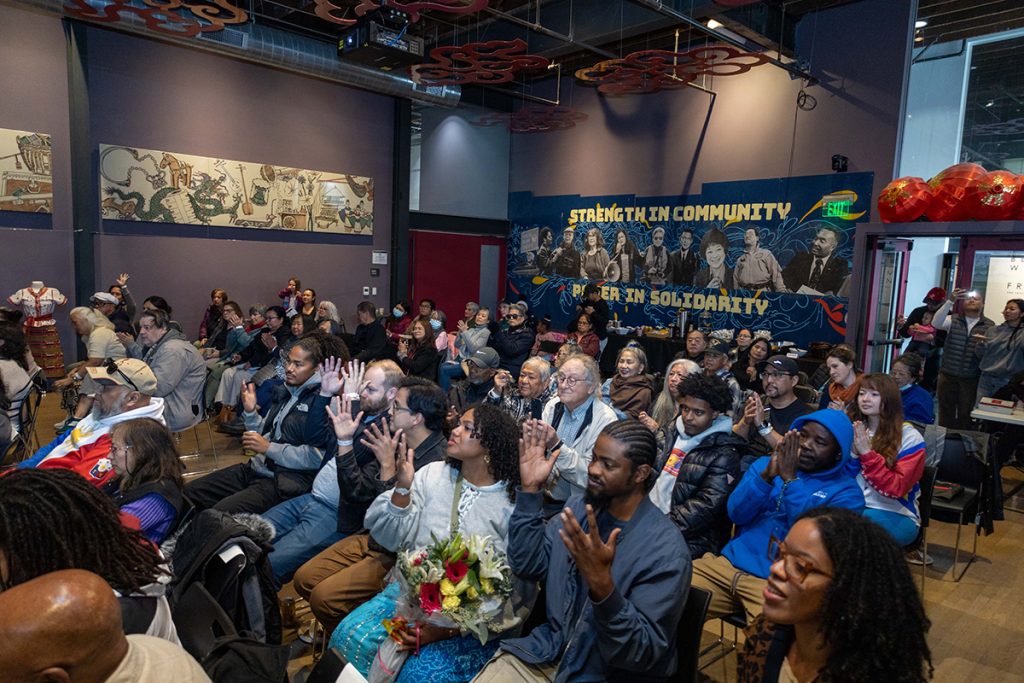
Attendees pack the room to listen to “Beyond the Margins” presenters at the Wing Luke Museum on Oct. 24, 2026. Photo by Andrew Hamlin.
The event marked the second-to-last weekend of Filipino History Month, and featured several Filipino activists, including Gernie Ventura and Cynthia Mejia-Guidici, both of whom are longtime community advocates.
As part of their opening welcome, the pair briefly spoke of Dorothy and Fred Cordova, co-founders of the Filipino American National Historical Society. The national society spoke alongside members of its Seattle chapter, the Filipino Community of Seattle, and the Wing Luke Museum itself.
University of Washington (UW) graduate and regulatory specialist Rainier J. Reyes was the first to tell his story, which focused on mental health. Titled “Through God’s Grace: Overcoming Bipolar Disorder,” Reyes’ story recalled his initial hospitalization for bipolar disorder in college, when he became infatuated with a woman he associated with the Virgin Mary. He was hospitalized after this infatuation led him to pull a fire alarm.
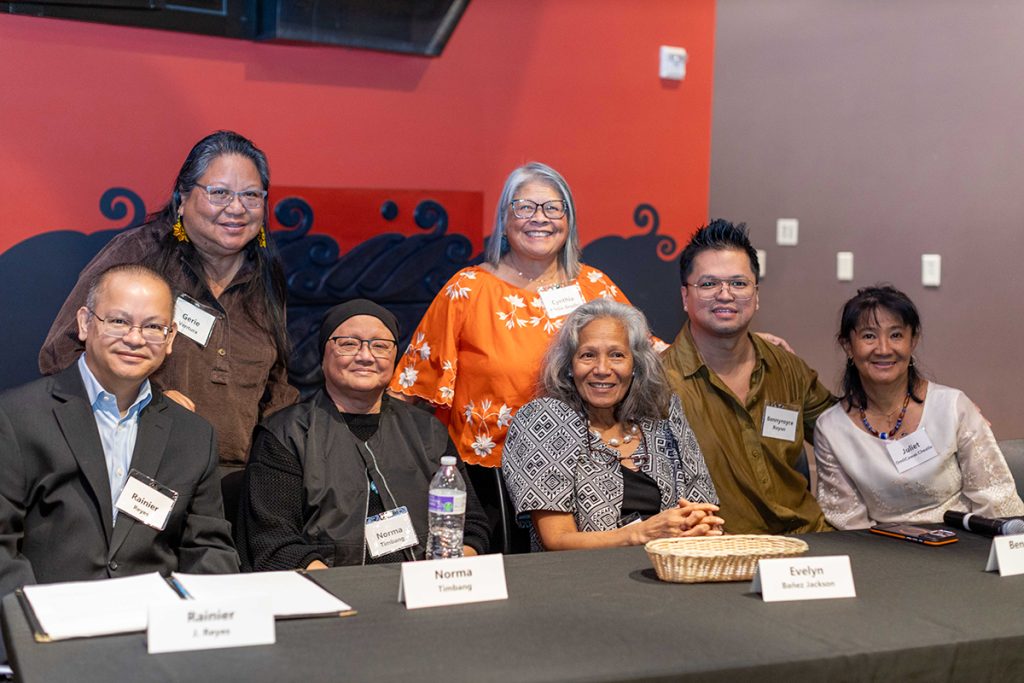
Presenters at the “Beyond the Margins” gather together for a photo at the Wing Luke Museum on Oct. 24, 2026. Back row: Gernie Ventura, Cynthia Mejia-Guidici; front row: Rainier J. Reyes, Norma Timbang, Evelyn Bañez Jackson, Bennyroyce Royon, Juliet OmliCawas Cheatle. Photo by Andrew Hamlin.
Reyes said that he suffered five bipolar episodes, each addressed with inpatient treatment. He reminded the audience of the stigma against mental illness amongst many Filipinos, and how people can go a decade or more without proper care. He resolved to live life with purpose, in accordance with his lifelong Catholic faith.
Norma Timbang, who identifies as nonbinary queer person, recalled their childhood in Kingston, Washington, in a building: “[It] was like a sharecropper’s cabin.” They spoke English at school, but could understand enough Tagalog to know “[w]hen my mother yelled at me to do something or stop doing something.”
Timbang dropped out of Lincoln High School at a time of racist riots. They eventually graduated from the UW, and got married. But when they had to leave their husband, because he was abusive, their mother said to them, “We don’t divorce.” That was Filipino culture.
Evelyn Bañez Jackson was born deaf in 1958. She attended the Manila School for the Deaf, where she boarded during the week. She communicated at the event through interpreters Amie Pease and Mark Guzman.
She studied at Roosevelt High School, and went on to spend 45 years working for the National Oceanic and Atmospheric Administration. Along the way, she also married, raised four children with her husband, and took part in snowmobiling, motorcycle riding, paragliding, and water-skiing. She said she wanted her family to remember her as “a strong woman.”
Bennyroyce Royon, a dancer and choreographer, remembers being raised by a single mother who traveled frequently for work, leaving the dancer in care of family. For many years, he assumed his mother worked as a nurse at the Riyadh Hospital Saudi Arabia. She was actually the janitorial service manager.
Royon is proud of his dancing, which took him to New York City’s Broadway. But, he stressed, the most important thing in life is to “talk to your family, and know your history.”
Juliet OmliCawas Cheatle—also a dance artist and a choreographer—stressed the importance of history, context, and perspective for the dancers she teaches.
“I want students to ask, ‘Where does this dance come from? How do we dance it with respect?’” she said. “I want young people to feel that they belong in the story.”
She also invoked her childhood as “daughter of Kalinga,” a northern province in the Philippines with its own language, culture, and customs. Teaching and performing dance, she said, needs to be intertwined with consideration for who isn’t being represented, including Filipinos who don’t speak Tagalog, islanders, and immigrants to the Philippines.
After a few questions to the panelists, the presentation drew to an end. Gernie Ventura returned to the stage to thank everyone, and to give one final piece of advice.
“Don’t hide your light,” she advised. Keep expressing. Keep building. Keep fighting. Keep striving.
Leave a Reply