



By Madison Morgan
NORTHWEST ASIAN WEEKLY
Wildfires, landslides, and extreme weather have become routine across the Pacific Northwest. And according to a Sept. 1 United Nations (U.N.) report, these conditions will only worsen over the next few years, as global temperatures continue to rise.
In the Chinatown-International District (CID), the climate crisis hits differently. The neighborhood ranks among the city’s most vulnerable to extreme heat, urban flooding, and sea level rise.
“We already see the impacts of climate variation—extreme storms, big weather events —and they tend to affect those that are the most disadvantaged in our society,” Sameer Shah, assistant professor in the University of Washington’s Environmental and Forest Sciences, said.
In a 2020 report, the Puget Sound Clean Air Agency found that the CID has “more air pollution-related hospitalizations (asthma, COPD, cardiac-related) than 99% of other neighborhoods in [the] region.”
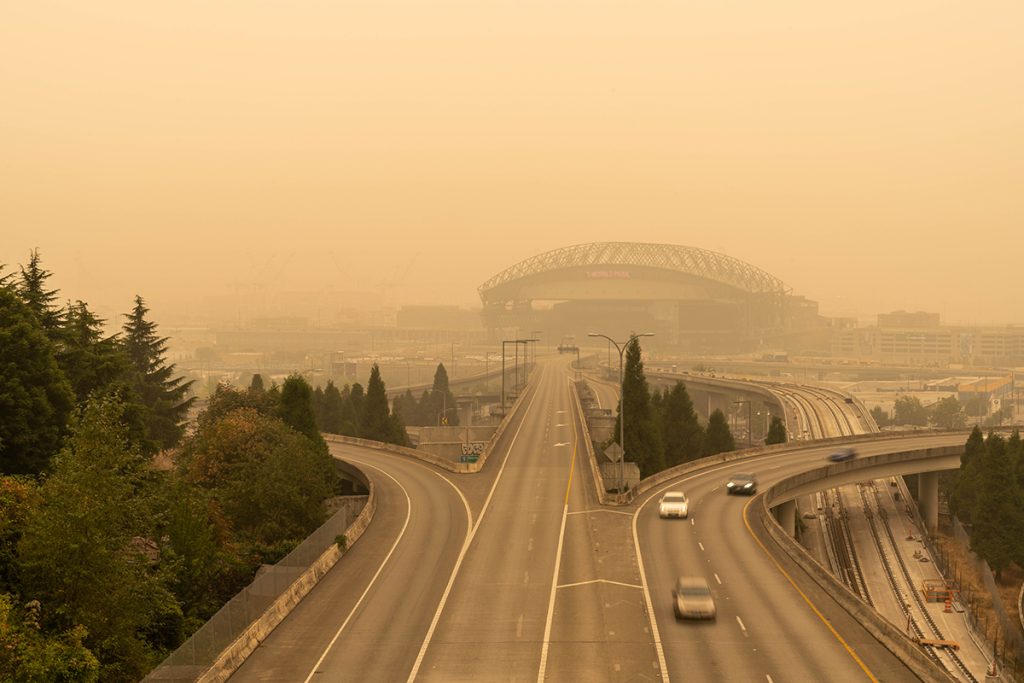
Seattle smoke. Sept. 12, 2020. Photo courtesy of Trevor Dykstra_Flickr.
This stems from decades of infrastructure decisions—particularly I-5 construction and stadium development—that displaced residents and businesses while degrading air quality, the report said.
Anna Lising, former senior climate adviser to Gov. Jay Inslee, highlighted stark disparities within Washington state, noting that communities near the ports and along the Duwamish River have an average lifespan that is 13 years shorter than the lifespan of communities who live in more affluent North Seattle neighborhoods.
“There’s just a lot of unintentional and quite intentional harm that has been placed on overburdened communities,” Lising said. “That’s something that we have to be intentional about addressing when we are talking about how we build a clean energy and sustainable future that is actually going to serve all Washingtonians.”
In 2023, an Asian American Journalists Association survey of Asian American voters found that 75% of Asian Americans say the environment matters to them, but it rarely ranks as a top voting priority because immediate concerns like housing, jobs, and health care take precedence.
Today, roughly a third of CID residents live below the poverty line, according to the neighborhood’s 2020 Healthy Community Action Plan. The Gates Foundation reports that median household income sits at approximately $37,000, less than one-third of Seattle’s citywide average.
This means that during extreme weather events, such as 2021’s heat dome, many in the CID are forced to go without a reliable method of cooling their living spaces. They are forced to do so, because of electricity costs.
For Shah, that reality reflects a broader shift in climate science.
“We no longer look at climate change and say it’s this predictive, abstract thing that we can then tell societies what the impacts are,” Shah said. “A lot of the great work in the last several decades has looked at and even asked people, ‘How are you experiencing this?'”
Turning from impacts to action, both Shah and Lising emphasized that meaningful change happens at the local and state level.
Shah highlighted King County’s Strategic Climate Action Plan, which weaves equity and justice components throughout, as a blueprint other governments could follow. At the state level, Lising pointed to Washington’s 2021 Climate Commitment Act, which establishes an economy-wide emissions cap and requires at least 10% of revenue to benefit tribal nations and 35% to benefit overburdened communities. However, she warned that recent state budget deficits have diverted some climate funding to cover other needs.
Lising identified systemic barriers, rather than physical hazards, as the biggest climate risk.
“Our systems are designed to deliver as much profit as quickly as possible,” Lising said. “Sometimes that is incentivizing the things that are also exploiting our planet’s resources at a rate that we cannot keep up with as a species and as a planet.”
With elections right around the corner, Lising urged individuals to make their voices heard.
“You shouldn’t have to pick and choose what are your top priorities,” Lising said. “You should tell your candidates and elected officials all your priorities … Just show up and vote; that’s what you can do.”
Leave a Reply