




By Nicole Chang
American Community Media
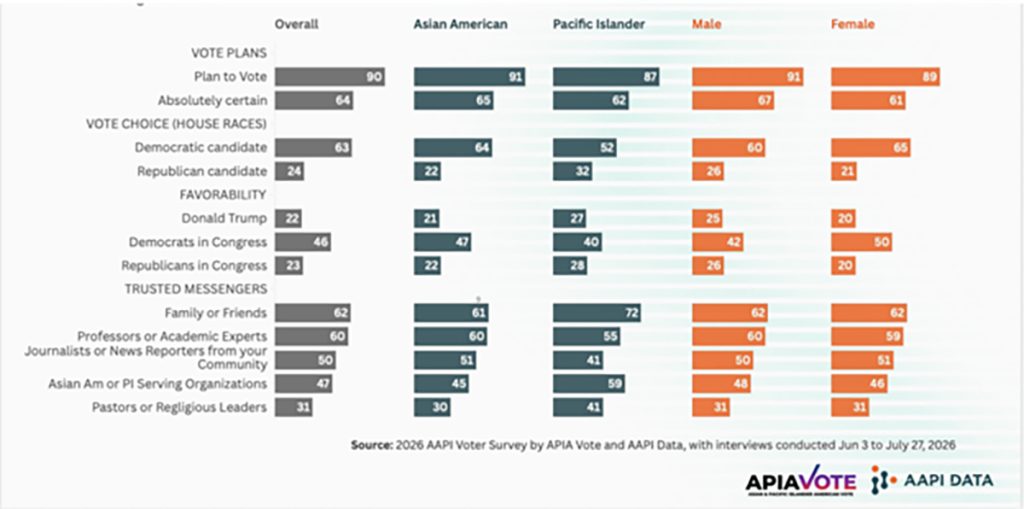
Nine in 10 registered Asian American and Pacific Islander voters say they plan to vote in the November midterm elections, signaling strong interest from one of the nation’s fastest-growing electorates.
The 2026 AAPI Voter Survey, released by APIAVote and AAPI Data, found that 90% of registered AAPI voters plan to vote in the midterm elections, up from 84% in 2022 and 86% in 2018.
Karthick Ramakrishnan, founder of AAPI Data, said the findings are important because they can help community organizations better understand AAPI voters and identify where more voter education and outreach are needed.
“It’s going to be a very consequential election, and I hope that these insights can be helpful to our partners in ways to make sure that our communities are informed and engaged,” Ramakrishnan said. “Prior elections have had consequences, and this election will have major consequences as well.”
He said the challenge over the next several months is to make sure voters understand how decisions made after previous elections have affected their lives and what is at stake in November.
There are an estimated 16 million eligible AAPI voters nationwide this year, and their electoral share has steadily increased over the past 15 years. That growth comes as many important congressional races continue to be decided by narrow margins.
Margin of victory
AAPI midterm participation has increased sharply over the past decade.
Asian American voter turnout rose from 27% in 2014 to 40% in 2018 and remained at 40% in 2022. Pacific Islander turnout increased from 37% in 2014 to 43% in 2018 and stood at 41% in 2022.
While 90% of respondents said they plan to vote in November, voting intentions varied across ethnic groups.
Japanese American voters reported the highest level, with 96% saying they planned to vote, followed by Asian Indian voters at 92% and Filipino voters at 91%.
The figure was 88% among Chinese American voters and 86% among both Korean and Vietnamese American voters.
The growing electorate could be especially important in close House races, where relatively small changes in turnout may affect which party controls Congress.
“The AAPI electorate has been growing, and a lot of the time the AAPI electorate is larger than the margin of victory, especially in key battleground states that will determine control of the House,” said Christy Choi, director of strategic communications at APIAVote.
“We believe that’s where we can make the difference — being the margin of victory, especially in battleground states,” she said.
Cost of living remains top concern
The survey did not directly ask respondents why they intend to vote, but it found that economic pressures are likely to play a central role in their decisions.
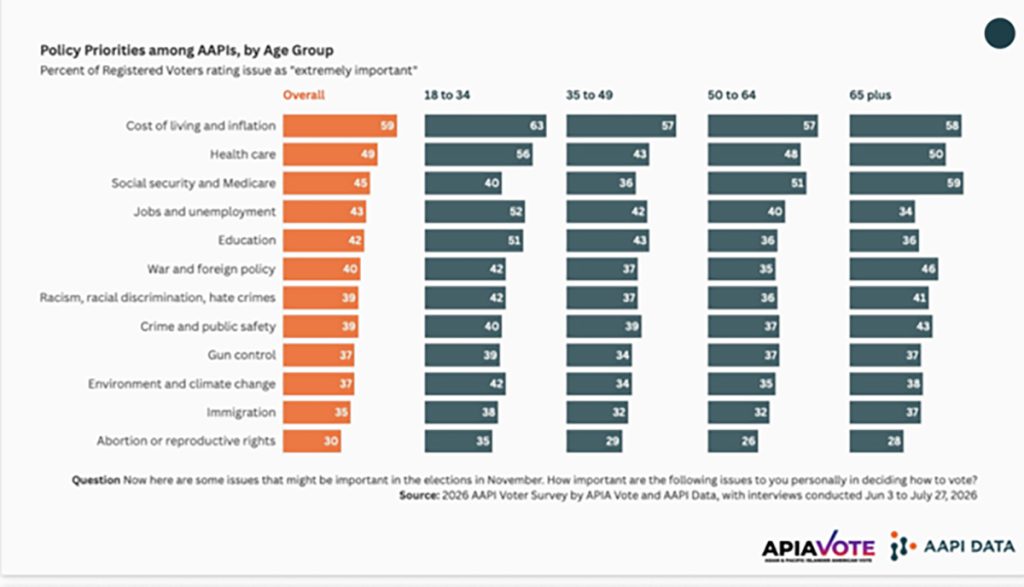
Cost of living and inflation ranked as the top issue, with 90% of Asian American voters saying it was very or extremely important in deciding how to vote. Fifty-nine percent rated it extremely important.
“Cost of living and inflation — this issue has dominated ever since 2024,” Ramakrishnan said. “Even in 2024, it was the top issue. Remains so today.”
The concern was widespread across ethnic groups. Cost of living and inflation were rated very or extremely important by 95% of Filipino voters, 92% of Japanese American voters and 90% of Korean American voters.
The figure was 87% among Asian Indian voters, 86% among Chinese American voters and 84% among Vietnamese American voters. Among Native Hawaiian and Pacific Islander voters, 97% rated the issue very or extremely important.
“Housing and health care are among the major contributors to household financial pressure,” said Ramakrishnan.
AAPI communities tend to be concentrated in metropolitan areas where housing was already costly or has become increasingly unaffordable, he said. Health care costs have also become a growing concern as families face higher premiums and uncertainty over coverage.
Health care ranked second among Asian American voters, with 82% calling it very or extremely important. Jobs and unemployment and Social Security and Medicare each followed at 80%.
36% say neither party leads on cost of living
AAPI registered voters currently favor Democratic candidates over Republicans in both House and Senate races.
“Bottom line: API voters favor Democratic candidates over Republican candidates when we look at it in the Senate or the House,” Ramakrishnan said.
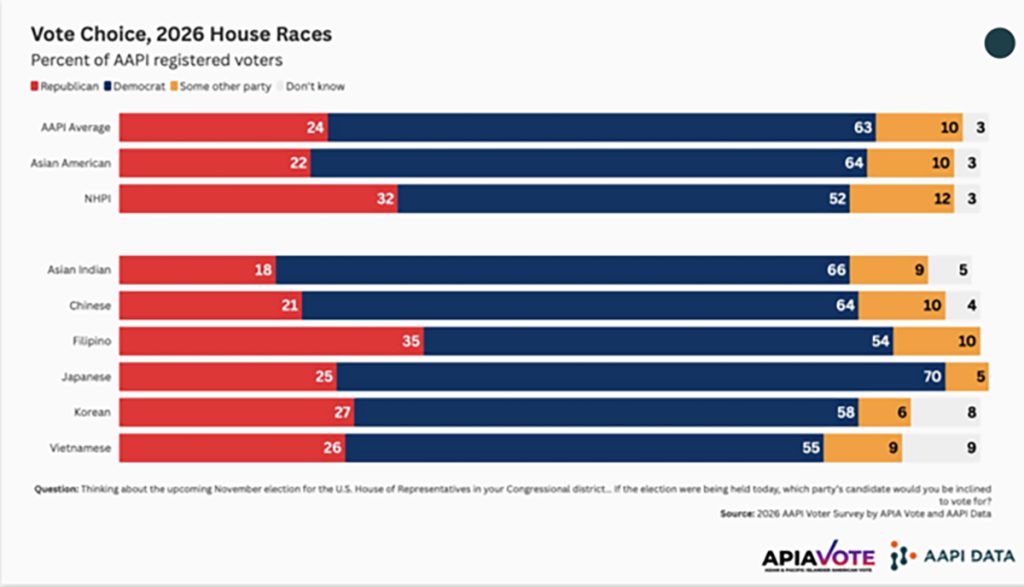
If the House election were held now, 63% of registered AAPI voters said they would support the Democratic candidate, compared with 24% for the Republican candidate and 10% for another party.
In Senate races, Democrats led Republicans 60% to 25%.
The Democratic advantage, however, varies considerably by ethnicity.
In House races, Democratic support was highest among Japanese American voters at 70%, followed by Asian Indian voters at 66% and Chinese American voters at 64%.
Korean American voters favored Democrats 58% to 27%, while Vietnamese voters favored Democrats 55% to 26%. Filipino voters showed the narrowest Democratic advantage, 54% to 35%.
The survey also found that many AAPI voters do not believe either party is clearly better at addressing their concerns.
On cost of living and inflation, 44% said Democrats would do a better job handling the issue, compared with 18% who chose Republicans. Another 36% said neither party was better.
Ramakrishnan said that latter group represents an important persuadable segment of the electorate.
“About a third say that neither party is doing a better job on the issue, and so that represents a persuadable population,” he said, adding that those voters also need more consistent outreach outside the immediate election cycle.
One-third not contacted by either party
Despite high voting interest, about one-third of AAPI registered voters said they had not been contacted by either major political party.
Forty-two percent reported no contact from the Democratic Party regarding the 2026 election over the past year, while 58% said they had received no contact from the Republican Party.
Overall, about 33% had heard from neither party.
“So it’s about a third of our population [that] has not been contacted by either party at all,” Ramakrishnan said.
Community organizations are filling some of that gap.
Among voters who had not been contacted by either Democrats or Republicans, about 8% had received outreach from a community organization.
“Community organizations are filling a critical void, where our registered voters are not being contacted by the parties,” Ramakrishnan said.
Even with that outreach, however, about 25% of AAPI registered voters said they had not been contacted by a political party or community organization.
Ramakrishnan said the finding shows that both partisan campaigns and nonpartisan organizations need additional resources to reach voters before November.
The Democratic Party has done a better job than the Republican Party in contacting AAPI voters, according to the survey, but both parties are still missing a substantial portion of an electorate that is increasingly capable of influencing close races.
The survey was conducted from June 3 through July 27 among 2,066 registered AANHPI voters, including 1,896 Asian American and 170 Native Hawaiian and Pacific Islander respondents. Interviews were conducted by phone, online and MMS-to-web.