



By Carolyn Bick
NORTHWEST ASIAN WEEKLY
Migration trends, cultural memory, religious trends, and socioeconomic trends underpin many of the decisions Asian Americans make—including when it comes to voting. Data collected by nonpartisan research organization NORC at the University of Chicago, in partnership with the Committee of 100, even shows distinct differences within individual Asian American communities, both generationally and between women and men, as well as shifts in political leanings over time.
Between 2020 and 2024, Asian Americans recorded the largest increase in eligible voters compared with other racial and ethnic groups, said Nathan Chan, an assistant professor of political science at Loyola Marymount University. As of 2026, there are 16 million eligible AAPI voters, 1.6 million of whom are newly eligible as of 2022. Voter turnout among both Asian Americans and Pacific Islanders has significantly increased since 2014.
These findings underscore this fact, and show that politicians must better acknowledge and engage Asian American voters, as they consider future campaigns.
“A community this large, this fast-growing, could increasingly determine election outcomes,” Chan said. “Nearly one in five [Asian Americans] identify as non-partisan, which is a reminder that this electorate’s vote should not be taken for granted.”

Chan participated in a Committee of 100 panel to unpack the findings with APIA Vote’s co-founder and moderator, Scott Wang, senior congressional reporter at NBC News. NORC collected the data as part of its Amplify AAPI and AmeriSpeak panels last June. The panels surveyed 1,046 Asian Americans, 717 of whom identified as Chinese Americans. The Sept. 10 roundtable concluded a four-part series focusing on Chinese Americans in the run-up to this year’s midterm elections.
More Chinese American women, U.S.-born Chinese Americans vote Democrat
The data showed that even amongst Chinese Americans, who as a whole tend to vote Democrat, there are distinct voting differences.
Notably, Chinese American women were more likely to vote Democrat than Chinese American men by a wide margin—64% to 44%. This is a larger gender gap than within in Black, Latino, or white populations.
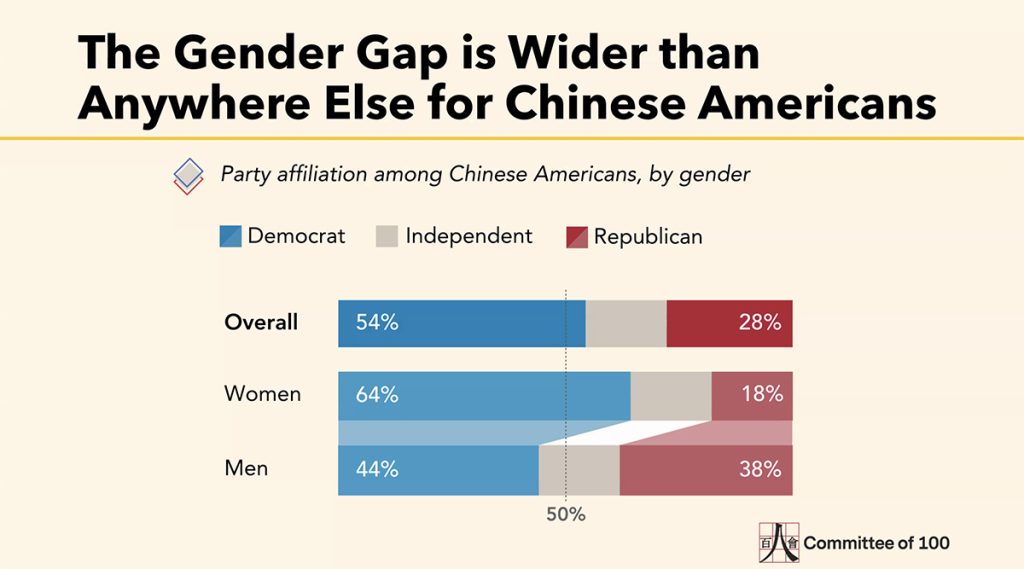
Chan said that it wasn’t so much the difference itself—generally speaking, women tend to lean Democrat, while men tend to lean Republican—as it was the magnitude of difference between Chinese American women and men that was so striking.
“We should be cautious about saying exactly why this might be the case on the data alone. However, one possibility is that some of the issues that are producing gender differences in the electorate, such as our discussions about abortion, reproductive rights, social safety nets, are really resonating with Chinese American women particularly. And Chinese American women are really perceiving, I think, certain political parties as more friendly on issues of gender and diversity.”
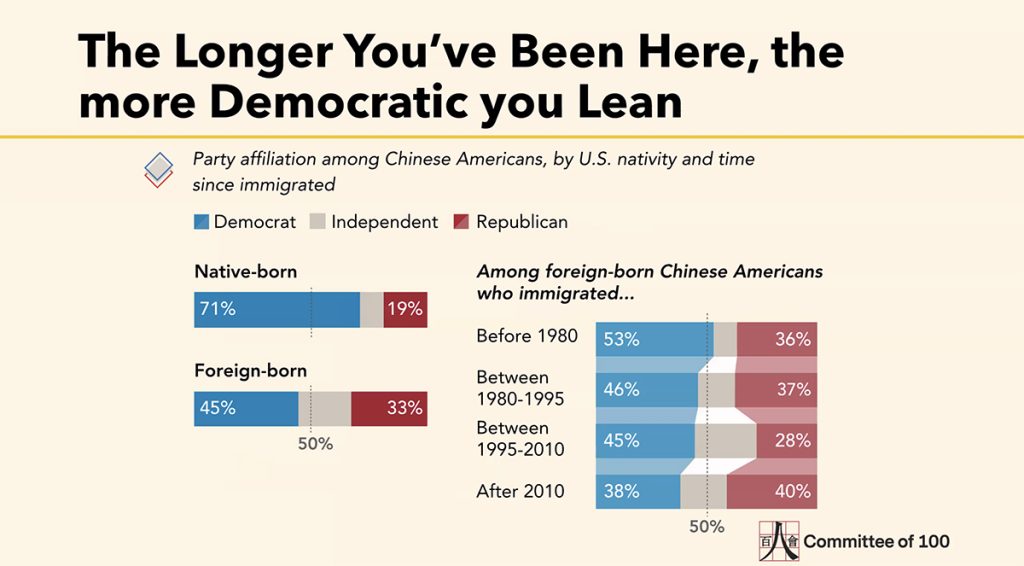
Chinese American men also leaned considerably more Republican, and U.S.-born Chinese Americans are more likely to vote Democrat than their Chinese-born peers.
Timing of immigration also affects party affiliation, the studies found. Chinese Americans who immigrated to the United States before 1980 tended to vote Democrat more often than those who immigrated here after 2010.
Asian Americans unafraid to cross party lines
In the 2024 election, 64% of Chinese Americans voted for Kamala Harris, while 31% voted for Trump. This was consistent with Latino voters, researchers found.
But compared with Republicans in the rest of the voting public, Chinese American and Asian American Republicans appeared to be the most willing to cross party lines in the 2024 presidential election to vote for Harris.
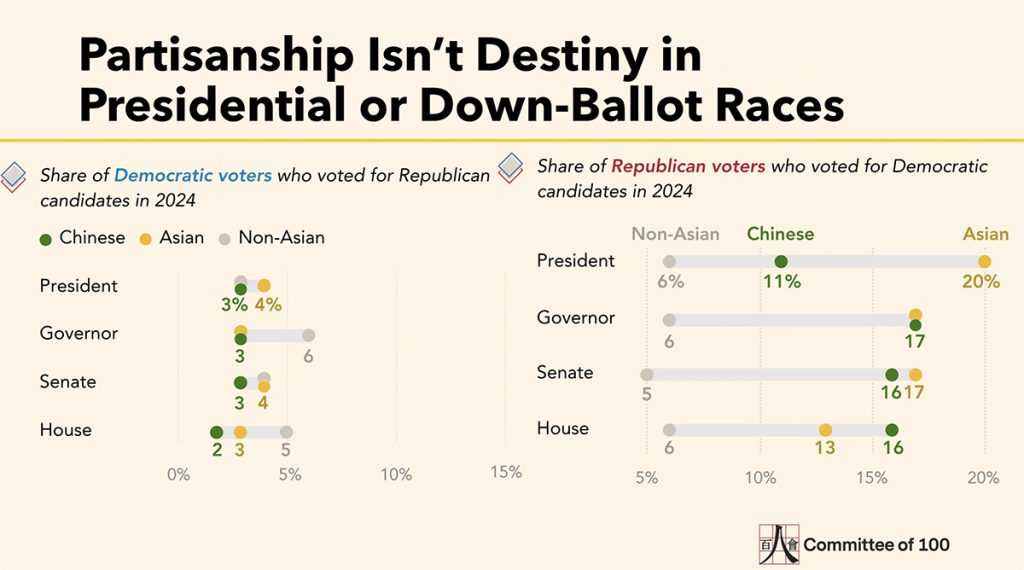
“A fair share of Chinese American Republicans did cross party lines. Eleven percent of Chinese American Republicans voted for the Democratic presidential candidate, Kamala Harris,” Chan said. “Among Asian American Republicans more broadly, that willingness to cross over actually reached 20%, surpassing the rate of cross-party voting seen among Republican voters of other racial and ethnic backgrounds.”
This trend also continued down-ballot in state and other national races. Between 16%-17% of Chinese American Republicans voted for a Democrat in House, Senate, or gubernatorial races in 2024. Amongst Asian American Republicans, 13% voted for a Democratic House candidate, while 17% voted for both a Democratic Senate and gubernatorial candidate.
Continued lack of outreach to growing AAPI electorate
The survey data also showed that both parties continue to fail to conduct much, if any, outreach amongst Asian American voters. Among those surveyed, 42% of Asian Americans reported no contact from the Democratic Party, and 58% reported no contact from the Republican Party.
Chen said that for the last 15 years, both parties have done a better job of investing in the Asian American electorate, and that each party started doing this at different times. For instance, she said, the Democratic National Committee has hired an AAPI person to do outreach since 2008. The Republican National Committee “decided to finally invest dollars in investing in ethnic press and some type of communication strategy to reach Asian American voters” in 2013 or 2014.
“But it’s still very inconsistent. When you look at campaigns and political parties, they tend to focus on just high propensity voters,” or voters who are registered and vote every single election cycle, Chen said. “So they don’t have to really do a lot of heavy convincing of getting you to turn out to vote. They’re just going to focus on why you should vote for their particular candidate.”
But this ignores the “reality” of the growth of the Asian American and Pacific Islander electorate, she said.
“We have many first-time voters, whether they’re aging in, naturalizing, and also a large base who finally understand the importance of the vote, especially as related to representation and addressing issues that they care about,” Chen said. So, she continued, from her point of view, neither the Democratic nor the Republican Party is keeping up with the growth of the electorate, and the investments the parties are making in the electorate are still “uneven, in terms of the investments that they put in during a presidential election cycle versus in midterm elections.”
She also noted that part of the issue surrounding voting for the AAPI community is “the broader challenge of trying to convince these political parties that they also need to be engaging the space of voters outside of the elections. It really should be engaging them and bringing them in to actually showing up at their events, talking to them, addressing their particular issues.”
Political, religious histories influence voting
However, as a whole, Chinese Americans, Vietnamese Americans, and Filipino Americans showed higher rates of support for President Donald Trump than Japanese Americans or Korean Americans.
But again, the information alone doesn’t tell the whole story. It doesn’t give a sense of why this is. For instance, Chan said, Vietnamese Americans’ migration history is inextricably connected to issues related to geopolitics and communism, which has led especially older generations of Vietnamese Americans to tend to vote Republican.
Similarly, Filipino Americans “have a really distinctive religious profile compared to many other Asian American groups,” with large Catholic and Christian populations. This religious leaning, Chan said, “can lead some Filipino American Republicans to support Trump a little bit more.”
While Filipino Americans appear to continue to be voting more conservatively, Chen said, this doesn’t mean that communities simply stay the same. For instance, she said, the tide appears to be shifting amongst Vietnamese Americans, as the community grows. “They started out as being a lot more conservative, but in more recent survey data, we’re showing that a number of them tend to be more moderate or progressive.”
Information sourcing plays key role
Chen also highlighted that where communities get their information from is also important, and that has to do with both time of arrival and English proficiency. This, in turn, appears to influence voting trends.
“We know that Indian Americans and Japanese Americans tend to be a lot more progressive or democratic leaning—but they also are more English proficient,” she said. “They’re going to rely on English language news, versus when you look at Chinese, Korean, and Vietnamese, there’s gonna be a lot more limited English proficient communities.”
“And so where are they getting their information from?” she continued. “Are they also in chat rooms with other aunties and uncles? When they’re introducing information and links, where is that coming from, or is that coming from abroad?”
Chen appealed to listeners to help educate their families and friends who may be struggling with overwhelming and outright misinformation regarding the upcoming midterms. This includes important information about whether they can use mail-in ballots and when those ballots are due. Chen said that it’s important to help them make a plan to vote.
“Their trusted messengers are really their family and friends. According to our survey, it’s also journalists and academics,” she said. “Everyone is exhausted, but they’re going to turn to their family and friends.”