




By Carolyn Bick
NORTHWEST ASIAN WEEKLY
Less than two years into President Donald Trump’s second term, the federal government has already deported more Southeast Asians from the United States than at any other point in history. Many of them are refugees from U.S.-backed conflicts in their original countries—including refugees from the war in Vietnam, most of whom are now elders—and a majority targeted for deportation have convictions that are several decades old.
This kind of targeted deportation at the level the government is carrying it out marks “not just the resurrection of Trump Era One tactics, but an exponential increase in terms of the cruelty and violence that fuels the largest number of South Asian deportations that we’ve ever seen in the history of America,” said Quyên Đinh, the executive director of Southeast Asia Resource Action Center (SEARAC), a national civil rights organization.
The center recently released a factsheet focusing on the rise of detention and deportations in Cambodian, Laotian, and Vietnamese communities in the United States. Most of the members of those communities live here because U.S.-backed wars in their countries of origin forced them out. They have built lives and raised families here.
“We know that [these deportations are] also being fast-tracked under unprecedented resourcing of deportation through the expansion of federal support for immigration enforcement and deportation,” she continued. “The numbers are really confirming the devastation and the crisis of deportation that our communities have seen in the last year and a half.”
Sharp rise in Southeast Asian deportations under Trump
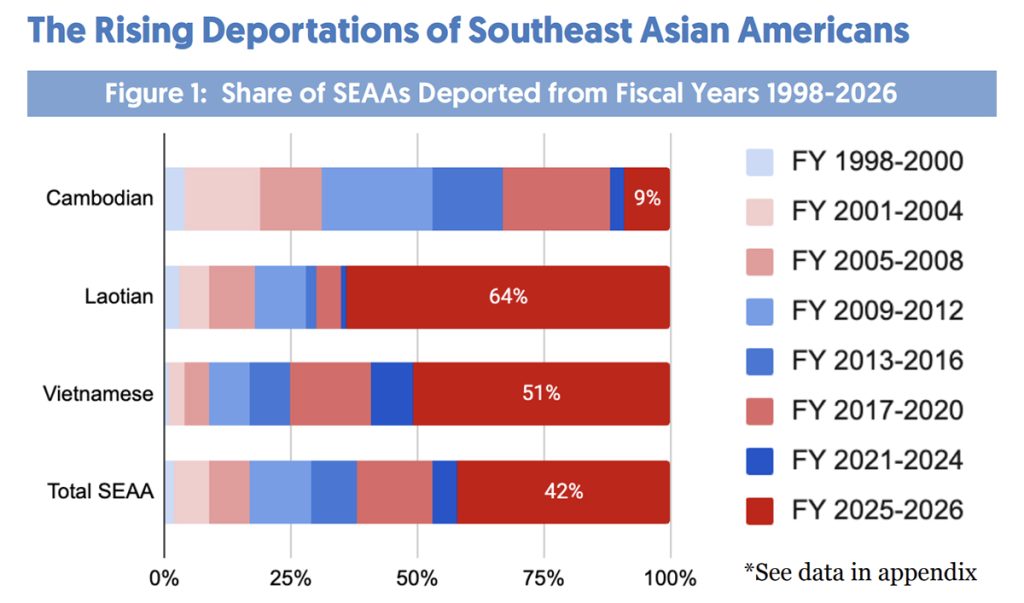
The center focused on Cambodian, Vietnamese, and Laotian communities in the U.S. The data shows that the highest number of deportations since 1998 have taken place between 2025 and 2026. Between 2025 and 2026, the federal government has carried out 42% of all Southeast Asian deportations since 1998, with 64% of all Laotian deportations and 51% of all Vietnamese deportations occurring in that same time frame.
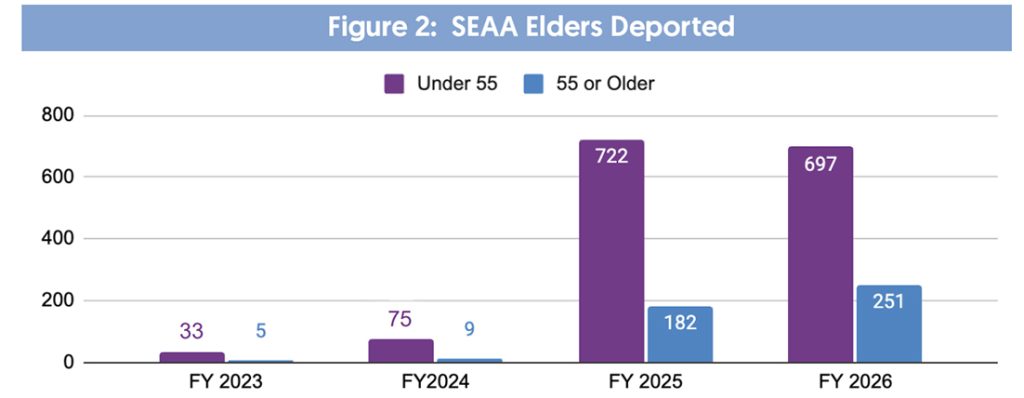
The federal government under Trump has also pushed a 20-fold increase in deportations of people aged 55 and older. Almost 80% of all Southeast Asians they targeted for deportation had a conviction at least a decade old, and more than 50% had a conviction that was at least two decades old.
Additionally, a significant number of Vietnamese refugees who entered the U.S. before 1995 are only facing deportation because Trump, at the tail end of his first term in office, eliminated protections originally negotiated in 2008.
“What we see through these decisions is really the blatant disregard of American duty to refugees, when, in fact, refugee protection should be permanent to remain accountable to the lifetime of harm that has been created because of U.S. occupation across Vietnam, Cambodia, and Laos,” Đinh said. “Instead, these are individuals who are being deported back to countries that they fled as refugees. And what we’re seeing, instead of protection and duty to refugees, is really this perpetuation of state violence to the largest community of states ever resettled for these individuals to be returned to the very countries that they fled in the first place.”
A false choice
But it can be worse than that. These refugees are often given a false choice: return to the countries they fled, or be deposited in a completely foreign country suffering through its own conflicts, where they don’t even speak the language.
“The tactics of sending individuals to third countries … [that] are undergoing their own civil unrest—it seems just like not only are these individuals facing double jeopardy for already having served their time and now being sentenced to deportation, but now they are in a country that resembles the crises in which they fled as refugees,” Đinh said. “It actually [leads] to an increased state of fear that, ‘If I am to be deported, I don’t want to be deported to these third countries, and I would rather deport myself back because at least I know where I am going.’”
For many refugees, the Trump administration’s deportation strategy has served to tear generations of families apart—again.
Đinh said that thoughts of “last times”—the last time someone might be able to say good night to their daughter, or hug a parent or grandparent, for instance—might race through a person’s head. Others might try to figure out why, after so much time, the government is targeting them. Still more shelter in place with their families, afraid to go to the grocery store or get needed medical care or send their children to school, “because maybe that’s when they’ll be picked up, which is an ICE enforcement tactic that we have seen now more than ever compared to any other administration.”
“It means that family members are facing tremendous social and emotional strain from a partner not knowing if they’ll become a single parent overnight to young people who are experiencing the distress of potentially being separated, as well as the financial burden of legal fees to try to fight their cases,” Đinh said. She said that some families even needed to sell their or their loved ones’ homes or businesses just to make ends meet. These knock-on effects show that deportations impact not just the person targeted for deportation, but their entire extended family and the people who support them and rely on them for support.
Extra burden on elders
Elders targeted for deportation must also contend with a sudden lack of access to medical care or even basic prescriptions.
“There are elders who are being deported without the support they need as older adults. So, for example, folks are being detained without even being able to pick up their reading glasses, and their partner has to try really hard to get those reading glasses into the detention facility,” Đinh said. “We’re talking about individuals who came here as teenagers or young people who have now aged through the school-to-prison-to-deportation pipeline and who have chronic health challenges as older adults who don’t have the help and support that they need, either in detention or within the countries that they are being deported to.”
Elders also suffer when their caretakers are targeted for deportation.
“Those elders no longer have the caretakers that they rely on to be able to age with dignity, so the layers of impact to elders is both to those who are being deported as elders, but also elders who remain who don’t have the caretakers that they now need as they are also aging,” Đinh explained.
Their caretakers may also be survivors of war and genocide, and may fall into the category of refugee or someone who has a decades-old conviction.
Policy paths
Alongside lawmakers, SEARAC and other immigrants rights organizations have been championing different pieces of legislation meant to provide increased protections for refugees and immigrants.
One of these pieces of legislation is called the Southeast Asian Deportation Relief Act, which provides not only deportation relief, but also work authorization and a pathway for some people the government has deported to return to the U.S.
The act also creates protections for people who came to the U.S. before 2008, not just before 1995, and eliminates in-person check-ins, which Đinh said can create “devastating” mental health trauma for families.
“We recognize that this Southeast Asian deportation problem is such a uniquely made American problem that requires a uniquely made American solution that has been crafted by our communities,” Đinh said of the act’s creation.
For the 15,000 people who have pending orders of removal, this act—which would eliminate those orders—is no small matter.
“We get calls from individuals and emails from individuals who’ve actually been deported to Vietnam, Cambodia, and Laos asking what is the prospect of this bill actually passing,” Đinh said. “And we painfully have to share with them that the chances aren’t looking good within the next couple of congressional cycles, but that we will continue to fight and increase the number of campaigns needed for it to pass.”
The other major piece of legislation SEARAC and other immigration organizations are backing is the New Way Forward Act, born in response to two Clinton-era bills signed into law in 1996 that advocates say have entrenched mass incarceration and laid the groundwork for the country’s current deportation system.
The act would overhaul the U.S.’s detention and deportation system, and “calls for common-sense American due process,” Đinh said. The act would end mandatory detention, ban private, for-profit detention facilities, and limit deportation. It would also prohibit state and local law enforcement from conducting immigration enforcement.
The New Way Forward Act, which legislators have introduced several times, also has not passed. But that doesn’t mean advocates will give up.
“At the end of the day,” Đinh said, “what we are building is … our community’s optimism that change is possible and that their voices matter when they’re calling their congressional members and saying that this issue matters to me and this is the solution that we want to bring forward.”