



By Kai Curry
NORTHWEST ASIAN WEEKLY
From “boat person” to Oscar award winner. It’s the way that people have described Ke Huy Quan. The story is so much deeper than that, as Quan explains in his new memoir, “Never Say Die.” Quan came to Seattle’s Town Hall on Sept. 24 to talk about the book, and his story so far.
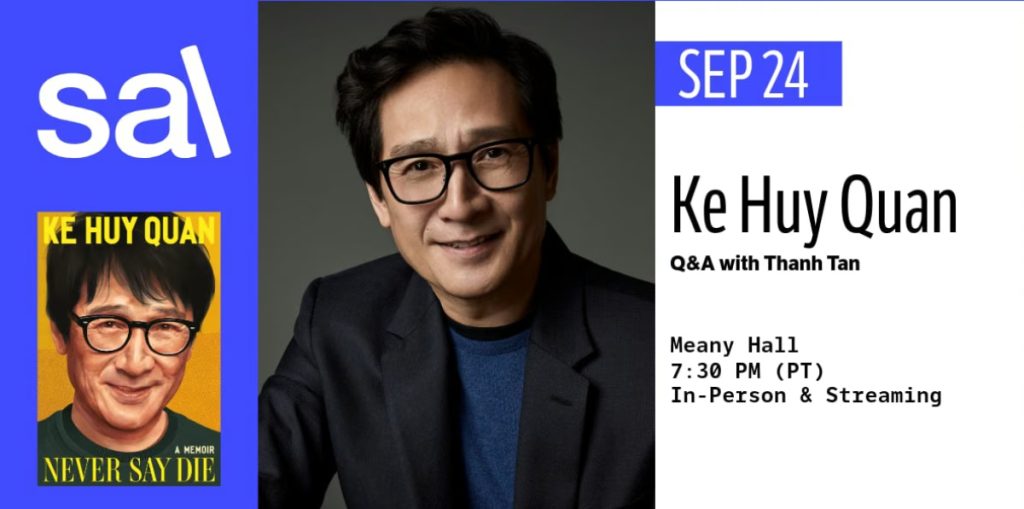
In 2023, the movie “Everything Everywhere All at Once,” won seven Oscars. For Quan, who won Best Supporting Actor for his role as “Waymond Wang,” the role, the award, the validation, was considered his comeback. Everyone knew Quan as the adorable and feisty “Short Round” from “Indiana Jones and the Temple of Doom,” all the way back in 1984. No one knew Quan like he showed up in this role or has shown up since in movies like “Love Hurts.”
“I don’t think there would be a book had I not had this incredible, uh, second opportunity,” Quan admitted during his Town Hall talk. Quan’s career success was not a sure thing. For many reasons, quiet and frustrating years, as he describes in his memoir, he thought lasting success might never happen. There were bursts here and there, but never anything he could count on.
An Oscar win is a huge achievement for anyone. For Quan, it came after a lifetime of struggle and self-searching. His refugee story—and he considers himself always a refugee, he said—started in 1978 in Vietnam. He and his family were part of an ethnically Chinese community there. Quan and his father were locked up in prison twice for trying to escape the war-torn country. Quan was just a child at the time, under 10 years old, and in prison with a father who was wrapped up in his own trauma, and who barely spoke to him. Eventually, Quan, his father, and some of Quan’s siblings (the family left in separate groups) made it onto a boat bound for Hong Kong, but at first, Hong Kong would not take them in. Imagine surviving the hellish ocean crossing, packed like livestock on the ship, only to be left hanging with the destination in sight. Of course, that was not the end. Once allowed onshore, they were put into a refugee camp, where they stayed for some time. One of Quan’s core memories from that period is visiting Hong Kong relatives for dinner, and the shame of being viewed as dirty. “Survival wasn’t the same as freedom,” he recalled. That shame became an insecurity that stayed with him.
Quan’s family made it to California. By pure chance, Quan and his brother, David, heard about an audition happening for a “Chinese kid” in a movie. It was David who auditioned, but Quan, who stood on the sidelines and yelled pointers, was the one who was hired. “Indiana Jones and the Temple of Doom” changed Quan’s life. Next was “Goonies” and his role as “Data,” another unforgettable landmark. But child actor roles started to dry up. To get work, Quan earned a degree, and he traveled to Taiwan and China. These were “the lost years,” as he calls them, when he was little known in the U.S. and yet built a rock-solid industry foundation both behind the scenes and on camera. Quan worked with the likes of Wong Kar-Wai. He learned martial arts. He got married. He lost his father and he learned how to become independent from his mother.
Quan never really says it outright, but it is implied in his memoir, and in his conversation, that the lack of roles might have had something to do with his being Asian. By the time that “Everything Everywhere All at Once” came out, the landscape had changed, somewhat. There were more roles for Asians and Quan has been thrilled to be a part of that.
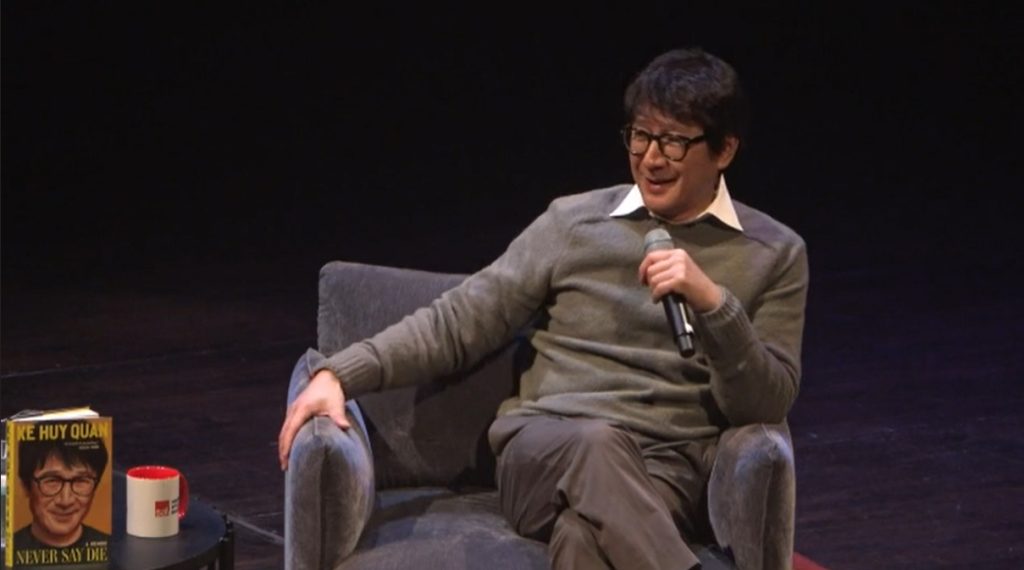
“For so long, when I read a script, I didn’t see myself in it,” Quan said during his Town Hall talk. With “Everything Everywhere All at Once,” not only was Waymond a lead character but he was also part of a Chinese family that was centered in the story. “It felt like it was written for me even though it wasn’t. What I had realized was that I had spent the last 30 years preparing for this one role.”
Quan hasn’t just sat on his laurels since that movie came out. He has been busy, not only with television and film making, but also with advocating for other refugees. He was invited to speak at the United Nations High Commissioner for Refugees and there he was given a chance to see the passenger log from the Huey Fong—the ship he and his family had been on so long ago. Quan realized that he owed so much to his early experiences, traumatic as they were. Today, he would change nothing, he said.
“To erase that part of my history would be to erase all the sacrifices that my parents made…. Now, I go everywhere and I tell people, ‘Yes, I was a refugee.’”
Quan’s memoir, “Never Say Die,” is available where books are sold.
Kai can be reached at newstips@nwasianweeky.com.