



By Carolyn Bick
NORTHWEST ASIAN WEEKLY
Washington has joined a new, multi-state lawsuit challenging President Donald Trump’s order targeting and restricting mail-in voting. The state is also proactively planning measures to ensure Washingtonians’ right to vote is preserved as much as possible, in case the challenge fails.
Trump—who regularly uses the mail-in voting system—has claimed without evidence that mail-in voting allows for illegal voting.
If the order survives legal challenges, it would mean, among other things, that any state with mail-in voting would be forced to destroy some mailed-in votes, and that only voters on lists handed over to the federal government can vote. The order could affect the upcoming November elections, and could disproportionately impact vulnerable populations, including immigrants, refugees, and elders.
The United States Supreme Court upheld Trump’s order earlier this week, solely on the grounds that states filed original challenges to the order too early. The court’s conservative justices headed the majority decision, while the court’s three liberal justices publicly dissented. On the question of whether the order was legal, the conservative justices wrote in an unsigned order that “[o]nly time will tell.”
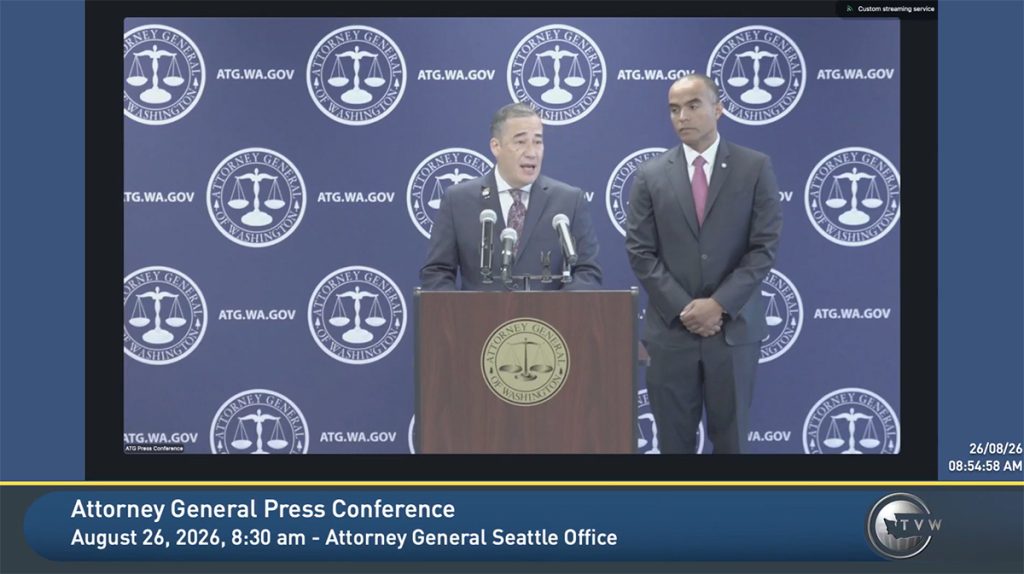
In a news conference on Wednesday about the lawsuit and Trump’s order, Washington Secretary of State Steve Hobbs said that he is confident the states’ legal challenge will not fail. He said that the United States Constitution puts control of elections in the state’s hands, not the federal government’s, and “there’s a lot of missing information,” including why the Justice Department would want voter rolls.
Danieli Evans, a University of Washington School of Law assistant professor, said that she did not want to speculate on what the Supreme Court will decide. However, she noted, district courts in prior cases had previously “found that the plaintiffs in these cases were highly likely to prevail on the merits” of the arguments Washington and others are bringing forward.
In previous cases, she said, “the plaintiffs argue that the President’s executive order is ‘ultra vires,’ meaning that the President is acting in a way that is impermissible under the Constitution or acting outside of the confines of his statutory authority. The Constitution gives states the power to set the time, place, and manner of elections, though Congress has the power to pass laws making or altering such Regulations.”
“The Constitution does not grant the executive branch any power to regulate elections,” she continued. “Hence, the President lacks power to prescribe or alter the process for holding elections.”
Even though he doesn’t believe the challenge will fail, Hobbs said that the state is moving proactively: his office is already working with counties to see if they can provide additional drop boxes for ballots. About 70% of Washingtonians already use ballot boxes.
He said that, if the challenge fails, his office also plans to ask the United States Postal Service (USPS) if Washington can be granted a waiver for the upcoming elections, “because the other part of this is they want us to throw away, destroy the non-compliant envelopes. So that doesn’t help us at all. It’s a big waste of taxpayer dollars.”
There are some other hurdles that present real problems for the state, he said. “For example, the rule states that there must be a barcode on the envelope, both incoming and outgoing. We do not have the capability to do outgoing ballots at this time.”
In a later press release, Hobbs’ office explained that the USPS would operate a special ballot portal that would match this barcode to each voter. But “to send ballots to voters, county election officials would have to validate the compliance of each ballot envelope at the post office, taking less than a minute per ballot envelope by the USPS’s own estimates.
“This would amount to over 9.5 years’ worth of time to send ballots to the more than 5 million Washington voters who will receive a mail ballot,” the press release continued. “The rule is clearly designed to discourage and burden vote-by-mail.”
“There is no reason to do this. Voter fraud is exceedingly rare and does not impact the outcomes of our elections,” Hobbs said in the press release. “No matter how many times the federal government repeats the lie, it does not make it true.”
If the rule stays in place, Hobbs said during the news conference, he will turn over the publicly available list of voters, minus personal information. But there are two immediate problems with this, he said.
“We update the list [of voters on] a minute-by-minute basis,” he said. “There’s no conversation or discussion on how [the federal government is] going to update their list.”
Additionally, he said, there are about 2,000 Washingtonians who use the address confidentiality program. Some of these people are survivors of domestic violence, and need protection.
“Are [federal officials] going to protect them?” Hobbs asked. “These are the questions that we have no answers for. But I feel that this lawsuit will be in place and it’ll hold. But I want Washingtonians and voters to know that we do have plans in case they do not.”
Hobbs said that it was unclear why the federal government would be focusing on undermining voter confidence ahead of the election, instead of supporting states and defending elections against credible threats to attacks from nation state actors.
“This is also the time where the federal government helps us build confidence with the voters by informing them how elections are [run] and encouraging them to vote,” he said. “This happened even during the first Trump administration. But, instead, this administration has been focused on dismantling our constitutional right to run elections in this state.”
The state will begin mailing out ballots in about three weeks, including to overseas members of the military, who can only vote by mail.