



By Kai Curry
NORTHWEST ASIAN WEEKLY
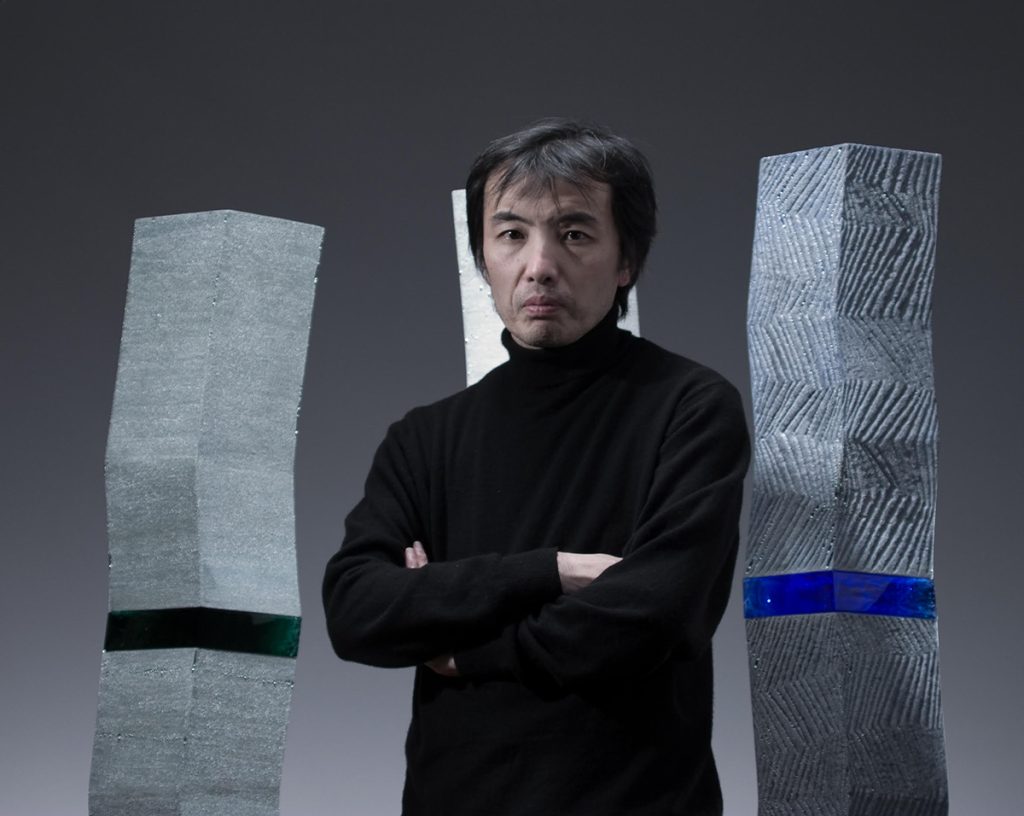
Portrait of Kondō Takahiro. Courtesy of the Lowe Museum.
Celebrated ceramic and glass artist Kondō Takahiro recently visited Seattle as part of Seattle Asian Art Museum’s exhibition: The Kondō Family: Storytellers in Clay. The exhibition, based on an original presentation of Kondō family art works at the Lowe Art Museum, University of Miami, features three generations of Japanese master artists who were integral, globally, to the consideration of clay as not just a medium for craft, but also a medium for art.
The grandfather, Kondō Yūzō (1902-1985), was designated a Living National Treasure in 1977. His two sons, Kondō Yutaka and Kondō Hiroshi, continued what Yūzō helped start, breaking new ground for what could be done with ceramics, especially porcelain, while also honoring a long-standing heritage of clay vessels in Japan. Kondō Takahiro, Hiroshi’s son, recently visited Seattle as part of the activities surrounding the exhibition. Takahiro is the only living representative of the family’s artistic line. All members of the family have long been recognized for their art in Japan and around the world, such as at the Kondō Museum of Ceramics in Kyoto.
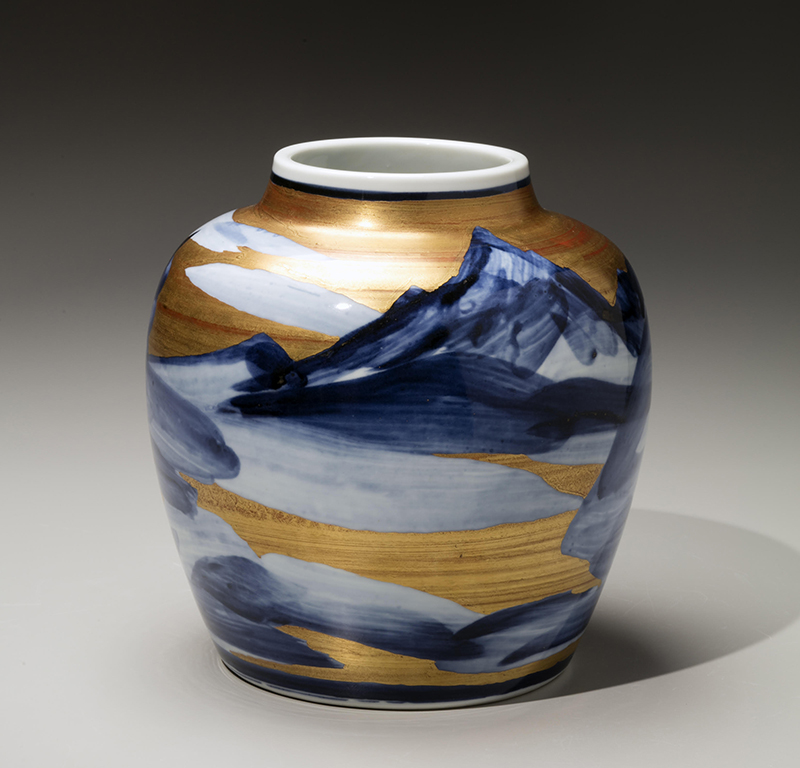
Mountains Cobalt-Blue and Gold-Overglaze Flower Vase, circa 1977, Kondō Yūzō, Japanese, 1902–1985, Wheel-thrown porcelain with blue cobalt pigment under clear glaze, with gold overglaze, 7 7/8 x 7 1/2 in., Collection of Carol and Jeffrey Horvitz, Collection #: JC2017.001, Photos: Richard P. Goodbody and John Morgan.
Takahiro is careful to recognize the timeline of which he is a part, which consists not just of his family but many other important Japanese clay artists, stemming back, potentially, all the way to the ancient Jomōn period, which lasted from approximately 14,000 BCE to 300 BCE.
“My family has participated in a particular phase of the history of art, about 100 years, whereby craft changes to modern art,” Takahiro told the Northwest Asian Weekly. He describes himself as “the next step in the process” and where that leads is an open road. Takahiro’s significant works are displayed alongside those of his father, uncle, and grandfather at the exhibition. Also included are the works of an important mentor and teacher, Tomimoto Kenkichi (1886-1963).
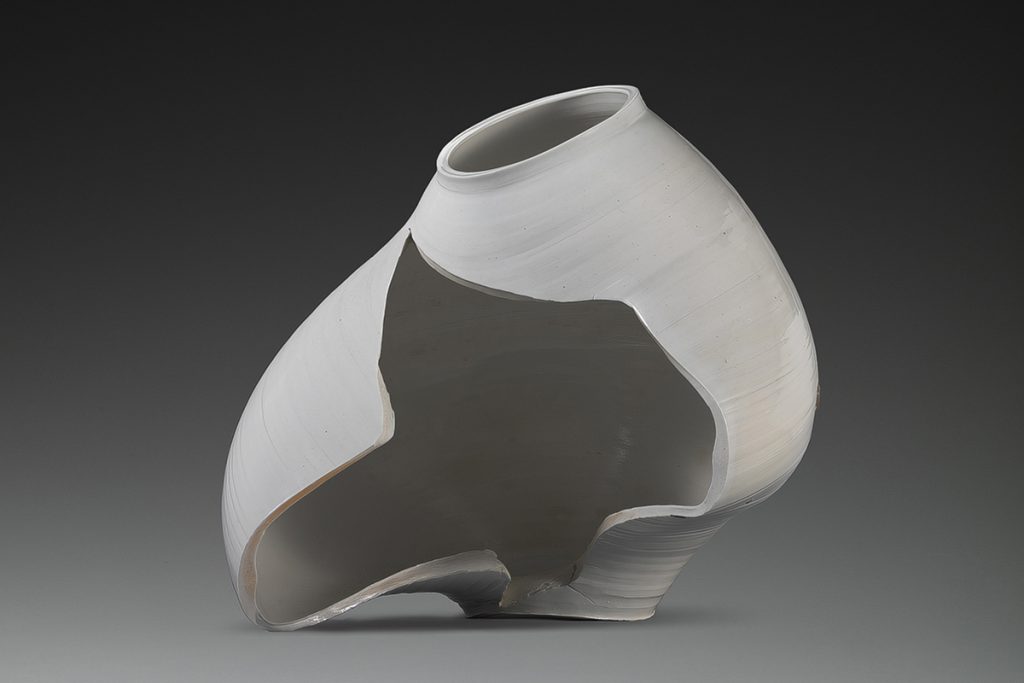
Large White Porcelain Vessel, 2019, Kondō Takahiro, Japanese, b. 1958, Wheel-thrown porcelain with clear glaze, 20 1/2 × 21 7/8 × 17 3/4 in., Collection of Carol and Jeffrey Horvitz, Collection #: JC2021.018, Photos: Richard P. Goodbody and John Morgan.
When you first step into the exhibition, you see a large and striking work by Takahiro, a gleaming white porcelain vessel which has been allowed to split, artistically, down the middle. “It’s falling apart, but it’s falling apart the way that Takahiro wanted it to fall apart,” said the museum’s Tateuchi Foundation Curator of Japanese and Korean Art, Aaron Rio. The vessel forms a shape reminiscent of what might have been its intact version, while simultaneously creating an entirely new form in which both positive and negative spaces are paramount. Just the surface, smooth, almost milky, which one imagines as pleasantly cool to the touch, is hypnotizing. Takahiro’s ceramic surfaces are renowned. He is particularly famous for what he calls “silver mist”—a sprinkling of silvery “drops” that he places over some of his works, which, to him, is a visual representation of the mist or water that is continually in the air around all of us. Takahiro’s worldview consists heavily of an idea of the interplay of the elements—fire, earth, water, air—how they impact us, move through us, their stability, and their chaos.
Moving further into the exhibition, you will see what Takahiro is perhaps the most famous for at the moment—his self-portraits. First, his face, duplicated, but with varying surface treatments. He calls these both life and death masks. He meant these to be a finale of his clay art, back in 2008. He turned 50 and, after reassessing his trajectory, thought this might be a good place to stop producing his clay art. All of his own background, his training, his former work, as well as those of his family and the others creating in the craft, Takahiro brought to bear on these self-portrait masks, he told us. But then, something happened. That something was the 2011 Tōhoku earthquake and tsunami off the east coast of Japan. Like many artists of all genres, Takahiro struggled with a response to this cataclysmic disaster in his home country. He struggled, he told us, with the anxiety that plagued most people in the country following the consequent breakdown of the Fukushima nuclear plant and release of nuclear radiation. The Tōhoku Earthquake, also called the Great East Japan Earthquake, was and remains the most powerful earthquake ever recorded in Japan, with a death toll of approximately 20,000.
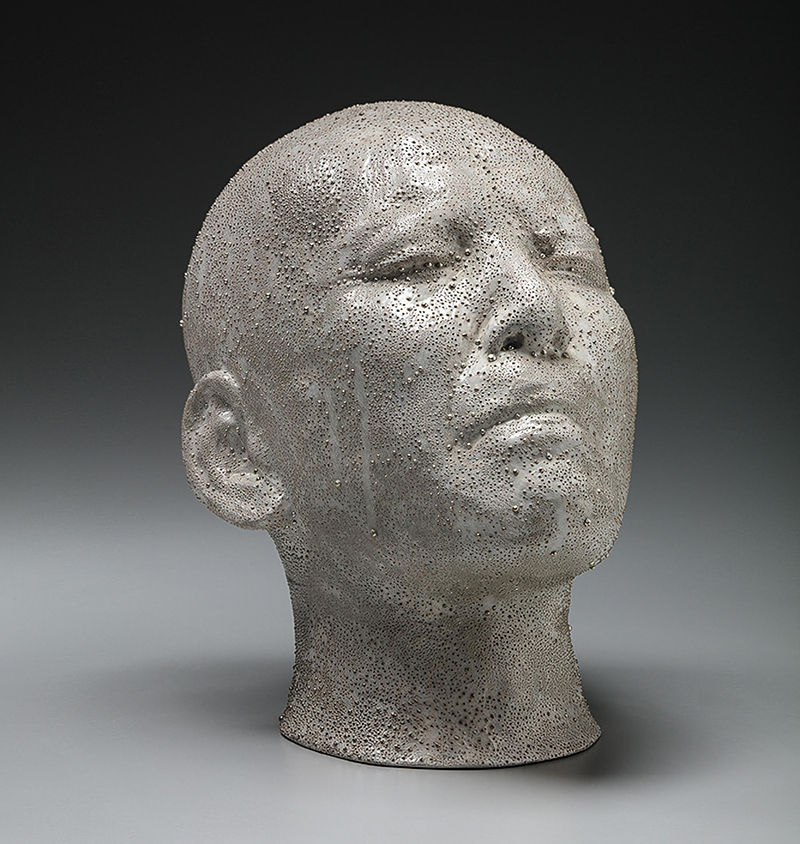
Reflection: TK Self-Portrait, 2010, Kondō Takahiro, Japanese, b. 1958, Molded and cast porcelain with graded white glaze and “Silver Mist”, 9 1/2 × 6 5/8 × 8 5/8 in., Collection of Carol and Jeffrey Horvitz, Collection #: JC2021.003, Photos: Richard P. Goodbody and John Morgan.
Out of this struggle came Takahiro’s “Reduction” series of full-size self-portraits. He intended them, in large part, as a way of communing with those who died in the 2011 disaster. To that end, he would place the life-sized sculptures onto significant locations, such as on a beach in Natori, Japan, a town which was hard hit by the tsunami and is still undergoing restoration. Thus, as Takahiro explained, the work becomes a direct part of the dialogue “as a capsule of people’s struggles, of the experience of dying, all of that gets embedded then held inside the sculpture.” The exhibition includes these works in front of a video that shows another work from the series on the beach itself. Also, a part of the exhibition is a room dedicated to what Takahiro is working on now—giant conical bowls covered in “silver mist.” In this room, you can see multiple images of Takahiro’s studio and other current information. You may also view Takahiro’s works in glass at this exhibition, which he started making over 20 years ago and which are related to his interest in the life of clay; from earth to fire, just as glass goes from sand to fire to solid.
Significantly, too, in the exhibition, is a video documenting the creation of one of Takahiro’s full body self-portraits at Tenkawa Daibenzaiten in the village of Tenkawa, near Yoshino. Takahiro chose this location, he told us, due to its ancient history of clay creation that goes back all the way to the Jomōn culture. While it has been a location sacred to Shintoism and Buddhism for over 1,000 years, the roots of the temple are even older, as is the clay firing tradition. Takahiro recalled to us that when he was making this particular self-portrait, he left it in the kiln during an unforeseen thunderstorm—an event unheard of during the season of the year he was there and which took on a spiritual significance for him and for the monks at the temple. When Takahiro returned to the work site/kiln the next day, he found that the collapse of the kiln in the rain had created an effect wherein the sculpture appeared to be wearing a monk’s robe. When we asked him, Takahiro said he would choose this work, out of all of his works, to represent himself and his legacy.
“The closer the art world gets to accepting clay as a medium in all of its instances, and all of its totality as a fine art, is the closer we will all be to understanding the actual power of that material,” Takahiro said. The Kondō Family: Storytellers in Clay runs until Jan. 3, 2027. For more information, visit www.seattleartmuseum.org/visit/seattle-asian-art-museum.
Kai can be reached at newstips@nwasianweekly.com.