



By Madison Morgan
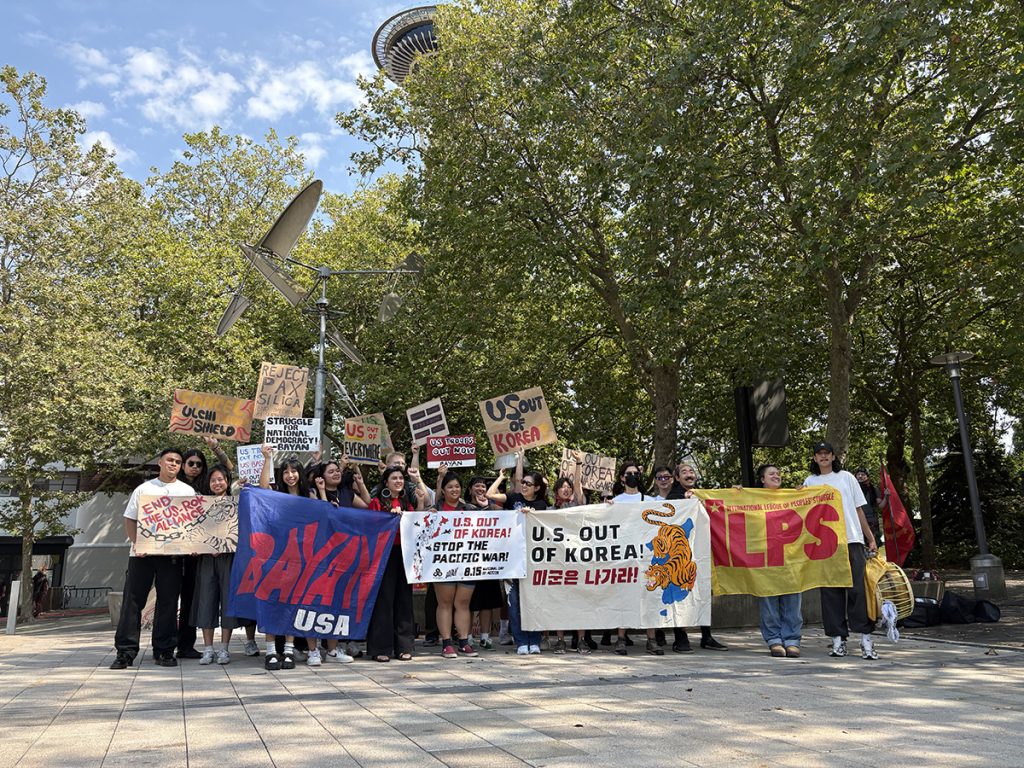
Protesters stand together during the Aug. 15, 2026 “U.S. out of Korea!” rally in Seattle. Photo by Madison Morgan.
Under the shadow of the Space Needle, dozens of protesters gathered at Seattle Center’s Fisher Pavilion on Aug. 15 with a clear demand: the withdrawal of more than 28,000 U.S. troops from the Korean Peninsula.
The demonstration, organized by the Haebang Collective, Korea Peace Now Grassroots Network, Bayan Washington, and the International League of Peoples’ Struggle Seattle-Tacoma, was part of Nodutdol for Korean Community Development’s “U.S. out of Korea!” campaign. Coinciding with the 81st anniversary of Korea’s liberation from Japanese colonial rule, the Seattle protest was one of several rallies held across the country as part of a coordinated national day of action.
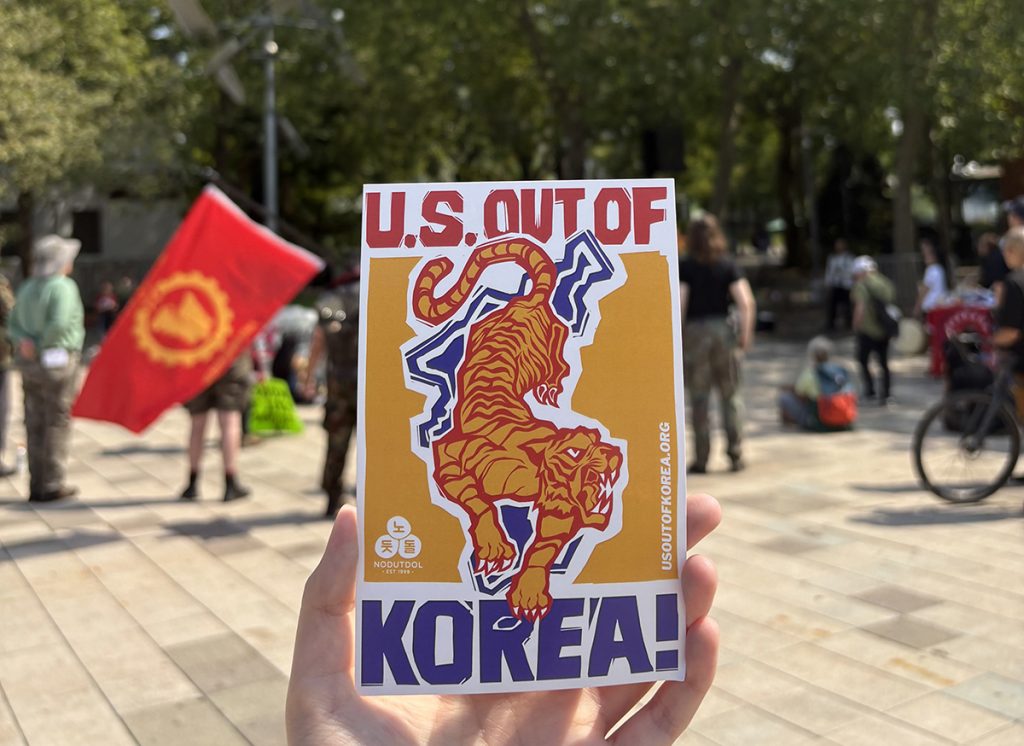
Stickers for the “U.S. out of Korea!” coordinated national day of action on Aug. 15, 2026. Photo by Madison Morgan.
“8/15 is a very bittersweet day, honestly, because it’s supposed to be meant as a day of celebration with liberation from a brutal 35 years under Japanese colonial rule,” Rachel Kim, an organizer with the Haebang Collective, said. “But we cannot celebrate if our homeland continues to be divided, occupied, and used—in the U.S. Army’s own words—as a ‘fixed aircraft carrier’ for the U.S. military to escalate and bring aggression toward a war in Asia Pacific, which will impact millions of people, not just Koreans.”
Washington state is also home to the fifth-highest concentration of Korean-Americans in the country, and many at the rally said the issue resonates personally with their families’ histories and ties to the peninsula.
“I have family, actually, who survived Japanese colonialism,” Kim said. “And in Korea, they later also survived the bombings that were indiscriminately dropped by the U.S. military during the start and the genocidal phase of the Korean War.”
Demonstrations occurred two days before the start of Ulchi Freedom Shield, an annual 11-day military exercise in South Korea involving approximately 18,000 South Korean troops and an undisclosed number of U.S. forces. This year’s drills will incorporate what officials describe as “realistic threats,” including lessons from recent conflicts and North Korea’s military cooperation with Russia in the war against Ukraine.
The 2026 drills also come as South Korea pushes to complete the transition of wartime operational control from Washington to Seoul before President Lee Jae Myung’s term ends in 2030. The exercise will include live field maneuvers, computer simulation-based command post exercises, and civil defense drills, according to South Korea’s Yonhap News Agency.
“We see these U.S.-led Ulchi Freedom Shield war exercises escalate every single year in severity, and this is a devastating toll on the people and also our homeland, as the U.S. military is using our lands to escalate and create these forever wars,” Kim said. “We, just as people, refuse to have our homeland be used as a battleground for the U.S. to escalate a war with China and North Korea. So not only does the ‘U.S. out of Korea!’ demand really mean solidarity with the Korean people, but honestly, it’s reflective of all people of conscience who want to demand an end to the U.S. war machine.”
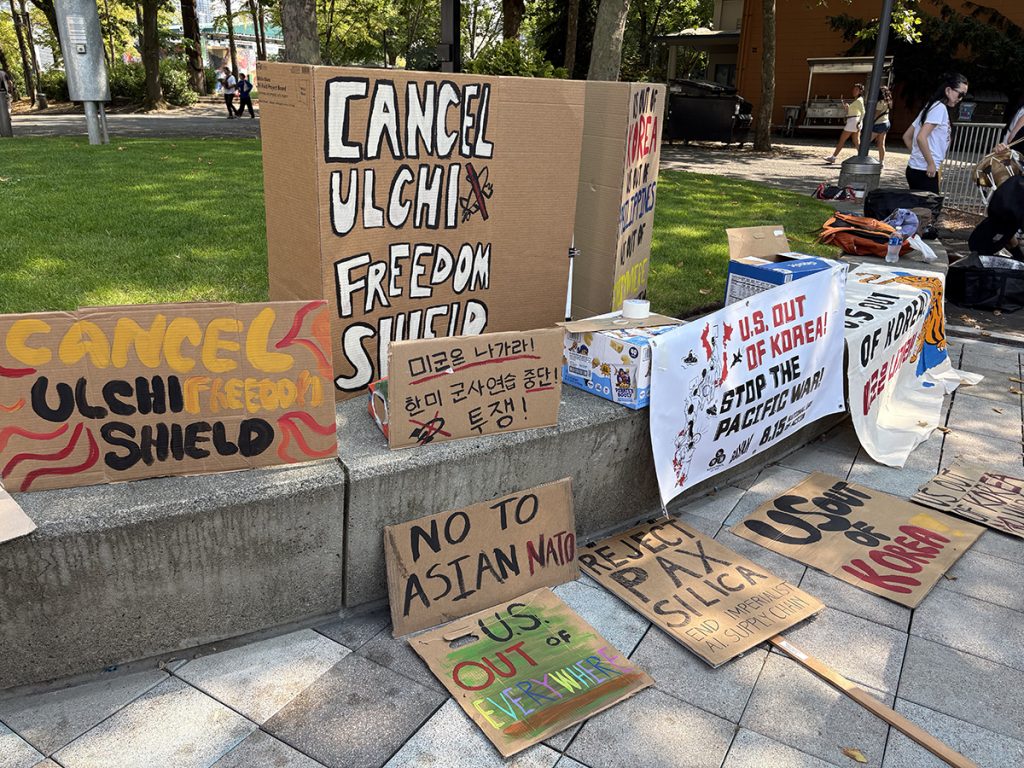
Signs at the Aug. 15, 2026 “U.S. out of Korea!” protest in Seattle. Photo by Madison Morgan.
Earlier this month, eight university students were detained for allegedly breaking into the Osan Air Base while shouting anti-U.S. slogans. According to the Korean Progressive University Student Union, the students were protesting what they described as U.S. military opposition to a South Korean semiconductor cluster project.
The incident marks the latest in a series of protests against the U.S. military presence in South Korea.
“Peace will not be given, it will be taken back by us,” Sung Park, a member of the Seattle Evergreen Coalition, said during a speech at the rally. “But peace has enemies, real ones.”
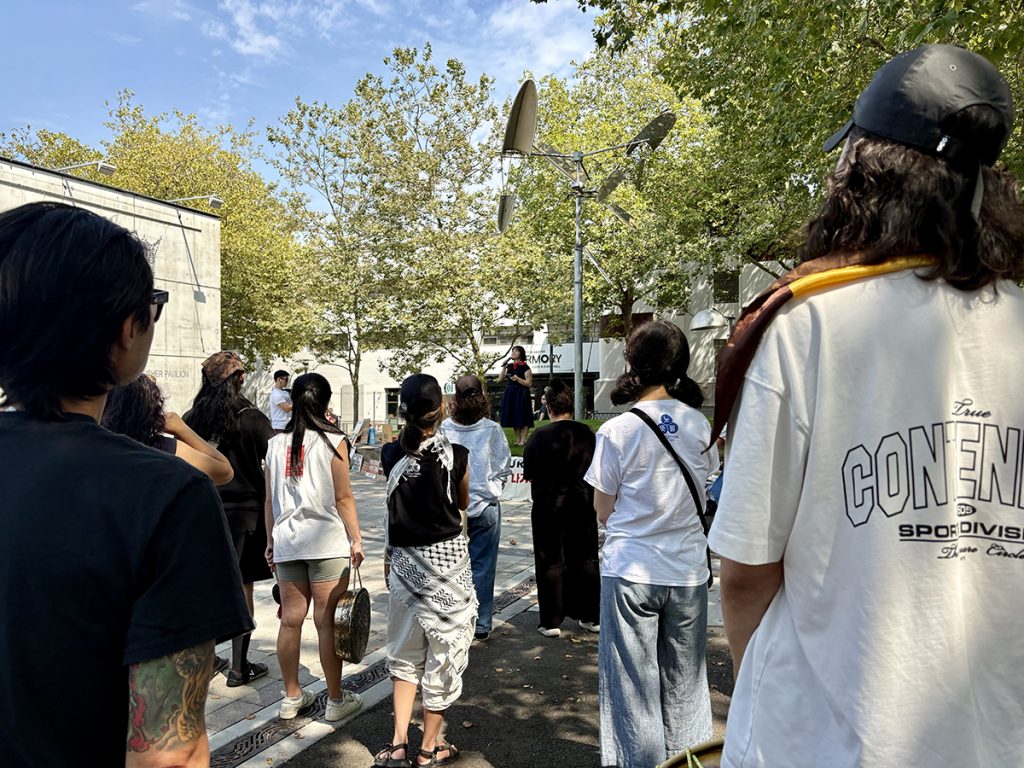
A representative from Nodutdol for Korean Community Development gives a speech during Seattle “U.S. out of Korea!” protest Aug. 15, 2026. Photo by Madison Morgan.
Organizers said they plan to continue advocating for an end to the military exercises and a shift toward diplomatic solutions on the peninsula.
“We’re hoping that this rally is a starting point for many other members in our community to learn and study more on how this impacts Koreans and Korean,” Kim said.
Raven Butawan, a spokesperson for the Defend Negros Campaign, recommended that those interested in learning more check out Nodutdol’s Korean Education Toolkit. Butawan said he appreciated “these forms of education and community education that are pretty unique to movements like ours.”
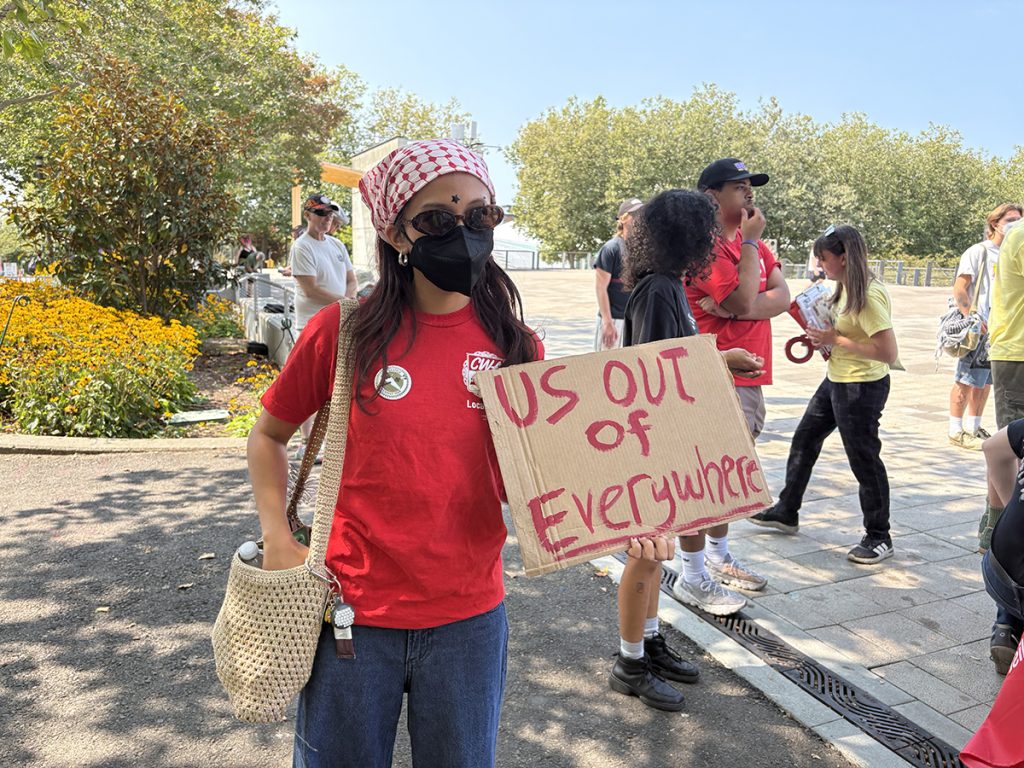
A protester during the Aug. 15, 2026 “U.S. out of Korea!” rally in Seattle holds a “U.S. out of Out of Everywhere” sign during chants of “No boots on the ground, no bombs in the air, U.S. out of everywhere.” Photo by Madison Morgan.
For many at the rally, supporting “U.S. out of Korea!” also means supporting the end of U.S. militarism across the globe, in countries such as Iran, Gaza, and the Philippines.
“As we’ve seen with the attacks on Iran, with the bombings in Venezuela and the capture of President Maduro, and with the ongoing genocide in Palestine, there’s a cost to the lives of the people in those countries, and also there’s an impact here in the U.S.,” Luz Betron, a representative from Bayan Washington, said. “So essentially what we’re sharing and really uplifting [are] the stories of the people of Korea also wanting the U.S. military bases out of their country; they also don’t want to experience those consequences at an intensified scale.”