



Interview by Angela Heiser
Seattle weather has a reputation. For Filipino American writer Antino Art, it’s pure sunshine.
Based in Raleigh, with roots in tropical places like South Florida and the Philippines, Art found solace in Seattle’s rainy day poise—and channeled it into the optimism at the heart of his book. He recently sat down with fellow poet Angela Heiser to talk about the project and how it can help people find peace in the post-2025 social climate.
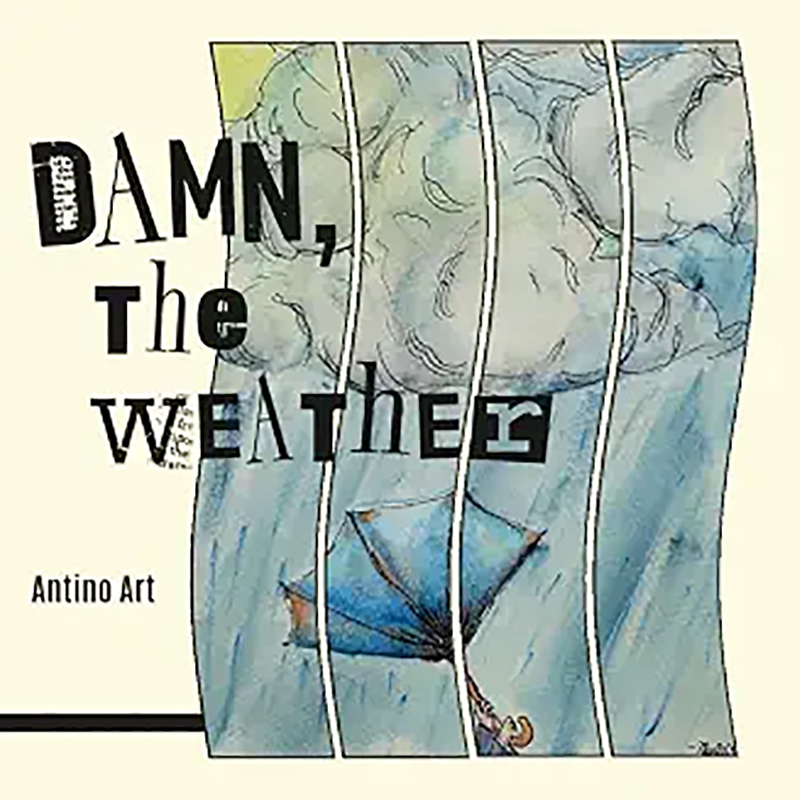
Angela: Congratulations on your new release, Damn, The Weather, out July 1, 2026 from Sabre Lake Publishing! Reading these pieces, I could immediately picture you performing them. Your stage presence and the bond you form with your audience translate seamlessly to the page. In addition to poetry, you also perform magic—an interplay that enriches your work from the start.
Art: I’ve poured myself into both the page and stage sides of the poetry game, so I’m grateful you noticed.
Angela: Your bio says you like to flee to Seattle with your daughter and the locals don’t feel the rain. Can you elaborate on that? What draws you to Seattle?
Art: Books, coffee, rain—as a writer, what’s not to love? Beyond the aesthetic gloom, it’s the city where I survived myself. After my nine-year marriage fell apart, my daughter and I fled to Seattle for a cross-country vacation. We ate clam chowder and rode the waterfront ferris wheel through a gentle rainstorm. And I may have thrown back a few old fashioneds at that Damn bar. There’s something poetic about fleeing to a place that’s raining when your world ends. It taught me that we create our own brightness.
Angela: I applaud and appreciate the variety in forms and leaning into vernacular, particularly hashtags. Two that stood out to me are:
#SurviveYourself—How does one survive oneself? How often do we stand in our own paths?
Art: We’re all natural disasters. I was personally going through a season of mental health burnout at the end of this project, so that was the rallying cry I gave myself to ride the storms that were clouding my headspace. Not every storm deserves a home inside of us. We have the power to withstand whatever the heavens hurl our way.
Angela: #OneNationUnderGuns encapsulates so much in an economic package. It’s one of those lines you read and wish you had written it. Gun violence is nearly as omnipresent as weather in the United States. How do you, as a parent, a poet, a human, make sense of all that #OneNationUnderGuns is meant to encompass?
Art: I wish I wrote that line, too. As you may notice throughout the book, I’m into communal line borrowing. That line came from a tweet that Amanda Gorman posted after another school shooting. I just turned it into a hashtag, because hashtagged words spread easily. Gun violence in the Wild West is a routine calamity that we can’t become deaf to, especially as parents, so I’m glad that line is sparking awareness, conversation, and resistance.
Angela: You open the book with a section titled “Four More Years of Winter: Thawing permafrost releases methane, a potent greenhouse gas. Forecast: Ice reign.” I’m immediately struck by the layers of meaning embedded into this section title, even before I get to the first poem. We have ingenious wordplay, ICE loose on the streets, four more years of Trump, and a nod to Punxsutawney Phil and climate change. How did you conceptualize this manuscript and was it shaped by our historical context or does it respond to it?
Art: The weather theme came from my resistance to small talk. I crave deep conversations. But I’m a socially awkward recluse. The only way for me to get to real talk is through poetry. So I wrote about the weather as a gateway to talking about the things that matter. Poems like the titular opener were overtly about meteorological events, while others like “Built for Damnage” coalesced organically around the theme. And the weather reports, as you observed, are poems in and of themselves. They’re mostly soundbites from real-life forecasts and line samples from peers. For example, the section title “Four More Years of Winter” comes from a line by Angelica Whitehorne, whose enviably brilliant writing about nature helped plant the seeds for this project.
Angela: When we talk about difficult phases of life, we often refer to them as seasons. I am reminded of this in the transition to the next section where the title mentions “human survival” and “Tropical Depression.” What would you consider your most challenging or depressing life season?
Art: This project came out of a personally dark season backset by the sociopolitical sh*tstorm we’re in. It felt like a storm within a storm. So I did what I’ve always done to survive: create. But I didn’t perform like I’d normally do. Instead, I evacuated the spotlight and showed up for me—which included stepping down as the co-director of the Third Angle Poets (all love to the clan), deactivating socials, turning down events, being with my daughter (who painted the cover art for the book), and traveling to Seattle many times. Doing so kept my walls from caving in.
Angela: Tell me more about Some-Her and human survival in a tropical depression. What does it mean to survive and weather one’s own life seasons/storms?
Art: Poets are heartbroken creatures. And Some-Her was that sunny season of romance that never came around. My wife left nearly a decade ago (but we are good), and I’ve been chronically single sovereign ever since. So Some-Her is a blur of unrequited love interests who came and went, blew me off, swiped left, didn’t show, chose someone else, or never saw the Asian guy as more than the diversity buddy. We all need the warmth of companionship to survive dark times. What does it mean to survive? 40% of my Philippine motherland lives in chanty towns that routinely get swept away by floods and typhoons. But they find a way.“In Winter I Dream of Some-Her” was my way to survive the dating wasteland—based on fragments from quasi dates and disillusioned hopes, but mashed into a dreamy recall for the sunniest moment in the book. The poem was part of a microchap and performance art exhibition we created for The Lover and the Sword, a reading series for unrequited lovers that I host with my poetry best friend, Travis Kyng.
Angela: Tell me about the decision to include three poems that double as patter (scripts for magic performances). Why these particular three?
Art: It’s my way of honoring my first-love art form. While I’ve written poetry since high school, I never had an audience for it. But I always had an audience for magic. Whenever I’d do things like make money appear, bend silverware, throw fireballs, or turn a pen into a sword, people noticed. Magic consumed me and became my full-time career after college, when I founded a Florida-based troupe of magicians called the House of Flying Cards. We did shows everywhere, like a garage band. Forget lofty lit mags with high rejection rates: live performance for live people was the platform my words needed. Performing creates connection. So I had the idea to connect poetry with wizardry and fully express myself. Publishing poetry that doubles as performance art is my way of slamming through barriers in the lit scene a la Marc Kelly Smith.
Angela: How does the knowledge that a draft could morph into either a poem or patter, or possibly both influence your creative process both in reading and writing?
Art: Emotion comes first. Poem comes next. And magic turns it into a moment. For example, “Heat Advisory” (FKA Unburnt Offerings). In 2025, when hell broke loose, I felt like everything was burning. So I wrote a poem about everything that was burning. It stood on its own—I performed it and got snaps. But it needed a more powerful ending that transcended words. I always knew how to burn objects and restore them (restoration effects are fundamental in magic). So on the night of the summer solstice at a Third Angle Poets’ show, I lit a candle. I began burning pieces of thread over the candle after saying what was burning. At the end, I blew out the candle: the thread was never burned. When I performed that version for the first time, people cried. And something inside me healed.
Angela: Another section title has stayed with me for its piercing imagery. “Evacuation: Sakura was the flower of Samurai because its falling petals revealed the beauty of impermanence.” The idea of impermanence struck me for its universality. What role did you want impermanence to play in this manuscript?
Art: I needed to make peace with impermanence to finish the manuscript. Because I was far from peaceful. My mental health darkness came in peak spring, when the cherry blossoms were in bloom. I was organizing the first Triangle Poetry Festival, but I was running on fumes with a mask on. After the festival crowds left, I was left with my shadow. And the listless feeling of futility. No Some-Her, no audience, no fire in me. You mention impermanence: the high of a show well-done was impermanent. Love interests, impermanent. Art, impermanent. Social likes, high hopes, recognition, all of it, impermanent. I was searching for permanence in a Holden Caulfield-like crisis. And I had nowhere left to go but within. Up until then, Damn, The Weather was only about winter and Some-Her. And it got rejected by many-a-publisher, maybe because it lacked that final season of impending bloom. As much rejection as I’ve endured in life, I can’t reject my own darkness. I had to get through it. So I wrote the last few capstone pieces in the dark, including “To Everything, With Love.” When I sent the manuscript to Sabre Lake Publishing, they saw the glimmer and said yes. That’s the beauty of weather: it changes. If we embrace change, we’ll get through anything.
Damn, The Weather is available here. Art can be reached at antinoart@antinoart.com.