





By Jason Cruz
NORTHWEST ASIAN WEEKLY
“One life, one thing: Tai Chi.”
This is the way of life for Grandmaster Chen Zhenglei, who visited the Chinese Wushu & TaiChi Academy on Mercer Island this week for its anniversary.
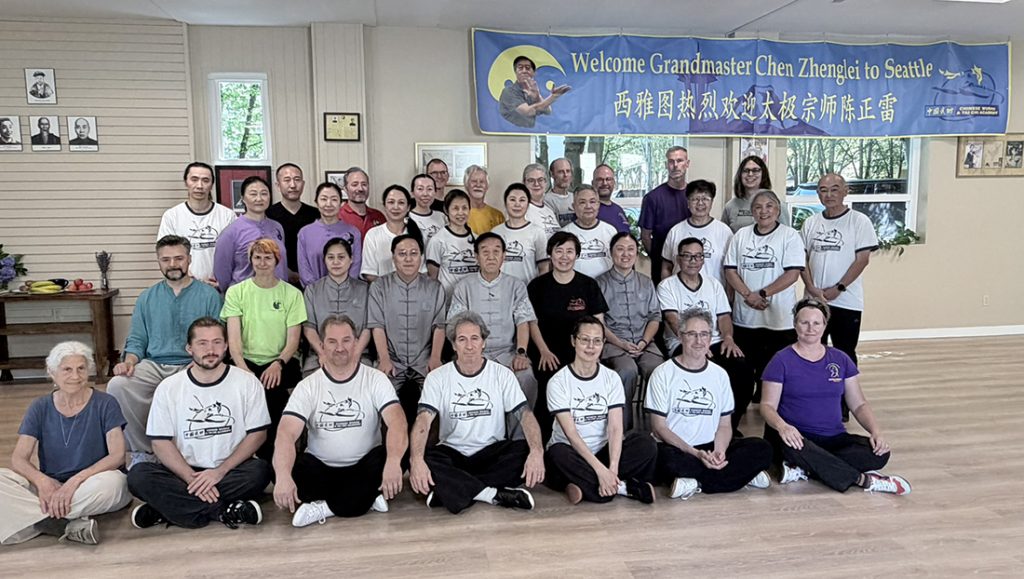
The Chinese Wushu & Taichi Academy on Mercer Island celebrated its 30th year in existence with a visit from Grandmaster Chen Zhenglei. (Photo by Jason Cruz)
“Since I was a child, my parents, grandparents, and uncles told me the responsibility of this art.”
Accompanied by his three adult children who also teach, the Grandmaster celebrated with the Academy with seminars at the Mercer Island studio and the weekend at the Chinatown Community Center in Seattle’s Chinatown-International District on July 11 and 12.
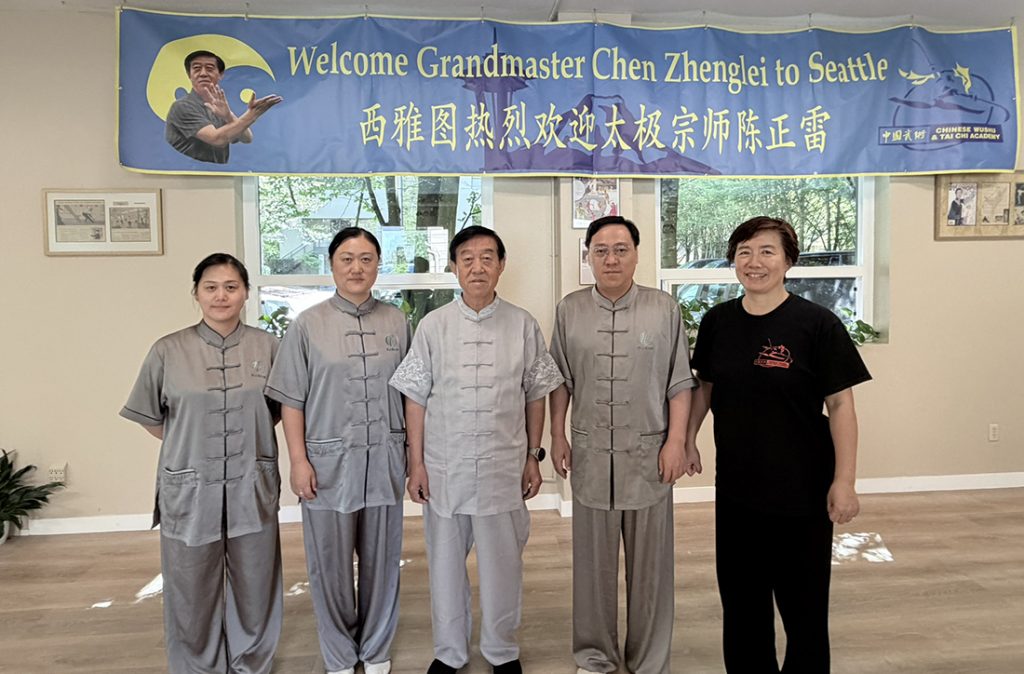
Grandmaster Chen Zhenglei (center) flanked by his children and Master Yijiao Hong in black. (Photo by Jason Cruz)
The 78-year-old Grandmaster Chen Zhenglei is the 19th generation descendent of the Chen family and 11th generation direct-line successor of the creators of the martial art known as Tai Chi. It is an ancient Chinese martial art involving deliberate, low-impact movements that work on both the mind and body.
Master Yijiao Hong founded the Chinese Wushu Tai Chi Academy in 1996. The academy has over 100 students. “For our school, it is a historic event. This year, we are celebrating our 30th anniversary.”
“In 1997, I met Grandmaster Zhenglei at an international event, and in 1998, Grandmaster Zhenglei gave a seminar.” Throughout the years, he has traveled to Seattle to hold over 15 seminars for her school.
Hong began Wushu Martial Arts and Tai Chi martial arts at the age of 8. She taught Wushu and Tai Chi at a Chinese university. At university, Hong studied Chinese medicine and the positive health attributes of Tai Chi.
Hong continues to teach Tai Chi because of “the love, the passion, and the belief.” She professes the health benefits of Tai Chi. “Based on traditional Chinese medicine, it’s the ‘energy flow’ that frees it from the illness,” she added, “[t]he way of moves is based on traditional Chinese medicine and a series [of moves] called Yin and Yang [representing the fundamental balance of opposing yet complementary forces].
Beginning at the age of 8, Zhenglei studied the martial art of Tai Chi under his uncle. As part of his training, he was the family stenographer as he wrote down the oral history of Tai Chi. His family would produce books on Tai Chi. As an “apprentice,” he copied “five times” for a book since there were no copy machines. Through this work, he memorized the technique and forms.
He began teaching Tai Chi at 20.
Zhenglei recalls the most challenging part of Tai Chi was persevering in practicing in China during the Cultural Revolution. “All the treasure of the art was suppressed,” he said. “They all trained in remote places, like the bank of the Yellow River or inside their houses.”
“After society was opened, people did not believe Tai Chi as a martial art,” he stated in Chinese through Hong’s interpretation. “It was ‘so slow,’ ‘where is the application?’” In his village in China, foreigners would come to observe the martial arts practice which involves methodical movements with hands and feet. “All kinds of people would challenge us.” Zhenglei and his followers would continue to hone and refine the practice of Tai Chi to gain the respect of other martial arts practitioners.
In 1997, Zhenglei recalled the opening of the country and Japanese martial arts practitioners came to his village. “Many outsiders came to Chen village,” he said. After seeing for themselves, they were convinced. “The martial arts side of Tai Chi appealed to the Japanese practitioners.”
With the positive impact Tai Chi had on martial arts practitioners from other countries, the Chinese government started to promote Tai Chi. It is a pillar of its national heritage and promotes public health.
“From 1998 until today, the Chinese government has promoted Tai Chi for over 40 years,” said Zhenglei. “I am very proud that Tai Chi has spread to over 180 countries and four to five hundred million people practice Tai Chi.”
“What makes me continue to practice is I carry the responsibility for the ancestors, my country and family. Over the years, I have traveled the world, including 30 times to Japan and over 40 times to the United States and Europe. Wherever I go, people are always happy and appreciative and that is why I am still going.”
For more information on the Academy, please visit www.chinesewushutaichi.com.
Jason can be reached at newstips@nwasianweekly.com.