



By James Tabafunda
NORTHWEST ASIAN WEEKLY
Three candidates for the King County Council District 2 seat outlined competing visions on housing, public safety, and immigration enforcement on July 23 during the 14th annual Asian & Native Hawaiian/Pacific Islander (ANHPI) Primary Candidate Forum, held less than two weeks before the Aug. 4 primary election.
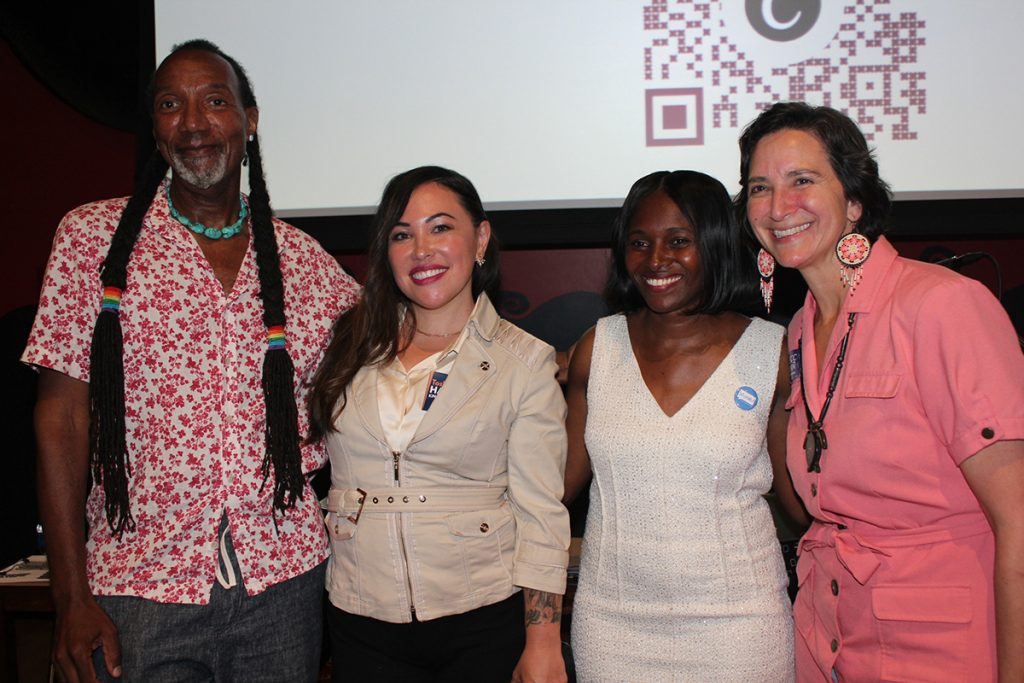
From left: Rosette Royale, Toshiko Hasegawa, Miriam Mboya, Rebecca Saldaña (Photo by James Tabafunda)
Toshiko Hasegawa, Miriam Mboya, and Rebecca Saldaña answered questions for 66 minutes at the Wing Luke Museum’s Ford Foundation Community Hall, addressing an audience of about 70 people. The forum offered Cantonese and Mandarin interpretation for attendees in a separate room with a livestream of the event.
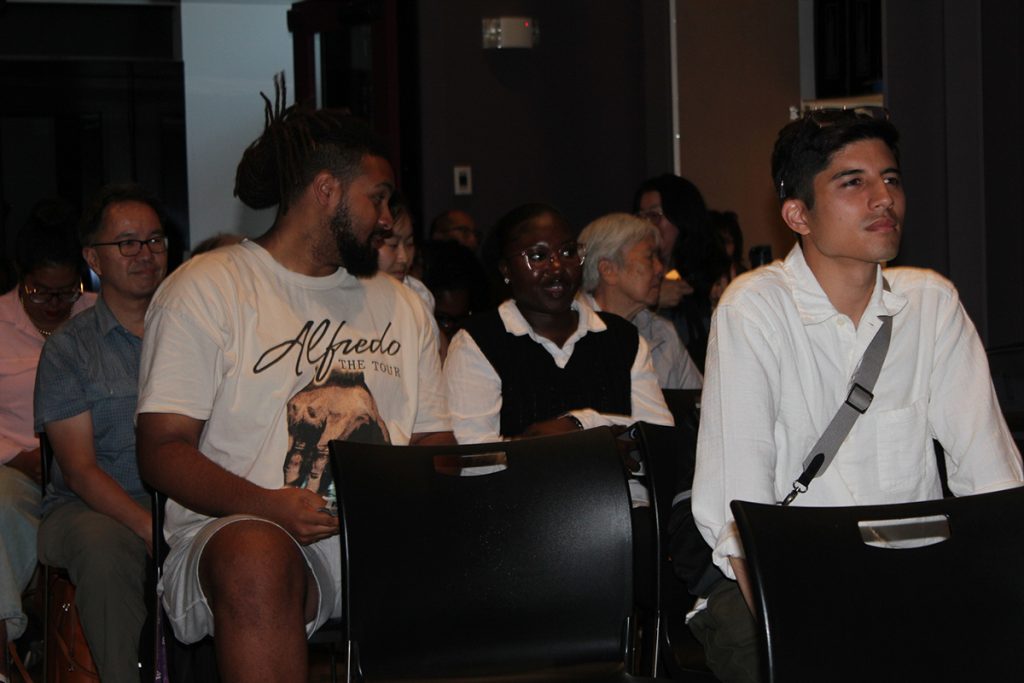
Asian & Native Hawaiian/Pacific Islander Primary Candidate Forum attendees (Photo by James Tabafunda)
Forum purpose and format
Rosette Royale, managing editor of the South Seattle Emerald, moderated the forum. “We hope today’s forum is one more way that we ensure elected officials participate in a meaningful relationship with our communities and are accountable to the needs of constituents who have historically been excluded from the political process,” he said.
The forum was sponsored by the Wing Luke Museum, Asian Counseling and Referral Service, Refugee Women’s Alliance, Chinese Information and Service Center, South Seattle Emerald, and InterIm Community Development Association. Organizers said the event was designed to ensure candidates understand the needs of Asian American and NHPI communities and to give residents a chance to hear how each candidate’s platform would affect District 2.
It was structured as opening statements, four issue-based questions, two rounds of candidate-choice topics, two scenario questions, and a closing question, Royale said, with candidates given between 60 and 90 seconds to answer.
Open seat draws three contenders
The forum came amid a leadership transition on the council. District 2 is an open seat formerly held by Girmay Zahilay, who began serving as King County executive on Nov. 25, 2025. The council appointed Rhonda Lewis on Dec. 9, 2025, to serve as interim District 2 councilmember until certification of the November 2026 election. The district spans the University District, Laurelhurst, Ravenna, Eastlake, Capitol Hill, the Central District, South Seattle, Allentown, and Skyway.
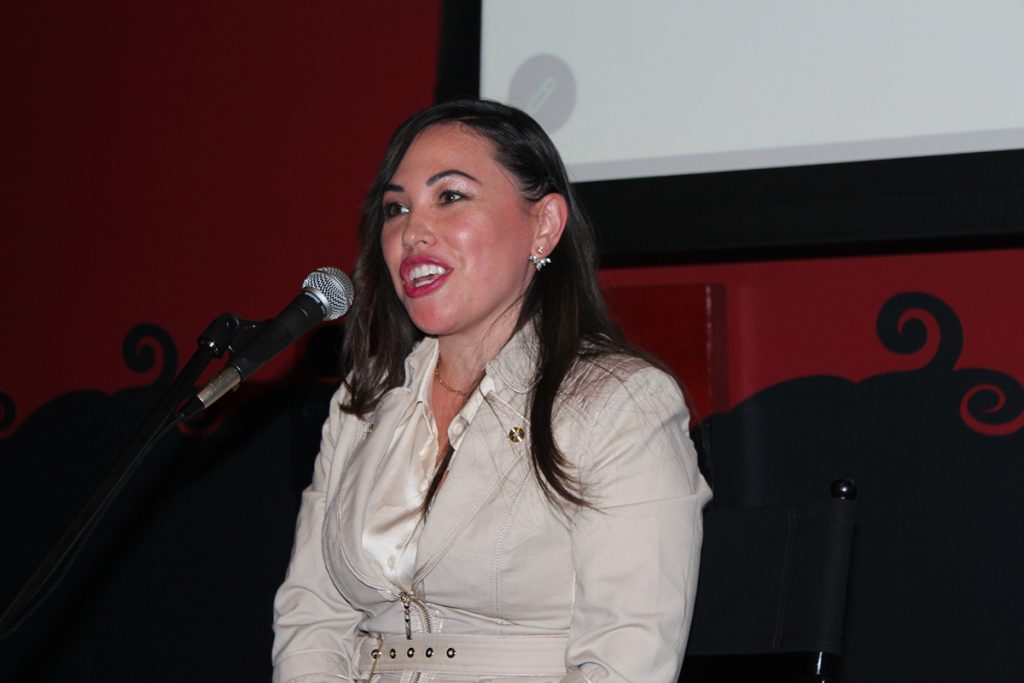
Toshiko Hasegawa, Port of Seattle commissioner (Photo by James Tabafunda)
Hasegawa, a Port of Seattle commissioner, described herself in her opening statement as “a fourth-generation Japanese American from the Beacon Hill neighborhood.” She said her family’s roots in the district trace to her great-grandfather and her grandparents, who returned to the neighborhood after being held in American incarceration camps during World War II. Hasegawa said she was the first woman of Asian ancestry elected to the Port of Seattle Commission in its 110-year history.
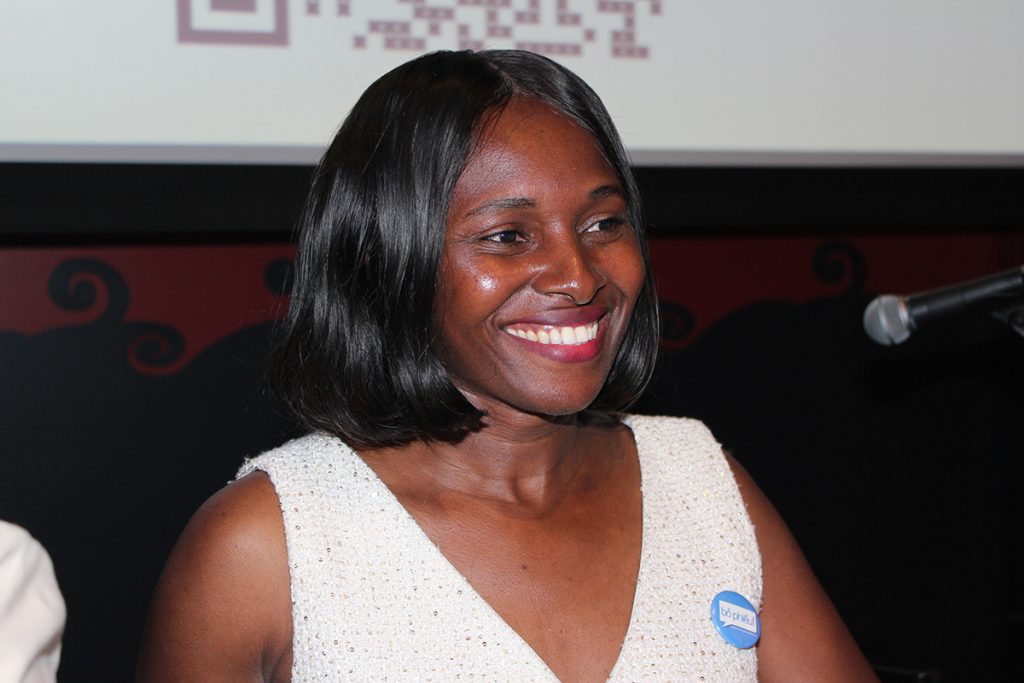
Miriam Mboya, program coordinator with King County’s public health department (Photo by James Tabafunda)
Mboya, who said she has worked for King County for seven years, told attendees she emigrated from Kenya as a child, grew up in Skyway, and has lived in Capitol Hill for more than a decade. “As an immigrant, I know how important it is for us to feel that the government that is part of our system really does consider us,” she said.
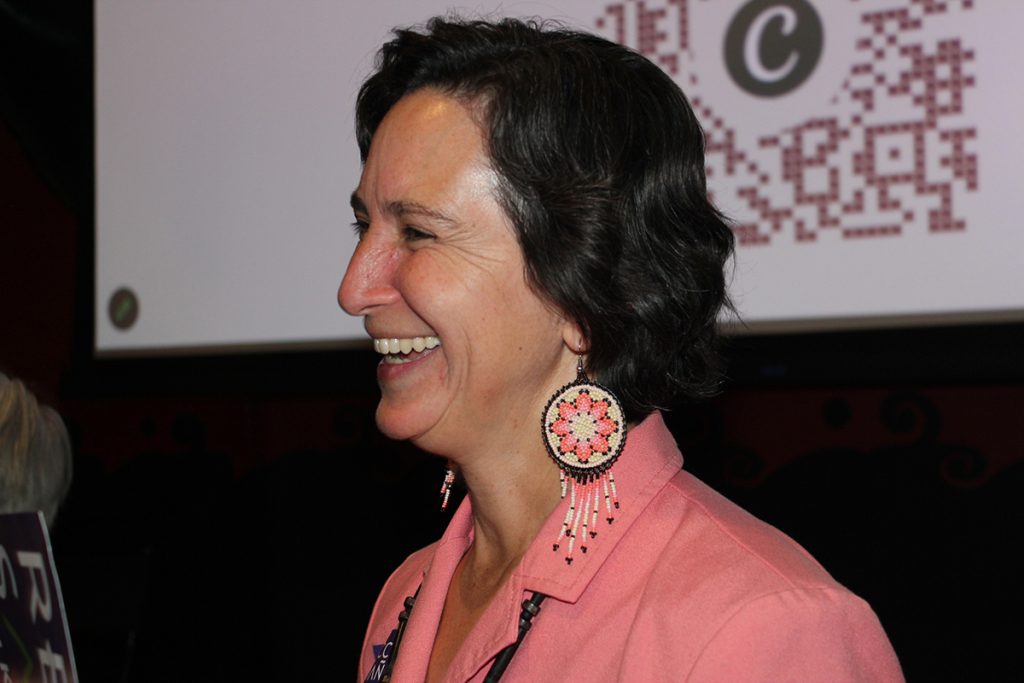
State Sen. Rebecca Saldaña, D-Seattle (Photo by James Tabafunda)
Saldaña, a state senator representing the 37th Legislative District since 2016, said she was running “to build housing affordable at all levels” and to strengthen wages, transit, and “our infrastructure of care from child care to elder care.” She cited her background as a community organizer and legislator, including her sponsorship of the Keep Washington Working Act.
Immigration enforcement dominates opening questions
Royale’s first question asked candidates what role King County should play in protecting immigrants from escalated Immigration and Customs Enforcement (ICE) activity. Mboya said she had “to carry my passport around as an immigrant” earlier this year in case she was stopped, and said she would use the 10th Amendment “to the maximum capacity to protect the immigrant community in the King County region.”
Saldaña pointed to the Keep Washington Working Act, which she said the Legislature passed during President Trump’s first term, and said the county must ensure “not a single penny is being used to aid or support ICE.” She said legal defense funding for immigrants grew from an initial $1 million to $25 million during her tenure in Olympia. Her campaign website similarly emphasizes accountability for enforcement agencies and worker protections.
Hasegawa said “local government is our first line of defense” against what she called “a rogue agency that is committing crimes on camera in daylight.” She said she supports giving the county’s Office of Law Enforcement Oversight (OLEO) subpoena power to ensure compliance with the Keep Washington Working Act. Her campaign website calls for OLEO to have “full subpoena power” to audit the sheriff’s office for ICE-related noncompliance.
Candidates split on public safety approaches
Asked about rising gun violence, Saldaña said she would prioritize community-based crime prevention, behavioral health investment, and victim resources, citing programs in Rainier Beach such as Community Passageways. Hasegawa, who holds a master’s degree in criminal justice, said gun violence is “the leading cause of death of young people in district 2” and cited the anniversary of the killing of Donnie Chin. She called for continued investment in the King County Regional Office of Gun Violence Intervention and expanded participatory budgeting in Skyway.
Mboya said she wants to reallocate part of the King County Sheriff’s Office’s annual budget toward after-school programs and internships, pointing to Baltimore’s community-based patrol model under Mayor Brandon Scott as an example she hopes to adapt locally. Her campaign platform similarly calls public safety a matter of “prevention, support, and accountability.”
Housing, transit, and neighborhood displacement
On homelessness, Hasegawa said, “Rent and mortgage is choking everyone,” and described her platform’s anti-displacement strategy, including legal counsel access for renters and a potential property tax exemption for legacy homeowners facing new levies. Her website details a proposed “Stay Housed Guarantee,” combining eviction prevention, rental assistance, and mediation services.
Mboya said the county should fund community-rooted nonprofits capable of delivering “culturally competent solutions” rather than relying on “theoretical solutions” from the government. Saldaña said the county must defend “Housing First” models and support frontline workers responding to the homelessness crisis.
On Sound Transit’s planned Chinatown-International District station, Saldaña said “Fifth Avenue is not an option” and called for partnerships with small businesses to mitigate construction impacts. Hasegawa cited the displacement of businesses, such as South China restaurant during Beacon Hill’s light rail construction, and called for dedicated mitigation funds and a “right to return” policy for displaced residents and businesses. Mboya said community members should have the power to block transit projects that would cause disruption, arguing “the government serves at our pleasure.”
Little Saigon and small businesses
On a question about supporting Little Saigon, Saldaña recalled her work with Puget Sound Sage and Friends of Little Saigon to secure capital funding for what became an anchor development in the neighborhood. Hasegawa criticized what she called a “lack of leadership” from the county on Little Saigon and pointed to Seattle’s hiring of former Little Saigon Executive Director Quynh Pham as director of its Department of Neighborhoods as a positive step. Mboya said she would push to redirect funding from the county’s Department of Community and Human Services, noting the agency receives about 17% of the county budget.
On small businesses, Hasegawa cited her past work as executive director of the Washington State Commission on Asian Pacific American Affairs helping lead the pandemic-era Small Business Resiliency Network. Mboya proposed increasing county security repair grants for businesses from $5,000 and expanding tax credits. Saldaña pointed to her sponsorship of paid family and medical leave and the Community Reinvestment Act, which she said helped fund the Small Business Resilience Fund.
Jail deaths and budget shortfall also raised
Candidates were also asked about county jail conditions after 11 people died in King County correctional facilities in 2025, including a 26-year-old man who died in custody earlier this summer. Hasegawa called for independent investigations modeled on Initiative 940 standards. Saldaña, who co-chaired the state’s Joint Legislative Task Force on Jail Standards, said the county has fallen short on oversight recommendations. Mboya described jail conditions as “horrible” and called for facility upgrades and expanded record expungement.
On a $150 million general fund shortfall facing the county, Hasegawa named “accountability first,” housing, and child care as her top budget priorities. Saldaña said she would push to defeat ballot initiatives she said would undercut a wealth tax and would protect anti-displacement and behavioral health funding. Mboya cited homelessness, affordability, and behavioral health as her priorities.
Closing question turns to accountability
In their closing remarks, all three candidates addressed how they would remain accountable to constituents. Saldaña described her approach to “co-governance,” saying her legislative priorities “are a reflection of the communities that they serve.”
Hasegawa proposed formal community listening sessions and participatory budgeting mechanisms modeled on practices she said she implemented at the Port of Seattle.
“I don’t intend to be a dictator that sits down and dictates what should happen,” Mboya said.