



By James Tabafunda
NORTHWEST ASIAN WEEKLY
The bánh mi sandwiches arrived crisp and warm, their French-style baguette crusts shattering slightly at first bite. Tucked inside were layers of pickled daikon and carrot, cool cucumber, and a filling that tasted like spicy lemongrass chicken—except there was no chicken.
It was June 30, and journalists from different countries were milling through Seattle’s International Media Center during FIFA World Cup 2026. They arrived to cover the greatest soccer tournament on earth—six matches at Seattle Stadium (Lumen Field). What they hadn’t expected was to be served Vietnamese vegan and non-vegan food made by a woman from Seattle’s Little Saigon who has shaped tofu since she was 6 years old.
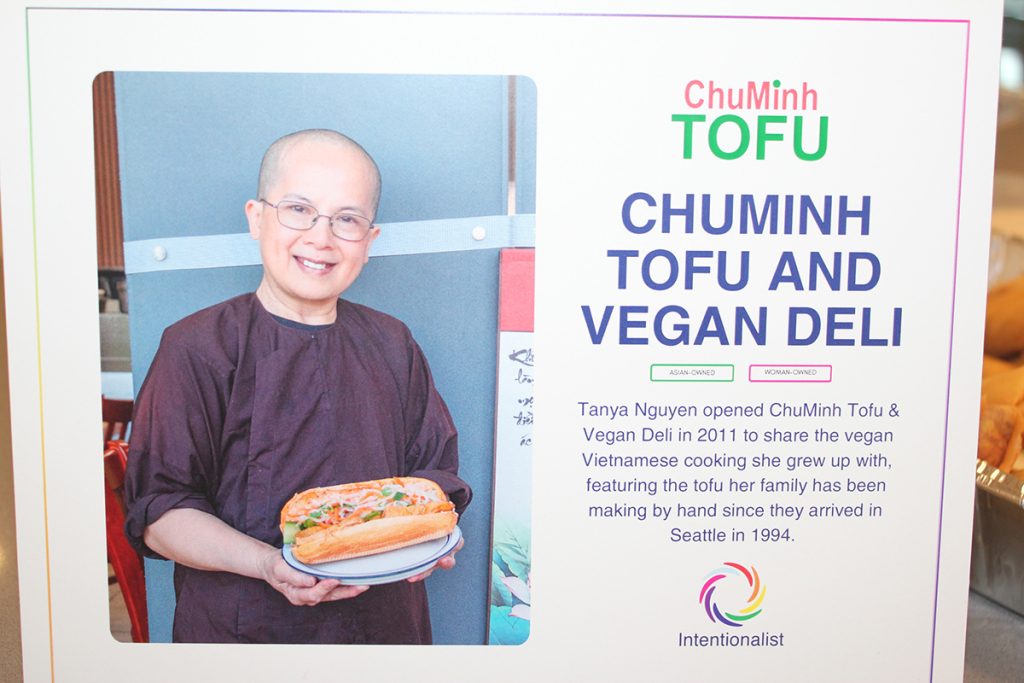
Tanya Nguyen’s chef profile card was located at the beginning of the buffet line (Photo by James Tabafunda)
Thanh-Nga Nguyen—everyone calls her Tanya—set out her Vietnamese food that day with the matter-of-fact efficiency of someone who has fed large numbers of people throughout her life. There were the spicy lemongrass “chicken” bánh mi, their protein made from seitan, the wheat-gluten staple of vegan cooking. There was the barbecue pork bánh mi, just as plant-based, seasoned to that sticky-sweet flavor that makes a person reach for a second one. There were Vietnamese vegan eggrolls or chả giò—crisp and fried, served with sweet and sour chili sauce. The classic bánh mi and grilled pork bánh mi were also available and contained real meat. Reporters who had worked locally or circled the globe to cover the world’s most-watched sporting event found themselves getting in line, buffet style.
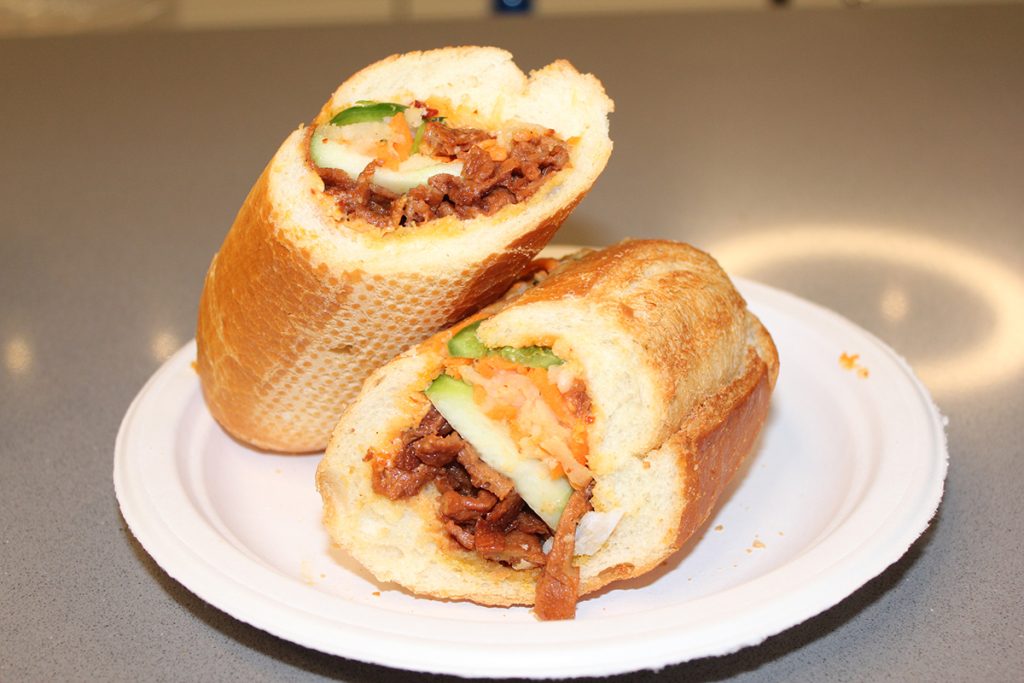
Barbecue pork bánh mi, a Vietnamese vegan sandwich (Photo by James Tabafunda)
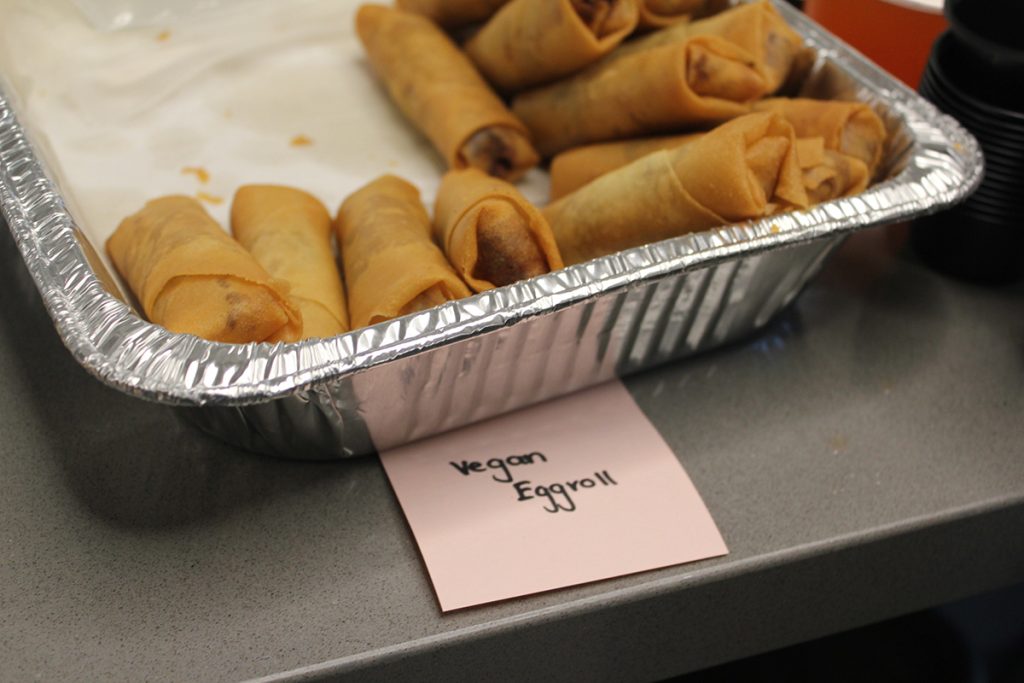
Eggrolls, Vietnamese vegan spring rolls (Photo by James Tabafunda)
“I feel so grateful that you gave us this opportunity,” Nguyen said. “Our purpose is to show the world how rich and beautiful and tasty Vietnamese plant-based food is. I feel very honored that our food went into this place and served everyone.”
A family business born in wartime Vietnam
The story of that food stretches back nearly six decades and half a world away. Her parents started their tofu business in 1968 in Vietnam. It was family work, which in those years meant everyone worked—including her. Her father was in the military, her family made tofu at home, and the children helped because that was simply how it was done.
“At the age of 6, I don’t think I had any interest,” Nguyen said, with a laugh. “Because I think tofu—it’s a family business. At that time, everyone gave a hand.”
But somewhere between those early mornings and the smell of soybeans and the particular satisfaction of watching curds set into form, something shifted. She grew into it. The work shaped her in a similar way as she shaped the tofu.
“The more you do tofu, the more you make tofu—the love that you have, it grows and grows,” she said. “Every time, when you finish a batch of tofu, you see it’s so beautiful. So much love you put in there. So much energy and effort. I think that’s beautiful.”
From biochemistry lab to tofu factory
When her family immigrated to the United States in 1994, they brought the tofu business with them. Her parents continued making tofu—by the late 1990s, they had established a production operation on Martin Luther King Jr. Way South—and she helped while pursuing her own career ambitions.
She enrolled at the University of Washington and later graduated in 2002 with a degree in biochemistry. She worked in the field for four years. And then, in 2006, she stepped away from lab work and returned to her family’s tofu factory—not because she had to, but because she chose to.
There is something striking about that decision. She had the credentials and experience to go elsewhere. She understood, at a molecular level, what tofu is and does—how protein, water, and coagulation interact in ways that most cooks never think about. She brought that knowledge back to an ancient craft. In 2011, she and Pablo Cordoba, who would become her husband and business partner, opened ChuMinh Tofu and Vegan Deli at the corner of 12th Avenue South and South Jackson Street in the heart of the city’s Little Saigon.
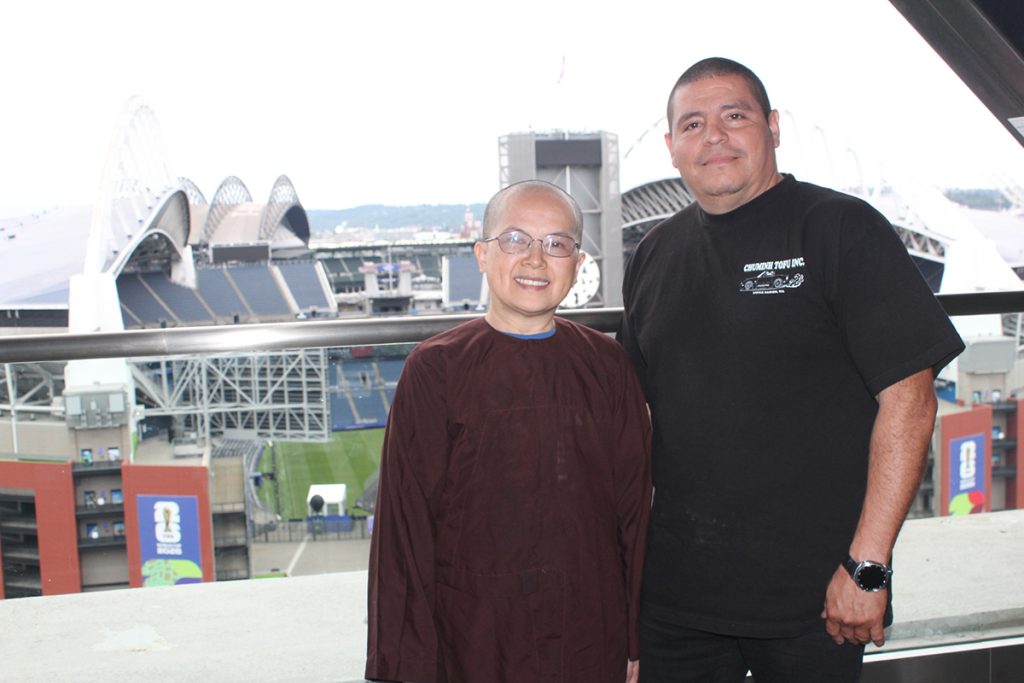
Tanya Nguyen (left), owner of ChuMinh Tofu and Vegas Deli, and Pablo Cordoba, with her husband and business partner (Photo by James Tabafunda)
The deli is now a fixture of the Chinatown-International District—an Asian-owned, woman-owned small business that has quietly fed the neighborhood for more than a decade.
What tofu is
Ask Nguyen about her food philosophy and she will not lecture. Instead, she will describe tofu the way a poet might.
“Tofu is like a universal absorber,” she explained. “It can get along with everyone, very friendly. It can go with anything, anyone.”
She is vegan herself—for the environment, for health, for the love of animals, she says—but she is not overbearing about it. She does not want her customers to feel pressure.
“Sometimes, for your health, some people really want to, but they cannot,” she said. “So I encourage them not to go completely [vegan] if they cannot. Don’t force yourself. You can alternate—less meat and more veggie.”
“Eventually, slowly, your body will adapt to it.”
The deli’s menu now spans more than 10 sandwich flavors, among them spicy tofu, roasted “pork,” barbecued “duck,” Mongolian “beef,” meatball, tofu ham, pork-skin style, egg, and a new ginger “chicken” that Nguyen admits she personally loves. Everything is made with non-GMO soybeans and, when oil is needed, organic soybean oil. Even the sugar, when the recipe calls for it, is non-GMO cane sugar. “We have to be very careful with the ingredients we pick,” she said. “It needs to be healthy and clean.”
The factory on Martin Luther King Jr. Way South—transformed into a walk-up café in 2024—is where the soybeans are ground by hand before a small machine finishes the process. It is a slower method than industrial production would allow, but that difference is the point. The tofu produced there now appears on the shelves of PCC Natural Markets, among other Seattle establishments.
Pablo: The one who makes everything happen
Pablo Cordoba came into Nguyen’s life in 2009, knowing nothing about tofu. He would be the first to say so.
“I loved this work,” he said. “Always when I worked, I never got tired. When I start to make the tofu, I put my heart in (it) and in my job.
The couple have worked together for about 17 years. Cordoba grew up in Mexico. They met at the tofu factory, and together they built what ChuMinh is today. He manages production, logistics, and the mechanics of keeping the business running—the things that have to happen before a single bánh mi can be made or a single eggroll can be fried.
Nguyen spoke about her husband with visible warmth. “When we talk about tofu, I can see the excitement in his face. I can see right away that he loves to make tofu,” she said. “I’m so grateful that I found someone who puts so much love … and energy in there.”
She paused. “Pablo is the one who makes everything happen. I’m so grateful that I have Pablo in my life.”
A global moment for a neighborhood kitchen
The International Media Center became, for those weeks in June and July, one of the more genuinely international rooms in the Pacific Northwest.
Into the center’s cafeteria area, they carried food they had been preparing for days. The seitan-based “meats”—the lemongrass chicken, the barbecue pork—are not quick work. The wheat gluten must be bought, a dough made, the dough sliced and fried, the pieces cut into strips, seasoned carefully, then incorporated into the final Vietnamese dishes. The eggrolls require their own unique assembly: tofu and various vegetables folded into wrappers and fried until the correct crispness is achieved.
Nguyen did not need to explain veganism or Vietnamese food or the history of seitan. She just let the food’s flavors speak to all who try it.
“Our purpose is to show the world and everyone how rich and beautiful and tasty Vietnamese plant-based food is,” she said. “I think this is our opportunity to show everyone that.”
One more thing to know
Since 2018, every Sunday—without exception—they have prepared food and served it for free to those in need. The program began simply: people would come into the deli asking for food, and she would give it to them when she could. What started as roughly 40 meals each Sunday has grown to an average of 250.
“We never miss any Sunday,” Nguyen said. “Even when the weather is bad or snowy or anything.”
For more information on ChuMinh Tofu and Vegan Deli, go to chuminhtofu.com.