



By James Tabafunda
NORTHWEST ASIAN WEEKLY
The streets of Seattle were still packed with soccer fans three hours after the final whistle, local bars were filled with revelers, and at least one local CEO had a word for the global extravaganza: hope.
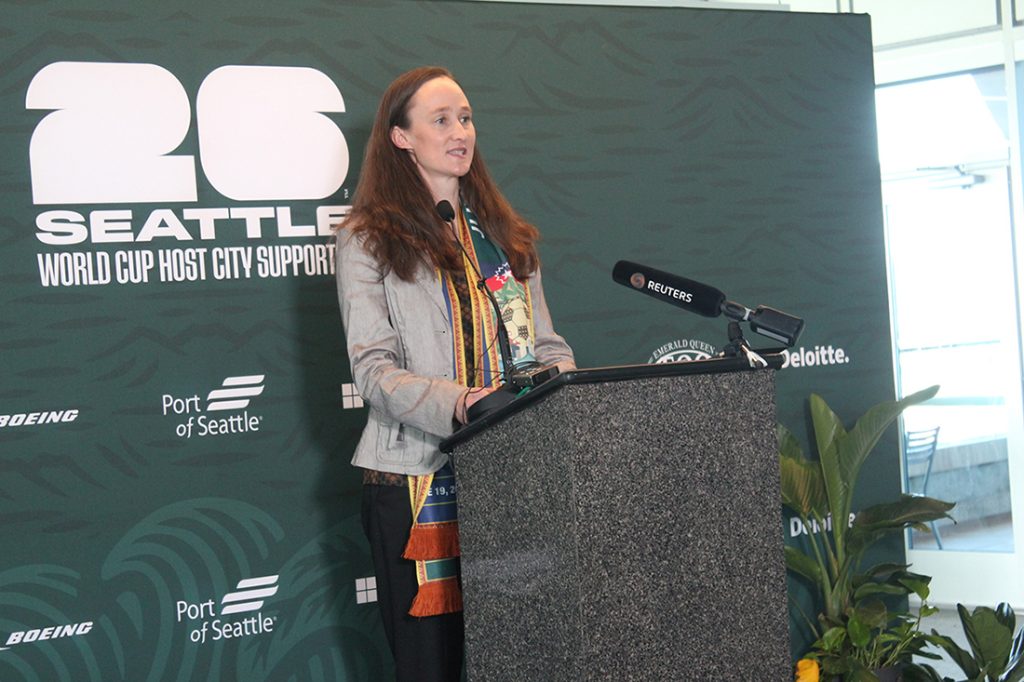
That was the scene Peter Tomozawa, chief executive officer of the Seattle FIFA World Cup 2026™ Local Organizing Committee (SeattleFWC26), described at the June 17 media conference held at the Seattle International Media Center—fresh off the city’s first-ever World Cup match and two days out from a second one carrying the full weight of American history.

Peter Tomozawa, chief executive officer of the Seattle FIFA World Cup 2026™ Local Organizing Committee (Photo by James Tabafunda)
Seattle Stadium (Lumen Field) hosted Belgium and Egypt in a Group G opener on June 15 that ended in a 1-1 tie. He said the event exceeded every projection.
SeattleFWC26 convened the media conference to unveil sweeping plans to honor and highlight Juneteenth ahead of the USA vs. Australia FIFA World Cup™ Group Stage match at noon, June 19—the national holiday that commemorates the end of slavery in the United States.
‘The star of the World Cup is Seattle’
Tomozawa drew a clear connection to another international event as he assessed what Seattle pulled off last Sunday.
“When I came back from the Paris Olympics, the star of the Paris Olympics was the city of Paris,” he said. “The star of the World Cup is the city of Seattle—and the state of Washington. It shined. It sparkled. It was welcoming.”
He said the energy did not end when the soccer match did. Three hours after the final whistle against Belgium and Egypt, watch parties were in full swing, he said.
The moment that stayed with him came from a conversation with an unnamed chief executive of a major Seattle company. Tomozawa told the CEO the scene was “a time of joy and unity” and added “He said, ‘Actually, I think this is a time of hope—shows us what this community can look like when we’re united.’”
“I said, ‘That’s the best comment I’ve heard about this tournament.’”
A responsibility, not a scheduling coincidence
For Tomozawa and SeattleFWC26, the USA vs. Australia match on June 19 is something more than a Group D soccer game. When the organization first learned the U.S. Men’s National Team (USMNT) would play in Seattle on Juneteenth, the response was immediate.
“From the moment we were bidding to be a host city over eight years ago, inclusion was a cornerstone of how we presented our region,” Tomozawa said. “We were honored to host a Juneteenth match, and we knew immediately we had a responsibility to maximize the moment and create a lasting legacy. When we learned the USMNT was coming here, that commitment only deepened.”
“We created the Juneteenth Matchday Advisory Committee (JMAC) to make sure our hosting of the World Cup authentically reflects our community,” he said about the group formed almost two years ago. “The partnerships and programming on display this week reflect Washington at its best—forward thinking, collaborative, and intentional about making sure the world understands why Juneteenth is a national holiday and celebrates the emancipation of Black Americans, and the universal hope for freedom.”
Seattle’s mayor: ‘The world will see Seattle as it really is’
Mayor Katie Wilson, the city’s 58th mayor, said the World Cup has already proven itself.
Katie Wilson, mayor of Seattle (Photo by James Tabafunda)
“The atmosphere around here was incredible, and there is plenty more to come,” she said, noting that Seattle’s schools are letting out for the summer and larger crowds are expected in the days ahead.
Wilson said the Juneteenth match represents what she values most about the city’s efforts regarding the tournament.
“One of the things I’ve appreciated most about our approach to the World Cup is that we looked for ways to connect this tournament to Seattle itself,” she said. “This week’s Juneteenth match is a great example of that.”
She said Seattle’s Black community has “helped to shape every chapter of our city’s story, from the Central District and beyond,” and called the match an opportunity to show the world a city that is “proud of its history, proud of its diversity, and committed to making sure that events like the World Cup reflect the communities that call Seattle home.”
“Seattle has always been a city that shows up for its communities, and this Juneteenth will be no exception,” Wilson said “We’re proud that the world will see Seattle not just as a host city for the World Cup, but as a city that recognizes the significance of hosting the U.S. national team on Juneteenth and the contributions of our Black community to the culture and character of our region.”
Beyond the pitch: A nod to the Chinatown-International District (CID)
Tomozawa also mentioned Seattle’s Asian American community toward a record attempt time to the World Cup. On June 18, the CID will host an official Guinness World Records attempt for the world’s largest dim sum meal, part of the CID Block Party and JamFest at 719 South King Street. The current record—764 participants—is held by Australia. Seattle is planning for 900 or more.

Peter Tomozawa, chief executive officer of the Seattle FIFA World Cup 2026™ Local Organizing Committee (Photo by James Tabafunda)
“You gotta win some to dim sum,” he said with a laugh. “It’s an amazing opportunity to showcase our Asian community. We support it. We’re going to try to get people out there.”
He framed the attempt as a sign of the tournament’s broader purpose.
“This goes so far beyond watching a match,” he said. “We’re really excited about how we bring this all to life.”
An invitation answered
Marcus Harrison Green, JMAC co-chair, said the committee’s mandate went beyond symbolism.
“When we learned the USMNT would play here on Juneteenth, it felt less like a scheduling coincidence and more like an invitation,” he said. “Our committee’s job was to make sure Seattle answered that invitation the right way, using the moment to give the world a history lesson, inspiring the next generation of Black athletes, and uplifting programming that’s built by and for our Black community, not just programming about it. What you’re seeing this week is the result of that work.”
Green was joined by other speakers at the media conference, including King County Executive Girmay Zahilay, Seattle City Attorney Erika Evans, former USMNT Player Tony Sanneh, Black Players for Change Executive Director Allen Hopkins Jr., State Rep. Jamila Taylor, and Northwest African American Museum President and Chief Executive Officer Brandon Bird.
Match day blueprint: Pier 58 to Pioneer Square
SeattleFWC26 Senior Vice President of Communications Hana Tadesse outlined the full schedule of Juneteenth match-day events at the media conference.
Friday’s programming begins at 8 a.m. at Pier 58, the city’s designated hub for the day. At 8:30 a.m., Men in Blazers Match Day Live! takes the stage, with hosts Roger Bennett and Rory Smith joined by Seattle Seahawks legend Marshawn Lynch, author John Green, Seattle Sounders FC legend DeAndre Yedlin, and Seattle Mariners Hall of Famer Ken Griffey, Jr. Local Black artists, creators, and performers will provide music and entertainment throughout the morning.
At 10:15 a.m., the USA March to the Match steps off from Waterfront Park at Pier 58 for the noon kickoff. Australian fans are directed to Victory Hall. In the Central District, Midtown Plaza at 23rd Avenue and East Union Street will host its own watch party.
On June 20, National Basketball Association legend Shaquille O’Neal—performing as DJ Diesel—will headline a block party in Pioneer Square’s Bryant Park.
For more information on the Seattle FIFA World Cup 2026™ Local Organizing Committee, schedules, transportation, and match-day information, go to www.seattlefwc26.org.