



By James Tabafunda
NORTHWEST ASIAN WEEKLY
It may not be on the same level as a U.S. win over Australia’s national men’s soccer team—created in 1922. But Seattle’s Chinatown-International District (CID) broke a Guinness World Record on June 18 when 830 people simultaneously ate dim sum on a closed stretch of South King Street, beating a mark of 764 set in Sydney, Australia, in 2019.
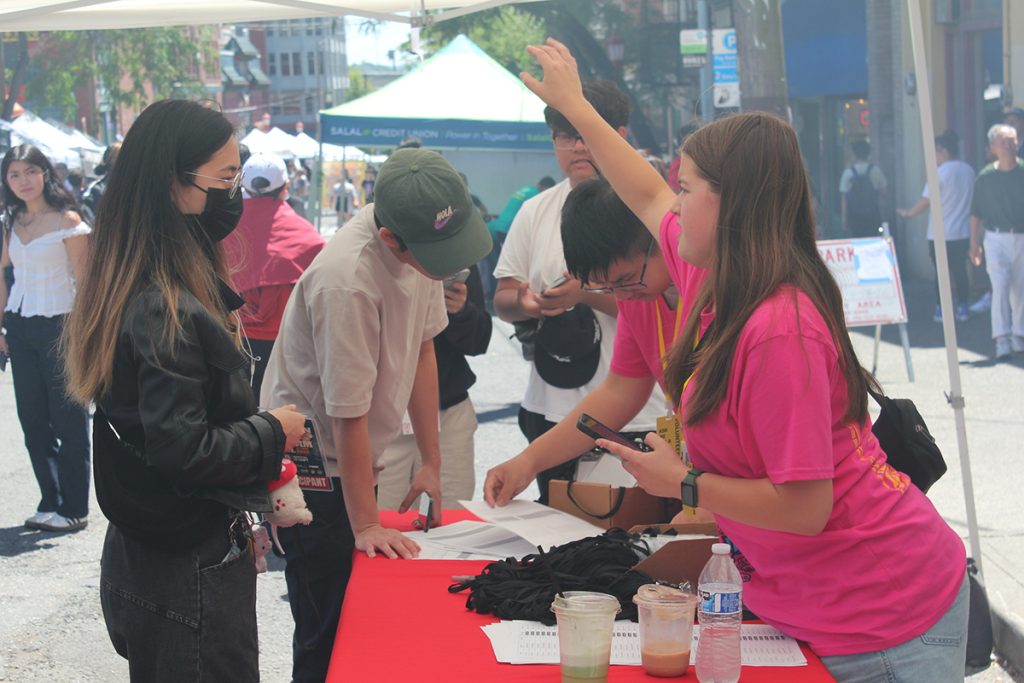
Guinness World Records participants checking-in (Photo by James Tabafunda)
The record became official at 3:32 p.m. by Michael Empric, a New York City-based Guinness World Records adjudicator, who announced the final count from the main stage to a roaring crowd that had endured the punishing heat.
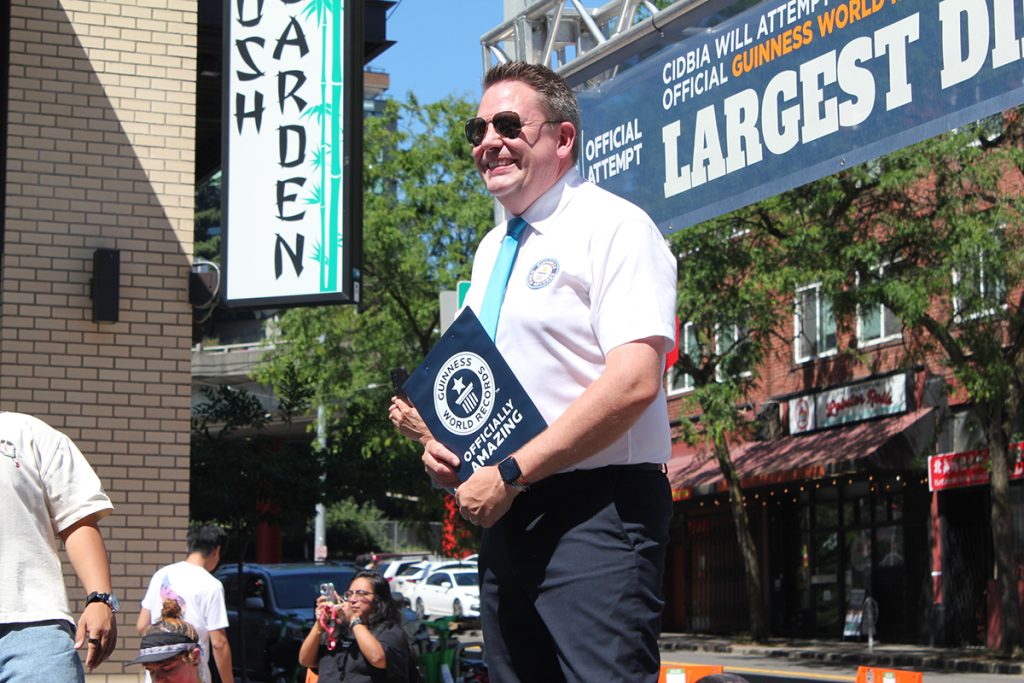
Michael Empric, Guinness World Records adjudicator (Photo by James Tabafunda)
“In Seattle, Washington, USA, you had a total of 830 people,” he said, acknowledging that some participants had been deducted from the preliminary count for leaving the tables or not consuming their dim sum.
The record attempt was the featured event of the CID Summer Kickoff, a free, community-wide celebration organized by the Chinatown-International District Business Improvement Area (CIDBIA) and timed to the opening week of FIFA World Cup matches in Seattle. The gathering took place one day before the highly anticipated Group D match between the United States and Australia—the nation that had held the dim sum record—set for June 19 at Seattle Stadium (Lumen Field).
‘We can’t have that’
The previous record of 764 participants was achieved on Feb. 5, 2019, at Tumbalong Park in Sydney’s Darling Harbour, during that city’s Lunar New Year festival. At the time, it beat a 2013 mark of 750 participants set in Melbourne.
When Tuyen Than, executive director of CIDBIA, learned that Australia held both that dim sum record and a World Cup match against the United States in Seattle, the decision about what to do became, in her words, obvious.

From left: Tuyen Than, CIDBIA executive director, and Michael Empric, Guinness World Records adjudicator (Photo by James Tabafunda)
“It just so happened that Australia was the current record holder for the largest dim sum meal,” she said. “And we just—we can’t have that.”
Than, who took the lead position at CIDBIA in May 2025, said planning for the record attempt began in 2025 following the FIFA Club World Cup, when her organization began looking for a signature event that would encourage foot traffic to the neighborhood while showcasing its identity.
“We were just trying to figure out something that we can do in the city that could bring people to the neighborhood that is representative of how unique this neighborhood is,” she said. “The city has over 300 businesses, and over 50% of them are restaurants and retail. It just made sense to have something at this large scale around dim sum, because it’s about family. It’s family style.”
Red tables, blue sky, and a countdown
Tables draped in red coverings were arranged in a single row stretching two city blocks along South King Street, from Maynard Avenue South on the west end to 8th Avenue South on the east, bisected at 7th Avenue South. Seattle Police Department officers and orange road barriers secured the route.
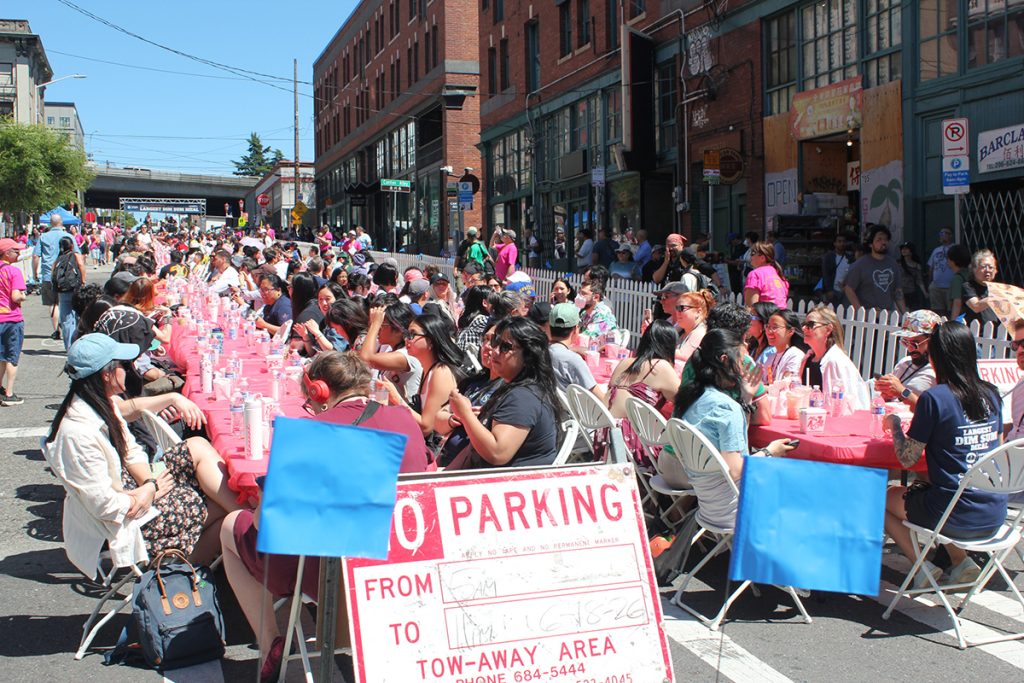
Participants gather at tables spanning two city blocks along South King Street in Seattle’s Chinatown-International District. (Photo by James Tabafunda)
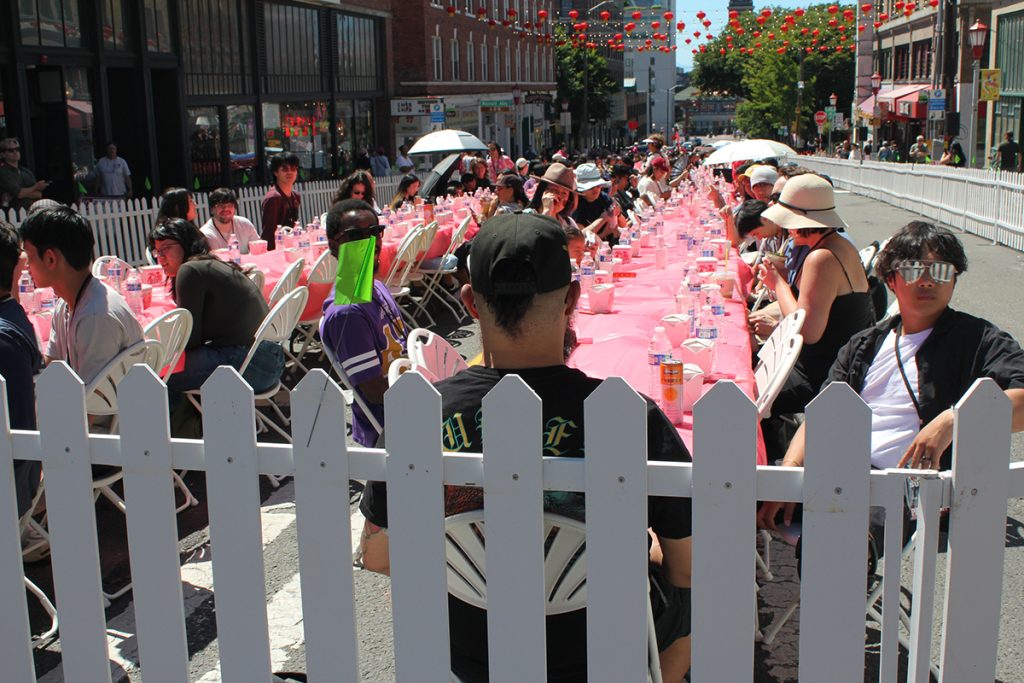
Photo by James Tabafunda
Check-in opened at 2 p.m.—some participants waiting in line at 1:30 p.m. At 3 p.m., participants received final instructions and were seated. Dim sum, provided exclusively by Jade Garden Restaurant—a Cantonese eatery located at 424 7th Avenue South, steps from the site of the Guinness World Records attempt.
Under Guinness World Records rules for mass participation events, every counted participant was required to receive at least four pieces of dim sum and consume all four. “As long as everyone consumed those pieces fully, they would count towards the record,” Empric said.
All participants are simultaneously beginning at 3:05 p.m., with the eating phase concluding at 3:19 p.m. Trained stewards stationed along the tables verified compliance. Empric then reviewed steward statements before taking the main stage to announce the results.
All of the 830 participants sat in direct sunlight, with temperatures reaching 77 degrees and no wind at the peak of the afternoon. Than acknowledged the conditions had been a significant logistical concern.
“Eating dim sum is easy,” she said. “Having 900 people eat dim sum at the same time while seated—yeah, with 80-degree weather at the hottest time during the day—that’s hard. People were sweating.”
Months of preparation, a city’s cooperation
The logistics behind the record attempt required coordination with the city, King County Public Health, and Guinness World Records itself, which required pre-approval of the gathering’s menu, marketing materials, health and safety measures, signage, and paid advertising. CIDBIA rented tables, chairs, and barricades and recruited volunteers to serve as stewards, counters, and check-in staff.
Sourcing the dim sum from multiple CID restaurants—Than’s original plan—was eventually abandoned in favor of a single supplier to meet King County Public Health requirements and Guinness’ demand for a pre-approved menu.
“We needed to have a preset menu,” Than said “Everyone has shumai, but not everybody has the same kind of menu. And so we were trying to find two vegetarian options. We just had to simplify it, go for that win. And we went with Jade Garden because they were right in the footprint, right in the heart of the city.”
The event was free and open to the public, funded through a coalition of sponsors that included The Asian American Foundation, Uwajimaya, Sound Transit, the Seattle Department of Neighborhoods, the Seattle Office of Arts & Culture, Seattle FIFA World Cup 2026™ Local Organizing Committee, and Marpac Construction.
A proclamation and a record
Moments after Empric certified the record, Quynh Pham, director of the Seattle Department of Neighborhoods, stepped to the microphone to deliver a city proclamation.
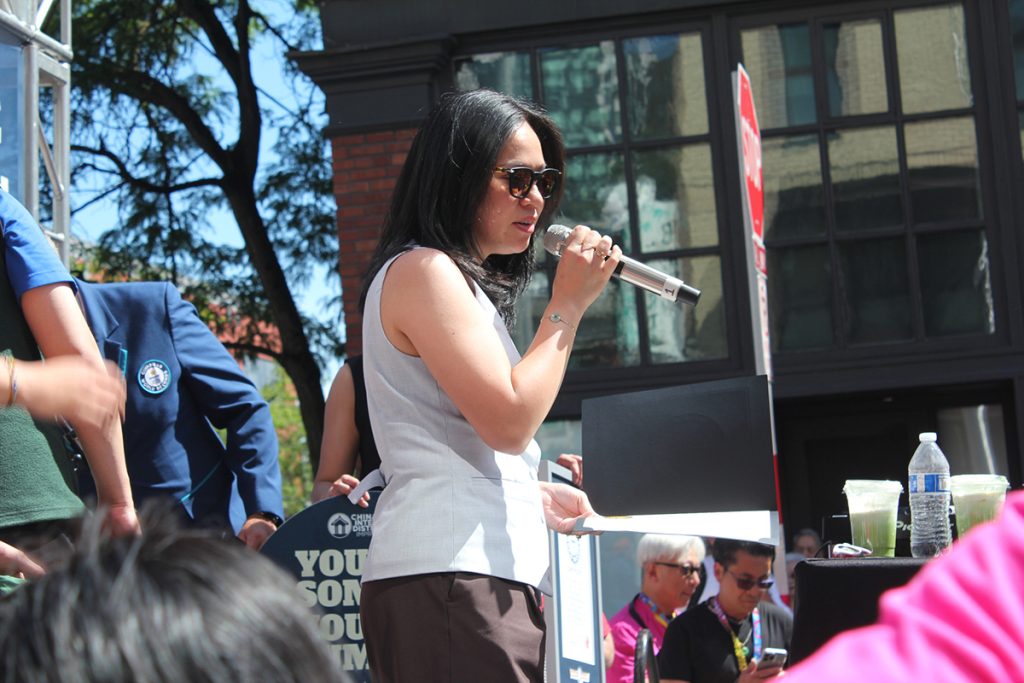
Quynh Pham, director of the Seattle Department of Neighborhoods, reads a City of Seattle proclamation declaring June 18, 2026 as “Dim Sum Day” (Photo by James Tabafundad)
“On behalf of Mayor Katie B. Wilson of Seattle,” she read, “I do hereby proclaim June 18th, 2026 to be Dim Sum Day.”
The proclamation recognized the CID as Seattle’s oldest neighborhood, home to Chinese, Japanese, Filipino, Vietnamese, and other Southeast Asian communities. It also mentioned the record attempt, titled “Win Some Dim Sum,” for generating national and international media coverage and directly supporting local businesses.
The CID Summer Kickoff launched a parallel neighborhood activation called “Kick It in the CID,” a stamp-book program running through July 6 that routes World Cup visitors through 72 participating CID businesses. Kickoff attendees were among the first to receive stamp books at the gathering.
A neighborhood writing a new chapter
The Guinness record arrives at a critical time for the CID. In 2023, the National Trust for Historic Preservation named the neighborhood to its list of America’s 11 Most Endangered Historic Places—the first Washington state community to receive that selection in the program’s 36-year history. The neighborhood had also weathered COVID-19 closures, a surge in anti-Asian hate crimes, and a prolonged public debate over Sound Transit light rail construction.
For Than, breaking a Guinness World Record in that context carries a meaning that extends beyond the event itself.
“For the last couple of years, the narrative around Chinatown has been the most endangered neighborhood in the country,” she said. “My hope from doing this is not just to beat a world record, but to show people that there’s more to this neighborhood than being endangered. We are a vibrant community and we’re determined. And we’re winners.”
She added: “I always knew what was special about the city. And now it’s official and it’s on paper. And now the world can see how amazing this neighborhood is.”
Empric, who has adjudicated mass-participation records for more than 15 years and has officiated events across the United States, Latin America, and Canada, noted that despite several participants being disqualified for not completing their dim sum, the final count easily surpassed the mark. “I’ve gone through the steward statements. I’ve reviewed the count at the door,” he said.
Each of the 830 record holders is eligible to buy an official Guinness World Records Certificate of Participation as well as a participation T-shirt. Than said the memories forged on South King Street on a sweltering afternoon are the more lasting souvenir.
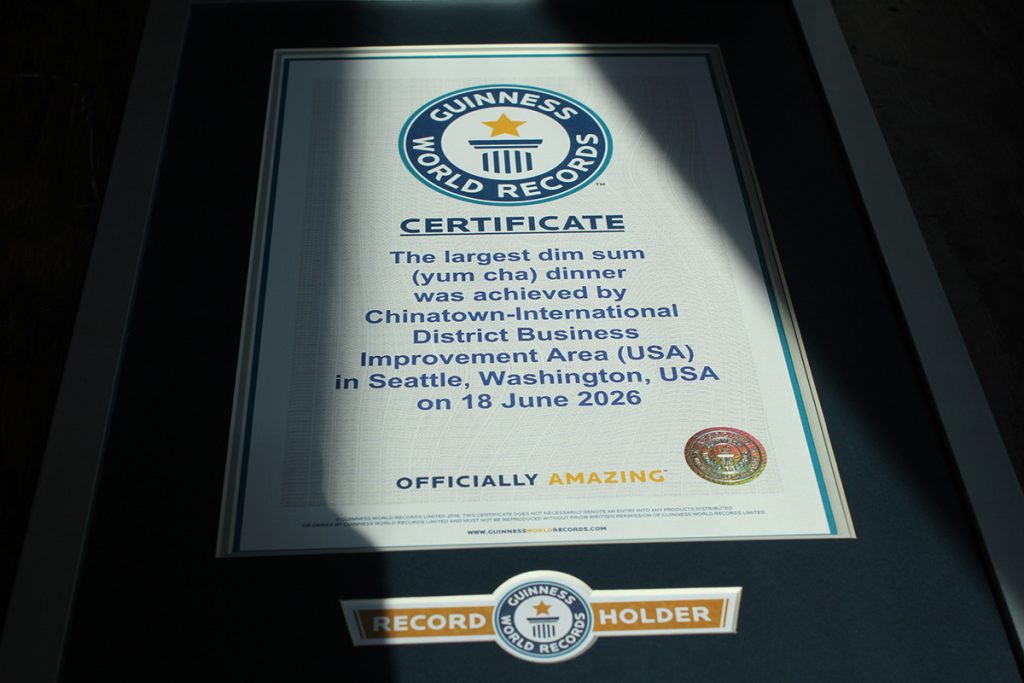
Guinness World Records certificate given to Tuyen Than, CIDBIA executive director (Photo by James Tabafunda)
“You can’t make it up,” she said. “You just cannot recreate this moment—the heat, the time, the dim sum, the stress, the sleepless nights. People are going to remember this moment year after year, and it’s going to fuel them. They’re going to remember: ‘Hey, remember we did that thing.’ And that is going to be a source of strength. You can do the hard thing.”
For more information on “Kick It in the CID,” go to www.seattlechinatownid.com/experiences/kick-it-in-the-cid.