



By Nina Huang
NORTHWEST ASIAN WEEKLY
On weekday mornings, Chrissy Shimizu starts her day the same way many working parents do: savoring a few quiet moments with her 18-month-old daughter, Kaiya. With the help of grandparents who pitch in with childcare, Shimizu boards the light rail into Seattle’s Chinatown-International District (CID), where she leads one of the city’s most beloved cultural institutions as the new executive director of the Wing Luke Museum.
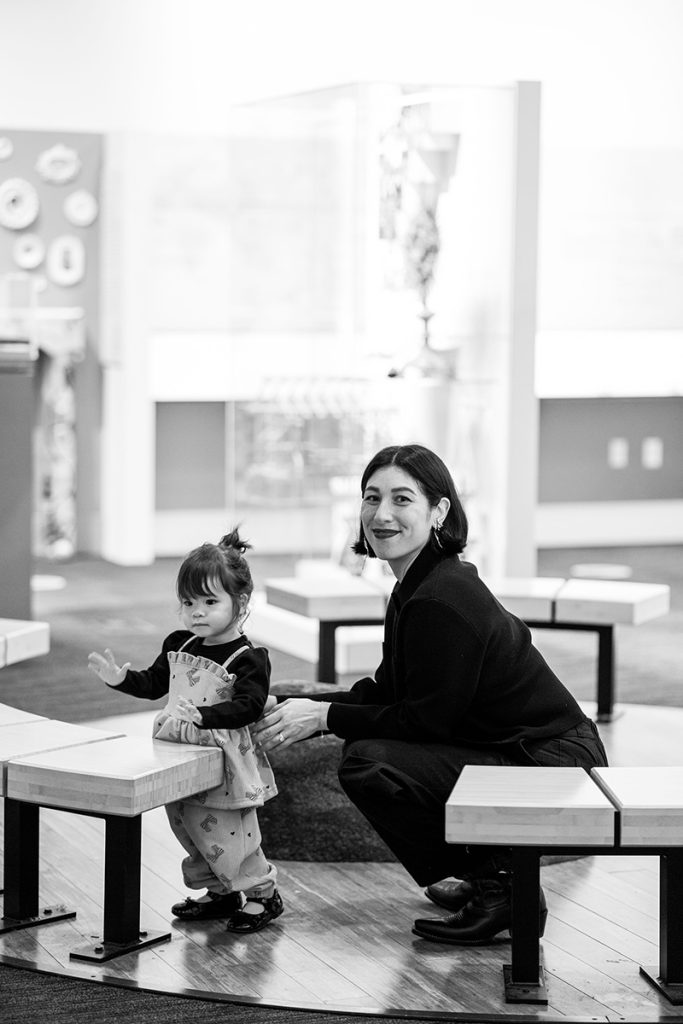
Credit: Truong Nguyen
For Shimizu, motherhood and leadership are deeply intertwined. Both are rooted in the same question that has guided much of her life: How do you create a place where people feel they belong?
As she raises her daughter, she’s also helping shape the future of a museum dedicated to preserving and sharing the stories of Asian American, Native Hawaiian, and Pacific Islander communities.
That search for belonging began long before she ever walked through the museum’s doors as an employee, before the rhythms of work and family pull them in different directions.
Growing up in Edmonds, Shimizu spent weekends in the CID with her large extended Japanese American family. She remembers shopping at Uwajimaya, eating dim sum, celebrating birthdays and Japanese New Year, and crawling underneath tables while her aunties and uncles gathered above her.
“I was the youngest of 16 cousins,” she said. “I remember running into the kitchen, where my grandma or aunt would hand me a bowl of tempura and udon.”
Her father is Japanese American. Her mother, who grew up in Tennessee, embraced her husband’s culture and made sure their daughter stayed connected to both sides of her family.
It wasn’t until elementary school that Shimizu realized her experience wasn’t shared by everyone around her.
She was one of only two Asian students in her Edmonds school and the only biracial child in her class. During a Grandparents Day letter writing assignment, she asked her teacher how to spell “Obachan.”
“She asked, ‘How come you don’t know how to spell it?’” Shimizu recalled.
The moment stayed with her.
In high school, a scholarship took her to Hiroshima, where her family has roots, as part of a cultural exchange bringing together members of the Japanese diaspora. The experience sparked years of international travel and deepened her understanding of immigration, identity, and history.
By the time she turned 30, she had visited more than 30 countries.
Yet the farther she traveled, the more she found herself wanting something closer to home.
“Being able to travel, learn and work abroad, and meet new people really helped me understand myself more. When I came home then, I had been learning from a place of distance; academia can feel separate from understanding who you are and where you’re from. I really craved having roots,” she said.
That search led her into community organizing, public service working in Americorps, Solid Ground, Asian and Pacific Islander Americans for Civic Empowerment, and eventually the Wing Luke Museum, where she first worked from 2017 to 2021 before leaving to become executive director of Puget Sound Sage.
Returning this spring to lead the museum felt less like accepting a new position than becoming the next steward of a community that had long shaped her own understanding of identity and belonging.
“I feel very conscious of the leadership that came before me,” she said. “I’m stepping into this legacy with a lot of care.”
Her understanding of leadership has also evolved through personal healing.
Like many millennials, Shimizu said she struggled with anxiety, burnout, and periods of depression in her 20s. Therapy became a turning point, helping her understand herself more deeply and become a stronger friend, leader, wife, and mother.
Around her 30th birthday, as national conversations about racial justice and systemic inequity unfolded across the country, she also began examining how she carried anger, grief, and identity into her own relationships.
“I realized I was carrying a lot of anger,” she said. “I had to learn how to sit with difficult emotions instead of letting them harden into resentment.”
That process taught her to make space for difficult conversations, extend grace to others, and approach conflict with curiosity instead of judgment.
“I had to learn how to love myself before I could really love other people,” she said.
Those lessons continue to shape her leadership today.
She believes in building consensus whenever possible, being transparent when decisions need to be made, and creating an environment where people feel heard—even when they disagree.
“I feel more grounded than I’ve ever been in my life. My barometer of success isn’t access to power or career milestones,” she said. “It’s the health and wellbeing of my community.”
Shimizu is proudest of the quality of relationships and village that she’s been able to build around her.
Over the next year, Shimizu plans to focus on listening as the museum prepares for several milestones, including the reopening of the Ing Family Home, a refresh of the museum’s signature “Honoring Our Journey” exhibit, and the museum’s 60th anniversary.
But some of her hopes extend much further into the future.
She imagines her daughter growing up around museum staff, volunteers, and elders—becoming one of the many “museum babies” who know the Wing Luke Museum as a second home.
And decades from now, she doesn’t picture herself remembering the exhibits she oversaw or the strategic plans she implemented.
Instead, she hopes to become one of the elders sitting in the museum’s community hall, sharing stories with younger generations before walking across the street to Bush Garden for karaoke.
“I’m so excited to be at the Wing Luke Museum. I’m excited because I get to work in the CID, the neighborhood I love with an intergenerational community of people who love the museum and love the community as much as I do… Being part of that is so clearly in line with what brings wellbeing to my community, happiness to me, and what I want my daughter to grow up around. I’ve designed my life in a way where I am doing what I love,” Shimizu said.
For someone who spent years searching for where she belonged, it feels fitting that her vision of success isn’t about the title she holds today, but about the community she’ll still be part of long after she leaves the executive director’s office.
Nina can be reached at newstips@nwasianweekly.com.