




By Kai Curry
NORTHWEST ASIAN WEEKLY
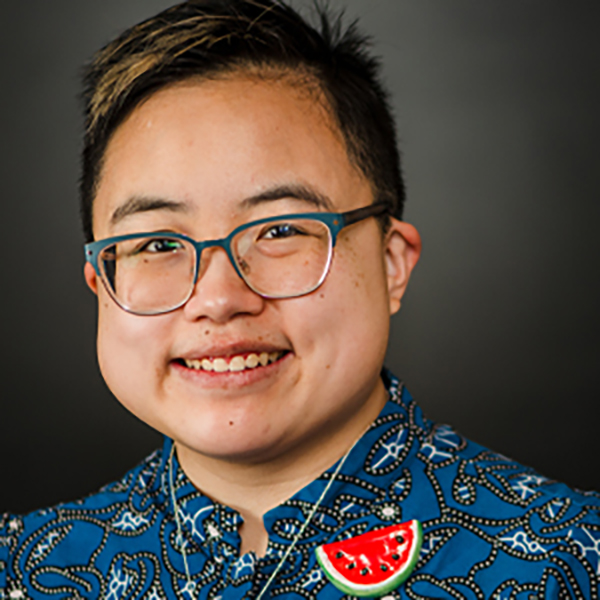
Ly Xīnzhèn M. Zhǎngsūn Brown
Listening to Ly Xīnzhèn M. Zhǎngsūn Brown is like listening to a secular sermon. At their recent Seattle talk, hosted by University of Washington (UW)’s Office of Public Lectures, Brown started with an “invitation and an invocation.” They invited everyone to be comfortable. They assured the audience at Seattle’s Town Hall that evening that in this room, they could be comfortable and safe in a world that tends to feel unsafe for minorities. In their talk on May 21, “What Does Law Mean in Crisis? How Crip Feminist Technoscience Will Save Us,” Brown focused on ableism and how it affects every part of our lives.
In addition to its usually associated religious meaning, “invocation” means “a spoken formula, to seek guidance, assistance, or presence.” Brown sought our presence and our assistance in battling the omnipresence of ableism in all of our lives and especially in the lives of people who are disadvantaged due to race, color, gender, sexual orientation, ability, or other characteristics. As founder of the Autistic People of Color Fund and an Assistant Teaching Professor of Disability Studies at Georgetown University, Brown is deeply familiar and deeply invested in this issue.
“This is an invitation to you,” they said, to get your needs met, and to believe that none of us are “burdensome” or “wrong” for asking that those needs be met. For those attending who did not feel they were currently in a safe space, Brown assured them that it would be the responsibility of the rest of us, of those who felt safe to advocate, to “keep fighting.”
Brown explained that they give this introduction every time they speak, and that the results vary wildly. They recalled a specific audience of teenagers, who readily lay on the floor. “Finally, an adult was telling them, you don’t have to contort your body into one particular mode of posture, of orientation, or of behavior in order to be seen as sufficiently respectful or attentive.”
The listener began to understand that Brown was talking about more than just getting comfortable in one’s seat, but in one’s body as it moves through the world and is seen by others. One’s “orientation” and “behavior” is judged and defined by others daily. “We are all still so often consumed by and constrained by ableist expectations and assumptions,” Brown suggested—and this doesn’t just apply to those outside of us, but also to ourselves. We are all deeply impacted by our ableist society. According to Brown, ableist ideas about what is “normal,” about who deserves to get their needs met and who doesn’t, about who deserves, even, to be alive (yes, it goes that far), infiltrates all of our legal and social structures. Ableism determines everything from how furniture is designed to how laws are made.
So what is ableism? In its narrowest sense, it is prejudice against those who have, or are perceived to have—an important distinction—mental or physical disabilities. Keep in mind that this can include women, when thought of as a “lesser” sex, or people of color, when thought of as not as capable as white people. Ableism, Brown explained, is closely connected to eugenics, the pseudoscientific belief that humanity can be improved through genetic “purity.” At its core, eugenics divides people into the worthy and the unworthy, elevating those considered genetically superior while treating others as less deserving of care, opportunity, and even life itself.
Eugenics is not gone, Brown warned. In fact, it is escalating. Let’s talk about forced sterilization, which is still imposed upon women of color, whom authorities deemed unfit to reproduce. It has happened in prisons in California, and it has happened in ICE detention centers. Let’s talk about AI. More than one tech company is, right now, researching how to diagnose all of us solely by our online interactions. They want to find out, not just our purchasing habits, but are we depressed? Are we anxious? Do we, perhaps, have a disability? The current administration has also funded projects aimed at developing tools for threat assessment to identify people preemptively who might be at risk of carrying out acts of violence. This is all eugenics, said Brown, who seemed to get choked up mentioning the recent stabbing of UW transgender student, Juniper Blessing. That, too, is eugenics. It’s the idea that some do not deserve to live.
“We are living at a time of accelerating eugenics,” they said. “We are living in a time of crisis.”
The title of Brown’s talk reflects their argument that the people most often marginalized by these systems—people of color, women, and people with disabilities—must not only pay attention to the development of technology and law, but also play an active role in shaping them. “Technology,” they explained, is not just a computer—it’s any tool. And “law,” they continued, is also a tool. As a technology, and as a tool, law can be made to harm. It is, in fact, a tool of ableist harm, Brown insisted. It has a trickle-down effect, so in case you think it doesn’t affect you, you are probably wrong, Brown advised. We’re all going to age, for instance, at which point we will have less mobility, less cognitive ability, perhaps, and at which point we will encounter ableism.
“At its core, ableism is a form of oppression, like other kinds of systematic or structural domination, harm, violence, and marginalization,” they said. “Ableism is just as much about power as it is about anything else. Ableism is a system that is about power relations.”
Clearly, Brown’s interest in disability justice and disability rights has an extensive reach. It includes anyone at a disadvantage because they are thought of as “less than.” Think about, for example, a decision as to where to build a new AI data center, Brown reminded. Those in Seattle’s Chinatown-International District know well the fight against outsider plans to build beside, and over, and under a community that might be perceived as “less than”—a community of color. “We’re gathered tonight, I think, at a particularly precarious time,” Brown said. “How many of you all, just by a show of hands, feel awesome about the state of the country we live in?”
Lest we think that everything is doomed, Brown pivoted their talk to the power of the disadvantaged, who have historically been the change makers.
“It is in times of crisis that people who are at the margins have always dreamed up tools, technologies to save us, to survive, and to lay the groundwork to plant the seeds for a better possible future,” they said.
Kai can be reached at newstips@nwasianweekly.com.