




By James Tabafunda
NORTHWEST ASIAN WEEKLY
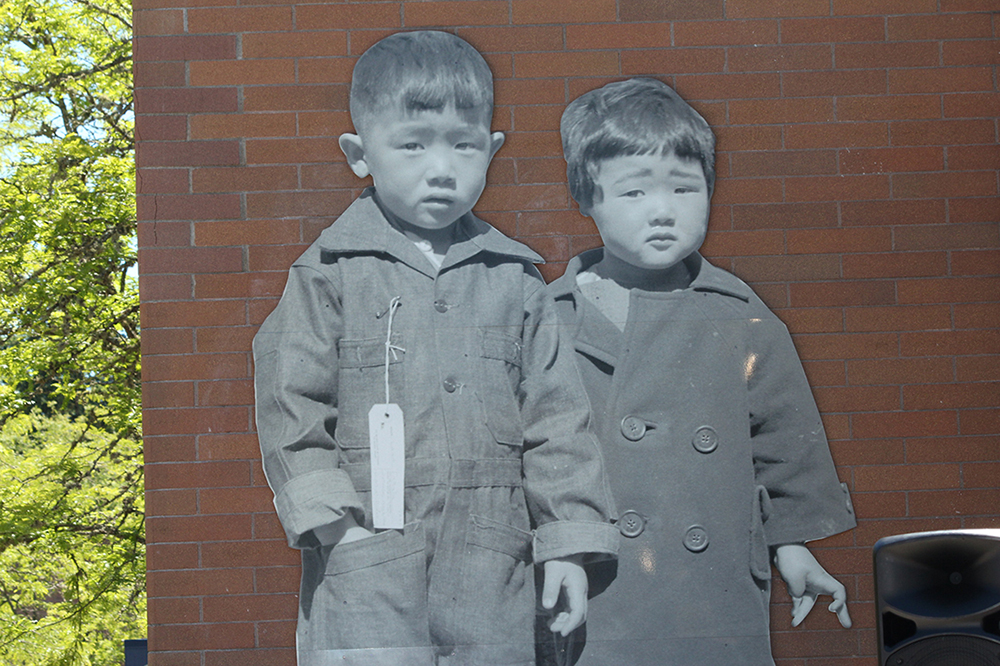
“Never Again is Now” (Photo by James Tabafunda)
The story behind some public artwork can involve specific kinds of prejudice in Asian American history. More than 200 people gathered under bright sunshine and the 77-degree temperature at Bellevue College (BC)’s Fountain Courtyard on June 11 to witness the permanent installation of “Never Again is Now,” an 11-foot mural depicting two Japanese American children.
The rededication marked the end of a journey that began with censorship six years ago and ended with a reflective, formal dedication ceremony.
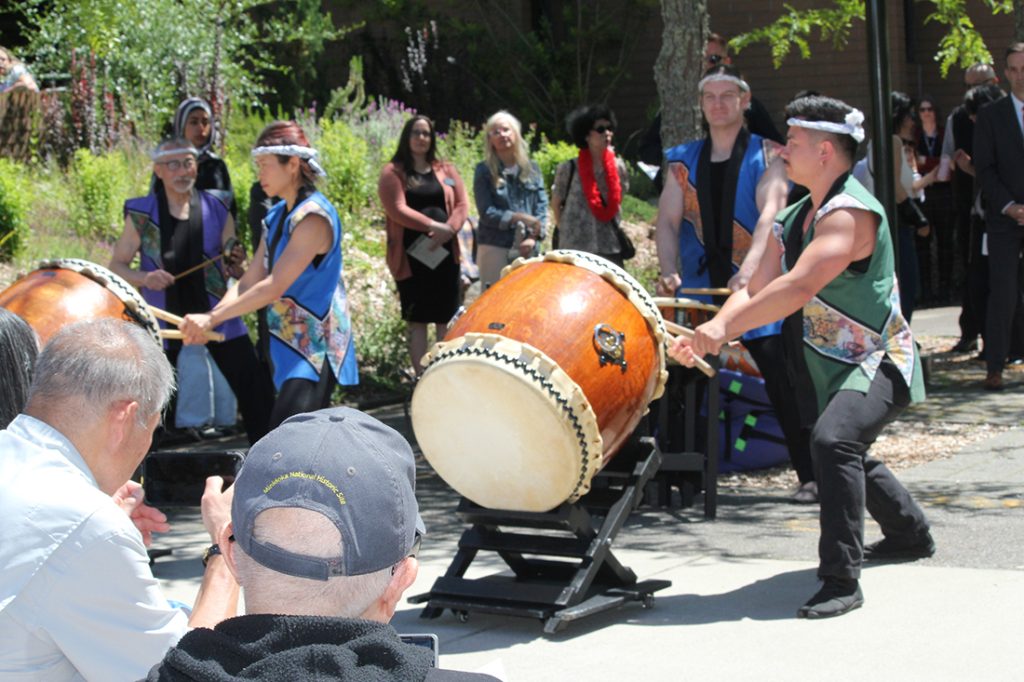
The ceremony, titled “Never Again is Now: A Permanent Commitment,” featured music from the Blaine Ukulele Group of Seattle and Seattle Kokon Taiko drummers, speeches, and the unveiling of the mural.

Blaine Ukulele Group of Seattle (Photo by James Tabafunda)
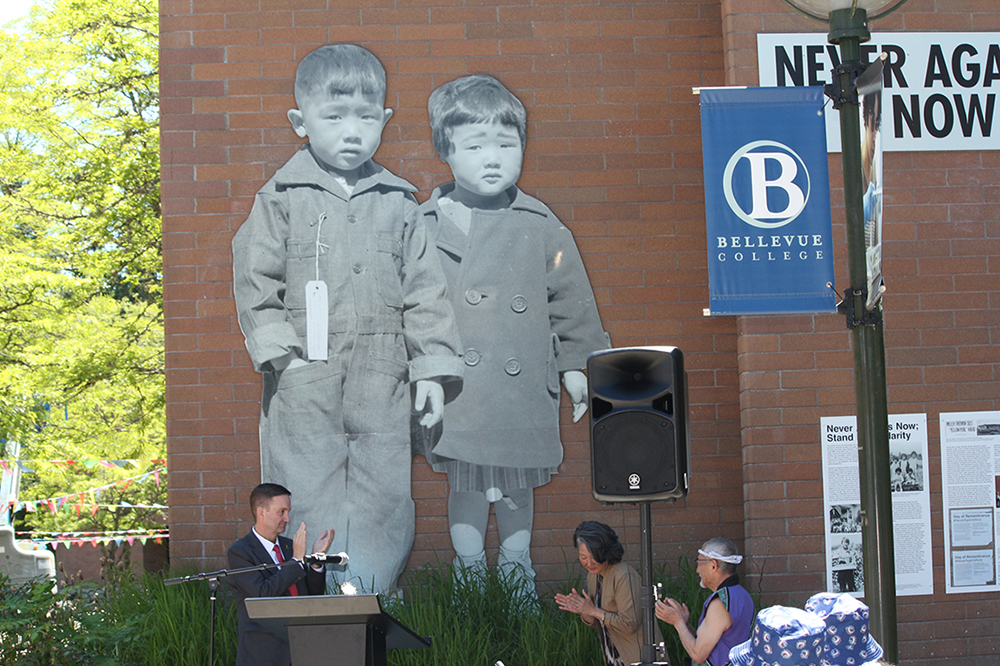
Unveiling of “Never Again is Now” (Photo by James Tabafunda)
An apology, six years in the making
BC President David May opened the program by explaining what happened in 2020, when a high-level college administrator ordered the whiting out of a sentence in the mural’s accompanying artist statement—a sentence that documented the role of Eastside businessman Miller Freeman and others in the anti-Japanese environment that preceded the mass incarceration of Japanese Americans.
“What happened here to this mural six years ago was wrong,” May told the crowd. “Real harm was done to the artwork. Real harm was done to the history that it represents, and real harm was done to our communities. On behalf of Bellevue College today, I apologize for that harm.”
The administrator who ordered the alteration, then-Vice President Gayle Colston Barge, directed someone else to remove the reference; her motivations were never fully explained. Both Barge and then-President Jerry Weber subsequently resigned in the fallout following a Seattle Times investigation.
May described the new permanent installation as something more than art restoration. “We are not placing this mural on our campus simply to commemorate and remember a past that’s important,” he said. “The questions that this mural asks us to confront remain with us.”
A mural born of history and family
Artist Erin Shigaki, a Seattle-based artist and activist, created the original installation in 2020 at the request of BC faculty and administrators seeking artwork for the school’s Day of Remembrance observance—the annual commemoration of Feb. 19, 1942, when President Franklin D. Roosevelt signed Executive Order 9066, authorizing the forced relocation and incarceration of Japanese Americans.
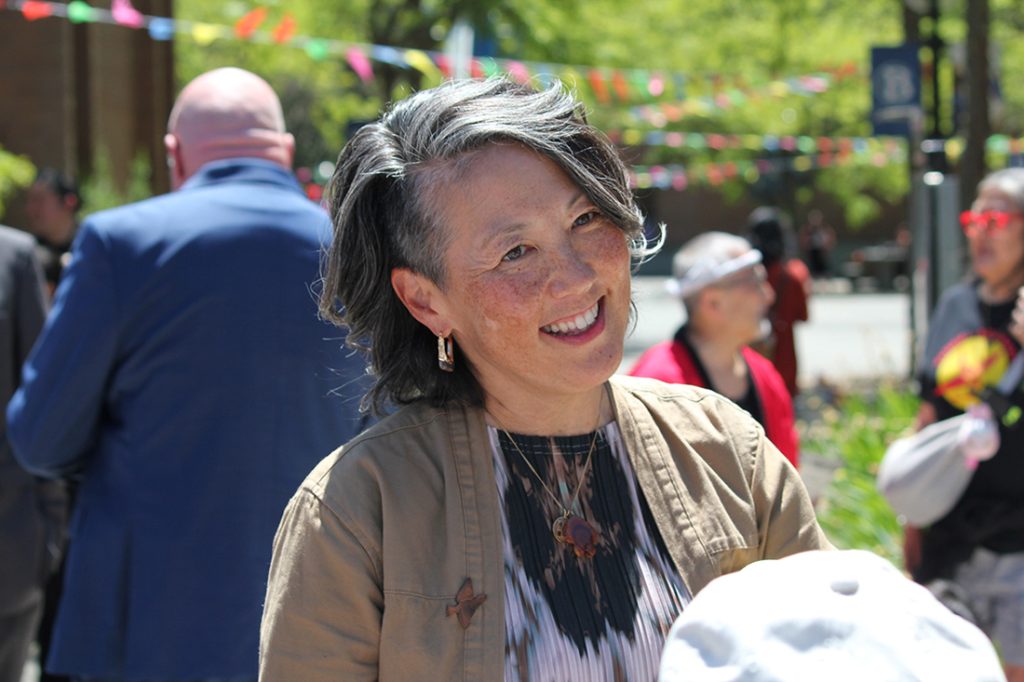
Erin Shigaki, Seattle-based artist and activist (Photo by James Tabafunda)
The mural focuses on a photograph by Dorothea Lange—two young children, identities unknown, wearing prison tags on the day they were taken to an incarceration camp in California.
“I saw two very precious children and their scared, sad faces,” Shigaki said. “I saw their little nervous fingers kind of twisting and saying everything that voices couldn’t say. I saw two children wearing prison tags. Tags everyone had to wear, but children wearing prison tags.”
Her own family history is woven into the artwork. Her father, John, was born in the Minidoka War Relocation Center in Hunt, Idaho. Her uncle, Dale, and aunt, Irene, American citizens, were sent first to the Puyallup Assembly Center and then to Minidoka—having known nothing but their small slice of Seattle’s Central District and Nihonmachi before they were forced out.
When the 2020 mural was censored, Shigaki said that was the moment she knew what “intergenerational trauma” felt like. “I last stood up here in 2020 because our mural had been censored by a high-level Bellevue College administrator,” Shigaki said. “And her action spoke loudly to me. It said that our already censored history was being whited out again.”
The weight of Bellevue’s history
The artist statement that was censored in 2020 named Miller Freeman, widely regarded as one of Bellevue’s key development figures, as a leader of the anti-Japanese movement on the Eastside. Freeman founded Washington’s Anti-Japanese League. He supported the mass incarceration of Japanese Americans before his death in 1955.
The mass incarceration affected more than 120,000 Japanese Americans nationally, including approximately 60 families—about 300 individuals—who had farmed Bellevue. Among those incarcerated were members of Shigaki’s own family, who, like many others, returned to the Pacific Northwest after the war ended despite having been forcibly removed, their possessions and dignity stripped from them for more than three years.
The artist said her permanent installation now tells that fuller history. “Miller Freeman, often referred to as the ‘Godfather of Bellevue,’ visioned and built so much. And he used his power to create an anti-Japanese organization and sentiment. Period,” she said. “He did both things, and he supported the mass incarceration of my people. Facts.”
A ceremony, a naming, a bowl
Before the tarp was lifted from the mural, Shigaki led the crowd in a solemn naming ceremony, inviting those who attended to close their eyes as Stan Shikuma, a member of the Japanese American Citizens League and a member of Tsuru for Solidarity, struck a singing bowl as she read aloud the names of the 10 War Relocation Center incarceration camps—Tule Lake, Manzanar, Poston, Minidoka, Rohwer, Jerome, Gila River, Topaz, Heart Mountain, and Amache—as well as the Puyallup Assembly Center and 15 other temporary prison centers.
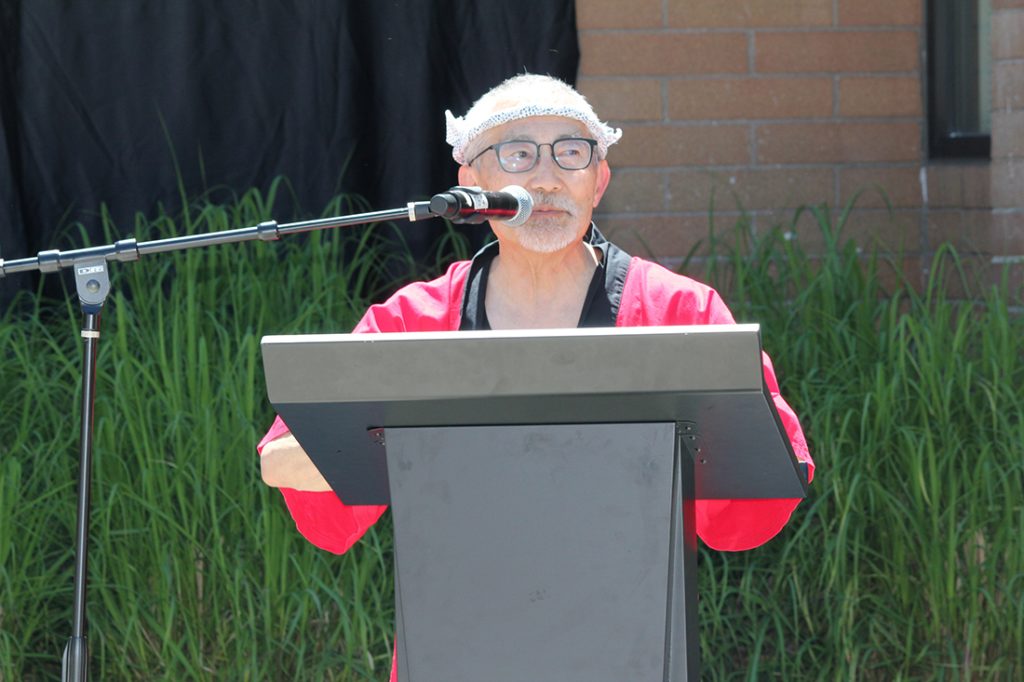
Stan Shikuma, Japanese American Citizens League member and Tsuru for Solidarity member (Photo by James Tabafunda)
“May you be happy. May you be peaceful. May you be free of all danger, both inner and outer,” she said. “May all beings be happy. May all beings be peaceful. May all beings be free of danger, both inner and outer,” she said.
In attendance were Japanese American survivors of these incarceration camps. Tsuru for Solidarity is a national, nonviolent, direct-action organization led by Japanese American World War II incarceration camp survivors and their descendants.
‘Never Again’ meets ‘is Now’
Shikuma spoke about the ceremony’s central question: what the mural’s title means in the present tense.
“Never again points to the past, the past that we are not proud of,” he said.
“The never again that we were talking about in the 1980s during redress is now. It’s happening now. It’s happening today. It’s happening in Tacoma at the Northwest Detention Center (now often called the Northwest ICE Processing Center).”
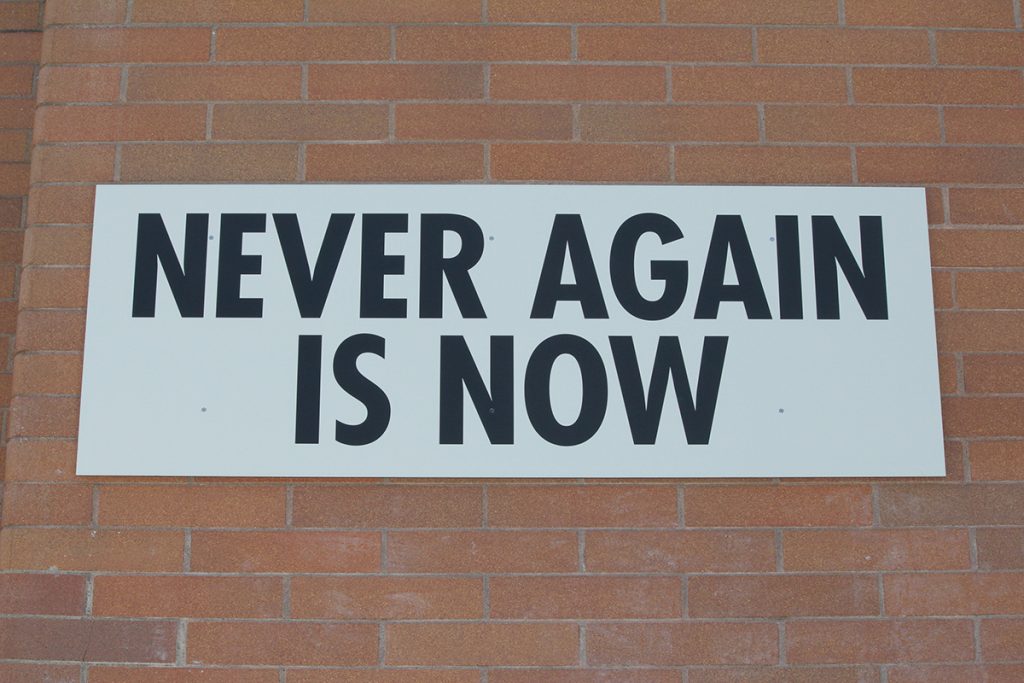
The redress movement to which Shikuma referred led to the Civil Liberties Act of 1988, signed into law by President Ronald Reagan, which gave a formal apology to camp survivors on behalf of the U.S. government and described the incarceration as a “grave injustice” motivated by “racial prejudice, wartime hysteria, and failure of political leadership.”
Shikuma drew parallels between the conditions that resulted in Japanese American incarceration—the invocation of the Alien Enemies Act, the absence of due process, forced relocation, and indefinite detention—and what he said is occurring today with immigration enforcement. He mentioned Tsuru for Solidarity’s ongoing work with La Resistencia, an immigrant-rights group that has worked for more than 11 years to close the Northwest ICE Processing Center.
“The colors change, the names change, but it’s all the same old s*#%,” Shikuma said, quoting his friend Paul Tomita, a camp survivor in attendance. “And Paul, you were right.”
He framed the ceremony’s meaning through his 8-month-old grandson. “I have to think about what kind of world he is going to inherit,” Shikuma said. “What kind of ancestor am I? Will I be? Are we going to be?”
He pointed to the two anonymous children in the mural as an answer. “It’s why we do what we do—because we’re concerned about the next generation,” he said. “We’re concerned about our children and our grandchildren.”
‘What kind of ancestors do we want to be?’
Shigaki closed her remarks with a question she said has become a guiding principle of her artistic practice.
“What kind of ancestors do we want to be?” she asked the crowd. “Do we want to be silent and complacent and turn our eyes from injustice? No.” She asked again, getting the crowd to say ‘No’ louder.
“Let’s be loud and fierce and stand for those being harmed the way our families wished more people would stand.”
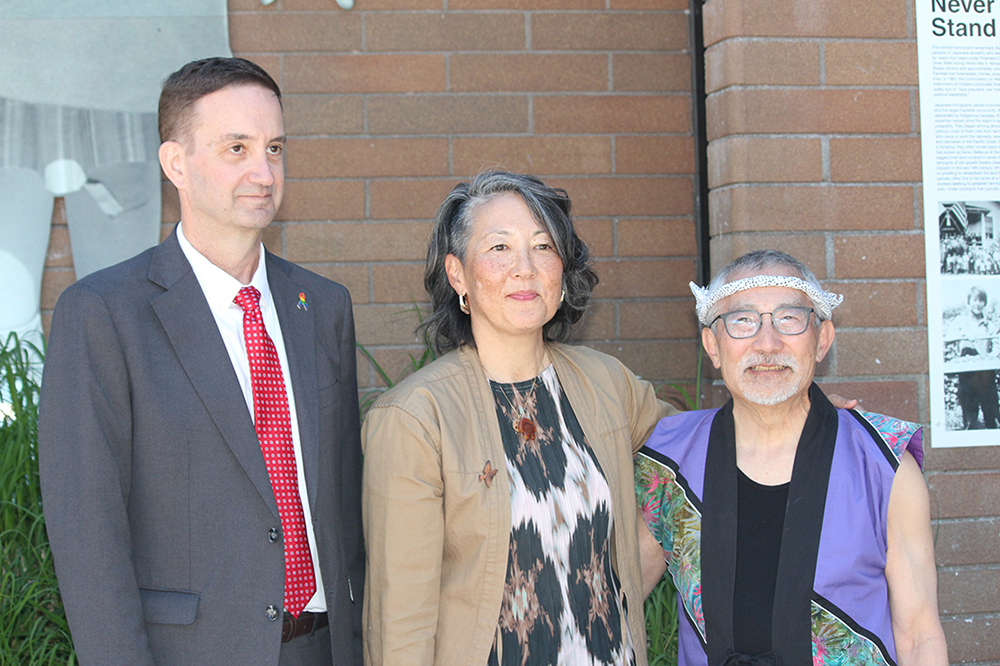
From left: David May, Bellevue College president; Erin Shigaki, Seattle-based artist and activist; and Stan Shikuma, Japanese American Citizens League member and Tsuru for Solidarity member. (Photo by James Tabafunda)
The permanent installation, which May described as BC’s “second permanent art installation,” will remain on an exterior wall that will be seen by more than 20,000 enrolled students. Alongside the mural, an expanded written history documents the incarceration of Japanese Americans in the Pacific Northwest.
May closed his speech with a call-to-action that fell equally on the institution and the individuals gathered in the courtyard. “Every time someone walks by,” he said about the mural, “it asks them to remember. It asks us to learn, and it asks us to remain vigilant in protecting the dignity and the humanity of every single person.”
Bellevue’s reckoning and reminder
“I was appalled. I was shocked, and sadly, I was not surprised because Bellevue has long lived with this issue of race,” said longtime, now retired journalist Lori Matsukawa, who first learned of the mural’s censorship in 2020. “I don’t think Bellevue has come to grips with its history of racism. So today makes me feel very proud … I think it takes a lot of courage to step up and say, we are a community that supports all people and civil liberties under the law.”