




By Carolyn Bick
NORTHWEST ASIAN WEEKLY
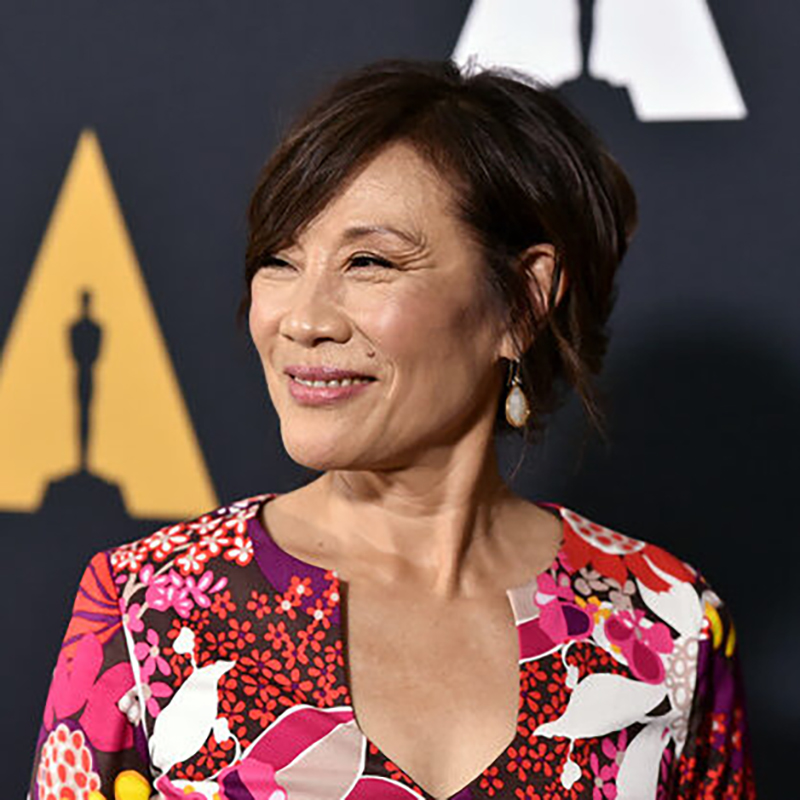
Janet Yang
Since the 1980s, Janet Yang has been making waves in Hollywood. The Chinese American film producer has made notable contributions to the art, including executive producing the landmark work of Chinese American cinema, The Joy Luck Club, and serving as an integral production advisor to Steven Spielberg’s wartime drama, Empire of the Sun. Both Yang and her many films have won prestigious awards, and she even has a pillar at the Academy Museum of Motion Pictures named in her honor.
She recently ended her tenure as the Academy of Motion Picture Arts and Sciences’ first Asian American president from 2022 – 2025, and accepted the role of board president for Committee of 100 (C100). The committee formed in 1989, following the crackdown on Tiananmen Square, and works to promote Chinese American civic engagement and foster relations between the U.S. and China.
Over the decades, Yang has watched U.S.-China relations through two overlapping lenses: As an American citizen growing up in a Chinese American household and as an integral part of uplifting Chinese cinema and Chinese stories. She said that her new work leading C100 feels like a continuation of her career thus far, not a departure.
“I’ve spent my career making the case, through film, that Asian stories are universal stories. The Joy Luck Club, Over the Moon, Empire of the Sun—each one was a bet that audiences would connect across cultural lines when people doubted they would,” she told the Northwest Asian Weekly in an email. “Those bets paid off. … Cultural shifts, on both sides of the Pacific, help create more imaginative interactions among leaders as well as more people-to-people engagement. That will affect both perception and practice in all areas of our lives. My hope is that Chinese will be more humanized, and not painted in black and white. And that Chinese-Americans will not be seen as a threat, not seen as foreign players.”
“Hollywood seemed like a distant planet run by white people”
As a child, none of the ways her career turned out seemed even remotely possible to the young Yang.
“Growing up on the east coast, Hollywood seemed like a distant planet run by white people. Having grown up in a white community, I knew I was not one of them,” Yang told the Northwest Asian Weekly.
She remembered “the beginning of an identity consciousness” around age 15. Her mother was a Chinese citizen working for the United Nations (U.N.), and was only allowed to visit China every other year. It was only after President Richard Nixon and U.S. Secretary of State Henry Kissinger returned from China in 1972, and the U.N. recognized the mainland, not Taiwan, as “China” did Yang’s cultural roots really begin to open up for her.
“My parents were finally allowed to see their relatives after decades of separation. China was still in the middle of the Cultural Revolution,” she remembered. “Upon return, my intense curiosity about my parents’ upbringing and ancestry continued and it ended up dictating why I chose Chinese Studies at Brown University, which was followed by a stint working in Beijing at the Foreign Languages Press. It was during this year and half that I started seeing an explosion of modern Chinese culture—through paintings, music, literature and film. And it was their movies that really struck me.”
She eventually enrolled in Columbia University’s business school. But “amidst classmates who were gunning for jobs at Goldman or McKinsey, all I thought about was how to get others to see Chinese films. I started organized screenings with 35 mm prints I borrowed from the Chinese consulate in [New York].”
A move into production
Even then, though, the idea of becoming a film producer didn’t hit her until a job running World Entertainment, a film distribution company in San Francisco, landed her a role with Universal Studios, where she worked to open up the China market for the first American studio films out of the country since 1949. In fact, the Universal executive who offered her the job found her because of her work at World Entertainment: During Yang’s time there, World Entertainment quickly became the exclusive North American distributor for Chinese films. These films included those from directors like Chen Kaige and WuTianming, “who defined the now-famous fifth generation of Chinese filmmakers,” she said.
While at Universal, she met Steven Spielberg, who wanted to create as much authenticity as possible for his then-upcoming film, Empire of the Sun. This meant many of the large, exterior shots had to be filmed in Shanghai—and Yang was the one to negotiate that.
“I was in heaven working on that film,” she recalled, “and finally discovered what I wanted to be: A film producer.”
Shifting relations
In her role on Empire of the Sun, much of Yang’s initial work consisted of navigating the still-tender political waters of U.S.-China relations. But, she said, “the advantage of shooting during a time when the government was very centralized, once top level approvals were given, everything else fell nicely into place—work units, army units, the whole city more or less cleared for us.”
These days, she said, the system is much more complicated to navigate. She remembered that filming for Shanghai Calling and Disney’s High School Musical: China lacked that same system. This was also a sign that “China’s film industry had become its own market by then, no longer just a host to Hollywood.”
But “layer onto that a colder diplomatic climate, and you get a lot more caution from studios about anything touching Chinese history or politics.”
“And it doesn’t stop at the industry,” she continued. “When U.S.-China relations sour, Chinese Americans feel it directly—through suspicion, through the anti-Asian hate we saw during the pandemic, through false accusations of disloyalty. That’s exactly why I think the people-to-people work that C100 does matters more now, not less.”
Representation—at every level
As much of her production work as she brings to the role of leading C100’s board, Yang feels that her time at the Academy is a closer parallel to the work she will be doing. One of her priorities at the Academy was expanding international membership and providing connections for members across the organization’s 19 branches. Thanks to her efforts, a quarter of the Academy’s 11,000 members are based outside the U.S.
“That’s the same mission I have for C100: building real cross-cultural and cross-industry connection into the DNA of the org,” she said. Fortunately, despite political tensions, she sees both curiosity and connection between America and China, especially amongst young people, who are “not buying into the narrative being handed down from above and from the past. On social media, American youth are witnessing unvarnished, authentic glimpses of life in China. Many are traveling there and they like much of what they see. … Chinese in the meantime have always had a healthy curiosity about America. While the official flow of scholars, business persons, and cultural creators both ways may not be quite as strong as it was 10 and 20 years ago, there is deep interconnectivity across many industries. The mainstream media does not tend to report on this.”
Yang especially feels that it is important that she is a woman leading C100.
“It seems obvious to many that women should be in more leadership positions, and that we are showing up to do so,” she said. “I was only the fourth woman leading the Academy in its nearly 100-year history. … Today, we see excellent women leading whole countries. What we bring, I have found in working with many women, is an innate sense of humanity, compassion and justice. We also seem to be more focused on getting things done, and less on who gets credit for it. We are generally more collaborative because we rarely have a sense of entitlement.”
“And of course, being a role model for young people to look up to is exceptionally powerful,” she continued. “Just as with minorities, representation changes what people believe is possible—for the people being represented, and for everyone watching. That’s been true for me being Asian American as well as being a woman. Both the Academy and C100 have historically been perceived as male-dominated. I’m privileged to be able to change that to some degree.”
Still, she won’t be making any drastic changes to C100’s initiatives or focus points. She doesn’t want to get too ahead of herself with new programs, she said, but knows the direction she wants to keep going. This includes highlighting cultural work, like what billionaire philanthropist and C100 co-founder Oscar Tang brought to his executive production of Laufey’s hit music video for her song “Madwoman,” as well as creating a community of leaders who bring empathy, passion, and a sense of purpose to all fields.
“For now, that means building on the dual mission C100 already has, rather than inventing something new on day one,” she said. “I like to think I’m simply hitting a refresh button.”