




By Andrew Hamlin
NORTHWEST ASIAN WEEKLY
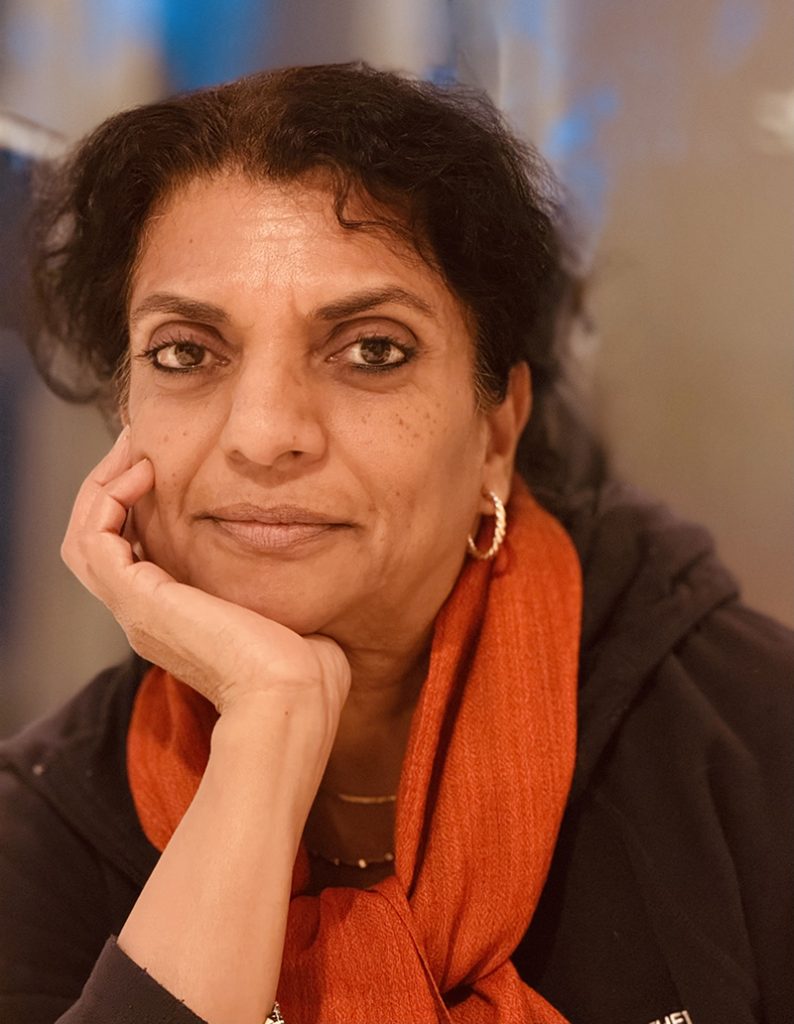
Shailaja Rao (SIFF profile )
Seattle International Film Festival (SIFF) programmer Shailaja Rao grew up across several regions in India, and spent three years in England. Her earliest memories of the arts involve the movies, but something more personal as well.
“My first distinct memory is of my mother performing folk dances for us,” Rao, a programmer for SIFF’s Asian Crossroads section, recalled. “My brother and I would sit in awe, watching her dance and sing simultaneously, draped in a saree. That image has never left me.”
But film was always a big part of life as well. “We were also taken to the movies every three to six months, a full day’s affair. Bollywood films typically run three hours or longer, so we’d dress in our best clothes, and afterward, without fail, be treated to a small bottle of Coca-Cola and vanilla ice cream before heading home. I adored the costumes and secretly wished I could wear the flowing gowns and elaborate hairstyles of the heroines. Since Indian films weave dance and music throughout, I would practice the moves and memorize the tunes and lyrics as quickly as I could.
“Around the age of 18, I discovered what were then called ‘art’ films: Indian parallel cinema, where the emphasis was firmly on story, and song and dance were not emphasized. I became completely enamored. These were films that felt like my calling, and I knew I wanted to be part of that world. The desire to somehow be part of that world never left me, and it set me on the path that eventually led me here.”
Rao first lived in Virginia when she came to the United States, but moved to Seattle in 2024, to be close to her daughter’s family. She found the city “diverse, inclusive, and vibrant, and the people here are generous in a way that makes you feel welcome right away. Having arrived relatively recently, I can’t speak to how the city has changed over the years, but what I can speak to is the warmth I’ve encountered. My neighbors alone have made that impression unforgettable.”
After working for Tasveer, the city’s South Asian film festival, she came to SIFF as a programmer in 2025. “My particular emphasis is South Asia, though team members SuJ’n Chon, Mayumi Tsutakawa, and I support one another, and I often serve as a second or third set of eyes on other Asian films when needed.”
Asked for her five favorite Asian films in the current festival, Rao first mentioned “Roid” from Bangladesh, directed by Mejbaur Rahman Sumon. She described the film as “a visually stunning story set in rural Bangladesh. A poor tenant farmer repeatedly tries to abandon his wife, a woman the village considers mad, fiercely herself, and untamable. Each time he leaves her, a fruit falls from the palmyra palm beside their shelter, and she finds her way back. Sumon, whose earlier film ‘Hawa’ was Bangladesh’s Academy Award submission, brings an artist’s eye to every frame.”
“Deadline,” directed by Kiwi Chow, is a co-production between Taiwan, Hong Kong, and the United Kingdom. The action “follows elite high school students and administrators, pushed to a breaking point in the relentless pursuit of perfection. It is a taut, unsettling look at what pressure does to young people when no one is watching.”
Sikkimese filmmaker Tribeny Geeta Rai marks his debut feature, “Shape of Momo,” co-produced from South Korea and India. “Bishnu quits her job in Delhi and returns to her Himalayan village, only to find her grandmother, mother, and sister still bound by the same expectations she left behind. The shape of a momo (a steamed dumpling) becomes a symbol for the impossible standards placed on women. The Himalayan cinematography is beautiful on the surface and oppressive beneath it.”
Japan’s “Burn,” directed by Makoto Nagahisa, follows a runaway teenager who finds belonging among a community in Kabukicho, Tokyo’s red-light district, only to watch that fragile world collapse into something far more dangerous. “It is a raw, tender film about what it means to find your people in unexpected places.”
Finally, from South Korea comes “The Seoul Guardians,” a documentary co-directed by Cho Chul-young, Kim Jong-woo, and Shin-Wan Kim. Rao called this “the one I urge everyone not to miss. On the night of December 3, 2024, South Korean President Yoon Suk Yeol declared martial law. The country pushed back fast. This documentary puts you on the streets and inside the National Assembly chamber as it happened, beside citizens, soldiers, journalists, and parliamentarians navigating the same volatile hours in real-time. It is a close examination of what democracy looks like when it is tested.”
After the festival ends, Rao pivots back to her work as executive director of eShe, a global editorial platform headquartered in Seattle dedicated to amplifying women’s voices across South Asia and the diaspora. My immediate focus will be on eShe’s South Asia Union Summit, scheduled for the last week of September, which will require my full attention in the months ahead.
“Alongside that, I will continue building something close to my heart. My friend, Sandy Nathan, and I co-founded the South Asian Lens Collective (SAL Collective), a platform for South Asian filmmakers in the diaspora to network, collaborate, and share knowledge with film professionals across South Asia and beyond. The project is in its early stages, and we are actively building as we speak. It feels like the natural convergence of everything I care about: cinema, community, and South Asian stories finding the audiences they deserve.”
The 52nd Annual Seattle International Film Festival runs May 7-17 across several venues in and around Seattle. For prices, showtimes, and other information, visit https://www.siff.net/festival.