




By Carolyn Bick
NORTHWEST ASIAN WEEKLY
Continuing our collection of interviews with panelists who will speak following the premiere of Strawberry Fields Forever—a new documentary about the surviving berry picker cabins on Bainbridge Island’s once-thriving farms—Carole Kubota reflected on growing up on her family’s strawberry farm after World War II. Born shortly after her mother’s release from an incarceration camp, Kubota returned to Bainbridge Island as a baby with her parents, Mary Hayano and Noboru Koura, whose family rebuilt and expanded Koura Farm after the war. In this interview, Kubota recalls farm life, the lasting effects of Japanese American incarceration, and the gradual disappearance of Bainbridge Island’s farming communities.
This interview has been lightly edited for length and clarity.
We had two houses. I grew up in one small house on the farm and then my dad built the second house, and I moved into that second house when I was 12 and my brother was 9. That’s where I lived from the age of 12 until I went away to college.
My dad was one of six kids. His name was Noboru Koura. My mom was named Mary Hayano. They got married in 1945 or 1946. After the war was over, the whole Koura family was lucky enough to move back to Bainbridge Island. Mr. Raber had taken care of the property while they were [incarcerated]. [The farm’s owners were] originally my great-grandfather, my great-grandmother, my grandparents, and then my grandparents had their six kids, and my dad was one of the six kids.
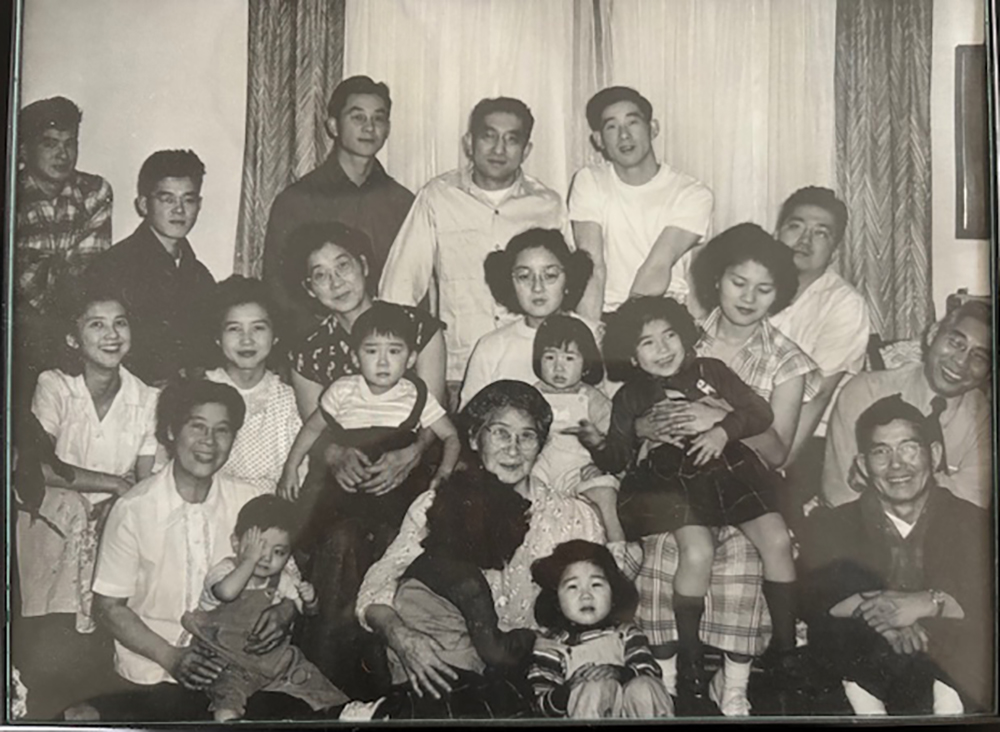
Koura family photo from 1949. (Courtesy: Carole Kubota)
Now, at that time, they did not have 180 acres. I think they had purchased 20 acres from Mr. Raber—I’m not totally sure of all these figures. But he took care of those 20 acres, and then there was some negotiation, apparently, when they got back, and they were able to get the property back. They started purchasing more and more parcels from Mr. Raber and others, and eventually, by the time they sold it in the mid-60s, it was 188 acres.
Most of the people on Bainbridge were not wealthy. The wealthy people lived around the edges of Bainbridge, on the waterfront, for the most part. We were poor. Farmers were poor.
I don’t think we realized how poor we were, but we had our own chickens. We had a giant vegetable garden, where we raised our own food. We foraged in the woods for mushrooms and ferns.
We had a peach orchard, pear trees, cherry trees, and plum trees. We went to the beach, and dug our own clams. The Japanese on Bainbridge would go to the beach and collect seaweed. We would bring it home, rinse it off, and dry it, and then store it, and then eat it throughout the year.
We didn’t just grow strawberries on our farm. We had currants, blackberries, peaches—what else did we grow? I guess those are all the crops, really.
[Besides strawberries], I don’t remember us bringing any of the other fruits and vegetables [to markets or the cannery to sell]. Most of that was just for our own consumption. We did a lot of canning and freezing. The cannery was on Bainbridge Island. We would just bring it down there in our trucks. The fresh market berries we would bring into Seattle.
There was a lot of work to do on the farm. After the berry season was over, there was still a lot of work to do on the farm from “setting the runners.” That doesn’t make any sense to anybody not working with strawberries, but you really have to maintain the plants in late summer, so that they would be ready for the next year. Not only that, but you’re getting fresh plants in.
[I also did something with] those fresh plants [that] I would call “trimming the plants.” You’d be working in the barn with a little knife, and you’d have to trim the roots off and get the plants ready for planting. There was work basically all year round, except in the dead of winter.
The other piece was that a lot of my friends had cars and so they would be able to just go places with classmates. I didn’t have a car and I can only really remember a couple of times when I went somewhere with my classmates. It was really weird. It’s kind of confusing to me sometimes, because I’ll be driving around Bainbridge and I’ll think, “I don’t really know what’s down in that part of Bainbridge Island,” because I didn’t socialize with the people down there outside of school that much.
I don’t know exactly how to explain it, but I feel personally that my white friends were much more active socially. There was a group, I think, called the Rainbow Girls. A lot of my white friends belonged to Rainbow Girls, and they did a lot of things socially. I did belong to Girl Scouts. Lilly Kodama’s mom, Mrs. Kitamoto, was one of my Brownie leaders, and my mom was one of the Brownie leaders. I know Lilly’s mom from a long time ago.
I think the minority kids on Bainbridge definitely had a different experience than most of the white kids on Bainbridge. Japanese kids were class officers. We were presidents of this club and that club. There was one Japanese girl that was one year older than I was [who] was a cheerleader … but most of the kids who were white kids were the cheerleaders.
[Growing up, we were taught not] to embarrass the family, and … especially don’t embarrass your grandparents. We did really well in school. I was a class officer. I was a class vice president my senior year. I was active in all the different clubs. I got scholarships to university and so on. Academically, I did great.
Socially, it was different. When I went to the university, I started to date white guys who had never asked me out when they were my classmates at Bainbridge High School.
And finally, one day, I asked one of my dates, “Why did you never ask me out in high school?” Because I always thought I was just so ugly [in high school].
He said, “Carole, a lot of guys wanted to ask you out, but our parents didn’t want us to.”
That was just a shock to me. I didn’t realize that there’s still some latent racism that existed on Bainbridge.
The other interesting thing about Bainbridge didn’t really hit me until I was on Bainbridge [this year] on March 30th [for] the Day of Remembrance. [I realized] that there were 13 kids in the senior class that were supposed to have marched during graduation so long ago. The population percentage-wise in school before the war was so much bigger than after the war. I think in my senior class, there were two of us.
[That told me that] most of the Japanese families were not able to come back to Bainbridge [after the war], because they had nothing to come back to.
It was really very sad. … When I was teaching my classes out at the university, I would talk to my students and I’d say, “Imagine you have one week, and you and your parents are told to pack one bag each and you are going to be leaving. We’re not going to tell you where, and we’re not going to tell you for how long, but you have to figure out what you’re going to do with all your stuff, all your animals, and whatever property you have, and then we’re going to take you away.”
When I think about that, I just can’t even imagine what it must’ve been like. Not only that, but the heads of the families had already been removed. My grandfather and great-grandfathers, they had already been taken because they were leaders in the Japanese community. The FBI had already removed those leaders. So really, the heads of the families during that evacuation period were boys, basically—19, 20, 21 years old. And they were the ones that were responsible for trying to keep the family together and reassuring everybody that everything was going to be okay.
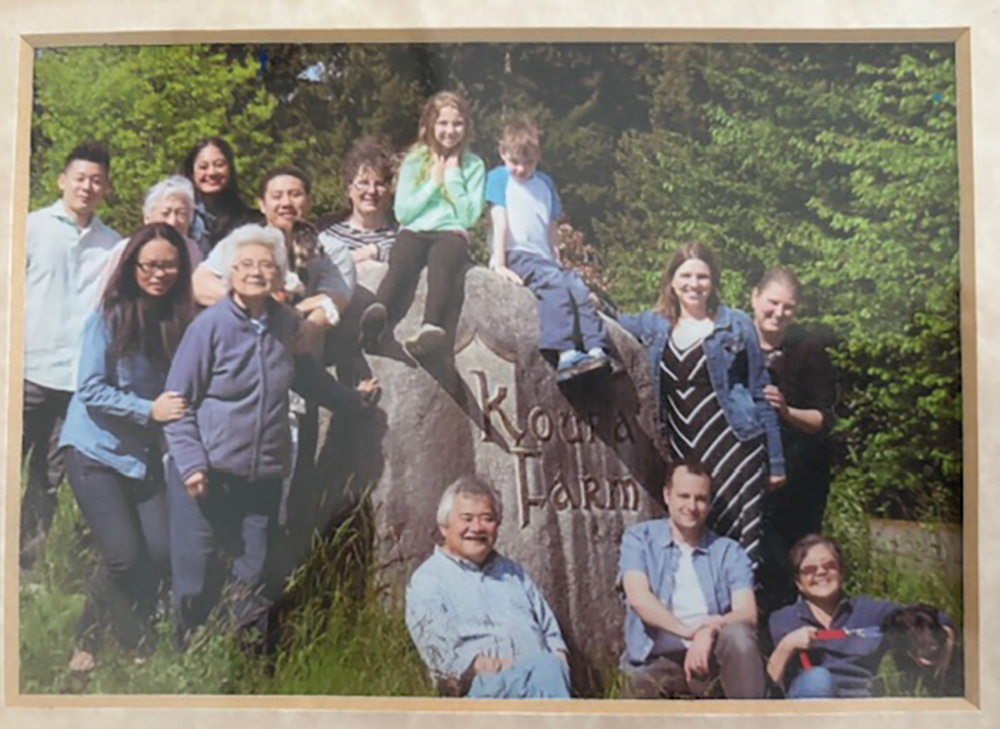
Koura family photo circa 2013. (Courtesy: Carole Kubota)
Most of the families that were removed were farmers. The Kitamotos were lucky. My family was lucky. The Sakais were lucky. The Nakatas were lucky. They had parcels of land that people took care of for them, for us. But a lot of the families did not. And if they had nothing to come back to, then they would move to Seattle. I think a lot of the people from the West Coast … moved into the Midwest. My mother’s family, for example, moved into the Midwest, because she was able to leave the camp early and move her family into the Midwest. I was actually born in Minneapolis and came out as a baby back to the farm. But with the demise of the farms, you had people who [sold the land].
One of the reasons that we stopped farming [and sold the land] was because—I personally think—it was due to refrigerated trucks. … [The people who used refrigerated trucks] could raise so … much more, pound-wise, of strawberries than we could on Bainbridge. … I think that that contributed to the demise of the farms on Bainbridge Island.
…
When we were growing up, the mantra was, “I can’t wait to get off the rock”—we called Bainbridge the rock. We just thought that living in the city and going to college would be so exciting and we talked about “getting off the rock.”
…
I graduated high school in 1964. I went away to college and then I came back, and then that summer of, I think it was ‘65, my parents and my Uncle Art said, “They’ve decided to sell the farm.”
I get kind of choked up just thinking about it. I remember crying for hours. I didn’t realize what the farm actually meant to me.
We grew up on almost 190 acres. … When I was growing up, we could look to the west and see Mount Rainier … to the southeast, the Cascades, and if we looked out the window to the west, we would see the Olympics.
[My cousin’s and my] parents kept 20 acres of their property and sold off [the rest]. It became the Meadowmeer Golf Course.
The pond that my dad and my uncle excavated … they lugged pipes around 188 acres and put in a pump and irrigated 188 acres during the summertime. … I think [that pond] probably still exists, but I’m not even sure if you can actually access it unless you’re golfing. It’s probably a water hazard or something.
The only thing that’s remaining on the old farm right now is a stone. It’s got “Koura Farm.” I’m just so grateful, because the people who own the property, where the Koura Farm sits and the Koura Farm stone sits, take really great care of the stone.
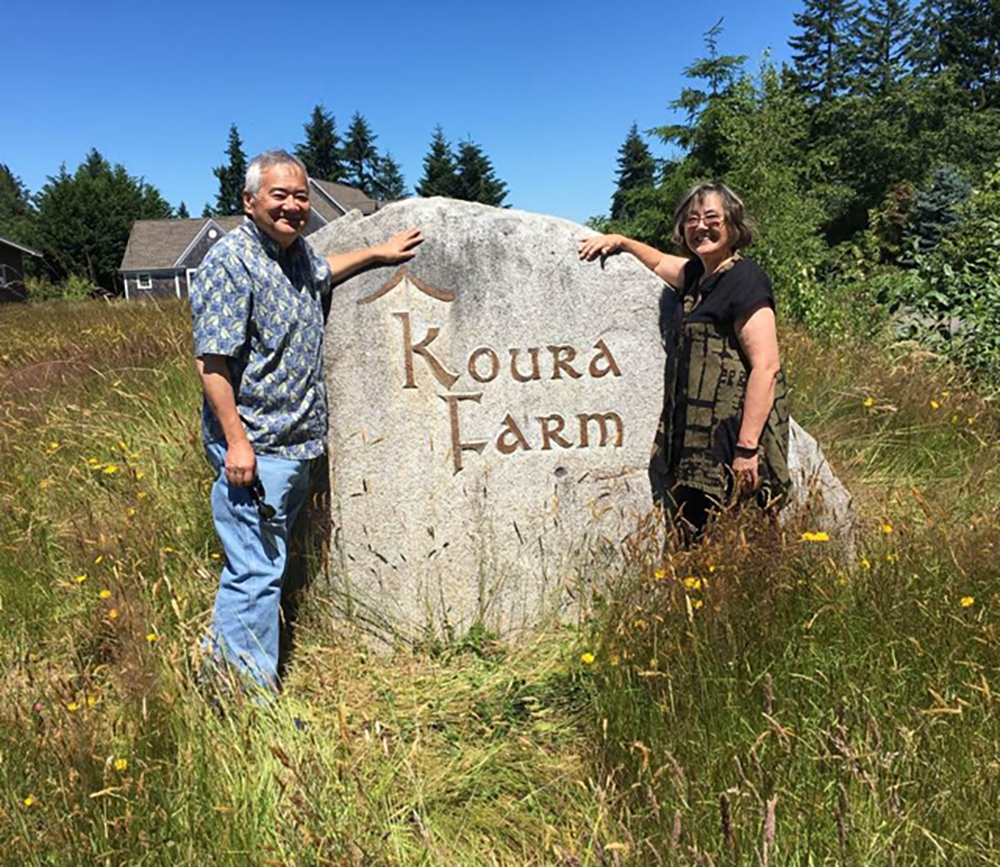
Carole Kubota and her brother, Scott Koura, pose for a photo with the Koura Stone. (Courtesy: Carole Kubota)
When that little parcel was for sale, the stone was just kind of sitting there with “Koura Farm” carved into it. It was covered with moss and got all gray. I’m not sure who owns the property [now], but they built this beautiful house and they clean up the stone, and every time I see it, it’s got beautiful flowers planted around it.
So, they’re just taking really wonderful care of that stone and I’m just so grateful for that.
Strawberry Fields Forever premiers at the Bainbridge Island Museum of Art on May 17 at 2 p.m. Readers can find more information here.