




By Carolyn Bick
NORTHWEST ASIAN WEEKLY
Despite the country’s long history of immigration serving as the foundation of the contemporary U.S. population, half of U.S. adults believe that, to be considered “truly American,” a person must be born in the U.S.
But, as is often the case, the overall percentage doesn’t tell the whole story: 77% of Asian Americans and Pacific Islanders (AAPIs) who answered this particular question believe the opposite, according to The Asian American Foundation (TAAF)’s and NORC at the University of Chicago’s 2026 STAATUS Index survey.

Sruthi Chandrasekaran
“To me, [this finding] almost feels like … the most important, and also feels really timely … especially, as we know, that the Supreme Court is weighing the birthright citizenship case,” said Sruthi Chandrasekaran, TAAF’s director of data and research.
The study’s other findings also revealed the continued struggles AAPIs continue to face, particularly when it comes to questions of visibility, perception, and belonging. Still, responses from younger age brackets and overall questions of methods of support appear to show what Chandrasekaran calls a “silver lining.”
Lack of visibility
The lack of visibility is immediately apparent in a specific survey result asking respondents to name famous AAPIs. The AAPI community has a long and storied legacy in the U.S. alone, making significant contributions to every single field and area of society, from ethnobotany, astrophysics, literature, dance and music to politics and history-altering civil rights causes.
But when asked about famous Asian Americans, nearly 40% of respondents were unable to think of a single person. Those who were able to answer largely identified actors, like Jackie Chan or Lucy Liu, with the single exception of those who named Kamala Harris.
Even fewer could name a single famous Native Hawai’ian or Pacific Islander. Those who were able to name actors included Dwayne “The Rock” Johnson and Jason Momoa.
Slide from 2026 STAATUS Index report.
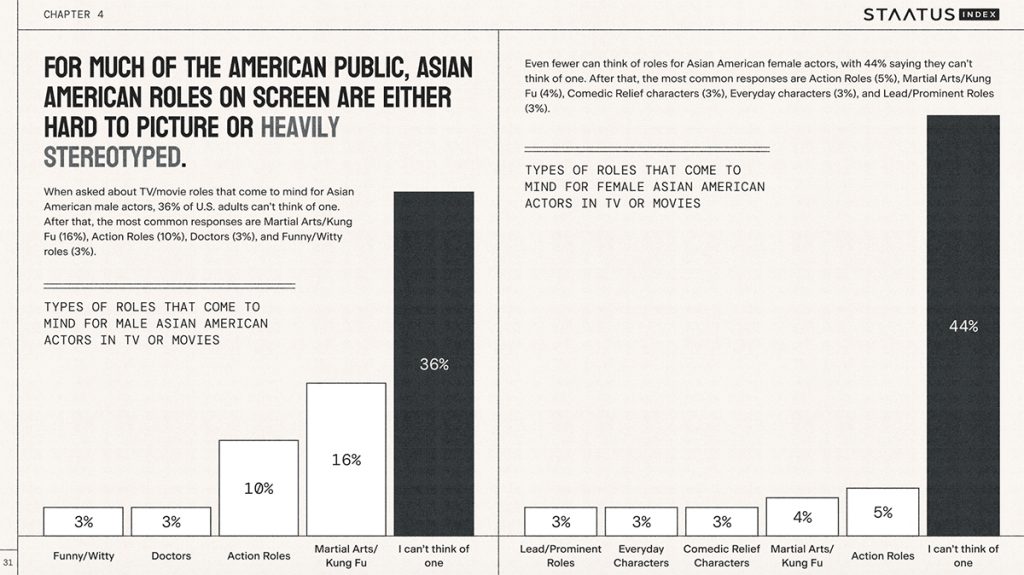
“When we sort of probed and asked about the kinds of roles that people see actors in, folks are usually not able to name roles,” Chandrasekaran noted. “And when they do, it’s more the stereotypical kinds of martial arts and action-oriented roles for male and female actors. I think [that] speaks to that lack of visibility.”
Slide from 2026 STAATUS Index report.
Chandrasekaran highlighted that this issue speaks to society more broadly. More than a quarter of respondents had no connection to the AAPI community at all. Most got their information about the community from social media, entertainment, or news outlets, rather than a direct personal connection, like a friend, family member, or colleague. More than 30% said that they didn’t get any information about the AAPI community at all.
Moreover, more than half of the total respondents said they could not think of a major moment in Asian American history, and most of those who could named the forced incarceration of Japanese Americans during WWII.
The “bamboo ceiling”
Even within places that could foster interpersonal relationships, like work environments, the data showed that most people didn’t think of AAPIs as leaders, hearkening back to the idea that even famous community members usually wouldn’t hold the lead role in a film or television show—and they would instead be a supporting character.
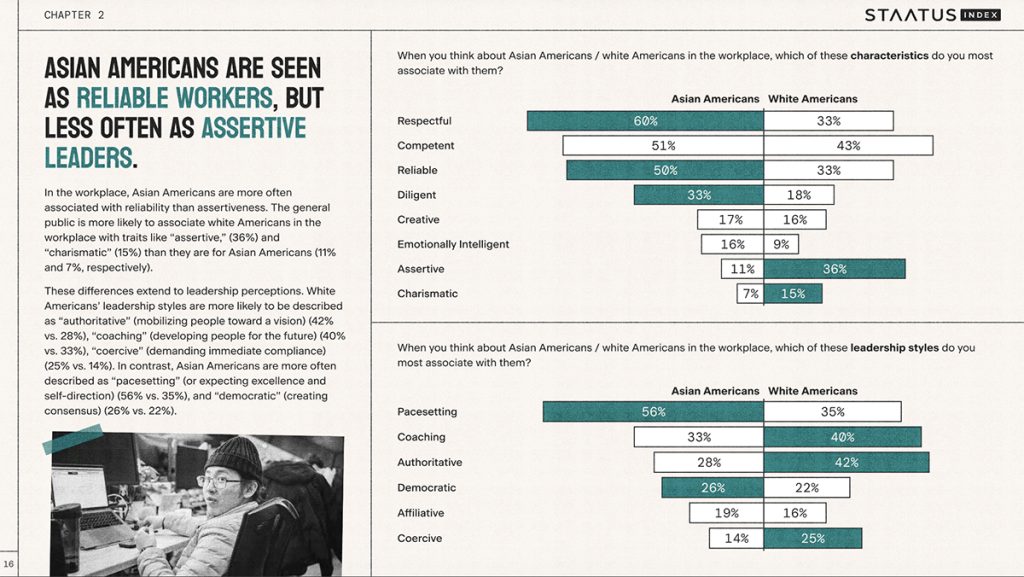
“We are seeing that the model minority continues to play out. AAPIs are seen as intelligent, hardworking, respectful, polite—but not really assertive or charismatic. Those are, you know, more associated with white Americans,” Chandrasekaran said. “Even when we think about leadership styles, we are seeing that AAPIs are seen more as pace-setting or having democratic styles of leadership than the typical, authoritative work style that is usually associated with white Americans. I think it speaks to the lack of visibility of Asian Americans. We’re seen as, ‘We’ll keep our heads down and get the work done.’”
Slide from 2026 STAATUS Index report.
These are some of the reasons the community continues to face “challenges with the bamboo ceiling,” Chandrasekaran said. In 2005, author Jane Hyun popularized the term, which refers to the obstacles Asian Americans specifically face in the workplace, when it comes to advancing their careers and attaining promotions, owing to stereotypes rooted in racism, including the “model minority.”
Women who belong to the AAPI community are more likely to face this career obstacle than men, due to overlapping harmful stereotypes, including the myth of the “docile” Asian woman and the “glass ceiling” women as a whole face in the workplace.
“These are some of the reasons why our communities continue to face … not being able to grow into positions of leadership, being represented at senior levels of leadership, and in the C-suite,” Chandrasekaran said. “I think that also speaks to the lack of visibility … of our contributions, our history, our stories.”
Younger people more likely to recognize AAPI influence
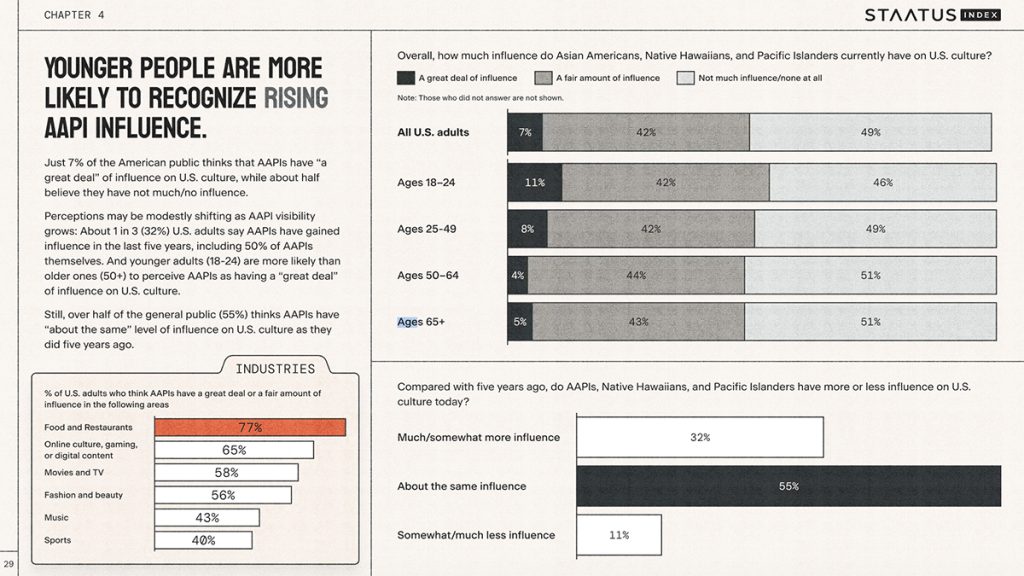
While the overall number of people who believe the AAPI community has a strong influence on U.S. culture is just 7%—despite the increasing presence of the community in popular media and political office, as well as everything from different forms of martial arts and cultural dance to food, beauty products, and machinery becoming entrenched in American culture over the course of decades—survey results revealed that younger people are recognizing the influence of members of the AAPI community, and the achievements of the community as a whole.
However, the number is still low. Just 11% of respondents ages 18-24 said that AAPIs had “a great deal of influence” on U.S. culture, versus 5% of respondents older than 65, and 4% of respondents aged 50-64.
Slide from 2026 STAATUS Index report.
“While we’re seeing some differences across Gen Z versus older Americans, despite all of our contributions, it is quite disillusioning that we’re not recognized,” Chandrasekaran said. “But I think the silver lining for me really is that people are seeing our influence growing over time in movies and TV and online gaming and food, etc.”
And this growing influence appears to have fueled an appetite to learn more about the AAPI community and the many diverse groups’ histories. The survey also asked respondents how they would be willing to support more visibility for the community overall.
Generally speaking, more women than men affirmed that they would like to support the community in different ways, ad distinctly more Democrats than Republicans said they would engage in different ways to do so.
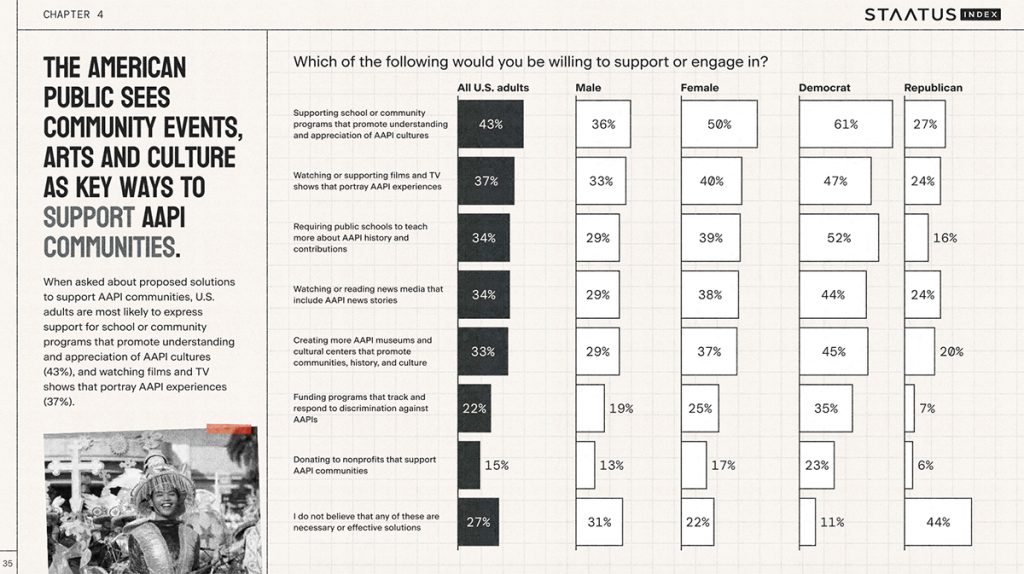
Slide from 2026 STAATUS Index report
The top method of engagement survey respondents agreed with was supporting school or community programs centered on promoting an understanding and appreciation of different AAPI cultures. A little further down the list was requiring public schools to incorporate AAPI history and contributions into students’ curricula.
When asked specifically about what topics students should learn about in schools, a majority of respondents—65%—answered that educators should teach students about the community’s history of immigration and migrant communities, closely followed by culture and representation. A little less than half said that students should learn about racism the community faces, and a little more than 40% said that students should hear AAPIs’ stories in their own words.
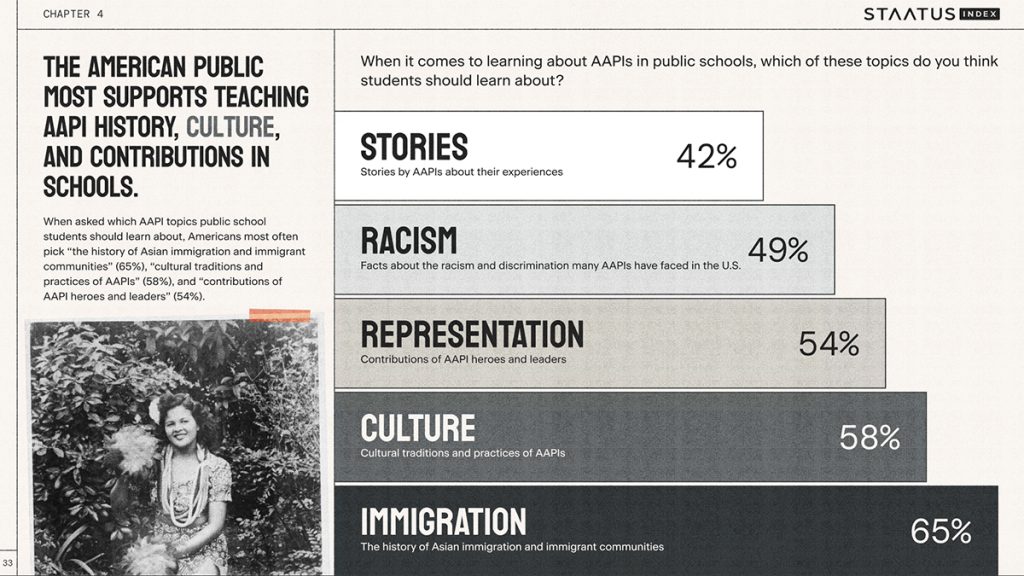
Slide from 2026 STAATUS Index report.
“There is interest in learning more about our community. There’s interest in watching more TV shows and going to Chinatowns and Little Saigons … and using school and curriculum as a way to get to learn more about the AAPI community,” Chandrasekaran said. “So, some bright spots there.”