



By Saraphena Wong
NORTHWEST ASIAN WEEKLY
Sitting at her kitchen counter, fourth-year international student Hanqiu Zhong recalled her decision to come to the University of Washington with a smile.
“Frankly speaking, it was because of the cherry blossoms,” she said. “I thought, ‘If I don’t come here, I’ll regret it.’”
Zhong graduates this spring. Originally from China, she moved to the U.S. to complete high school and college. Now that her time at UW is done, she’s stepping into a new, more uncertain chapter of her life. She was accepted into a philosophy and education graduate program at Columbia University.
“It feels like the correct choice, but it’s definitely not the happiest choice,” Zhong said. “I’ll need to leave my friends, and I have a lot of things to worry about, like the rent. The rent is so high in New York City.”
To fresh international graduates, the uncertain job market, affordability crisis, and federal immigration enforcement pose a significant challenge.
International student enrollment rates have dropped across the nation since the Trump administration’s crackdown on immigration, but the change isn’t spread evenly across the states. According to Department of Homeland Security data, Washington saw a 16% decline in international student enrollment compared to March 2025, while other states with high international student enrollment like New York saw a decrease of only 6%.
In April 2025, Immigration and Customs Enforcement abruptly revoked nine student visas at UW as part of a nationwide sweep of visa rollbacks. The UW student visas were reinstated by the end of the month, but the damage had been done. International student enrollment dropped by 7% for the fall 2025 quarter, marking the fewest international students enrolled since fall 2017, according to international student enrollment data.
That enrollment data also shows that students from China make up the largest proportion of the total number of international students enrolled in UW undergraduate programs.
International Student Services sent emails to all international students reassuring them that, as long as they prepared extra travel documents and remained on top of their status, they would be fine.
“I think for any international student who wants to study here, it definitely feels not good,” Zhong said. “But also we really don’t know the reason why they got revoked.”
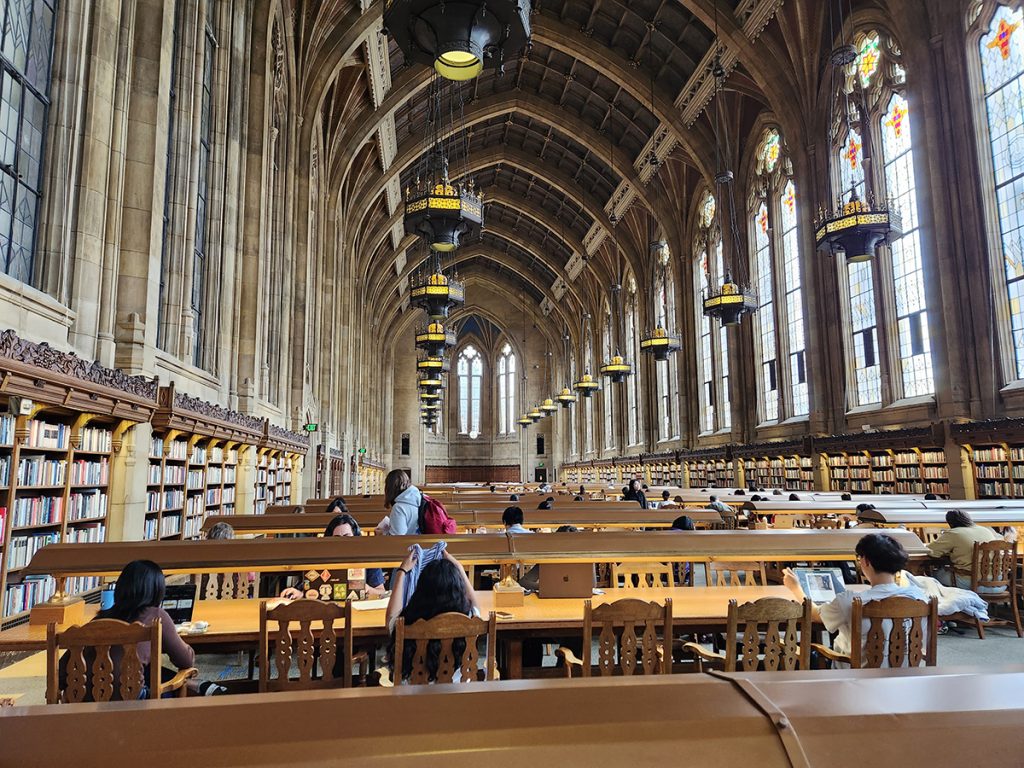
Students study in the Reading Room at the Suzzallo Library. (Credit: Saraphena Wong)
Zhong is on an F-1 visa that designates her as a full-time student, but that alone doesn’t guarantee her stay in the United States. International students on F visas require I-20 forms issued by the university they enroll in, certifying that they have been admitted to a full-time program of study and have the financial means to stay in the country. To continue into graduate school, Zhong must transfer her I-20 to Columbia University in a time-sensitive process.
“I was afraid that if I transfer my I-20 now, I can’t continue my undergraduate study,” she said. “The moment I graduate and finish school here, I will transfer my I-20 to Columbia and they will issue me a new one.”
Despite the stresses of visa management and moving, Zhong is undeterred.
“I cannot imagine myself not studying philosophy,” she said. “Because when I do philosophy, I feel more ‘me’ for some reason… it allows me to express my own opinion, and encourages me to listen to my inner voice a lot more than before. So I think there is anxiety in the air, but at the same time, I feel pretty excited to go on to a new journey.”
For many international students, the clock starts ticking immediately after graduation. If they don’t plan to pursue another degree, the end of their undergraduate program means they technically no longer qualify for an F-1 visa. Without an employer to sponsor a non-immigrant H-1B visa, those who wish to stay in the U.S. to find work have one option: Optional Practical Training. If approved, it allows a new graduate to remain on their student visa for an additional 12 months, giving them time to search for and secure employment.
While Zhong’s concerns center on graduate school and rising living costs, younger students like Yichen Wu are confronting a different challenge: whether they’ll be able to stay in the country long enough to build a career.
“With a STEM degree, after you graduate from college, you have a longer OPT time than other majors,” Wu said. “You can stay in the U.S. on a student visa working for a company longer than other degrees. That’s definitely an advantage.”
Wu is also an international student from China. After graduating high school on the east coast of the U.S., he made the move to Washington state for college.
Wu may be two years from his projected graduation date, but time moves quickly in such a demanding program, he said, and the state of the job market is worrying. He hopes to remain in the U.S., but his plans hinge on whether or not he can find work. Internships are an integral part of finding full-time employment for fresh graduates, and Wu has found that being on a student visa sometimes disqualifies him from the hiring process.
“At the end of the interview, they ask, ‘Are you an international student or a U.S. citizen?’ and I will tell them I’m on an F-1 visa,” he said. “They say they can’t offer an internship for a student visa. What I’m assuming is that they can’t sponsor the H-1B visa, so they don’t want students on F-1 visas to even intern. It happened to me multiple times.”
The employment uncertainty is not an uncommon experience among international students, he added. While he wishes to stay in the U.S., the breadth of opportunities still open to him allow some flexibility in his future plans.
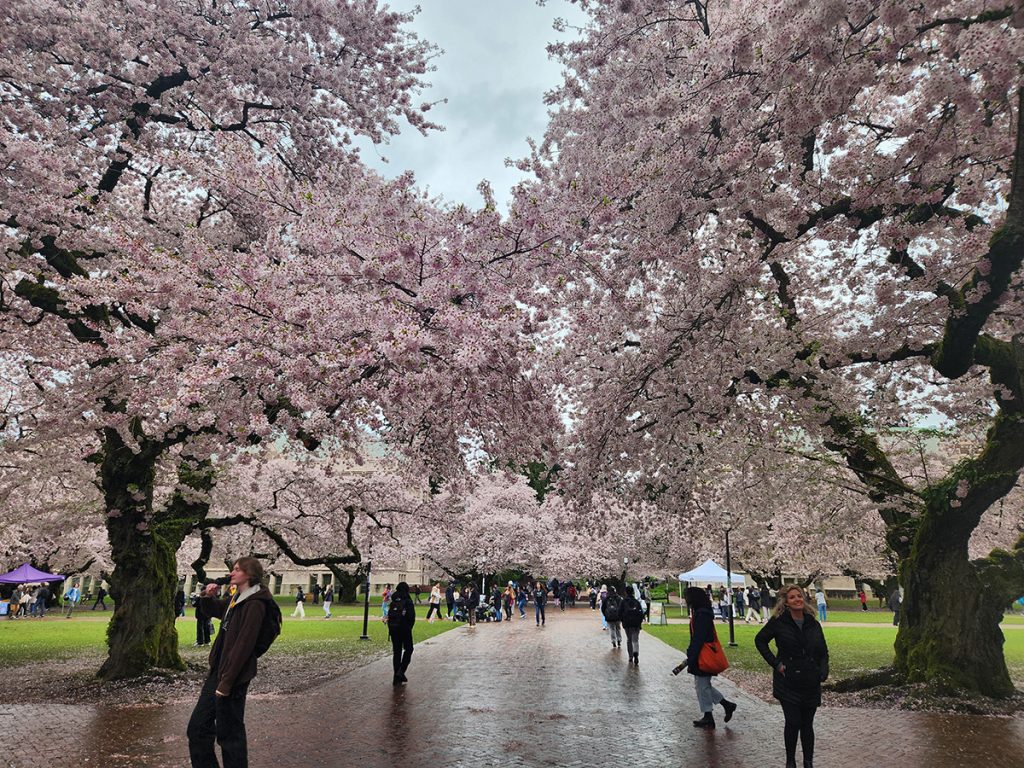
Cherry blossoms bloom on the Quad at the University of Washington campus. (Credit: Saraphena Wong)
“There’s always abilities to do other stuff in the future,” Wu said. “After I graduate, I might stay in the U.S. and find a job, or I might go to a lab and pursue my master’s degree. Maybe it’s not UW — maybe it’s somewhere in California, or the east coast. I can also go somewhere in Asia or Europe to do my master’s degree over there.”
In the humanities field, Zhong also has concerns about future job prospects at Columbia. She works at UW’s writing center and hoped to find a similar position during her graduate studies, but discovered that only a single position exists at Columbia — and is reserved specifically for doctoral students.
“I do want to find a part time job while studying there, but it’s going to be challenging,” she said. “Everybody’s kind of looking for one. But there is a lot more students who are also facing the same difficulty. I think maybe it’s just a difficult time for everyone.”
In the meantime, both Wu and Zhong continue to enjoy university life. Wu volunteers with the Center for International Relations & Cultural Leadership Exchange, which hosts events for international students seeking community and friendship. Zhong works at the Writing Center, tutoring students who want to improve their writing skills. Like most of their other peers at UW, they’re focused on their studies — ensuring a bright future, no matter what comes next.
“I think maybe it’s challenging, but it’s also not impossible,” Zhong said.