



By Kai Curry
NORTHWEST ASIAN WEEKLY
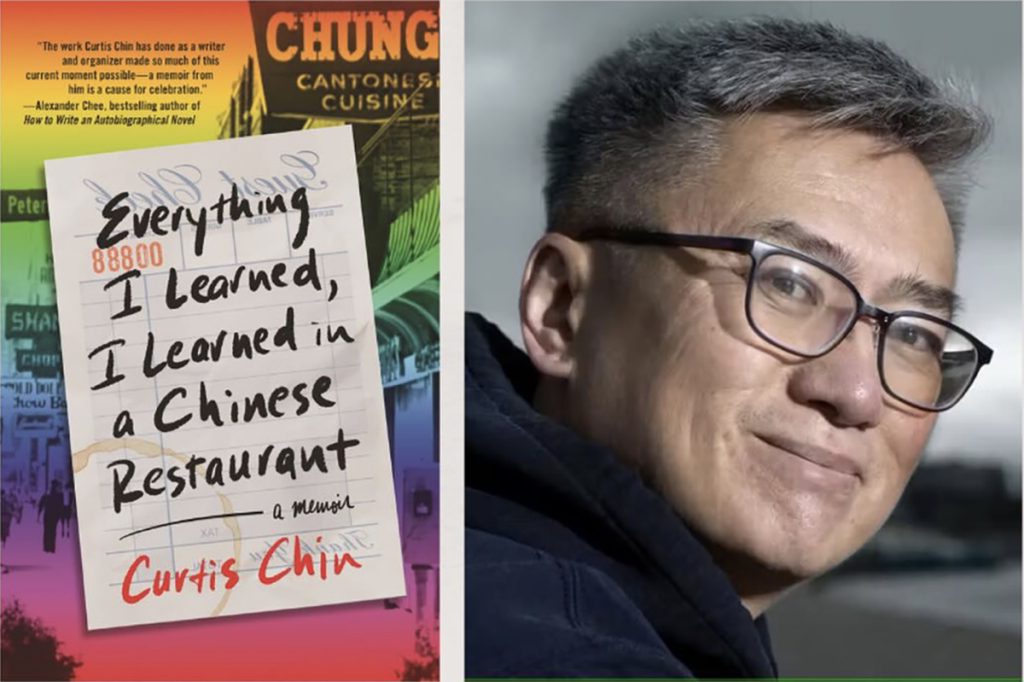
Curtis Chin
Curtis Chin sees the glass as half full. The author of the memoir, “Everything I Learned, I Learned in a Chinese Restaurant,” gave an online talk to the media on May 22. Chin spoke about his book, about being Chinese American and gay, and about the state of the world.
It is possible that Chin’s outlook was not as controversial as organizers had expected. He didn’t struggle as much as some with his identity as a Chinese American, for instance, yet he is very cognizant of being Chinese and American, and of the history of the Chinese in the United States. When asked during the Q&A if things were “worse” now for people of color, and Asians in particular, Chin emphasized that there has actually been some improvement—maybe not so much in the existence of racism, but rather in the community building of minority groups.
“I like to focus on the Asian American community itself and the infrastructure that we have developed,” Chin said. He talked about the murder of Vincent Chin in 1982, an event that is embedded in Detroit history, where Chin grew up. Vincent Chin was murdered at a time in Detroit when there was a lot of hatred towards Japanese immigrants who were viewed as taking jobs from white people in the automotive industry. Vincent Chin was attacked by men who probably thought Chin was Japanese, but any way you look at it, this was a hate crime.
The stereotypes have not changed, the discrimination has not changed, Chin acknowledged. He spoke about the improved representation in industries such as journalism. When Vincent Chin was killed, it took several days for a mainstream newspaper to mention the incident at all, he said. There was no one looking out for this type of story, this type of injustice—or even labeling it as injustice (the perpetrators of Vincent’s murder spent no time in jail). Now, we have Asian American journalists in the newsrooms uplifting stories, Chin emphasized. Although Chinese and other Asian immigrants, including Curtis’ family, have been in this country for a long time, Chin considers the Vincent Chin murder as a kind of catalyst for Asian activism.
Chin started the talk humorously by asking everyone how many egg rolls they thought his family made at their restaurant in total (it’s in the millions). This factoid is part of Chin’s memoir and a regular part of his talks, of which he is becoming a seasoned veteran. On this day, he was fresh off of a multi-country tour. Altogether, so far, he has done about 350 talks since his book was released in 2023. Chin read a portion of his memoir and told the audience his family history. Despite the tensions in Detroit when Curtis grew up, he felt he had a wonderful childhood. “Writing the book was a thank you to my parents for teaching me and my siblings everything we needed to navigate this world,” he said. The book is also a tribute to Detroit, which Chin believes is misunderstood and capable of good things. One thing Chin set out to do, he said, was to represent the life of Chinese immigrants in the Midwest, a slice of American life that he feels is underrepresented compared to, say, Asians in California or the eastern seaboard.
Chin’s family arrived in the United States in the 1800s. Starting in Guangzhou, China, his great-great grandfather traveled first to Canton, Ohio (he hadn’t understood that this Canton had nothing to do with Canton, China). After realizing “there weren’t actually any Chinese people there,” Chin’s great-great grandfather moved to Detroit. The family started in the laundry business, which Chin explained during the Q&A was a little bit of an easier business to start, in terms of staffing and overhead. He then moved into the restaurant industry. Nowadays, Chin said, there are support networks in place for immigrants coming over who want to go into business. Back then, a person was more on his or her own. When the Chinese Exclusion Act went into effect, Chin’s relative was spared because he did own his own business.
In 1940, the family opened Chung’s. The family doesn’t own the restaurant anymore, and Chin does feel regret about that. He would like to keep the legacy alive, he said, but is not sure how yet. Your book is your legacy, said one of the attendees, which may be true because for Chin, his book represents his belief in the power of community. He would like to see more people sitting down in restaurants and talking. “I like to think that Chinese restaurants are going to save America,” he said, only half joking. “Before there were street tacos, there was Chinese food. I think it is one of the few cuisines that has brought Americans of all colors together.”
Chin has become known for advocating for social justice. He jokes it is because he was conceived during the social tensions in Detroit. He believes that a lot of what was happening when he was a kid set in motion much of what is happening today, in terms of racial identity and belonging. “It’s a very topical book,” he said. Once a Republican, Chin has witnessed changes in political parties, and also, much that has stayed the same—such as debates over immigration. His memoir was given the honor of being chosen as “The Great Michigan Read”—which means that the state of Michigan will pay for copies of the book to be given away to schools. Unfortunately, due to funding cuts by the current administration, the number of copies that the state was able to furnish was drastically cut. Chin loves talking to diverse audiences about his book—sometimes he holds the talks in actual Chinese restaurants.
The title of the talk implied there might be some controversy over how Americans are perceived in the countries where Chin has traveled. In fact, Chin found those he met to be friendly and open. “I think everybody’s just really confused about what’s going on in America.,” he said. He observed that, because he is a person of color, people in the places he visits seem to give him more “leeway” than they might a white person—he is obviously not someone in charge, he joked. What people want to talk to Chin about has changed since the book first came out during a different administration. Then, readers wanted to hear about what it was like to open a business as an immigrant, which they still do, but less so. “Now, with this new presidency and because of these things that are breaking down, it’s a different conversation,” Chin admitted. He mentioned Detroit’s close relationship with Canada, for instance, and the fact that Trump’s antagonism of our northern neighbors has been hard for people who consider the Canadians as friends. “We actually like Canadians better than we do people from Ohio,” he joked.
Ultimately, Chin appears to be a cheerful person. Fully aware of the disparities and injustices of today and of the past, he chooses to focus on the positive. As an author doing so many book talks, it’s important to have a greater mission, he said. For him, he said, “It is about using the book to help build friendships and connections with different communities.”
Kai can be reached at newstips@nwasianweekly.com.