




By Carolyn Bick
NORTHWEST ASIAN WEEKLY
Going into this year’s midterm elections, the main issue that’s top of mind for many Asian American, Native Hawai’ian, and Pacific Islander communities is affordability.
“Fifty-eight percent cite that as the top issue. The number three issue is jobs and the economy. Put that together, it’s the economy that remains dominant, as we saw in 2025,” Karthick Ramakrishnan, executive director and founder of AAPI Data, said, during an April 29 briefing on the University of California, Berkeley-based research and policy organization’s 2026 AAPI Policy Priorities Survey results.
The survey, which AAPI Data co-conducted along with the National Council of Asian Pacific Americans, conducted its data collection from March 23-30, drawing random panel members from NORC’s Amplify AAPI® Panel.
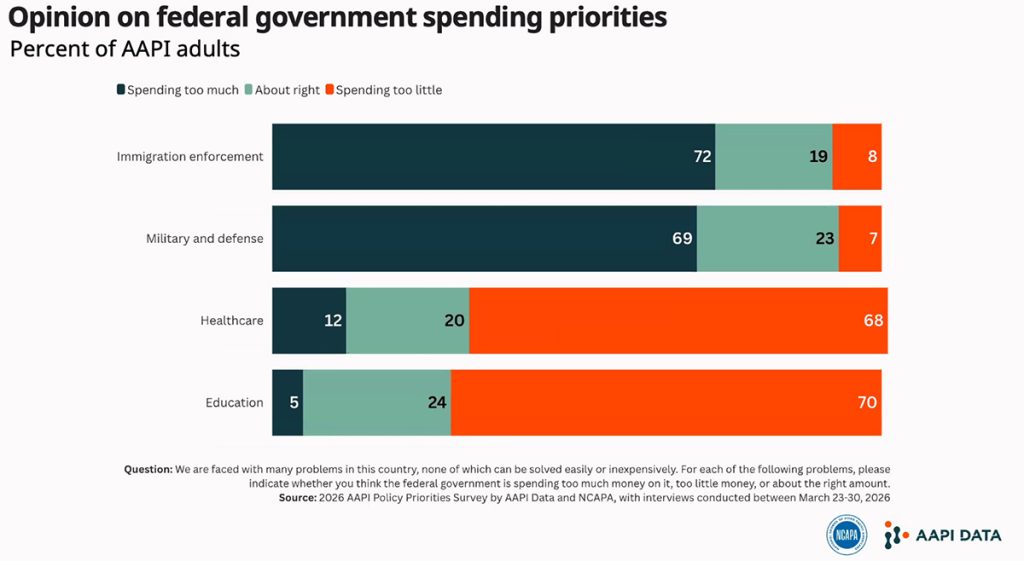
“War and foreign policy has shot up to number two,” he continued, “but if you sift through other data, including on congressional spending priorities, that also comes back to the economy. Essentially, AAPIs think we’re spending too much on military and on immigration enforcement, and not enough on healthcare and education.”
For NH/PIs, climate change is where many other problems begin
There are variations in opinion amongst different communities, Ramakrishnan noted—and for Native Hawai’ians and Pacific Islanders (NH/PI), there’s a nuance to all of this that the data doesn’t immediately show, said Sina Uipi, the director of national policy and advocacy for Empowering Pacific Islander Communities.
Standing at a population of 1.6 million, NH/PIs are one of the fastest growing communities in the country, and have contributed a great deal to its success, she said—but they are still some of the most overlooked and least supported communities in the U.S.
“Right now, our communities are concerned about whether or not they can afford to eat, stay housed, access healthcare, and keep their jobs,” Uipi said.
But she didn’t start with those issues directly, because those issues aren’t where problems start for NH/PI communities. Instead, she started with climate change, “because climate displacement is an affordability crisis, and that’s where it starts for many NH/PI communities.”
“It increases insurance, destroys crops, contaminates water, forces migration into cities where the safety net is being cut simultaneously,” she said. For instance, she said, this year, Hawai’i has been hard-hit by several storms, many of which completely destroyed houses and infrastructure. The northern Mariana Islands just weathered a typhoon. And yet, there are ongoing federal cuts to the Federal Emergency Management Association, the National Oceanic and Atmospheric Administration, and different climate resiliency programs that provided buffers for island and coastal communities.
NH/PI communities also suffer a disproportionately high rate of diabetes, high blood pressure, and cancer, Uipi said. But with the federal government’s decision to slash Medicaid—upon which many NH/PIs rely on—the affordability crisis only compounds within these communities. Families who are forced to cover their own insurance costs may choose to forego insurance, leading to more emergency room visits, unmanaged conditions, debt, and early death.
For immigrants from Compacts of Free Association (COFA) nations—the Federated States of Micronesia, the Republic of the Marshall Islands, and Palau—she continued, new federal regulations threaten their access to programs like Head Start and community health programs. While court injunctions have temporarily blocked such restrictions, this doesn’t mean these programs will remain accessible.
“For COFA nations, signed compacts grant their citizens the right to live and work in the U.S. in exchange for decades of military use of their lands, including nuclear testing in the Marshall Islands,” Uipi said of the rights of COFA immigrants. “COFA migrants also received full federal benefit eligibility in March of 2024, and had it partially rolled back within 16 months, with further restrictions currently blocked in court.”
Such crises are not separate, she emphasized, and elected officials have direct effects on whether they worsen.
“Climate displacement forces migration into a system that has already cut the programs to receive them and leave our ancestral homes unprotected,” she highlighted. “Low wages make housing unaffordable. Unaffordable housing leads to overcrowding and poor health outcomes. Medicaid cuts leave chronic conditions untreated. SNAP cuts mean families go hungry trying to make rent. And COFA cuts break a formal federal promise to people who’ve been displaced. Our communities have survived colonization, migration, and a pandemic.”
Fears over immigration
Accompanying AAPI’s main midterm issues are increasing concerns regarding constitutional rights and personal autonomy, particularly when it comes to First Amendment rights and protection from unreasonable search and seizure.
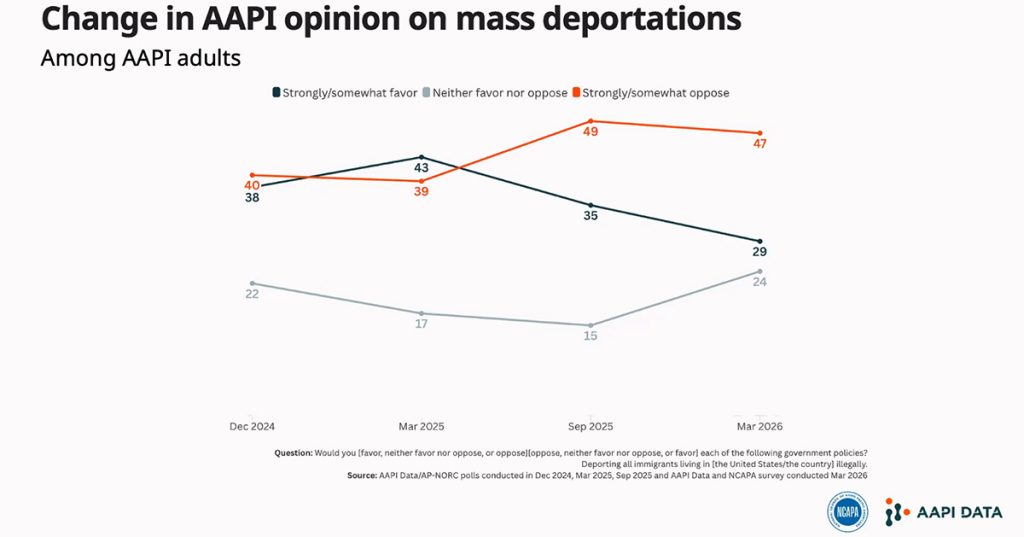
Ramakrishnan highlighted that recent events appear to have distinctly impacted some respondents’ opinions. Since 2024, AAPI Data has asked respondents about deporting all undocumented immigrants on several different surveys. While there was a fairly even split between supporting and opposing this in December 2024, and even into March 2025, by September 2025, there was a sharp split that has continued, with more respondents opposing deportations.
“It’s likely that the major enforcement actions in Los Angeles and Chicago last year, as well as the more recent actions in Minneapolis, have played a considerable role—not necessarily because people have direct ties to communities there, but also because of the media coverage that has been generated, both in mainstream media as well as in ethnic media,” he said. “We see continued opposition to many tactics, like conducting large-scale immigration raids, allowing immigration enforcement agents to wear full face masks, as well as conducting immigration enforcement in places like sensitive locales, like schools and hospitals.”
In addition to more than 80% of respondents supporting requiring that immigration agents wear body cameras, close to a majority of respondents also supported eliminating Immigrations and Customs Enforcement (ICE) altogether.
“I think the data results are not surprising at all. I think we’ve seen that Immigration and Customs Enforcement and Customs and Border Protection (CBP) have been terrorizing our communities for over a year and a half at this point,” said Kham Moua, the national deputy director for the Southeast Asia Resource Action Center. Of all Laotians and Hmong the U.S. has deported since 1998, he said, the country has deported more than 60% of them between 2025 and 2026. Of all Vietnamese the U.S. has deported since 1998, the country has deported half of those between 2025 and 2026.
“This administration has done so much damage to those communities, including mass raids of our communities, going after undocumented populations, going after anyone who looks like they might be an immigrant, and, quite frankly, expanding the definition of what criminality looks like and who they can try to remove or go after for minor convictions or crimes,” he continued.
Moua, who grew up in Minnesota, said that he believes that “what we saw in Minneapolis and in St. Paul was a flashpoint for our communities. We saw Immigration and Customs Enforcement go door-to-door looking for Hmong and other Asian American families.”
“We saw that they basically trampled on the rights of our communities regardless of their immigration status, racial profiling the people in our families, in our neighborhoods,” he said. “We saw them ignore due process protections, violate our communities, and be violent with them when they dragged them out of their houses in the middle of the night or left them outside detention centers in Houston, hundreds of miles away from their home with no one to pick them up. And I think we’re sick of it.”
Kelvin Lum, who serves as the director of federal policy for Stop AAPI Hate, said that for more than a year, Stop AAPI Hate has been working to help people understand that anti-immigrant sentiments are a form of anti-Asian hate, against the background of an increasing number of anti-immigrant policies.
“We’re really seeing a trifecta of anti-Asian hate playing out, from hate acts, rhetoric, and now the rise of policies that are targeting our communities that only fuel dangerous rhetoric and continue high levels of hate acts,” he said.
First Amendment rights, voting rights under attack
Thu Nguyen, the national director of OCA, highlighted that freedom of speech is under attack, as are voting rights. Earlier that day, the Supreme Court severely weakened the Voting Rights Act, a 60-year-old piece of legislation that protected U.S. citizens from race-based discrimination in voting and representation.
“Even [starting in] late 2023, but increasingly so through last year and now, is the attacks on freedom of speech. On college campuses, we’ve seen students’ freedoms of speech under attack,” Nguyen said. “Most of our movements that we have known have started with youth-led movements on college campuses. It is critical that our university and college leaders protect our students’ ability to speak freely.”
She also pointed to the “administration’s blatant attacks on freedom of speech through the Federal Communications Commission,” referring to the unprecedented moves the Trump administration has made to crack down on news outlets and news-based entertainers, like Jimmy Kimmel.
“This administration is allowing a single entity to control up to 80% of American TV viewership,” she continued, referring to the takeover by Trump loyalist David Ellison of several media companies. “We are basically pipelining into essentially what could end up being a state media that propels what propaganda that is coming out of certain outlets and certain viewpoints. Our American TV viewers won’t be able to have diversity of content. They won’t be able to get local media and news reporting about their own community. And we really need to put a stop to this.”
Lum cited a survey that Stop AAPI Hate conducted, which revealed that 39% of respondents reported withdrawing from public life—including becoming less politically and civically engaged.
“Drilling down more into the threat of freedom of speech concerns over immigration enforcement is going beyond just the fear of these rights being taken away. Our community members are actually changing their daily habits because of it,” Lum said, explaining the link between anti-immigration policies and voter suppression. “According to our survey, one quarter of respondents said that they or an individual they personally know changed their social media presence, while a similar number became less civically or politically active.”
Nguyen noted that OCA has partnered with different organizations, as well as legislators, to push forward the Vote Without Fear Act, which would prohibit firearms within 100 feet of federal election sites.
“This is a bipartisan issue. We don’t want voter intimidation for anyone. We want everybody to be able to go out and vote at the polls,” she said. “So, it’s really concerning, and we’re glad to see that the data shows the API community is paying attention to the attacks on our freedom of speech and our freedom to vote. We need to continue keeping the spotlight on those two issues, and we need to turn out at the polls this fall.”
Readers can find the disaggregated survey data here.