




By Andrew Hamlin
NORTHWEST ASIAN WEEKLY
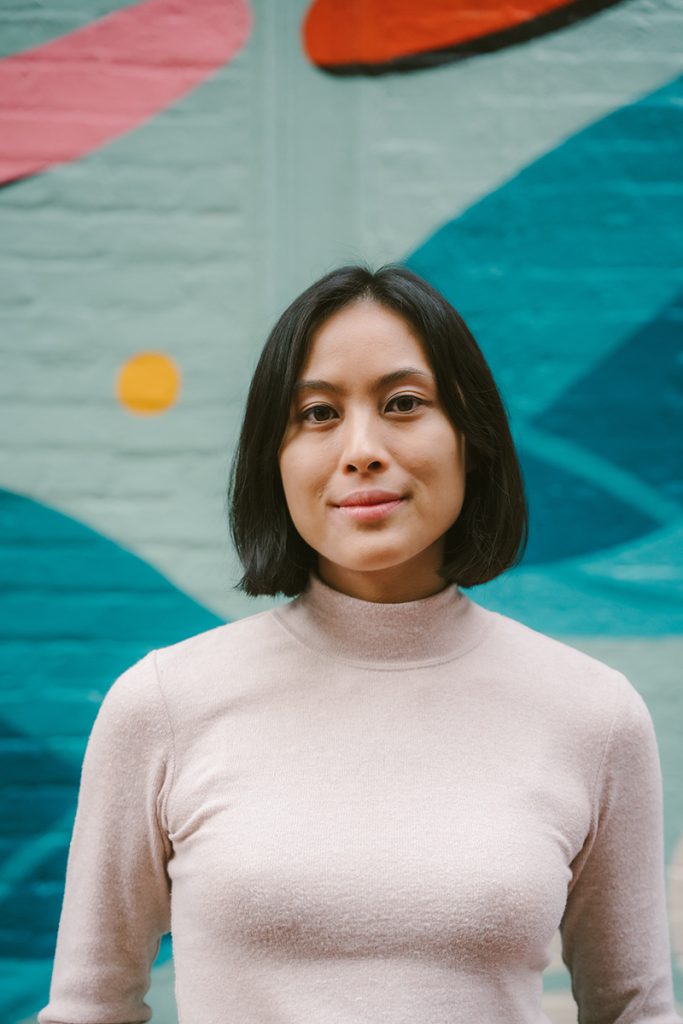
Hai-Li Kong
Not being able to communicate with your relatives could well seem like a horrible predicament. But Hai-Li Kong, a film editor and director with an entry in the Cadence Video Poetry Festival at the Northwest Film Forum, chooses to view language barriers from a broader perspective.
“I speak English fluently, and my Mandarin Chinese is elementary,” explained Kong, whose entry “Snow” features in the festival. “My family often waffles between English and Chinese in conversation, sometimes even in one sentence, which I love. It’s a verbal marker of immigration and straddling multiple worlds.
“The inability to speak languages also impacts me. I don’t understand Hokkien or Cantonese, the dialects of my mom and dad, respectively. At large family gatherings, I often get totally lost in the conversation. It is frustrating to know I am missing out on stories and I feel like I can’t fully connect with my family. At the same time, hearing these dialects feels nostalgic and comforting.”
When she shot “Snow,” she put text front and center in the frame, as opposed to at the bottom like a subtitle. This approach tends to “call attention to the importance of language. As [cognitive scientist] Lera Boroditsky posits, language isn’t just a tool for communication. It can also be a site of identity, distance, and connection all at once.”
Kong grew up near Washington, D.C. in suburban Maryland. “My favorite memories are along the Billy Goat Mountain trail. It’s a stunning hike and anytime we had visitors, my family would take them there for a fun excursion. My friend and I also did the trail nearly every day the summer after graduating college, talking about what the future might hold. And I still make an effort to hike with my parents whenever I visit home.”
She attended Harvard University, where she credits professor and filmmaker Alfred Guzzetti for exposing her to crucial influences, such as Chris Marker’s “Sans Soleil” and Victor Erice’s “Dream of Life.” Another crucial influence, discovered outside of class, was Zhang Yimou’s historical epic “To Live.”
“The most important lesson I took away was: There is no such thing as nonfiction, in the sense of objective truth. All stories are told through someone’s perspective. All images are captured through someone’s eye.”
Asked how her Chinese identity influences her life and work, she replied, “I think of this question in the opposite way. Filmmaking gives me the structure to engage more
slowly and deeply with my identity, whether that be defining what being part of the Chinese
diaspora means to me, or balancing that part of myself with other identities.”
 She’s shot video poetry before, but this is her first piece that’s gotten into a festival. “Video poetry is more about conveying a mood or a musing, rather than a story with a beginning,
middle, and end. There’s not necessarily a precise point or argument to get across. It is just something to experience. The form can be much more abstract.
“Production-wise, I like to use whatever is easily at hand to capture everyday life, which is mostly my iPhone. I don’t find myself wanting the higher-end cameras I would usually seek out for a more traditional video. I think there’s something to making video poetry out of everyday digital scraps.”
The video piece opens with a poem written by Kong’s late aunt, Cheng Sait Chia. It then moves into Kong’s conversation with her own mother, about the poem, and the mother’s family life.
“The biggest surprise I had was learning that my mom and aunt didn’t know each other well. That in fact, for most of their relationship, they didn’t have a shared language. My mom is
now so close with all her siblings, that it surprised me to learn that that wasn’t always the case in their youth when war divided the family.
“Audio came first for this one. I just felt it was really important to capture this conversation I was having with my mom. The visuals were kind of by chance. It happened to be snowing when I was working on this project and thinking a lot about snow. Looking at the falling snow outside my bedroom window gave me a strong wistful feeling. So I filmed it.”
Asked about future plans, Kong said, “I will continue to work on a combination of documentaries, experimental film, and commercial work to pay the bills. I am also starting to explore narrative filmmaking.”
The Cadence Video Poetry Festival shows April 17-30 online and April 17-19 in person at the Northwest Film Forum, located at 1515 12th Avenue on Seattle’s Capitol Hill.
For prices, showtimes, and other information, visit https://nwfilmforum.org/festivals/cadence-video-poetry-festival.