




By Carolyn Bick
NORTHWEST ASIAN WEEKLY
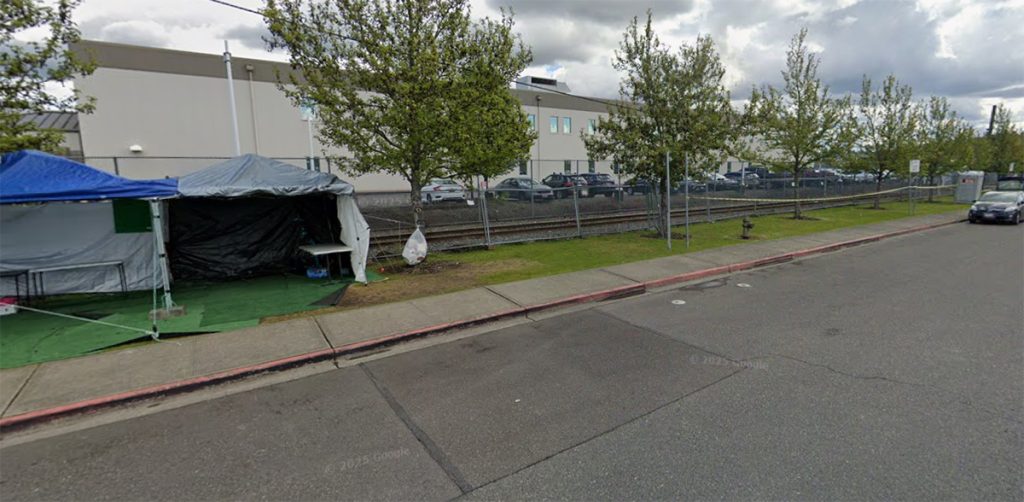
The Northwest Detention Center in Tacoma (Screen capture from Google Street View)
Over the course of just three years, the state has received more than 3,500 complaints about the conditions inside the Northwest ICE Processing Center in Tacoma. The facility is one of the largest in the country, and has time and again come under the spotlight for complaints regarding conditions inside. These complaints allege everything from moldy, raw, or bug-infested food and poor drinking water quality to outright physical abuse and sexual assault.
Following a 2023 state law mandating that private detention facilities adhere to specific health and safety standards, the state’s Department of Health (DOH) has repeatedly tried to inspect the facility—but GEO Group, the private detention corporation that operates the facility, has resisted. Even after a 9th Circuit Court of Appeals decision last summer tossed out a Seattle judge’s injunction barring DOH officials from inspecting the facility, the corporation still refused to comply, instead filing an appeal.
And now, the state is taking the corporation to court about it.
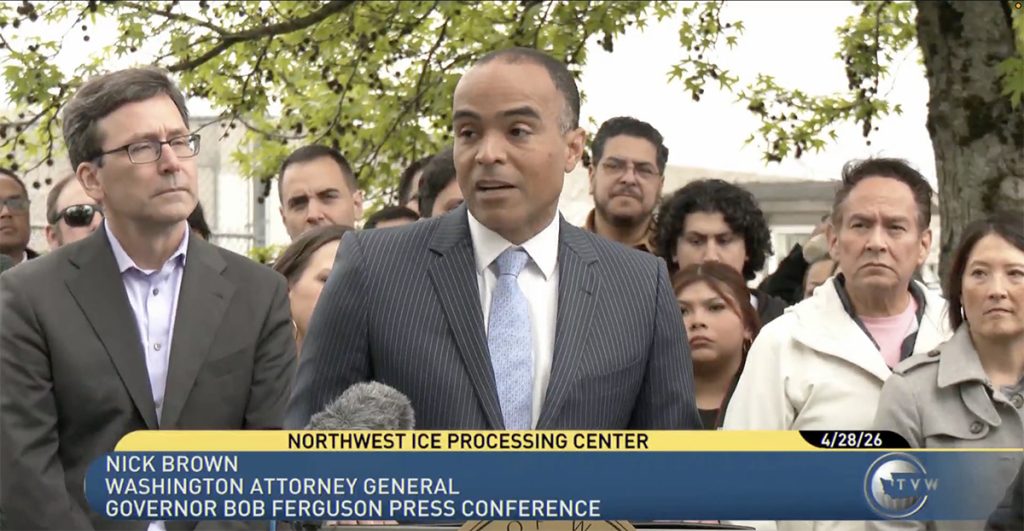
Gov. Bob Ferguson and state Attorney General Nick Brown announced at a news conference outside the detention center on April 28 that Brown and his office have filed a preliminary injunction to allow DOH inspectors inside.
A false choice between illness and hunger
In total, Ferguson said, the DOH has tried 10 different times to get inside the facility, and “[t]hey’ve been turned away all 10 times.”
More than 990 of the complaints regard water, food, and air quality, Ferguson said. Detailed in those complaints are things like “food is contaminated with burned plastic, metal string, splinters, hair, and worms.”
“Detainees report that the food—and I’m quoting now—‘appears rotten, has been served on dirty trays, and contains bugs,’” Ferguson read. “They state the food tastes bad, smells bad, and that they do not receive enough.”

“One complaint reports that, quote, ‘Yesterday for dinner, they served us raw meat. You can see the blood inside the meat. Many of us in the unit, 54 people, chose to throw it away, but others made the decision to still eat it because they were hungry,’” Ferguson continued, reading from an incarcerated person’s complaint. “‘Today, around 15 people woke up sick due to the food from last night.’”
The water, another person said in their complaint, “tastes disgusting. It does not taste like normal water you usually drink, which makes sense because all the staff here bring in their own water bottles because they know the water here is not safe to drink.”
Refused proper medication, basic sanitation
About 900 complaints address the lack of medical attention and access to medication.
“One individual reported being admitted to the hospital for a medical emergency, but when he was released, GEO staff refused to give him the medication he was prescribed,” Ferguson said. “Instead, they gave him ibuprofen, allowing his condition to get worse.”
People inside the facility have also filed more than 650 complaints about the unsanitary conditions in the facility. One person reported that not only are they not allowed to launder their own clothes, but they are not given clean clothes, either. In the rare event facility staff do launder clothes, “the clothes come back wet and dirtier than before. One person reported that, quote, ‘A few days ago, I asked them to change my boxers, and they brought me ones that were dirty and belonged to somebody else. The socks are also used and smell bad.’”
There are also reports of sheets not being washed, even after someone is sick with an infectious disease, including chicken pox or COVID. One person with mental health challenges “soiled their clothing but was refused clean clothing by one of the guards.” There are also many reports of black mold in the showers, and a recent complaint said that there are only two working bathrooms for about 100 people to use.
Sexual assault
More than 100 complaints detail both physical and sexual assault.
While those are not the purview of the DOH, WHO said, DOH staff would note them and send those on to the Tacoma Police Department. When asked whether the state would seek to file individual criminal charges, Ferguson noted that the state has to get inside first.
“But as you heard, all the complaints are serious. … There are some that obviously are … things that are crimes,” Ferguson said. “As you heard from the department, if there are allegations of criminal activity, that gets referred to the appropriate individuals. So, in some ways, the state has the authority. Sometimes you go to prosecutors. It will depend. … When they rise to that level, we have the appropriate place we can go.”
“Others give up completely”
Just this month, said Malou Chávez, executive director for the Northwest Immigrant Rights Project (NWIRP), immigration agents detained more than 1,200 people.
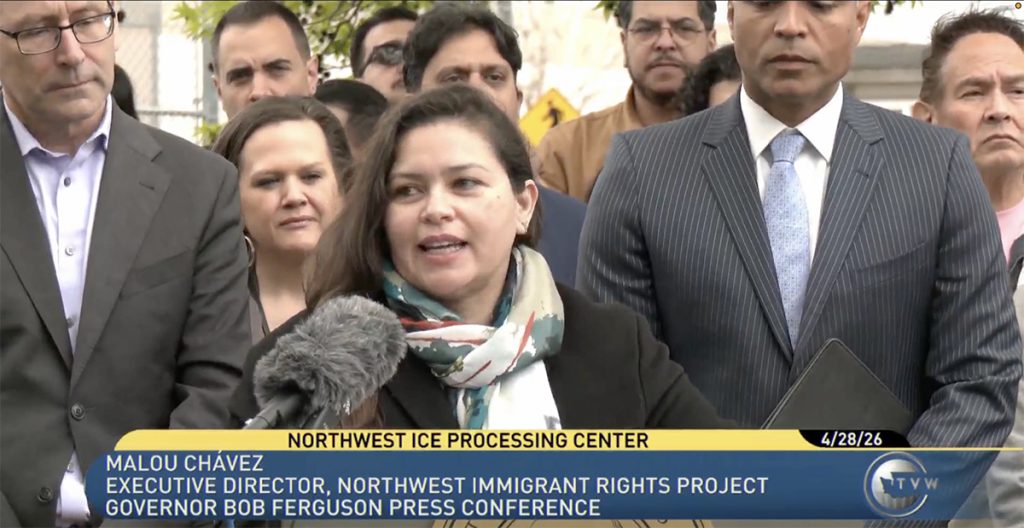
“We know the federal administration has a stated goal of mass detention, mass deportation for immigrant communities,” she said. “Beyond the legal challenges and due process slipping away, our client communities are facing dire conditions while detained.”
Even when they win immigration protection, she said, the center continues to hold them, as the federal government appeals the decision.
“Others give up altogether because of the conditions they face and the inevitable mental health toll that they’re facing that the detention imposes on them,” she continued.
She specifically thanked La Resistencia, a grassroots immigrants rights group led by undocumented immigrants, for their work. The group has long worked on the frontlines to not just support undocumented immigrants and their families, but also to shut down the detention center and monitor deportation flights from King County’s Boeing Field.
“Much of what we know through their work led Washington state to take action. The conditions facing our clients, neighbors, and loved ones are many,” Chávez said. “Abusive conditions are present, and solitary confinement is a practice. … Across the country, 2025 was the deadliest year in immigration detention in over two decades. And 2026 is shaping up to be even deadlier.”
Repeated refusal to follow the law
Ferguson himself has faced GEO Group in court when he was the state’s attorney general. Together with the NWIRP and the ACLU, Ferguson filed a 2017 lawsuit against the detention corporation for only paying inmates $1 per day—and sometimes only giving them extra food or snacks—to effectively do every single job inside the facility, except serve as security. These jobs included things like cleaning floors and washing dishes.
But still, GEO Group has resisted, and has dragged out the suit for years, including refusing to pay a court-ordered sum of $23.1 million—not once, but twice. In 2021, a U.S. District Court found that the company had violated the state’s minimum wage law, and ordered the company to pay workers $17.3 million in backpay. A federal judge ordered the corporation to pay Washington an additional $5.9 million in penalties.
Instead, GEO Group suspended the work program and fought the order, even after the 9th Circuit Court of Appeals rejected the corporation’s appeal in 2025, and instead upheld the pay order.
To date, the corporation still hasn’t paid a dime.
Next steps
DOH officials won’t be allowed inside immediately. The case first has to go to court.
Brown said that he anticipates the state will win, but still explained the process, starting with the assumption that GEO Group will likely oppose the state’s motion for a preliminary injunction.
“And then our lawyers will go to court and do what they do most often, which is win,” he said. “What’s going to happen, ultimately, is we’ll have access to investigate the complaints. It’s a basic duty of the Department of Health. It’s an important one for any Washingtonian who has a complaint. GEO Group is not special. They don’t get to ignore those laws. They don’t get to ignore those requests from the Department of Health, which are entirely lawful.”