


By Samantha Pak
NORTHWEST ASIAN WEEKLY
The Elsewhere Express
By Samantha Sotto Yambao
Del Rey, 2026
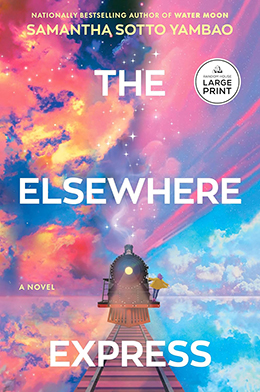 Welcome to the Elsewhere Express. You can’t buy a ticket for the train as it only appears to those whose lives are adrift and carries very rare and special cargo: a sense of purpose, peace, and belonging.
This being said, it’s no surprise (to the readers) that Raya finds herself on the train. She once dreamed of being a songwriter, but after her brother died, she gave up on that dream and started living his life instead. On the train, Raya meets Q, an artist who, like her, is in need of a little direction. Together, they discover a train built on thoughts that runs on faith.
But over the course of their night, they discover things aren’t as magical and wondrous as they seem. Along with Raya and Q, it appears that a stowaway has also boarded the train—and along with their dark magic, threatens to destroy the train. So now Raya and Q, along with others aboard, must work together to get to the bottom of the stowaway’s identity and get them off the train.
“The Elsewhere Express” is a story of two lost people finding each other and themselves. Both Raya and Q are at a point in their lives where they are just going through the motions. Life hasn’t turned out how they wanted and they’re trying to figure out where to go from here—thus they’re boarding the Elsewhere Express. This is a story about the importance of connection and the impact we can have on others, and their impact on us, in even the smallest ways, that could lead to life-changing consequences.
One of my favorite things about this story is Yambao’s world building aboard the Elsewhere Express. From songs that repair the train, to vows to hold train cars together, her imagination seems endless and will have readers daydreaming in the hopes of punching their ticket for the train.
Lost Souls Meet Under a Full Moon
By Mizuki Tsujimura, translated by Yuki Tejima
Scribner, 2025
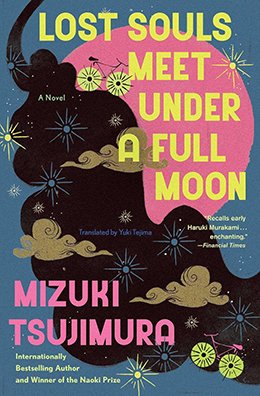 If you could meet anyone who has died, who would it be? The idea seems impossible, but not with the go-between. In Tokyo, the go-between arranges meetings between the living and the dead—a once-in-a-lifetime opportunity for folks who wish to see their loved one, one last time.
While the thought of meeting the departed is unbelievable, something that’s just as unbelievable is the fact that the go-between is a teenage boy, dressed in a designer duffel coat, and carrying a tattered notebook. But Ayumi Shibuya is in fact who he says he is. Here, at your service.
From a young woman requesting to meet a recently deceased TV star who once helped her and a resentful eldest son who wants to ask his mother one last question, to a teenage girl who blames herself for her best friend’s death and a business man in search of his fiancee who disappeared just days after he proposed, Ayumi connects them all.
“Lost Souls” is a very human story about what it means to get closure. Sometimes it’s about grief, but not always. Each person has their own personal reason for wanting to meet the people they’re drawn to. Tsujimura does a great job of showing readers a range of why our characters seek out the go-between. Sometimes it’s guilt, sometimes it’s grief, sometimes it’s practicalities, and sometimes it’s to simply say thank you. No reason is wrong, and no reason is right. But we also see that not everyone receives what they seek.
While we see what these meetings mean to the living, they also raise the question of what they mean to the dead. Do the deceased also get closure from these meetings, or do they feel they are called upon simply to serve the living? Tsujimura raises a number of existential questions, but good questions that we should be thinking about when it comes to life and death.
The Satisfaction Cafe
By Kathy Wang
Scribner, 2025
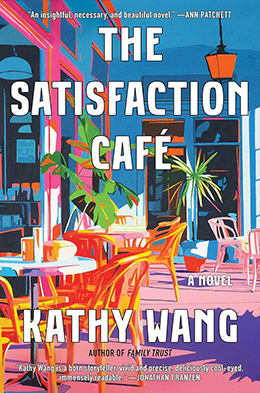 Joan Liang’s life has been a series of unexpected events. As the youngest daughter, she never expected to move from Taiwan to California. She never expected her marriage to fall apart as quickly—and spectacularly—as it did. And she never expected to then fall in love with a much-older man with grown children and become his fourth wife, and mother of his youngest children. But that was the hand Joan was dealt, and that was the life she lived.
In her later years, with her children grown and now a widow, Joan makes a huge change. She opens the Satisfaction Cafe, a place where customers can find connection through conversation, building community, and creating a space where people can go and be a little less lonely.
“The Satisfaction Cafe” is a story about what it means to be human. Told mostly from Joan’s perspective—with a few other characters’ points of view interspersed throughout—we meet a cast of characters with different approaches to life. Even when they grew up in the same family. We see how different people cope with adversity, grief, and even success. Some handle things better than others, just like people in real life.
Joan is a strong, multifaceted woman. She’s not perfect, and definitely has her flaws. But she’s doing the best she can in a world where she hasn’t been exactly welcomed in. Some of my favorite moments are when she stands up for herself and others when they’ve been wronged. She truly shines then, and bucks the lotus flower stereotype in so many ways. Though there are other times when I would have loved to see her make different decisions. But that’s not how life works. People aren’t always going to act however you want them to. And it’s always good to remember that.
Leave a Reply