



By Kai Curry
NORTHWEST ASIAN WEEKLY
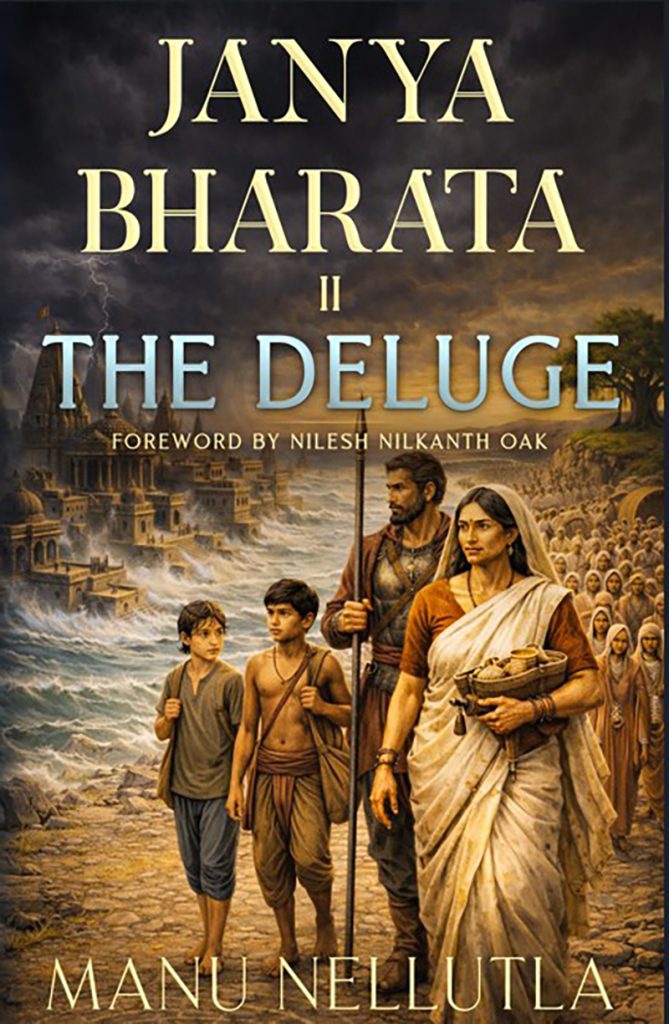
An immigrant has a unique view on their home country. It’s a view that a person who has never left does not have—and cannot have. Leaving, or even going back later, sometimes causes a person to look at their native land in a new way. It might lead, as it did for M (“Manu”), to inquiring about ancient legends and ways of life. The Northwest Asian Weekly interviewed Nellutla about his upcoming book, “The Deluge.” It is part of a two-book series titled “Janya Bharata”—or the common people’s epic—and it is a new take on the “Mahabharata,” one of India’s most sacred and well-known original stories.
Courtesy of Manobhiram Nellutla
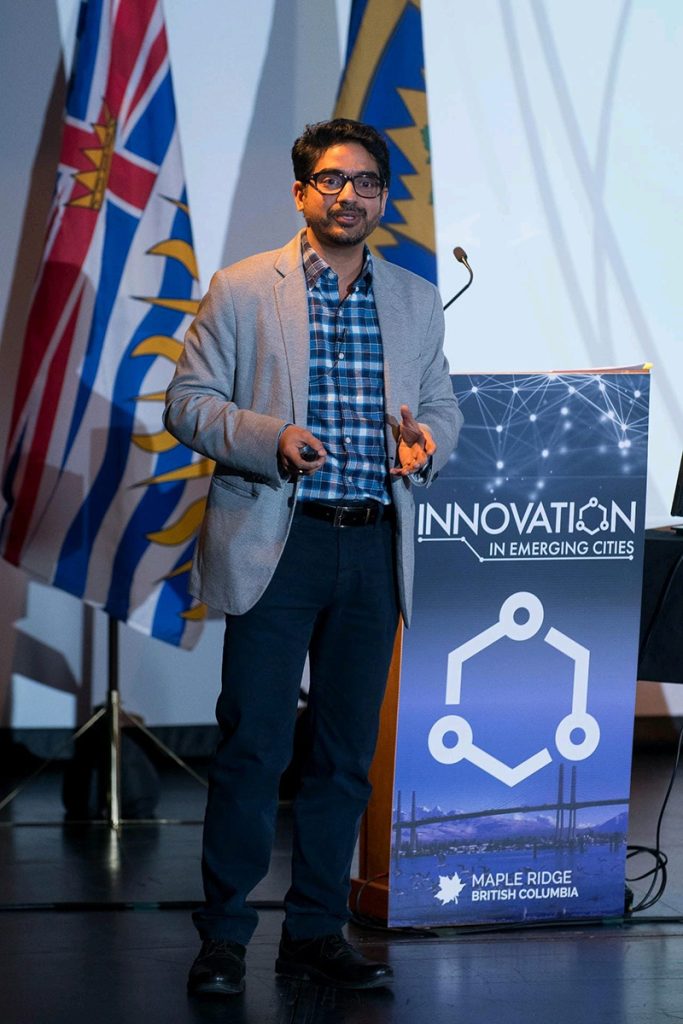
Nellutla, a Canadian citizen of Indian origin, moved to Seattle from Surrey in Canada for the opportunity to work at Amazon. It was sort of an experiment. Nellutla runs on curiosity. Already a global citizen who had spent time in Rwanda, for example, and with a successful track record in more than one industry, heading industry organizations, not to mention multiple degrees, he simply wanted to know what it might be like to change things up. Nellutla works at Amazon as a Program Manager in Health and Safety. He also continues to do management consulting in Canada, runs a podcast, has been on TEDx, and, oh yes, writes books.
Life in other countries aside from India has allowed Nellutla to look back and forward at the same time. He has sought to gain a greater understanding of his own cultural background and of his mother country. For this reason, he turned to an examination of the “Mahabharata,” one of India’s oldest epics, which is treated as a true story by many Indians. The “Mahabharata” deals with the divine, in the form of the god Krishna, and also primarily with royalty.
“So many people believe that this happened,” Nellutla said, and pointed out that this amounts to around a billion people accepting the story as telling about real events and real heroes. There are places in India that exist that are in the story, such as the city of Kurukshetra, where the big battle occurs. “If so many people believe in that, but the story is all about the royals, the demigods, etc.,” Nellutla wondered, “then what was happening to people like me or you? What was happening to common people who were just going on with their lives?”
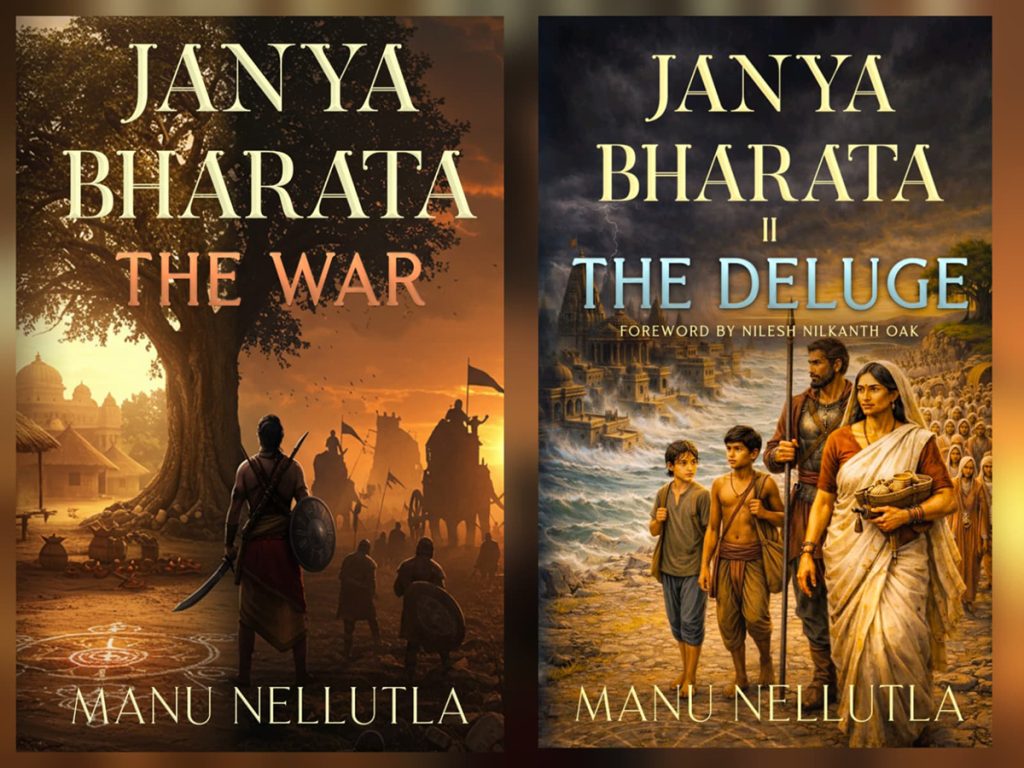
Surely, in a war of the scale represented in the “Mahabharata,” a fight between two rivals for a throne, the Kauravas and the Pāṇḍavas, there must have been thousands, if not millions, of soldiers and civilians who were affected, Nellutla suggested. He decided to write a book about it —about the common people during the events of the “Mahabharata.” He called it “Janya Bharata,” which means epic of the people, of the commoner. It is an alternative, and a complement, to the original legend. The first book, called “The War,” tells of the village whose men are called upon to join the Kauravas in the fight against the Pāṇḍavas. Specifically, it tells of a husband, wife, and daughter, what happens when the men go away to war, and what happens when the women and children are left at home to fend for themselves.
Courtesy of Manobhiram Nellutla
“Why must common folk like us be ensnared in this dispute between royal families?” the wife, Dhruti, asks in “The War.” “Do the Pāṇḍavas and the Kauravas truly grasp the cataclysmic consequences of this war?” If you hear echoes of mothers from every war that has ever been, then you are not wrong. Nellutla means this series to be a commentary not just on the events of the “Mahabharata” and Indian history, but on the greater history of our warlike planet. The second book also covers both a past and a current concern—that of climate change. Called “The Deluge,” and just launched on April 16, the second book in the “Janya Bharata” series takes place 36 years later. It relates to a curse that Gandhari, the mother of the Kaurava men, put on Krishna after the deaths of her sons in the war. Like so many, she questioned a deity that could allow such destruction, and not intervene. She doomed Krishna and his heirs to a similar destruction, which took place 36 years later, in the form of a flood that wiped out their city.
The protagonist of “The Deluge” is a woman—the daughter from book one, Purna. The spotlighting of women’s roles in ancient India—their equality to men and their equal responsibility and talent—is purposeful. Purna grows up to be a geologist who suspects that something is going on with the water level, and is ignored by the powers-that-be. “Nobody in charge is taking it seriously,” Nellutla explained, in the same way that global warming today is not taken seriously by many. Nellutla chose a scientific approach to the story and the time. He wanted to analyze and recount how the events of “Mahabharata,” and afterwards, could have happened, in a realistic way. This included returning women to a place of prominence that perhaps later patriarchal societies have tried to whitewash. In “Janya Bharata,” women are educated, they are fighters (Krishna’s wife, famously, was a warrior), they are respected.
“They say that almost 14 million men died in that war,” Nellutla told us. “That would be devastating.” That would annihilate entire tribes, entire villages. So if that really happened, what was it like for those common people? In the second book, Nellutla uses scientific reasoning to understand how the flood happened, a flood for which there is scientific data of its existence. This real life flood started as far west as the Strait of Gibraltar and is known to have submerged Dwarka, an ancient city located in present-day Gujarat, India. In this way, Nellutla skillfully weaves together the myth and the reality. “People can easily relate wherever they are,” Nellutla assured. “They can relate to the current society, while also learning about Indian culture. My hope is that, when people read these books, I want them to get inspired.”
Manobhiram Nellutla (Courtesy of Manobhiram Nellutla)
Inspired to be curious, as Nellutla is every day. Inspired to learn more about history, the stories, and the true events behind them. Inspired to learn more about other cultures, or their own. For these reasons, “Janya Bharata” is a treasure trove of vocabulary and cultural concepts, while still being entirely readable. How does Nellutla do so many things at once? He is fueled by his inquiring nature. But also, he is driven by a near-death experience. In 2024, a cardiac arrest caused him to fear for his life—and fear that he would never finish this series. “It was very emotional for me to go through,” he said. He survived and with as much love for life as ever.
“They call me polymath in progress,” he told us, about previous articles written about him. “I love learning things, doing things, exploring things, and writing became a part of that.” Nellutla lives in Seattle, while his wife and two sons live in Canada. Nellutla is now working on a second series of speculative fiction. He spends a lot of time with family members who also live in Seattle. The “Janya Bharata” series can be found where books are sold. As of the first days of release, “The Deluge” is trending number one in Indian Literature books on Amazon.
Kai can be reached at newstips@nwasianweekly.com.