





By Carolyn Bick
NORTHWEST ASIAN WEEKLY
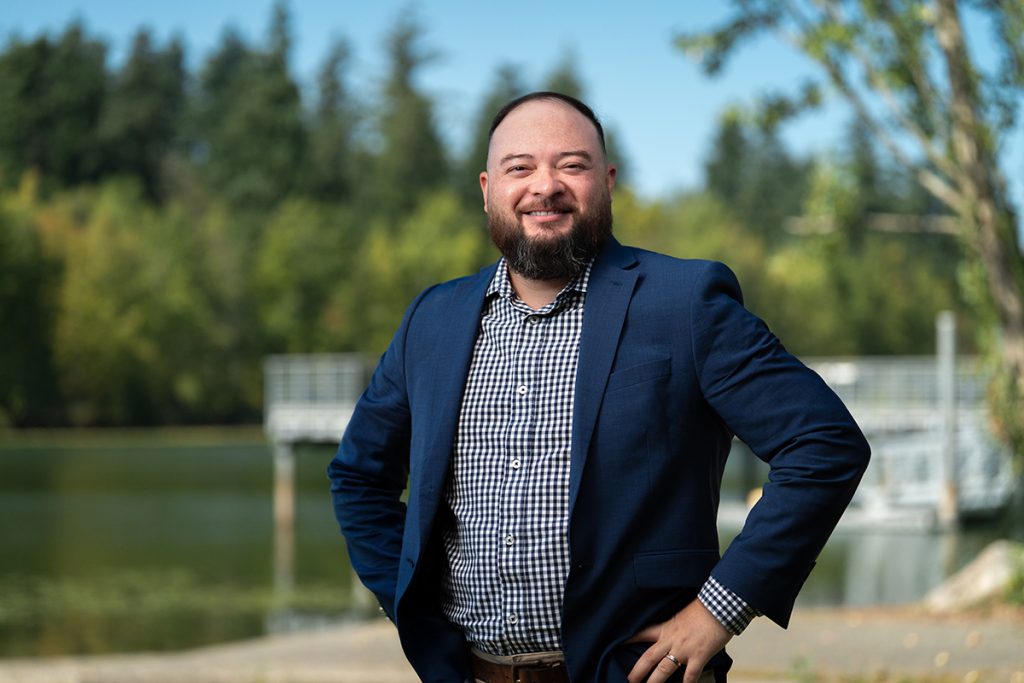
Joe Bushnell (Courtesy: Joe Bushnell)
Chanjolee “Joe” Bushnell is Tacoma’s deputy mayor. “I love Tacoma,” he told the Northwest Asian Weekly in a recent interview—and his love for the city where he was born and raised is part of why he’s now eyeing the 29th District’s Position 2 seat, which is up for grabs this coming November.
As a mixed-race child of a Cambodian refugee mother and white father, Bushnell grew up with feet in overlapping worlds. It wasn’t easy, especially because there were so few mixed-race children at the time. But despite the difficulties he faced, he found inspiration both in his family’s legacy of service and his community’s resilience and spirit of care. It’s why he got into politics, he said. If elected, he would work to amplify the voices and concerns of those in his district, and champion policies starting at the community level, instead of working top-down.
NWAW
I wanted to start by asking about your background. I know you were born to a Cambodian refugee mother and a white father. What was it like to grow up mixed-race in Tacoma at the time, and what layers did you have to navigate that other kids didn’t?
Chanjolee “Joe” Bushnell
My experience growing up in Tacoma, obviously, is a little bit different than others. Being mixed race myself and having a mixed family, I kind of felt different—the pulls of the different worlds, so to speak.
The trauma that my mother experienced and that side of my family experienced really changed perceptions of how we moved about in the world—how we talk to each other, how we see things, especially—but it kind of conflicted with Western ideology and the Western lens of things, especially how people acted or operated in school.
My cuisine is a little bit different. I remember being made fun of for bringing lunch to school one time that didn’t conform to Western norms, and from then on, I never brought lunch to school ever again.
Cambodian was the primary language in the household. We would speak English as well, but when I was talking to my mother, it would always be in Cambodian. I never learned to read or write, but it was a challenge growing up. The other side of it is also because of my complexion. There weren’t that many mixed kids growing up back then. It was kind of frowned upon to really mix with other communities.
When there were kids my age in the Cambodian community, there weren’t really any other mixed kids, other than my younger brother. That created interesting situations where I might hear elders speaking in Cambodian to each other, whispering about me or my brother, not always saying the nicest things in the world—always wondering whose kids are those, this, that, and the other. I think the irony today is that a lot of those same elders or older folks at the time have grandbabies that are mixed.
The times have changed a little bit. I think the diaspora overall has changed demographically, as well as we’ve matured as a community and we’ve expanded. It’s a lot more welcoming.
I feel a lot more accepting and understanding that Cambodians are going to still want to connect to our culture, but might not look traditionally Cambodian. And so I think that it’s kind of amazing and beautiful that we’re able to open ourselves up to that, but then also open ourselves up a bit more to the wider community and the world community as well, and trying to share our culture with as many people that are willing to understand us and learn about it.
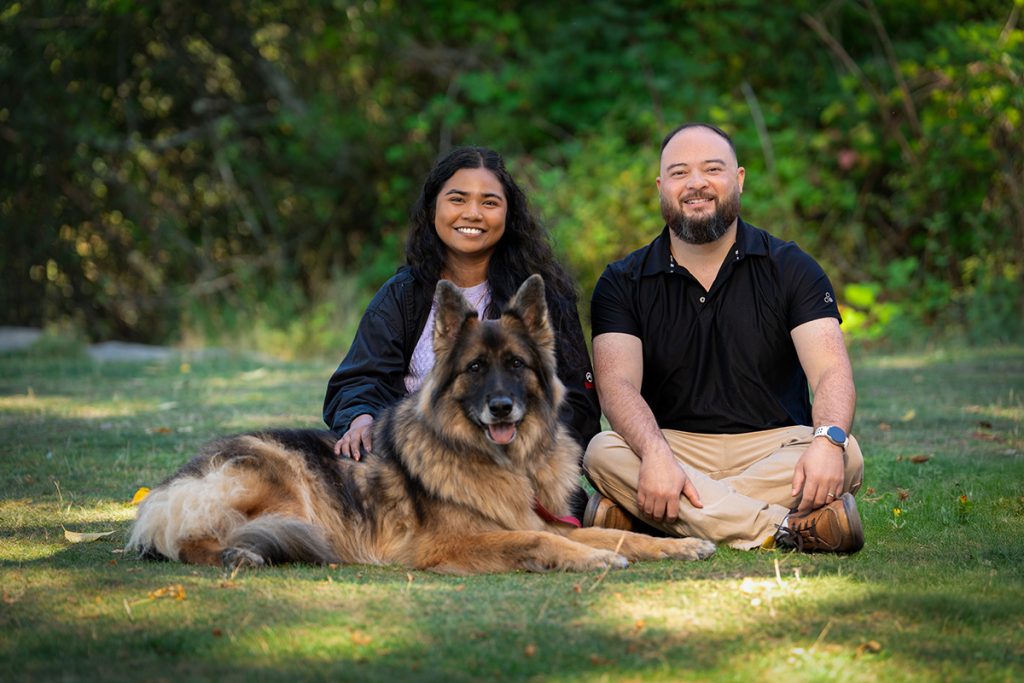
Joe Bushnell with his wife and dog. (Courtesy: Joe Bushnell)
NWAW
Well, that’s actually a pretty good segue because I was really curious how you got into politics, and whether there was someone who inspired you or an issue in your specific community that you particularly wanted to address.
Bushnell
When I was growing up, there were a lot of different community groups and organizations. My dad, in particular, did a lot of volunteer work to support the Cambodian refugee community. And I saw … how impactful that service [was]. It really set up so many families for success and opportunity.
My dad in particular is super inspirational to me. He got involved in that work and had visited the refugee camps in Cambodia and all these things. I can’t imagine having to go through all that and doing it as a volunteer, trying to support people. Later on in life, he continued to serve in other, different ways that he was able.
There’s something to be said about serving others without any expectation of anything in return. And it takes a special kind of person to really be able to do that. In today’s world, unfortunately, it’s very transactional. It’s like, if I do something for you, you can do something for me.
I really believe in service as a selfless thing, with no expectations of your own gain or return, but just for the mere fact that we’re all in this world together and we should be lifting each other up. And how can I be a part of the larger ecosystem of making the world better?
I was [also] really inspired by my grandfather on my dad’s side. He was in the military, on the tail end of World War II. They fought for something they believed in. That really inspired me to serve in the Marine Corps after high school.
There’s so much good that the military can do and support people here locally, but then also around the world. It’s ultimately up to our civilian leadership on how they’re deployed. 9-11 was super impactful for me as a child, growing up, and really appreciating the United States for what it’s done for my family. And then to see it attacked in that way—it really was galvanizing for me as a sixth grader.
I set my eyes on service, but then it was more of a military lens. After high school, several years later, I joined the Marine Corps in 2008. I did that for 11 years. And after a while, I was like, “OK, maybe there’s other opportunities to serve.” That’s when I started to get involved in the neighborhood councils here locally in Tacoma. I was on the Tacoma Public Utility Board, as well as volunteering with litter cleanups—anything that I could be a part of and help support and do what I could. Then the opportunity came up to run for council.
…
I love Tacoma, and that really set me on a path to serving our community and trying to do best by it. I always ask myself, what would I expect out of my council member? … So in that vein of service, I was like, “OK, if the community is willing to have me, I’ll do my best, and try to live out what I believe service should look like and have a duty and a civic responsibility to serve in this way.” And so I did it.
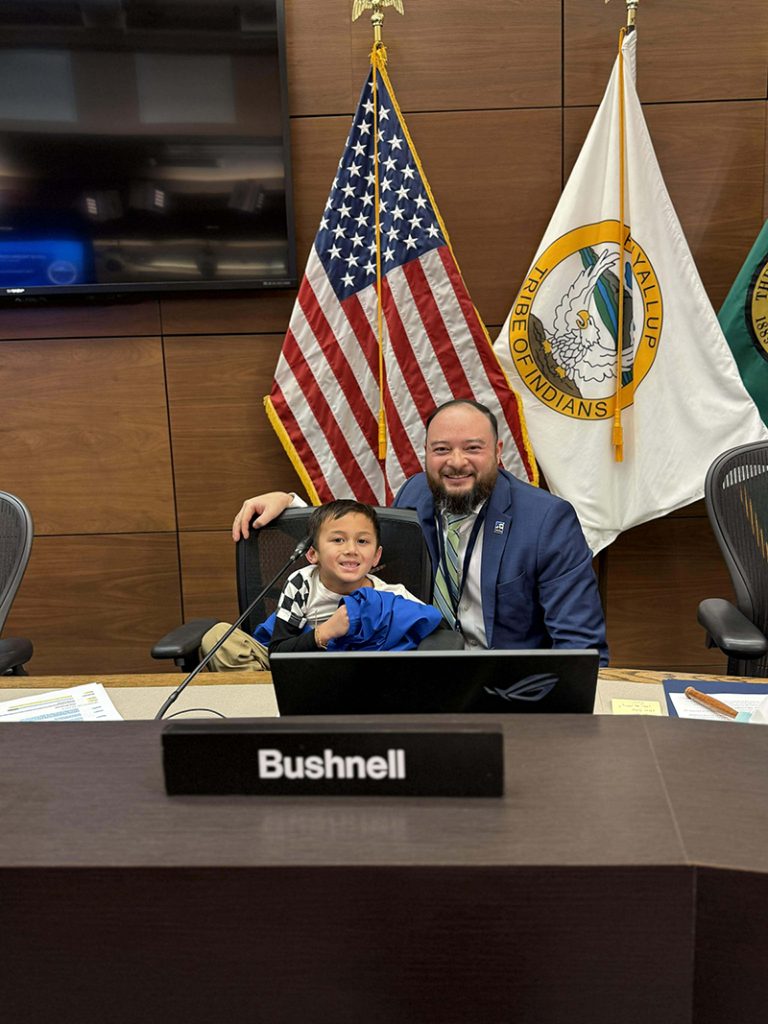
Joe Bushnell with his nephew at Tacoma Council Chambers. (Courtesy: Joe Bushnell)
I won. And I just won re-election last year [with 65% of the vote]. I’m over the moon and just really appreciative of the people that believe in me and the service that I’m providing for our community.
Now, the opportunity has come up to run for the legislature. And I asked myself the same question: What would I expect out of my legislator?
NWAW
You’re the current deputy mayor of Tacoma. What challenges and lessons have that position brought? And how would you bring those lessons to office if you’re elected?
Bushnell
It’s been such a valuable experience being able to serve at a local level. I really believe that change and best quality of life impacts happen at the local level. I believe that supporting neighborhoods and supporting organizations and supporting cities to be able to do the work to support their neighbors really impacts people’s opportunity for jobs, impacts people’s opportunity for a good life. It impacts health outcomes. There’s a lot of different things that really just happen at the local level.
I’ve heard time and time again about a lot of challenges. I’m out there listening [to] all these different groups and soliciting feedback for our budget and all these things. I found time and time again that a lot of the challenges we’re facing here locally really stem from statewide policy and resourcing needs. And so I really want to bring that experience, that lens to the legislature. I think it would be valuable.
…
You have to be listening to all sides of an issue in order to make the best decision, the most impactful decision for the community. That’s how I would operate as a legislator. I would make sure that I’m listening to as many stakeholders as I can about different policy issues. I really believe that the best ideas come through partnership. I can have an idea of what a solution may be, but I don’t assume what the solution is without all the people, the partners, to figure out what the problem is and how we get to a solution collectively.
I think you go much further, both as a community, as a city, and, in the future, as a state, if you have those collaborative efforts, because you have everybody rowing in the same direction.
NWAW
If you’re elected, what will your focus areas be and why those areas? Why do you think you’re uniquely qualified to address them?
Bushnell
I believe that people want to be heard and they need their input reflected in whatever legislation is being passed. I believe also that some of the highest priorities that our community has is in regards to community safety. We need to be supporting our local jurisdictions with community safety issues.
That’s not just police. That’s also supporting our fire departments. It’s supporting crime prevention through environmental design work. It’s [protecting] our local retailers from organized retail theft, and a whole host of other things.
It’s building communities so people are living and feeling safe in their own communities. It’s making sure sidewalks are built out. And those really impact the quality of life in terms of community safety.
The other big thing that I hear constantly is, especially in light of rising gas prices and taxes and other things, is the affordability of everything. The price, the cost of doing business has gone up significantly. The price of goods has gone up significantly. The price of housing. What are we doing to help address that? There are some tangible things that we can do to address affordability at the state level.
I know that [the legislature has] been working really hard to try and address some of those things. But I almost feel like we’re spinning our wheels a little bit.
It’s great that certain taxes are being passed to support different programs and things like that—but at the end of the day, [for] a vast majority of us, that doesn’t impact my bottom line. That doesn’t support my budget at home. I’m not seeing any reductions in my taxes. I’m not seeing any real tangible benefits to me as an individual at the ground level.
I feel like a lot of people are feeling like they’re being left behind. I want to make sure that I’m championing that concern, that voice. I think everybody wants to be able to pay their fair share, but they don’t want to feel like they’re getting knocked down and not being able to get back up.
And then another big issue, along with affordability, is around health care. There’s been very concerning rhetoric happening at the federal level regarding health care. I think it’s really important that we shore up our Apple Health and other health care options we have here in the state, because with this administration, there’s no guarantee that Medicare and Medicaid are even going to be there. They’re talking about removing it, and it’s very concerning.
On top of that, we have to talk about the federal government generally.
One of the great things about our U.S. Constitution is [that] we have the Tenth Amendment, which gives the states the opportunity to make laws for our own states. We really need to be exercising that right in defending ourselves from federal overreach, as well as protecting and supporting our residents as best as possible from the federal government where we are able. Those are some of the top priorities for me in the legislature, as well as I believe in the community.
NWAW
Thank you. So, then, what issues do you see that Asian Americans, Native Hawaiians, and Pacific Islanders (AANHPI) in your district, specifically, are facing?
Bushnell
I’m from an immigrant family, and I’ve talked to many different immigrant families that are very, very afraid of the uncertainty around federal immigration. We have folks on green cards that are unsure of being able to leave the country [because they don’t know] if they’ll even let [them] back in, even though they’re permanent residents.
They can be turned away at the border and their whole life could be destroyed. We have legal residents being picked up by Immigration and Customs Enforcement. Even a small disruption in someone’s life, they could lose their job, they could lose their home. And there’s no repercussions for it. There are folks that are acting with impunity and really destroying people’s lives, even if they “have the law on their side.” And it’s really sad, and it’s very concerning, especially in our Asian American community.
We have a lot of people that walk around with their passports now that didn’t used to. And even then, there’s no guarantee that they still won’t arrest you. There’s been multiple incidences across this country and even here locally where there’s clearly been some violations of constitutional rights. It’s alarming. And so we need to be doing what we can at the state level to support and protect our residents as much as possible.
We have to make sure that whatever information is being put out, either locally or at the state level, that it’s based in fact and understanding. I want people to be able to have the best facts and information so they can make the best decisions for themselves and their families. I think it is irresponsible for politicians to just say things to say things if they have nothing to back it up with.
There is a lot of legal nuance and a lot of things that we can do around immigration, due to it being federal in nature. I think we have to be very clear with our immigrant community about what is possible, what’s not possible, what we can do, what we can’t do. That way, we’re not setting up false expectations, because people are going to make life decisions based on what somebody says, especially someone in a position of power.
I take that responsibility very seriously, especially at the local level when they’re looking to their local elected leaders to help them and support them through these difficult times. That’s another thing that the legislature needs to make sure that they’re staying on top of.
NWAW
So, then, why do you think it’s important for Asian Americans, Native Hawaiians, and Pacific Islanders to hold public office?
Bushnell
It is so important. Growing up, I was always told, “You need to be a doctor, you need to be a lawyer, you need to make a lot of money.” And I think that’s very common for many AANHPI communities and families. You hear that a lot.
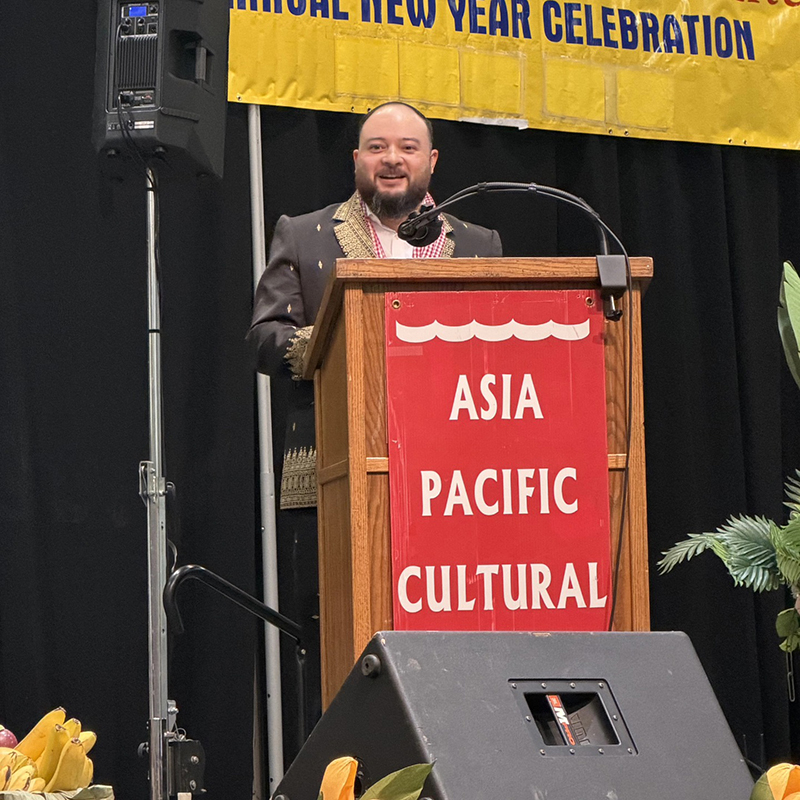
Joe Bushnell spoke at the Cambodian New Year event at the Tacoma Dome earlier this year. (Courtesy: Joe Bushnell)
But what we don’t hear often is, ‘Oh, you should serve the public and be in service to others,” and all these things. I think all those other professions are certainly noble, but I think this is also a noble profession.
I think it’s really important to have people in these positions that are thinking beyond just themselves and their families. I know that we have such great, compassionate, loving, and smart people in our AANHPI community that we deserve that representation. And we deserve our voices to be heard in the halls of power, both locally and in service.
It’s important that we show up for our community in these different ways. That way, our communities have someone that they can also reach out to and look up to and support them and understand where their own values are and what they care about. There’s nothing to replace a person that grew up in your community understanding where you’re coming from.
It’s a very broad community. We are not a monolith. We have so many different languages, so many different cultural variations, so many different things, but there is a lot of commonality between a lot of us as well. We need to celebrate our differences and come together in unity and support of one another, as well as our larger community.
Bushnell said supporters can reach him directly at 253-792-1857 or via joebushnell.com.