



By James Tabafunda
NORTHWEST ASIAN WEEKLY
A 14-foot bronze sculpture commemorating the violent expulsion of Seattle’s Chinese community in 1886 moved closer to reality on April 28 when civic leaders, community historians, and media professionals gathered at the Wing Luke Museum of the Asian Pacific American Experience to announce the project had reached its fabrication funding threshold—more than two decades after the idea was first conceived.
About 50 people came together in the museum’s Community Hall to celebrate the Chinese American Legacy Artwork Project (CALAP), a public art initiative to install a bronze and stainless-steel sculpture at Occidental Park in Seattle’s Pioneer Square. This is the spot where, on Feb. 7, 1886, a mob of approximately 1,500 people forced 350 Chinese immigrants from their homes and marched them to the waterfront for expulsion.
A milestone decades in the making
“We are just a small part of the folks that have been shepherding this work for decades,” said Kamahanahokulani Farrar, the museum’s interim executive director. “I am so happy to see that you’ve been able to join us and to get more information about this amazing project.”
Farrar acknowledged that the gathering represented only a fraction of those who had advanced the project. “Many people have come before us to do this work, and we’re really fortunate to be part of this project,” she said.
The idea was initiated more than 20 years ago by Doug Chin, a community historian and then-president of OCA Asian Pacific American Advocates of Greater Seattle. Bettie Luke—sister of Wing Chong Luke, the museum’s namesake and the first Asian American to hold elected office in King County—was a pivotal early backer and lead capital donor. The museum serves as fiscal sponsor and project manager, OCA Greater Seattle as a founding community partner, and the Chinese American Citizens Alliance (CACA) as an ongoing supporter.
History the city has long ignored
Connie So, PhD, a teaching professor of American Ethnic Studies at the University of Washington (UW) and vice president of internships at OCA Greater Seattle, delivered a historical presentation tracing Chinese immigration to America and the events of 1886.
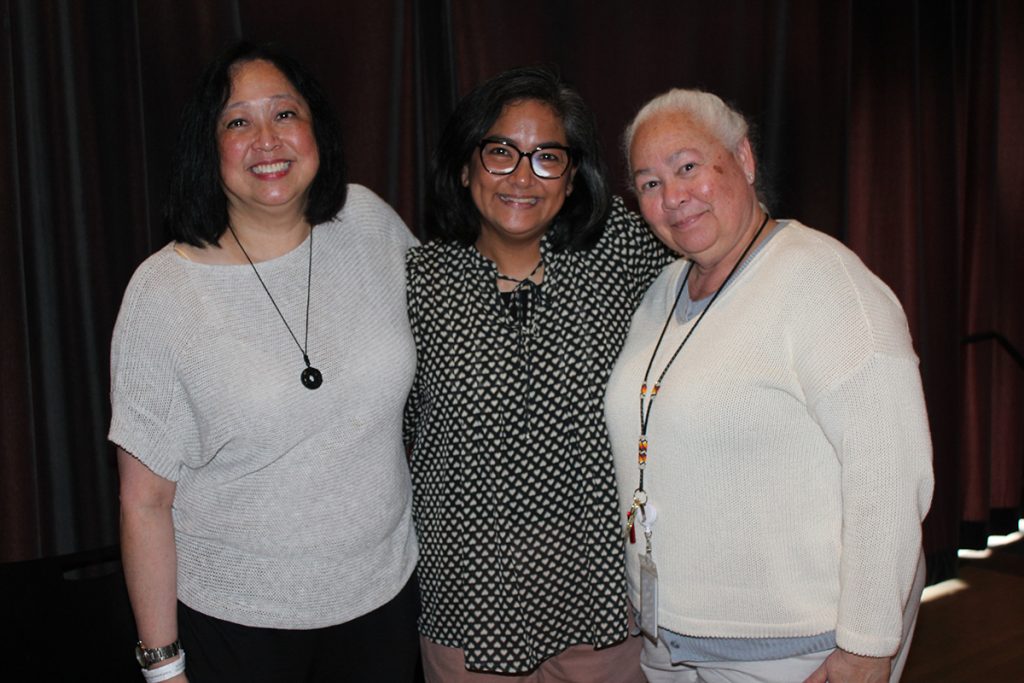
From left : Connie So, Wren Wheeler, and Kamahanahokulani Farrar. (Photo by James Tabafunda)
“Doug Chin and Bettie Luke really deserve a lot of credit for putting things together,” So told the audience. “This is actually a long time coming. When I was an undergrad at UW in the 1986 commemoration—so that’s how long ago that was. I happen to be a senior at the time.”
The expulsion grew from the 1882 Chinese Exclusion Act—the first federal law to bar immigration based on race or nationality—and anti-Chinese rage among white labor unions, chiefly the Knights of Labor. On Feb. 7, 1886, a mob swept through Seattle’s Chinatown, rounding up hundreds of residents and forcing most aboard the steamship, Queen of the Pacific.
“It’s taken more than two decades to get this acknowledgment about the Chinese American community,” So said, “to show why it is that people came to America in the first place, contributed dramatically to the employment, operations, and development in Seattle and this whole Puget Sound area.”
So argued that the sculpture’s proposed location carries deep historical meaning. “All ethnic and racial communities in Seattle all lived east of Occidental Street,” she said. “We think right in it, or just outside of it, is where you ought to have this sculpture so that people know Chinese and other Asian people were all being discriminated against, targeted against, and placed at an unfair disadvantage, despite all their contributions.”
The artist and the design
Seattle artist Stewart Wong, who has Hawaiian and Chinese heritage and has lived in the city since 1982, was selected to create the sculpture—titled “Exclusion, Expulsion, Expunge”—through a competitive process conducted over Zoom in 2020 at the start of the COVID-19 pandemic.
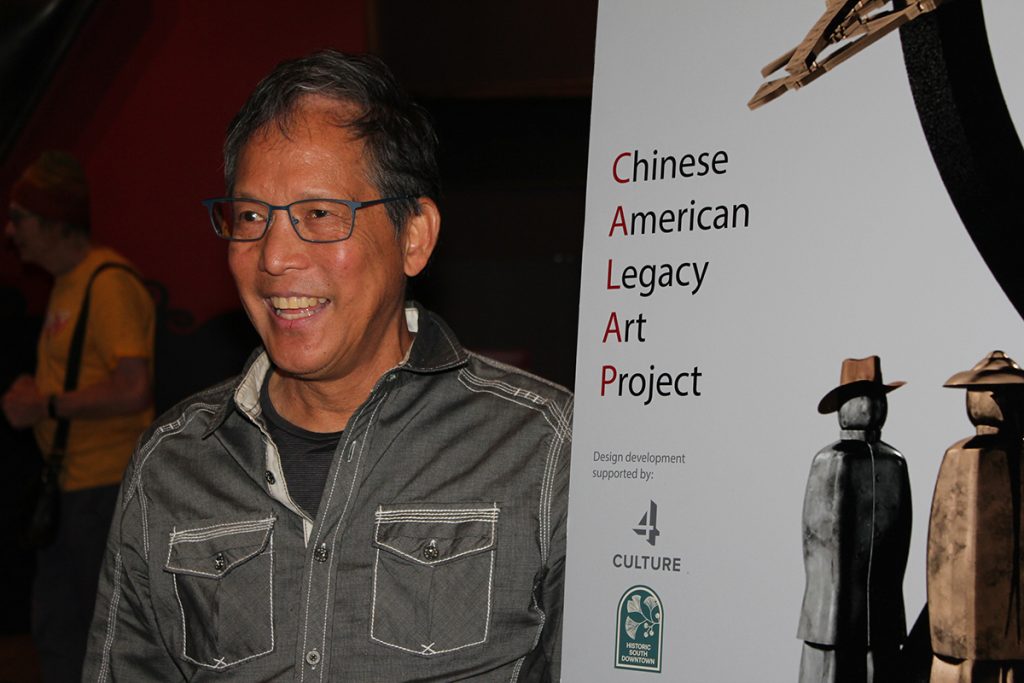
Stewart Wong, Seattle artist and creator of “Exclusion, Expulsion, Expunge” sculpture (Photo by James Tabafunda)
Wren Wheeler, the museum’s civic engagement specialist, described the selection to the audience. “The week before, Stewart came to prepare for his interview,” she said. “That Friday, the world closed down because of the pandemic. So over Zoom, we were all stumbling. We interviewed three artists virtually. It was crazy. But the group selected Stewart Wong—and hot off the 3D printer is a maquette of what will be, we hope, very, very soon.”
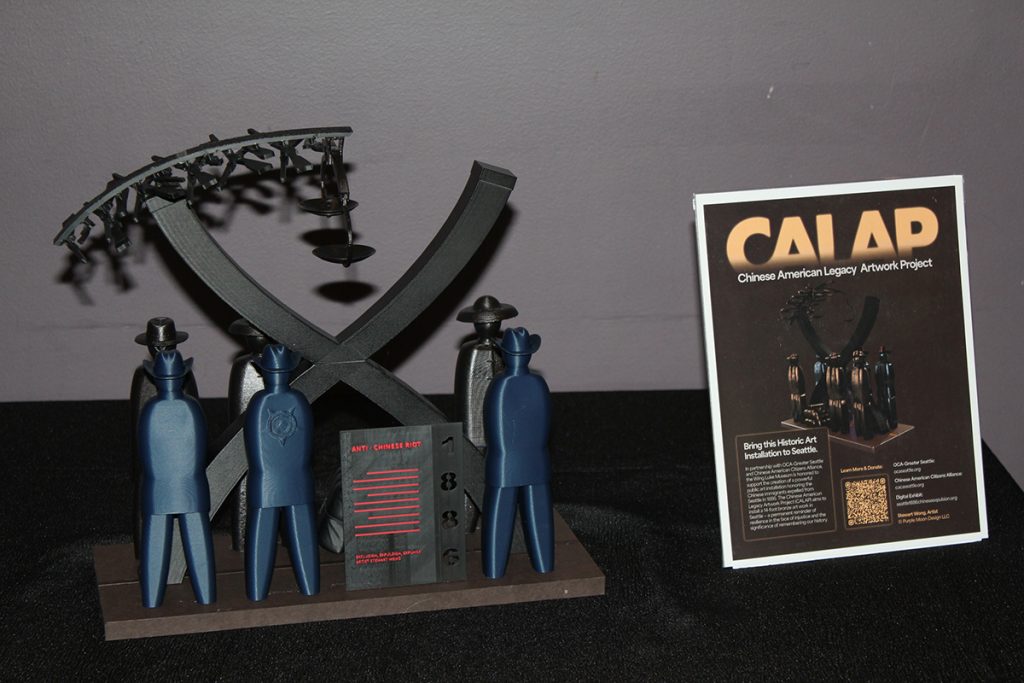
A maquette of Stewart Wong’s “Exclusion, Expulsion, Expunge” sculpture (Photo by James Tabafunda)
The sculpture features six life-size figures—three Chinese laborers and three mob members—flanking a 14-foot stainless-steel “X,” a symbol of division and displacement. Above them hang the Scale of Justice, composed of firearms and tipped toward the mob. The artwork measures 14 feet high, 12 feet long, and 6 feet wide.
Navigating city hall
Wheeler told the attendees the road to installation remains complex, with fabrication funding secured.
“This is a very complicated process,” she said. “If anyone has ever tried to figure out how to get something built in the city of Seattle, you will understand why this is all goofy and crazy. We are wanting this statue to be in Occidental Park because of the historical significance—part of the second Chinatown, and the actual spot in the park is near where the expulsion started.”
A permit application has been submitted to the Seattle Department of Transportation. Contract negotiations with Wong remain ongoing. The proposal must also receive a Certificate of Approval from the Pioneer Square Preservation Board.
“All these moving pieces are very slowly moving forward,” Wheeler said. “But eventually all this gets approved and we can, hopefully very soon, start fabrication and installation.”
World Cup sparks international donors
The event’s most encouraging moment came when Leo Flor, chief legacy officer for SeattleFWC26—the local organizing committee for Seattle’s role as a 2026 FIFA World Cup host city—announced that the committee’s November 2025 challenge grant had been matched by two international donors, hitting the CALAP’s fundraising goal.
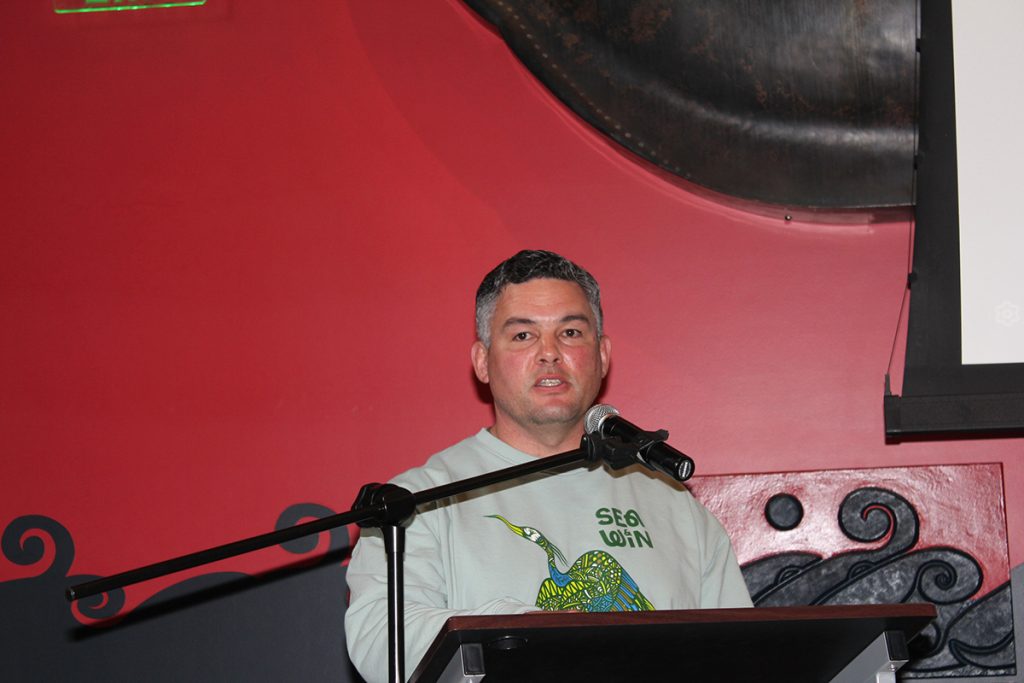
Leo Flor, SeattleFWC26 chief legacy officer (Photo by James Tabafunda)
“I think the history that Dr. So shared here today could not be more relevant to our current times,” Flor said. “Our organizing committee’s job is to take a World Cup of all things and use the attention and enthusiasm that come with hosting it in our city, to see if we might be able to advance our own community’s local priorities.”
SeattleFWC26 donated $50,000 to the CALAP in November 2025, when the project had raised approximately 58% of its total fundraising target, and issued the donation as a public challenge. The city will host six FIFA World Cup 26 matches in 2026.
“I’m happy to report that since then, two individuals have tuned in to what happened,” Flor told the audience. The first was Martin Mao, a Chinese Australian who, Flor said, “was moved by the story and decided that he wanted to contribute.” The second was Li Lu—founder of Himalaya Capital and one of the student protest leaders at Tiananmen Square in 1989—who learned of what was happening and chose to support the project.
“Those two individuals matched the amount of the donation that our local organizing committee was able to make and hit that fundraising goal,” Flor said. “I say that not to celebrate people who are funding this work, but because I think it is an example of the power of telling these stories. When we do get the word out there, people do pay attention. And when people pay attention and learn, I think it can cause them to act.”
“I couldn’t think of a more important and lasting way to use this event, which will be big but temporary, to create a long-term positive and hopefully educational legacy in support of what this group has been doing for so long,” he added.
Preserving history as resistance
Wheeler closed the event by connecting the CALAP’s mission to the current political environment.
“There are manufactured stories about immigrants being a threat to America,” she said. “There is laser-focused propaganda that steadily churns and fabricates falsehoods about immigrants. And the modern-day twist is that there are very specific efforts to ban books, limit what can be taught in classrooms, eliminating classes, eliminating departments and institutions of higher education, and basically trying to ignore and erase the fact that we have this history in this country of being who we are and then being attacked for who we are.”
The museum’s digital exhibit will stand alongside the sculpture as a permanent resource.
“Before this current administration, I never thought this,” Wheeler said, “but I am now realizing that preserving history is resistance.”
Lead capital donors listed at the event included Ellen Ferguson, Jean and Dennis Lee, Erika Lim, Li Lu, Martin Mao, and SeattleFWC26. Other major donors include The Boeing Company, CACA, Bettie Luke, Charlotte Bushue, Diane King, Catherine Lee, Frederic and Julia Wan, and John Peters. Design work is supported by Historic South Downtown and 4Culture. The CALAP’s digital exhibit is supported by the National Park Foundation.
For more information about the CALAP, go to www.wingluke.org/calap. For more information about the museum’s digital exhibit, go to www.Seattle1886ChineseExpulsion.org.