





By James Tabafunda
NORTHWEST ASIAN WEEKLY
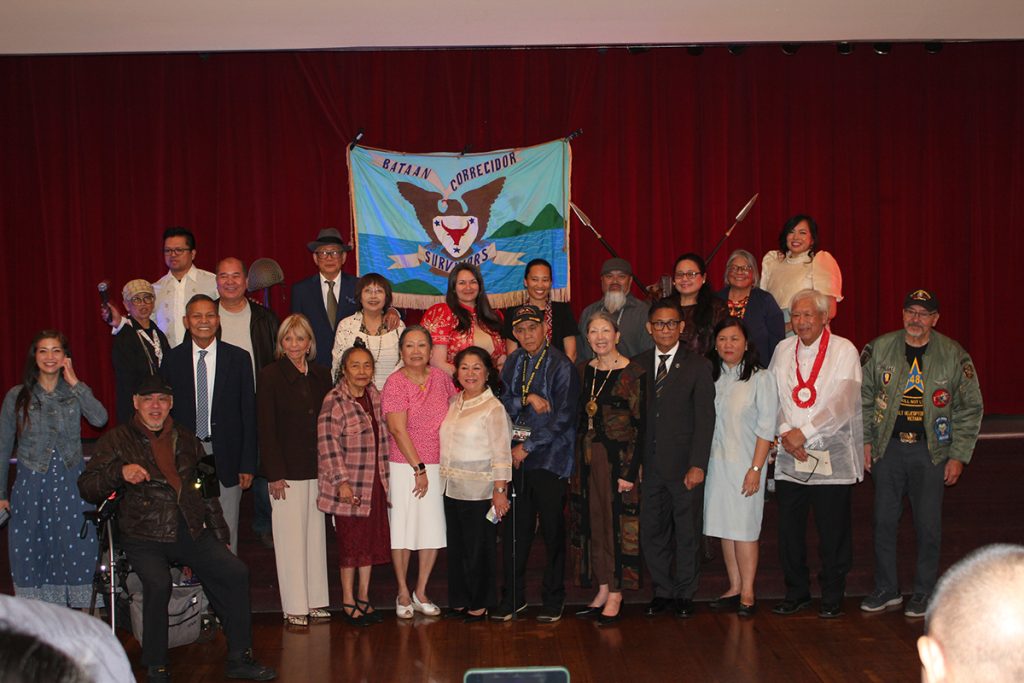
Day of Valor speakers and attendees (Photo by James Tabafunda)
The Filipino Community Center was filled with solemn remembrance on April 19, as about 115 people gathered to mark the 84th anniversary of the fall of Bataan, honoring Filipino and American soldiers who fought side by side against Imperial Japan during World War II.
The commemoration was hosted by the Bataan Corregidor Survivors’ Association and Their Families (BCSA&TF), the Filipino Community of Seattle (FCS), and the Filipino Veterans Recognition and Education Project (FVREP), Region 8.
State Rep. Sharon Tomiko Santos gave the keynote. Philippine Consul General Henry S. Bensurto Jr., newly assigned to the soon-to-open Seattle consulate, delivered a message of remembrance. A proclamation from Mayor Katie Wilson, who could not attend, declared April 9 as Day of Valor.
A shrinking circle
Organizers said the event was the group’s first formal gathering since 2019, when the 77th anniversary was marked at the DoubleTree by Hilton Hotel Seattle Airport. No Bataan survivors were present. Those who remain are sons, daughters, and grandchildren of men who endured the 65-mile Death March after the peninsula fell April 9, 1942.
“We have no survivors present,” said Thelma R. Sevilla, BCSA&TF organizing chair. “We have sons and daughters, and many sons and daughters are scattered throughout the country.”
Sevilla, whose late father was a Bataan survivor, prisoner of war, and founding officer, said she took on planning in late January to preserve the legacy. “I feel very strongly that we have an obligation to maintain, to keep up that legacy,” she said.
The Day of Valor commemorates the fall of Bataan and the Battle of Corregidor. About 76,000 Filipino and American troops surrendered on the Bataan Peninsula on April 9, 1942, the largest surrender of U.S.-led forces in American military history. Corregidor fell May 6, 1942.
Welcome and family ties
Commander Larry Cambronero, who leads the BCSA&TF, opened the program on behalf of “the 84th anniversary of the Day of Valor.” Cambronero is the grandson of Bataan Death March survivor Rufino Cambronero and the son of Isaac Cambronero, a wartime guerrilla fighter in Manila.
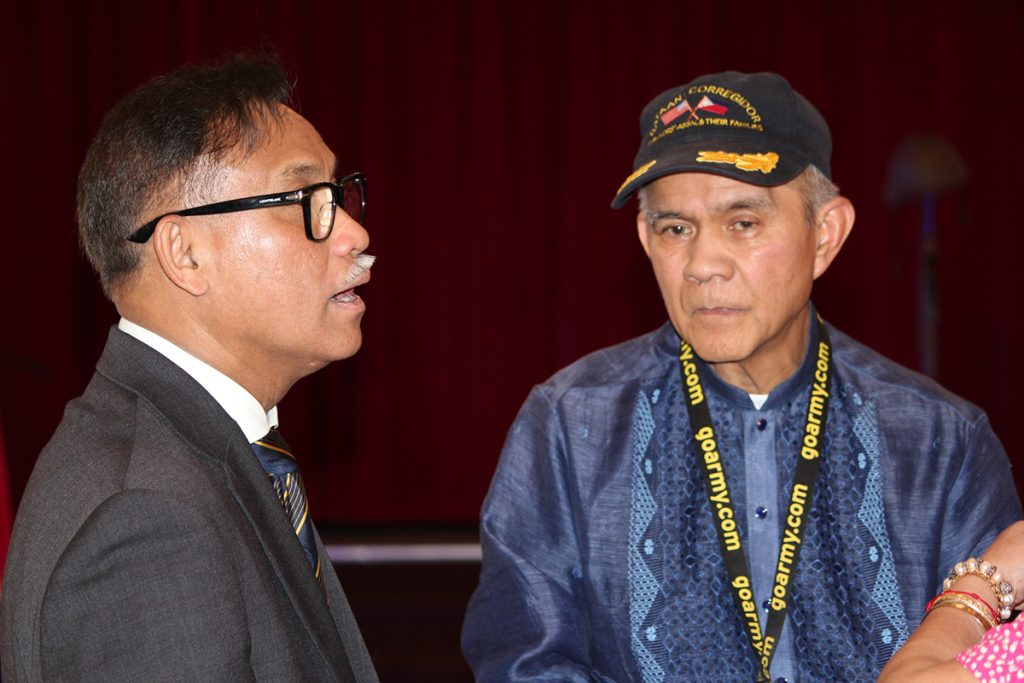
Philippine Consul General Henry S. Bensurto Jr. (left) and Commander Larry Cambronero, Bataan Corregidor Survivors’ Association and Their Families. (Photo by James Tabafunda)
He recounted how the association, founded in 1959, encouraged Seattle to approve a memorial marker at South Park and later helped establish a small World War II museum inside the center. “If the residents of our great state of Washington have these incredible rights, including the right to life, liberty, and the pursuit of happiness, it is because we stood on the backs of our Filipino and American World War II veterans,” Cambronero said.
Master of ceremonies Bennyroyce Royon guided the program, which included a Battlefield Cross Memorial, a candle-lighting tribute, a meal, and performances by the FCS Kalahi Cultural Dance Ensemble, an intergenerational folk-dance troupe based at the center.
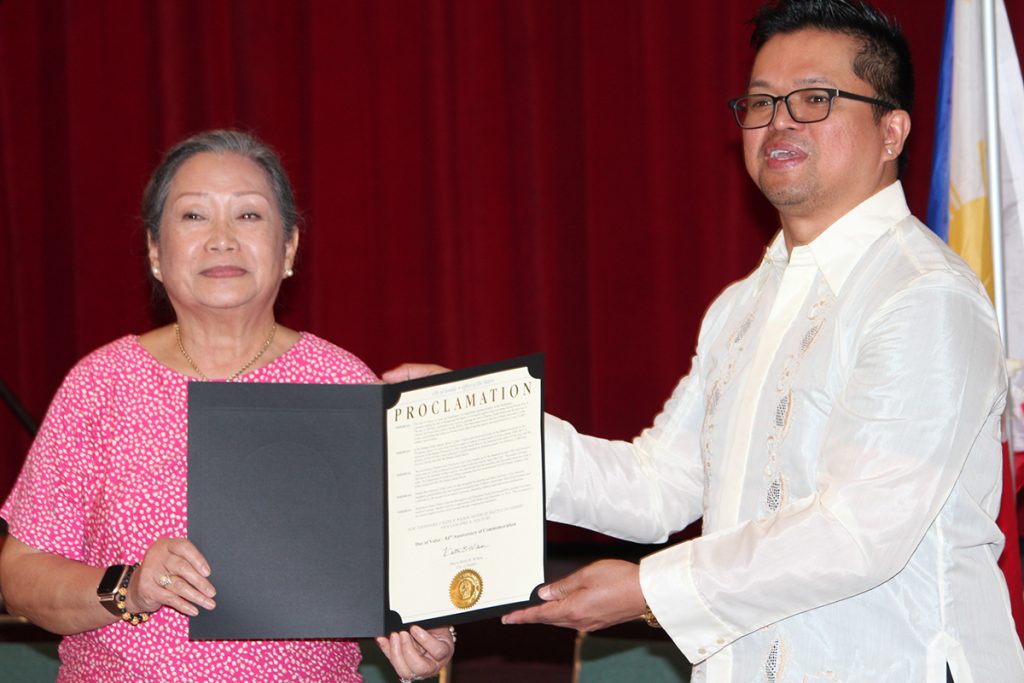
Agnes Navarro-Garcia, executive director of Filipino Community of Seattle (left) and Bennyroyce Royon hold Mayor Katie Wilson’s proclamation. (Photo by James Tabafunda)
Mayor’s proclamation
Agnes Navarro-Garcia, executive director of the FCS, read Wilson’s proclamation. The statement recounted that about 75,000 Filipino and American troops were forced to march an arduous 65 miles to prison camps in 1942, with the U.S. Department of Veterans Affairs estimating that 650 Americans and 16,500 Filipino soldiers died during and after the march.
The proclamation noted the state project has presented the Congressional Gold Medal to more than 300 veterans and their families since Dec. 14, 2016. “Now, therefore, I, Katie Wilson, mayor of Seattle, do hereby proclaim April 9 to be Day of Valor,” Navarro-Garcia read.
Consul general pledges engagement
Bensurto, a career diplomat and lawyer known as a Philippine expert on the U.N. Convention on the Law of the Sea, said he would speak “from the heart.” He served as Philippine consul general in San Francisco from 2014 to 2020 and most recently as ambassador to Turkey, ending that assignment last January.
Bensurto said the new consulate, whose jurisdiction will include Washington, Oregon, Idaho, Alaska, and Montana, received U.S. State Department accreditation two years ago but is still building staff and systems. “We will not be able to issue the passport tomorrow yet,” he said, noting a temporary office has been set up downtown.
Linking the Bataan defenders to current events, Bensurto cited the 2016 arbitral award at The Hague that favored the Philippines in its maritime dispute with China. “That same heroism, that love, that patriotism is again challenged in many parts of the world, right in our own backyard in the West Philippine Sea,” he said.
Roughly 12,000 Americans and 76,000 Filipinos fought at Bataan and Corregidor, Bensurto said, using the Tagalog word “Balikatan”—meaning shoulder-to-shoulder.
Keynote: love, loyalty, legacy
Former state Rep. Velma Veloria introduced Santos, who has represented the 37th Legislative District since 1999 and chairs the House Education Committee. Veloria credited Santos with securing funding for the Filipino Community Village housing projects and a digital-training program for “formerly incarcerated people.”
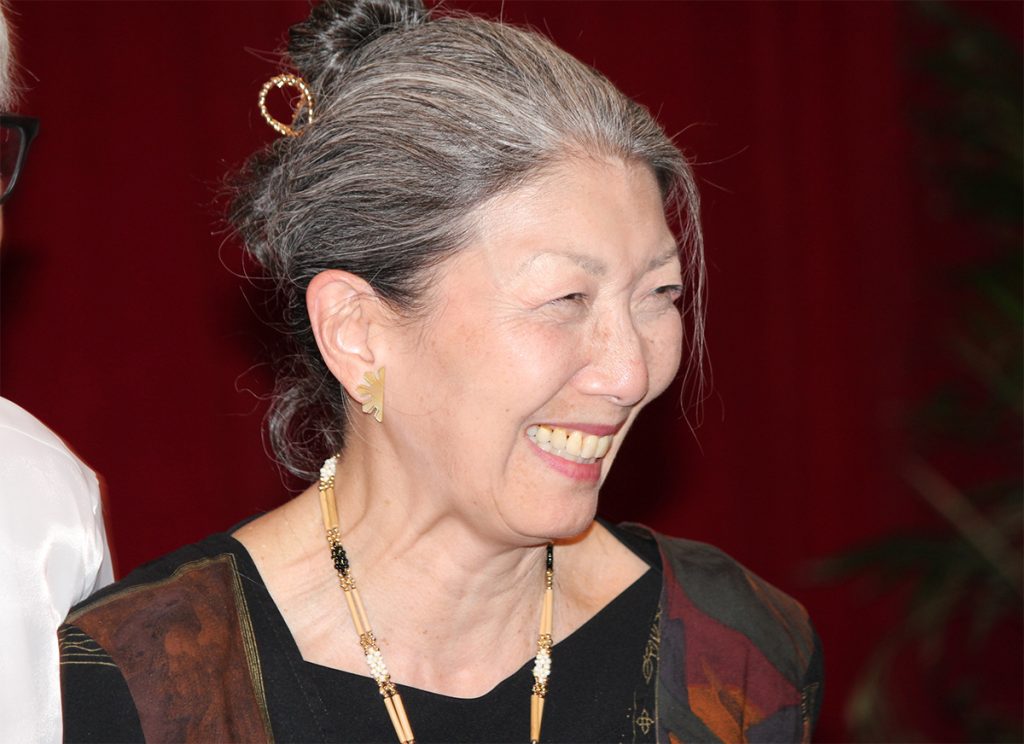
State Rep. Sharon Tomiko Santos (Photo by James Tabafunda)
Santos—widow of Bob Santos, a Filipino American U.S. Marine veteran of the Korean War—built her remarks around what she called a triptych: love, loyalty, and legacy. “Real heroes are ordinary people,” she said. “They’re farmers. They’re teachers. They’re cooks. They’re students who, in a moment of crisis, decide that something matters more than their own survival.”
She used bamboo—bending without breaking, rooted deep, growing in clusters—as a metaphor for the Filipino American veterans. More than 260,000 Filipinos answered the call incorporating the Philippine Commonwealth Army into U.S. service, she said, while Filipino Americans on the mainland, initially barred from enlisting under the Tydings-McDuffie Act, volunteered after the law was amended in early 1942 to form the 1st Filipino Infantry Regiment.
Santos described the action of Mess Sgt. Jose Calugas of the 88th Field Artillery, Philippine Scouts, who on Jan. 16, 1942, ran 1,000 yards across shell-swept ground at Bataan to return a destroyed gun to action. Calugas became the first Filipino to receive the Medal of Honor in World War II and later settled in Washington state.
She also honored Maria Orosa, who smuggled food to prisoners at Santo Tomas in occupied Manila and was killed by American artillery fire and bombs at Remedios Hospital in February 1945.
The unpaid promise
Santos discussed long-standing grievances over the Rescission Act of 1946, which President Harry Truman signed on Feb. 18, 1946, declaring that the wartime service of Filipino soldiers “shall not be deemed to be or to have been service in the military or naval forces of the United States.”
“A single pen stroke erased the actions of 260,000 soldiers,” Santos said. Of the 66 Allied nations whose soldiers served alongside Americans, only Filipino veterans were stripped of promised benefits, she said.
After her address, retired U.S. Army Brig. Gen. Oscar B. Hilman, Region 8 director of FVREP, presented Santos with a certificate of appreciation. “I’m honored to present to Representative Tomiko Santos the Congressional Gold Medal,” Hilman said. “She spoke about Bataan and Corregidor, and I just loved it dearly because it was delivered with such passion.”
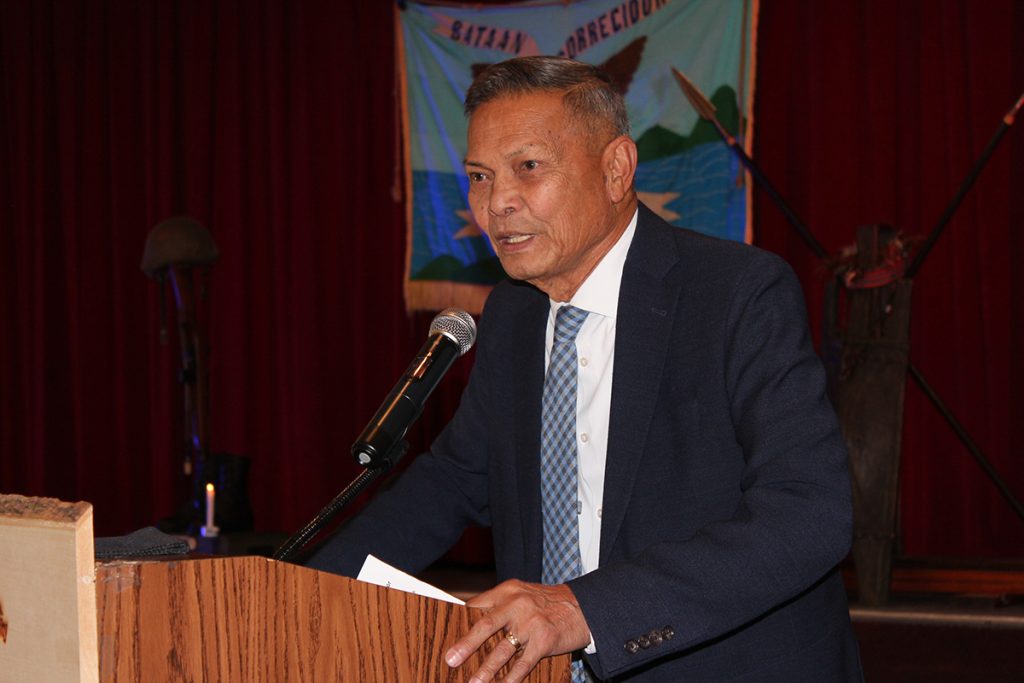
Retired U.S. Army Brig. Gen. Oscar B. Hilman, Region 8 director of Filipino Veterans Recognition and Education Project (Photo by James Tabafunda)
460 medals in Washington
Hilman, who commanded the 81st Heavy Brigade Combat Team in Iraq before retiring in 2007, said his grandfather and an uncle died in the Bataan Death March. As Region 8 director, he oversees Congressional Gold Medal work in Washington, Idaho, Alaska, and Oregon.
“We have 460 medals given in Washington state, and 15 ceremonies,” Hilman said. He recalled presenting medals to 16 living veterans before Veterans Day. “None of them are here today,” he said.
Hilman introduced Nicolette Oliver, a schoolteacher trained in Washington, D.C. and educator in Western Washington state.
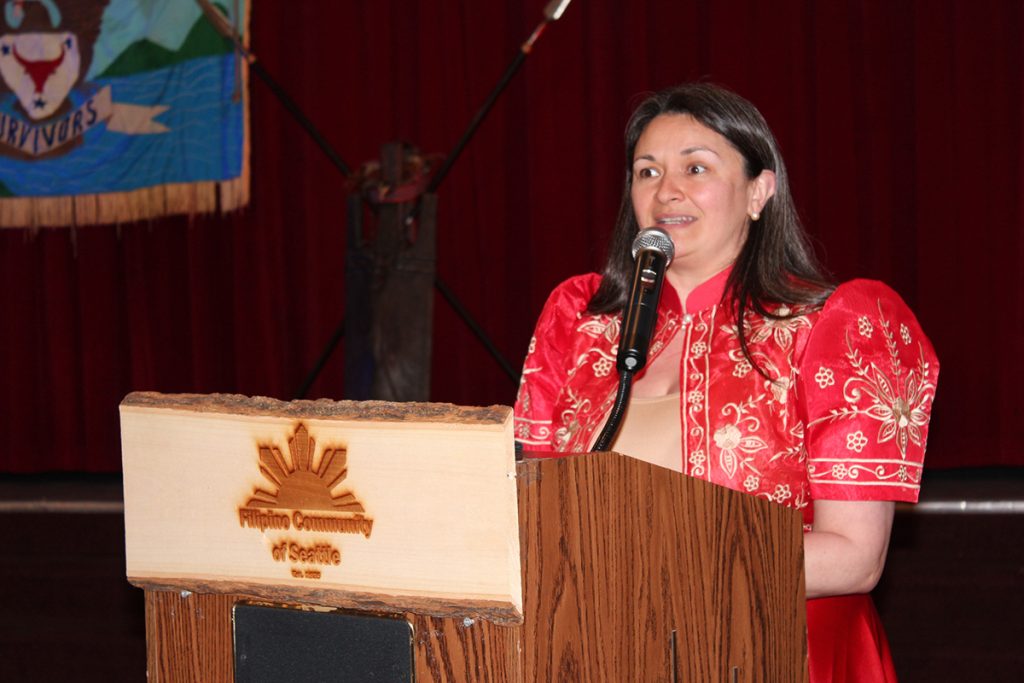
Nicolette Oliver, teacher of Filipino Veterans Recognition and Education Project’s free “Duty to Country” curriculum (Photo by James Tabafunda)
She told Day of Valor attendees she “didn’t learn about Filipino American history or the Filipino World War II veterans” in school, but now teaches FVREP’s free “Duty to Country” curriculum—including its award-winning graphic novel and oral histories—to her second- through fourth-graders. Despite new parental opt-out rules for diversity lessons, she said, “I have not had a single family” object and urged supporters to back Washington’s Senate Bill 5574 ethnic-studies bill.
Descendants bear witness
Among those present was Gloria Ysmael-Adams, an adviser to the BCSA&TF and daughter of Lt. Bartolome R. Ysmael, who served in the 26th Cavalry Regiment (Philippine Scouts). The 26th Cavalry was part of the U.S. Army in the Far East and fought in the early defense of Luzon against the Japanese invasion.
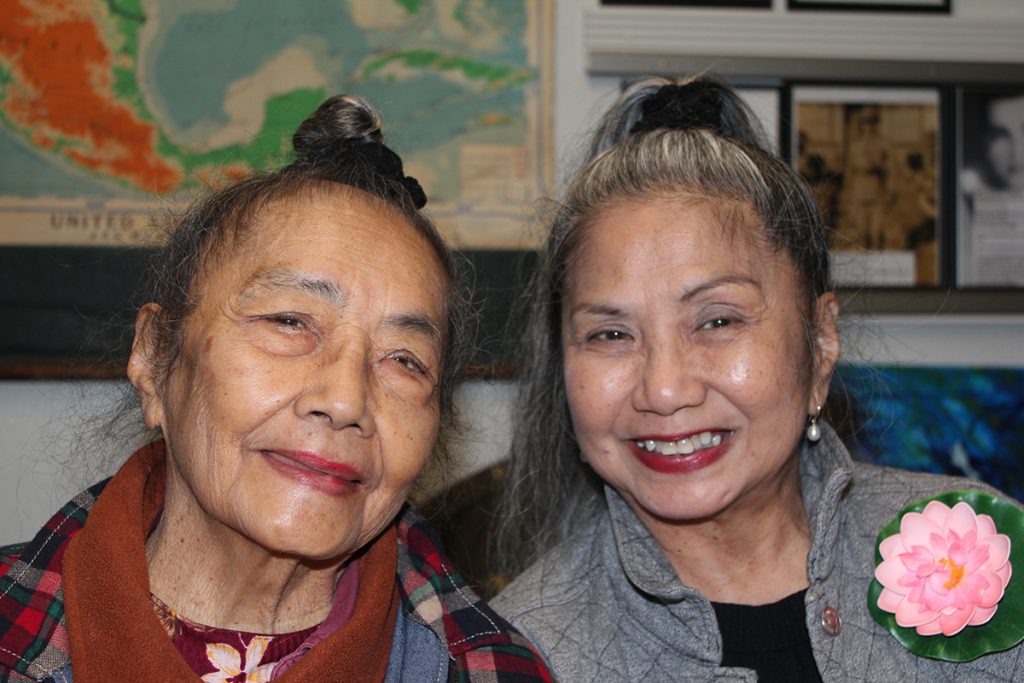
Gloria Ysmael Adams (left) and her daughter, Myrna Ysmael Victoriano (Photo by James Tabafunda)
Ysmael-Adams, who was 9 and living at Clark Field when Japanese bombers struck on Dec. 8, 1941, said the commemoration “means a lot to me.”
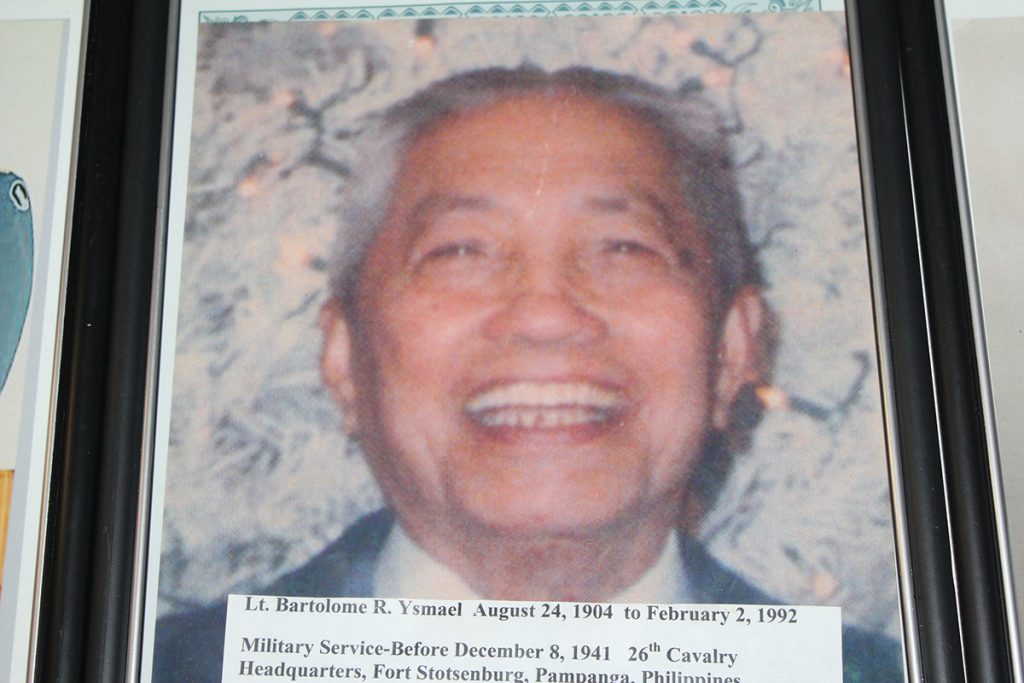
Lt. Bartolome R. Ysmael, 26th Cavalry
Her father, who died in 1992, worked in radio communications and served as an interpreter of Japanese radio traffic. Scholarly and archival works on Filipino guerrillas and communications describe their duties included maintaining radio links and gathering intelligence on Japanese forces.
Sevilla said the fight for full recognition remains unfinished. “For the Day of Valor, we only recognize the contribution, the sacrifices, the heroism, courage, and what it took,” she said.
The BCSA&TF’s membership is dwindling, Sevilla said, and its future depends on whether younger Filipino Americans carry the work forward. “It has to come from within,” she said. “It has to feel like they own it.”