



By James Tabafunda
NORTHWEST ASIAN WEEKLY
Handmade signs rejected “total surveillance” and urged Seattle city leaders to “fund housing, education, food, not cameras” as more than 50 activists, community organizers, and neighborhood residents gathered outside Seattle City Hall on April 10.
They demanded Mayor Katie Wilson shut down the city’s entire police surveillance camera network on the 100th day of her administration.
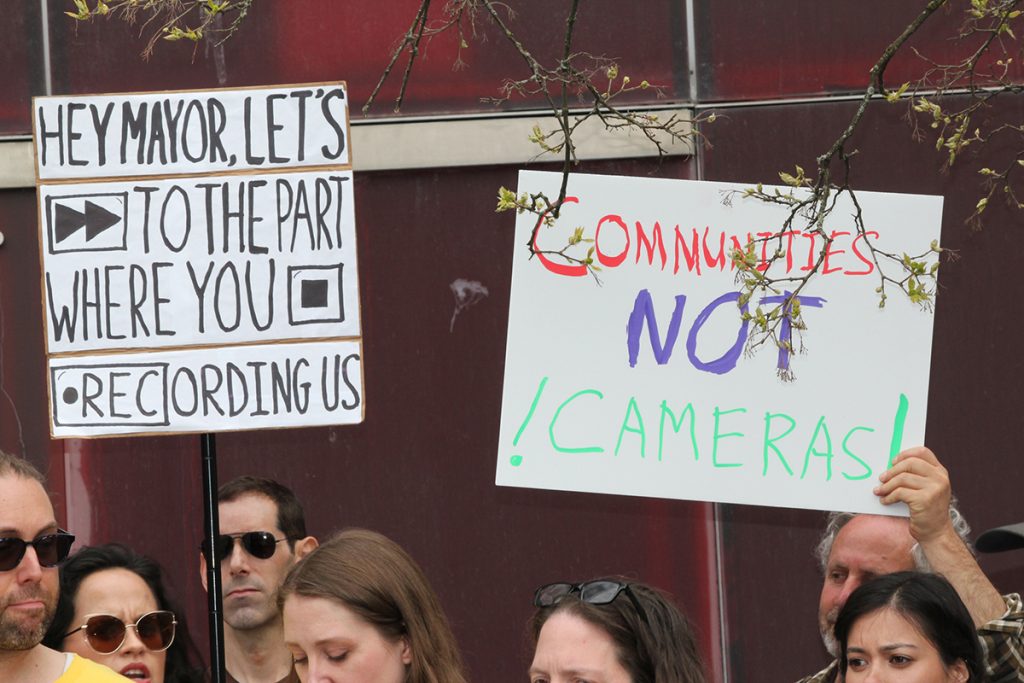
Community Not Cameras signs (Photo by James Tabafunda)
Organized under the banner “Community Not Cameras,” the rally and press conference brought together representatives from more than a dozen community groups. Speakers called on her to deactivate the cameras currently operating under the Seattle Police Department’s (SPD) Real Time Crime Center (RTCC) and cancel all pending expansions.
The rally was co-sponsored by Our Seattle, Stop Surveillance City, and UAW Local 4121, the union of 8,000 academic student employees, postdoctoral researchers, and research scientists at the University of Washington (UW).
Wilson’s pause falls short, protestors say
Wilson, who took office Jan. 2, announced a pause on any further camera expansion and ordered a privacy and data audit to be conducted by the NYU School of Law Policing Project. She also paused the use of automatic license plate readers.
But protestors said those measures did not go far enough.
“I’m with Our Seattle, a grassroots group of Seattleites who truly believe in the mayor’s progressive campaign platform and who are committed to holding her accountable to her promises,” said Melissa Howard, rally emcee and an activist who worked on Wilson’s 2025 mayoral campaign.
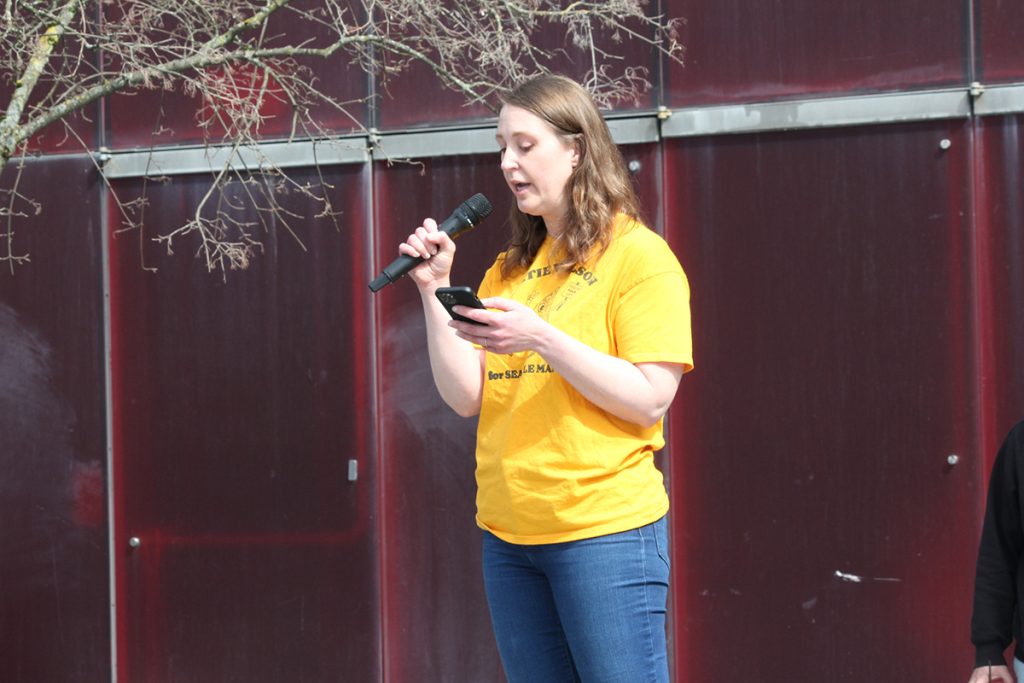
Melissa Howard, Community Not Cameras rally emcee and Our Seattle member (Photo by James Tabafunda)
Wilson, speaking at a March 27 public forum on the issue, defended her approach. “I think what I’m doing now, pausing the expansion until we do an audit of storage, security, and sharing practices, is very much in line with what I was saying during the campaign,” she said at the forum.
Howard said rally leaders had asked Wilson’s office to send a representative to the event, and staff member Matthew McIntosh attended on the mayor’s behalf. He spoke briefly near, but not from, the main speakers’ area in front of a “Community Not Cameras Seattle” banner, making his remarks inaudible to most attendees.
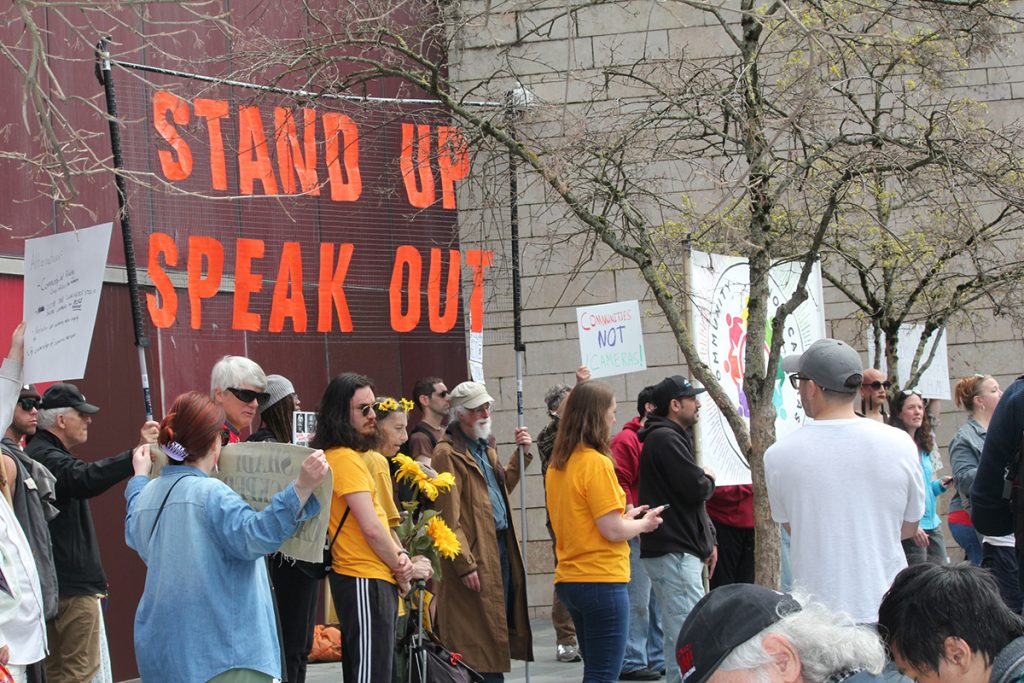
Community Not Cameras attendees (Photo by James Tabafunda)
Immigrant communities say they face the greatest risk
Several speakers tied their opposition to federal immigration enforcement, arguing that surveillance data collected by the city could be accessed by Immigration and Customs Enforcement under the Trump administration.
Yin Yu, a Chinese American community organizer with the CID Coalition and its Humbows Not Hotels campaign against displacement and gentrification, said the CID (Chinatown-International District) is disproportionately burdened by the camera network. She said the cameras subject the city’s “poorest residents in the majority immigrant of color community” to constant surveillance.
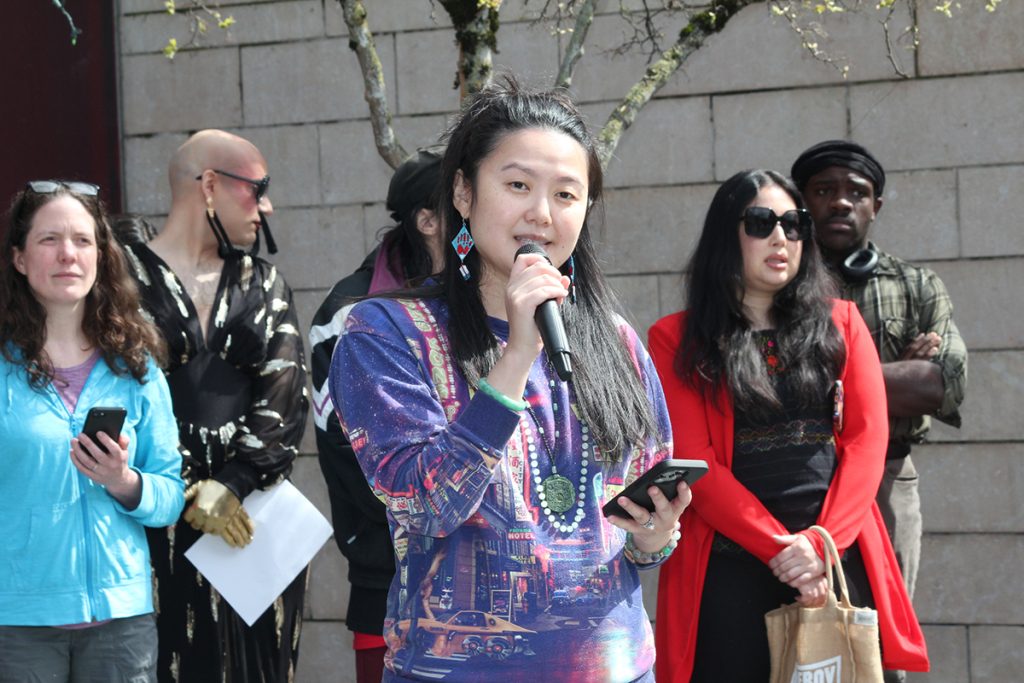
Yin Yu, a Chinese American community organizer with the CID Coalition (Photo by James Tabafunda)
“Mayor Wilson, you are risking our lives by allowing cameras to continue to exist,” Yu said. “You yourself stated the cameras are not meaningful nor secure.”
“Only five months ago, you promised you would not risk endangering immigrant communities. We voted for you based on that promise. We told our friends and elders to vote for you, and now you’re breaking your campaign promise to our community.”
She also said the city has spent more than $8 million to install and operate the cameras—money that could instead fund affordable housing.
“It is not hard to choose to fund affordable housing or shut down the cameras. It is not hard to choose between protecting vulnerable immigrant communities or shut down the cameras,” Yu said. “Mayor Wilson, the choice isn’t a hard one. You need to listen to those who put you in power and shut down the cameras.”
UW law professor calls for redirecting police resources
Angélica Cházaro, an assistant professor at the UW School of Law and a nationally recognized scholar on immigration law, drew applause when she proposed a unique reallocation of the city’s public safety resources.
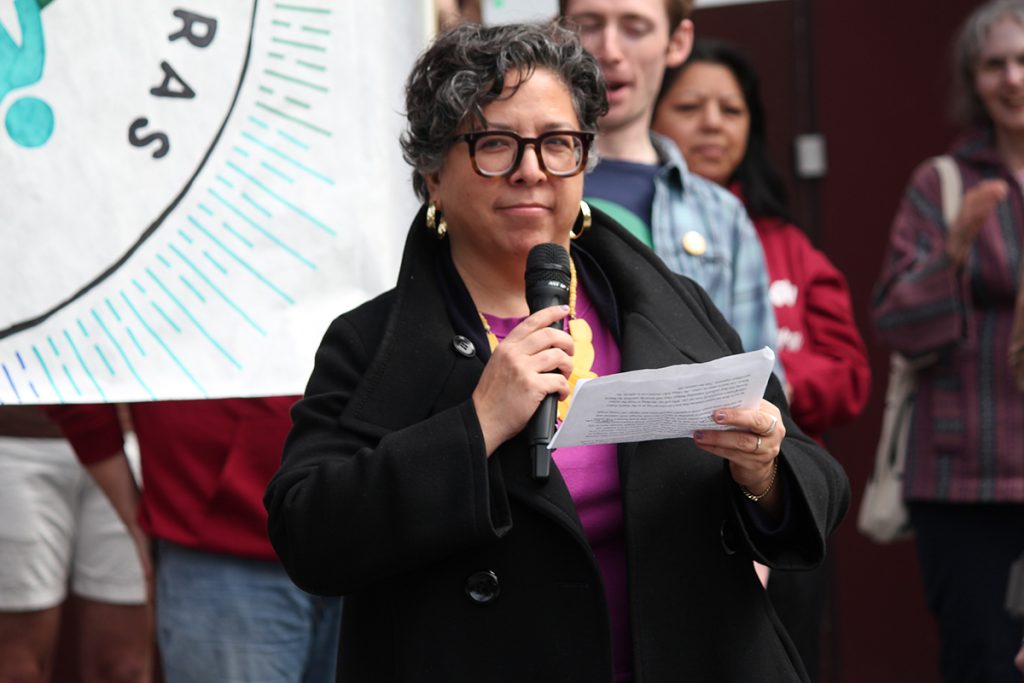
Angélica Cházaro, assistant professor at the University of Washington School of Law (Photo by James Tabafunda)
“We are being told the cameras help solve crimes. Mayor Wilson, if you think we need cameras in areas with high levels of crime, put them in the Amazon and Boeing boardrooms,” Cházaro said.
She argued that the city’s Office of Labor Standards, which combats wage theft, operates on an $8 million budget with a few dozen staff members, while the SPD employs roughly 1,800 staffers and operates on a budget of nearly half a billion dollars. She said, “The total value of property stolen through robberies, burglaries, and carjacking is not even four percent of what employers steal from workers each year in this country.”
Cházaro, who was named a “Freedom Scholar” by the Marguerite Casey Foundation and Group Health Foundation in 2021 for her work on racial and social justice, also cited a Chicago study showing that youth employed in summer programs experienced a 43% reduction in arrests for violent crime compared with those who were not enrolled, and called on Wilson to create a summer jobs guarantee for teenagers in high-crime neighborhoods as an alternative to surveillance investment.
“Instead of spending to surveil our youth through more cameras in the Real Time Crime Center, create a summer job guarantee for our young people,” she said. “Mayor Wilson, you need to stand on values. The values folks elected you to uphold. No surveillance expansion. Turn the cameras off.”
Police credit camera system with cutting crime
Seattle police officials offered a different assessment of the camera network’s value.
The RTCC launched under former Mayor Harrell in May 2025 as a two-year pilot program, with 62 cameras installed across three areas of the city: the CID, downtown Seattle, and the Aurora Avenue North corridor. It is staffed 19 hours a day, seven days a week.
SPD Chief Shon Barnes has publicly championed the program, pointing to a March 2026 SPD data analysis showing that officers are three times more likely to make an arrest when RTCC analysts are involved. He credited the center with helping detectives make arrests in 53% of the city’s homicide cases last year, a figure the department highlighted in its 2025 Year in Review. Overall, Seattle recorded its lowest homicide total in more than five years in 2025, with 37 killings, down 36% from 58 in 2024.
CID residents split over camera system
The debate has exposed a visible divide within the CID itself.
On March 24, Gary Lee, co-chair of the CID Public Safety Council, presented a 1,032-signature petition to the Seattle City Council signed by CID residents, seniors, business owners, and community leaders in support of keeping and expanding the city’s police surveillance camera network.
“I’m submitting this to you, over 1,000 signatures to keep it going. And that’s what we’re hoping for,” Lee said at the council chambers. The petition came five days after Wilson announced her pause on expansion, and cited the CID community’s original 2025 request for cameras as evidence of continuing neighborhood support.
J.M. Wong, organizing director of Puget Sound Sage and a CID-based community organizer originally from Singapore and Malaysia, challenged the validity of those signatures, arguing that residents were not fully informed about risks when they signed.
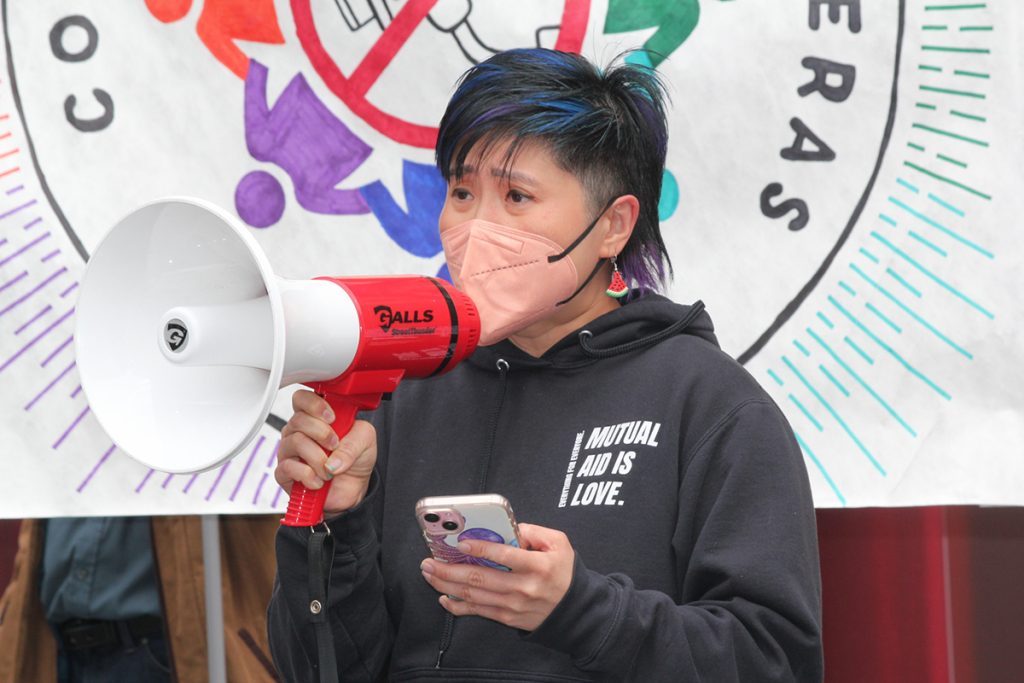
J.M. Wong, organizing director of Puget Sound Sage and a CID-based community organizer originally from Singapore and Malaysia (Photo by James Tabafunda)
“I promise you that the many, many pages of signatures that were collected from our neighborhood, were not accompanied with upfront discussions about the violent scenarios of Axon’s founder and his fantasy of surveillance,” Wong said, referencing the manufacturer of the camera technology. “Surveillance does not magically create safety.”
World Cup adds urgency to surveillance debate
The debate is playing out against the backdrop of Seattle’s preparations to host six FIFA World Cup matches this summer, a worldwide event that officials say creates added public safety demands.
Wilson has agreed to move forward with the installation of more than two dozen additional cameras in the SoDo stadium district ahead of the games, though city officials said those cameras would remain inactive unless authorities determine there is a credible, specific threat.
Protestors left Seattle City Hall’s plaza with a vow to continue pressuring Wilson, declaring that a pause and an audit fall short of the commitment they say she made to the city’s most vulnerable communities.
“No surveillance expansion,” the crowd chanted. “Turn the cameras off.”