




By Kai Curry
NORTHWEST ASIAN WEEKLY
Culture isn’t only something people inherit. It shows up in everyday choices, often without thinking—deciding where to shop, what to cook, and even how to spend a vacation can quietly carry forward a family’s traditions. The biggest ways people tend to get their cultural nourishment are from food and entertainment (TV, film, music, games). For Asian American Pacific Islander (AAPI) month, we spoke to Asian Americans about how they pass down their heritage, or how it was passed down to them.
Emily Chan is an artist, entrepreneur, and founder of Brightspot Design. She wrote and illustrated “Shibee & Friends Make Sushi.”
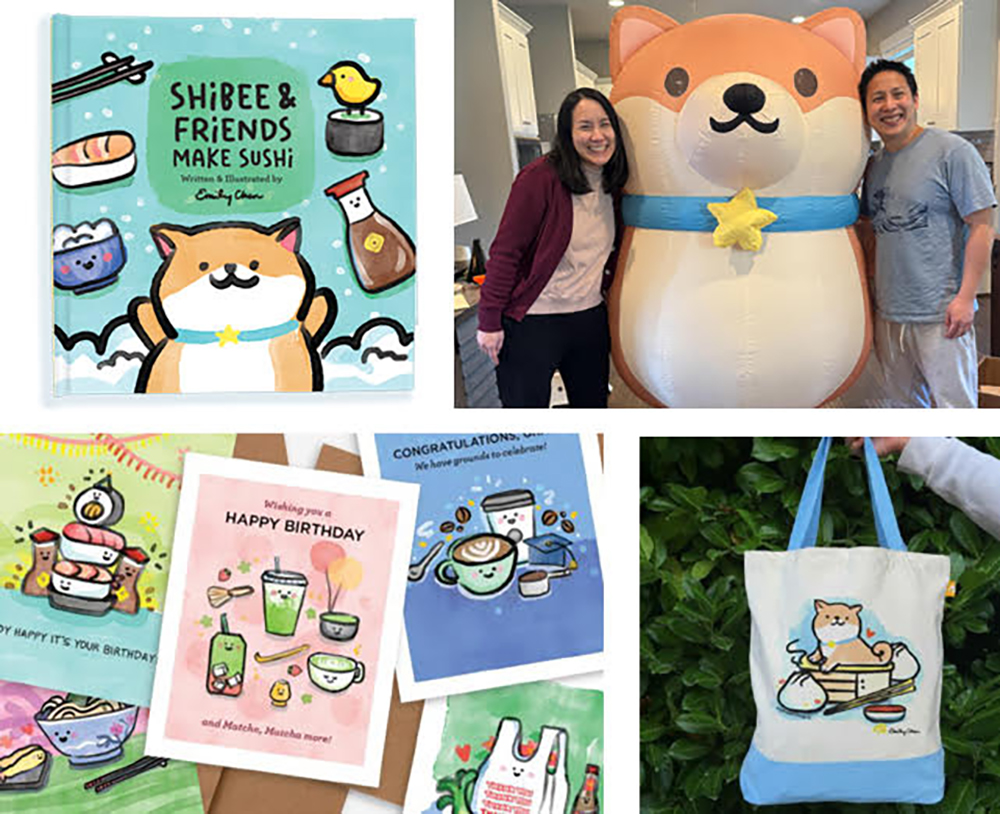
Emily and Jason Chan are excited about Emily’s new book and related items at Brightspot Design. (Provided by Emily Chan/Brightspot Design)
“People get excited about food. It’s such a big part of your culture and appreciation of other cultures.” This book was inspired by the Chan family’s trips to Uwajimaya which, to them, feels like being a part of a community. Every time they visit, it seems like they run into someone they know. Although Chan and her husband, Jason, are both of Chinese descent, they enjoy Japanese culture and food. A recent trip to Japan demonstrates how what might start out as a seemingly unrelated enjoyment of a particular country’s food (such as sushi) can blossom into full-fledged interest. In the book, “Shibee,” an adorable young Shiba Inu, goes to the store with their mother. While there, Shibee meets “Mako,” the “sushi cat” and “Daiki,” a capybara that works in produce.
The book includes wonderful art, charming rhyme, and an introduction to Japanese food vocabulary. Chan plans to extend the stories of all three characters in the near future. Just like in the book, where Shibee and Mom are preparing sushi for Dad’s birthday, Jason Chan enjoys sushi as a celebratory dish. He grew up in Canada with a family from Hong Kong. Because of the large Cantonese population near Vancouver, Canada, his parents are accustomed to regularly playing mahjong or eating dim sum, and Jason was more enculturated into what it means to be Chinese than Emily was, as her parents tended to keep their heritage quieter. Yet, even when we think that we don’t have much of our culture to pass on, it turns out we do. At Thanksgiving, for instance, instead of turkey, Chan’s family brings sticky rice and dumplings. Emily herself has mastered oxtail soup. Jason goes to their kids’ school to talk about Lunar New Year, and Chan recalls that at least one of her children did a school project related to Chinese traditions.
In this way, exchange happens.
Vicky Nguyen, NBC news anchor and correspondent, and author of the memoir, “Boat Baby,” told us about the importance of books such as Chan’s within her own family.
“When the girls were young, we always tried to find fun books to help them learn about their Vietnamese culture and heritage,” Nguyen told the Northwest Asian Weekly. Some of their kids’ favorite books included “The Yellow Ao Dai” and the “Very Asian Guide to Vietnamese Food.” As the kids got older, the family would attend events surrounding Tet, the Vietnamese New Year, and keep up with traditions like “li xi”—the giving of red envelopes. As with Emily and Jason, the older generation plays a part. Nguyen’s children are in almost daily contact with their Vietnamese grandparents. They know some of the language and hear stories about Vietnam and what it was like to grow up there.
“It’s very much a part of their everyday identity and I’m grateful they are proud of their roots,” Nguyen said.
“I remember my grandmother, who didn’t speak English, would make special things for Lunar New Year,” Chan said. “Looking back as a kid, you don’t really appreciate it.” Now, she wishes she could ask her grandmother how to make that tapioca brown sugar jelly that was so delicious.
“I guess you tend to gravitate towards your own culture,” she said. At the same time, the Chan family’s interest in all things Japanese means that Emily cooks udon on the regular, and that her kids—aged 14, 11, and 9—are getting into the music from Japanese TV shows. The kids are also on board with the trending entertainment circulating about China’s famous Monkey King.
Misa Murohashi, executive director of the Japan-America Society of the State of Washington, grew up in Japan and raised two mixed-race daughters here in the United States. Every year, she takes her daughters to her hometown in Japan. Her kids even had the opportunity for a few weeks to attend the same elementary school that Misa did. This gave them the meaningful experience of everyday school life in Japan, Murohashi shared. As with so many, food has also been an important way for Misa and her family to stay connected to their culture, which includes that of their father, who is half Black.
“I make sure they are exposed to authentic Japanese cuisine, whether at home or by visiting traditional Japanese restaurants,” Murohashi said. “For important holidays, such as New Year’s, I prepare traditional dishes like osechi ryori (a collection of dishes symbolizing good fortune, health, and prosperity for the coming year) and I have them dress in kimono to help them experience these cultural traditions more deeply.”
Murohashi, with her husband, makes a conscious effort to share Black culture with their children as well.
“I believe they have really benefited from and appreciate having a rich, multicultural background,” she said. This is the way of many Asians in the United States, particularly those who are second or third generation, but even those who are the first in their families to live here. When it comes to our heritage, we blend, we mix, we adapt, we innovate. We think we don’t have anything to pass along, and yet we do so without even realizing it. “Some of these things, I take for granted,” Chan admitted. “I’m so Americanized.” That is true. For AANHPI month, we remember that being “American” means that we give and receive our cultures every day.
As for her book, Chan said, “It’s a simple story for kids ages 4 to 7, but at its heart, it’s about celebrating Asian grocery stores, food, and culture for Asian American families and kids.”
Chan will be holding a book release event for “Shibee & Friends Make Sushi”on May 2, 1-4 p.m. at Seattle Uwajimaya and on May 3, 1-4 p.m. at Renton Uwajimaya.
The events will include a mascot photo op, a book signing, and a sticker giveaway wheel.
For more information, visit brightspotdesign.com.
Kai can be reached at newstips@nwasianweekly.com.