


By Carolyn Bick
NORTHWEST ASIAN WEEKLY
Three candidates vying for the District 5 seat on the Seattle City Council in this November’s election participated in a Lake City Collective community candidate forum on March 27. The seat represents North Seattle, including Bitter Lake, parts of Greenlake and Crown Hill, Maple Leaf, and Pinehurst. The council last year appointed Debora Juarez, who had previously served on the council from 2016–2024, to fill the position after Cathy Moore resigned the seat, citing health reasons.
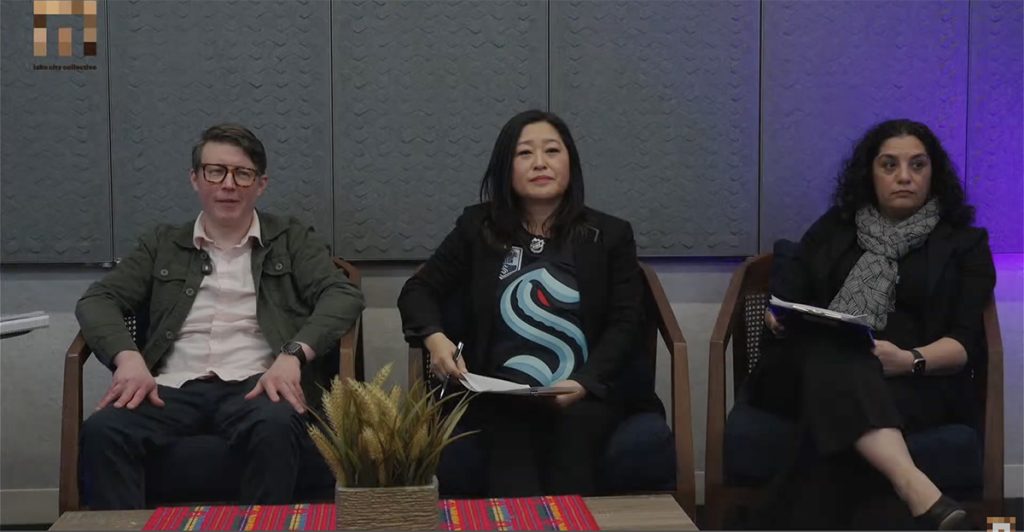
The candidates running for the seat—Silas James, Julie Kang, and Nilu Jenks—addressed multiple questions from moderator DeiMarlon “D” Scisney regarding homelessness, public safety, and long-term growth.
Pedestrian safety is public safety
Kang said that her experience as a Korean American immigrant, educator, and union member has shaped her life experience, and how she leads. Kang applied for the District 5 seat appointment last year. When asked about how she would marry accessibility and safety, Kang emphasized the need for safer pedestrian crossings and high-traffic corridors.
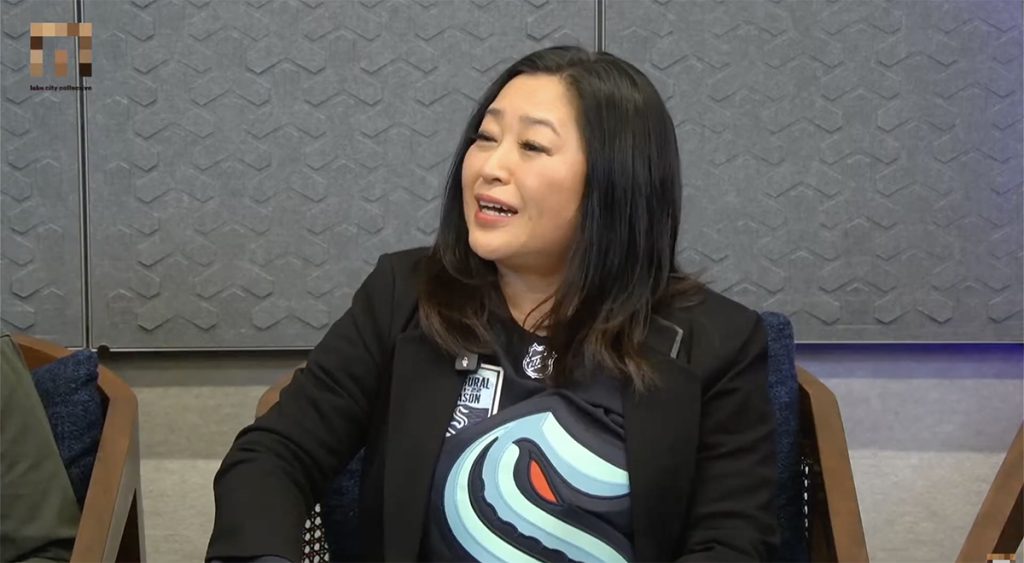
Julie Kang
“The reality is, we’ve had too many injuries and lost lives. Safety is non-negotiable,” she said. She briefly listed five ways she would approach safer streets and pedestrian crossings. These include using data to prioritize safety investments in the highest-risk areas, as well as incorporating broad design input with a focus on community input from pedestrians, people with disabilities, transit riders, drivers, and small business owners. She also said that she would work to improve transport reliability and connectivity, based on resident input. For instance, she said, she’s heard from door-knocking that bus Route 77, which connects Bitter Lake to the University District, suffers from congestion and lack of reliability.
“Fourth,” she continued, “build infrastructures that work together. Bike lanes, sidewalks, transit, and vehicle access should not feel like trade-offs. With thoughtful designs and phasing, I think we can make things better.”
She also noted the need for accountability. “If a project slows down, we need to make sure that we revisit and improve. I don’t just want to talk about these streets. I walk them and rely on the transit. I’ve seen what’s unsafe and where connectivity breaks down. Transportation is really about safety and process.”
As a person with disabilities himself, James—a healthcare educator and advocate—agreed with Kang. He highlighted the need for different kinds of safer crossings, like crosswalks with signals and sidewalks with drop curbs, as well as the need to engage with those who are most impacted.
“If we understand the needs of the most impacted and find a solution that works for them, we solve the problem for everybody. Universal design is meant to suit the needs of all ages, sizes, and abilities,” James said. “As a wheelchair user myself, someone who needs a car just to get to public transportation, I understand that having underrepresented voices like mine is essential in these discussions.”
He noted that he advocated for accessible, inclusive transportation when he chaired the Seattle Disability Commission, and that he has met outside that role with the Seattle Department of Transportation (SDOT) multiple times to discuss access matters.
“I’m a strong advocate for neighborhood hubs to increase the density throughout the entire city, but we also need rapid transit from neighborhood hub to transportation hubs,” he continued. “I think all that transportation should be free.”

Nilu Jenks
Nilu Jenks, a first-generation Iranian American who serves as the political and partnerships director for FairVote Washington, and who has served as a PTA advocacy chair and learning coach for English language learners, tallied the bleak toll unsafe streets have taken on the District 5 community: “Twenty people killed on Lake City and Aurora in 10 years. We also had a neighbor killed on Sandpoint Way, the street on which I live, just this past year.”
“These are not statistics,” she continued. “These are our neighbors. We have to do better, and we have to do it while keeping our community connected.”
She touched on several safety and accessibility concerns, including that children are walking to school on shoulders of roads; that wheelchair-bound individuals don’t have anywhere to go except the street; and that there needs to be both safer cycling infrastructure and reliable bus service. She said that she would push SDOT to “do genuine community engagement before projects are finalized, not after,” and that Metro should hear from District 5 residents that the neighborhoods need actual bus routes, not just “downtown spokes.”
“We need a bus system that meets our community needs and texts us to our local businesses and to our neighbors and communities. I support expanding bus frequency and reliability over road expansion,” Jenks said. “We need protected bike lanes, traffic calming, stronger vision, zero implementation, and free transit for all students, including college students. But the key to balancing all this, all these needs is bringing every user to the table before decisions get made. Not after the concrete is poured.”
Small business challenges
Jenks also said that her parents were small business owners, so she understands the challenges they face, and the necessary space they hold in the community. “Small businesses are the backbone of our neighborhoods and they need and deserve our support.”
She agreed with community members who say that the city has narrowly focused on just a few business districts, and has inadequately supported those elsewhere, including in District 5. Jenks said she would work to change this by pushing to decentralize resources, including expanding small business grants and technical assistance, as well as city marketing support to businesses outside City-designated Business Improvement Areas. She said she would also advocate for a District 5 neighborhood business liaison, look into commercial rent stabilization, and push for faster police response time to break-ins and burglaries.
“On break-ins and burglaries, I take this seriously. My friends have had their stores experience these burglaries and have reached out to me,” she said. “Small businesses can’t absorb these losses, so I’ll push for faster police response to commercial property crimes and for the city to fund storefront security grants for small businesses that can’t afford alarm systems or cameras on their own.”
As for unpermitted food vendors, she said, “I want to be direct: I support food entrepreneurship.”
“It’s how my family as immigrants did really well, and many of these vendors are immigrants and people of color trying to make a living,” she continued. “The answer isn’t a crackdown. It’s creating an accessible, affordable permitting pathway so vendors can afford to operate safely and legally, which also protects public health and levels the playing field for permitted businesses.”
She also highlighted the food and medicine desert Fred Meyer’s exit from Lake City in October last year left behind, and said that she would work to expand food co-ops and farmers markets, and change zoning to allow more grocery stores in neighborhoods.
Kang said that she would focus on safety for small businesses, including faster response time and coordinated support. She agreed that small businesses needed decentralized investments, and said that she would advocate for a more equitable distribution of resources. She also highlighted the need for affordability, especially in the face of rising rents, and costs of living.
“I will work with the city to explore tools like small business stabilization funds, technical assistance, and partnerships that help local businesses thrive. Last, create fairness around unpermitted vendors,” she said. “We need to protect public health and ensure fairness. That means enforcing basic standards, but also creating clear accessible pathways for vendors to become permitted and operate safely. And I want to be clear, yes, we are experiencing the food desert in Lake City, and bringing a grocery store back is not just economic development. It’s about basic dignity and access.”
James focused on the affordability factor, and said that the confluence of crime reducing sales and rising rents are hitting small businesses hard. He said he would work to resume the Seattle Restored program, which creates pop-up markets for businesses and artists in vacant buildings. He also said he wants to institute a vacancy tax on property owners to motivate them to rent the spaces that are otherwise sitting empty, like the old Bartell Drugs building.
Housing and homelessness
James believes that a guaranteed basic income would go a long way towards helping District 5 residents in many ways. Guaranteed basic income revolves around providing a certain amount of money to people below a certain income level that they receive, no matter what, and multiple studies show that it reduces crime, poverty, and homelessness.
He also strongly opposes sweeps, and supports Mayor Katie Wilson’s plan to create more tiny home villages throughout the city. He said that he hopes these villages will help to redistribute services that people rely on, and underscored that he believes in a “housing first” solution to homelessness, which guarantees permanent, stable housing to individuals and families experiencing homelessness.
“It’s a proven model that allows people to access services more reliably and have better outcomes faster,” James said. “We need to provide more case management to get people housed and connect them with health care, food access, and vocational services so they can change their station life when they get to that point. In addition, we need to make sure that every unhoused person has a safe place.”
He also noted that there is not enough emergency, transitional, or affordable housing throughout the city, so the city also needs to designate safe camping and parking spaces, and provide sanitization and waste removal services.
Kang said that the key to alleviating the homelessness crisis and addressing housing needs is combining housing services with behavioral health support. Kang said that she is finishing up her clinical mental health program at Seattle University, and therefore understands these concerns and needs. She said she will advocate for greater distribution of services and focus on prevention and access to voluntary treatment.
Jenks also said that her approach is housing first.
“The evidence is overwhelming. You cannot stabilize someone’s life, address their addiction, their mental health, or help with job prospects if they don’t have a stable place to sleep,” she said. “Housing first doesn’t mean housing only. It means housing is the foundation which everything else is built upon.”
She also does not support mandatory treatment as a condition to receiving shelter, because, she explained, “[t]his is a crisis. We should not be making it harder for people to get off the street. What I do support is robust, accessible, voluntary treatment, including mental health services, addiction recovery, case management connected directly to housing so people can access help the moment they’re ready.”
Jenks referenced studies showing that lack of housing and affordability is the primary driver of homelessness, and that the city needs to both help people financially and consider what may be coming down the pike from the federal government. She also said that the city needs to “build to match the needs of this national crisis we are facing,” which is why, if elected, she would champion building 1,000 new affordable housing units in the district.
Tenant protections and living conditions
But this new housing can’t come without strong tenant protections, Jenks said. Many people in older buildings find themselves disqualified for subsidized housing, yet being “one rent hike or one building sale away from displacement. My husband and I experienced this when we had a toddler and it was not okay. We were taken advantage of.”
Jenks believes in strong tenant protections and just cause eviction laws, alongside rent stabilization and tenant right to counsel. Eviction, she said, is one of the most destabilizing situations a family can face. She also believes in better code enforcement and rental inspection program resourcing, emphasizing better living conditions and sanitary maintenance—“affordable doesn’t mean uninhabitable.”
She also wants to revamp zoning laws, as exclusionary zoning has forced many renters to live in the noisiest, most polluted parts of the city. Reforming occupancy rules and introducing mixed housing, she said, is also key to helping mitigate the housing affordability crisis.
Kang agreed that the city needs to focus on caring for the homes it already has.
“I know that a lot of my working families of parents are living in those houses, and mold and unsafe neighborhoods and unsafe housing is not going to help them to thrive and it’s not going to help them to become the best version of themselves,” Kang said. “I think teachers and first responders also need to be able to live in the community in affordable units and they also deserve a safe place to live. I will pay attention to existing affordable housing so the tenants can live in safe conditions. … I also want to make sure that we do protect renters from displacement so that they don’t have to worry about how much their rent will increase and if they’re going to be able to afford it or if they’re going to be pushed out. At the end of the day, it’s about fairness and no one deserves to live with instability in housing.”
“It’s undeniable we live in a segregated city,” James said, agreeing with Jenks’ earlier comment. He said that he himself has never owned a house, and also knows the vulnerability of being a tenant living in fear of retaliation for reporting unsafe or squalid building conditions. James said that he would continue to advocate for tenant rights, and that he wants to create enforceable penalties for landlords who refuse to bargain with organized tenants who belong to tenants unions. He also wants to make tenants a protected class under the Seattle Office for Civil Rights, and favors increasing density across neighborhoods.
More than just police
In addition to overhauling roadways and sidewalks, Jenks said that public safety has to be centered on prevention and community wellbeing, as well as better emergency response. She said she would push for community responder programs that send mental health professionals and social workers, not armed police, to behavioral health and social service calls.
“I am not a thoughts and prayers person at all. I want us to be safer,” she said, in the course of noting her upcoming meeting with Seattle Police Department (SPD) Chief Dr. Amy Barden, who heads the Community Assisted Response & Engagement team for the City, and that she co-organized one of the nation’s largest gun buyback programs, following the Parkland school shooting in 2018. “I want our children to be safer and it motivates me every single day.”
Kang noted that people want to feel safe, but they also want solutions built on trust. She said that she would work to improve emergency response times, invest in prevention and alternatives, and help set clear standards for technology and surveillance.
“I understand why some neighbors want tools like the cameras, but we must also balance safety with privacy and civil rights,” Kang said. “That means transparent policies, community input, and clear accountability for how these tools are used.”
James said that he thinks expanding the CARE team and allowing them to dispatch on their own, rather than with police, is crucial to public safety.
“That will free the SPD up from participating in calls when their presence is not necessary,” he said. “I also want to say surveillance doesn’t make us safer. … It’s not just me saying that there’s a 2019 study by the Department of Justice reviewing 40 years of information about surveillance and they found that it’s not a standalone crime prevention. It doesn’t prevent crime. … We should terminate Axon’s … contracts with Seattle.”
“We pay over $7 million a year for [Immigration and Customs Enforcement] (ICE) to kidnap people from our streets and disappear them into detention centers. We cannot feed the corporate surveillance machine,” he continued. “We’re exposing our most vulnerable neighbors to even more danger. It’s not reasonable to expect the data to exist but not be accessed. [The Department of Governmental Efficiency] should have taught us that. Axon works closely with ICE and has active contracts with ICE. The best way to reduce crime is by reducing poverty.”
Leave a Reply