




By Carolyn Bick
NORTHWEST ASIAN WEEKLY
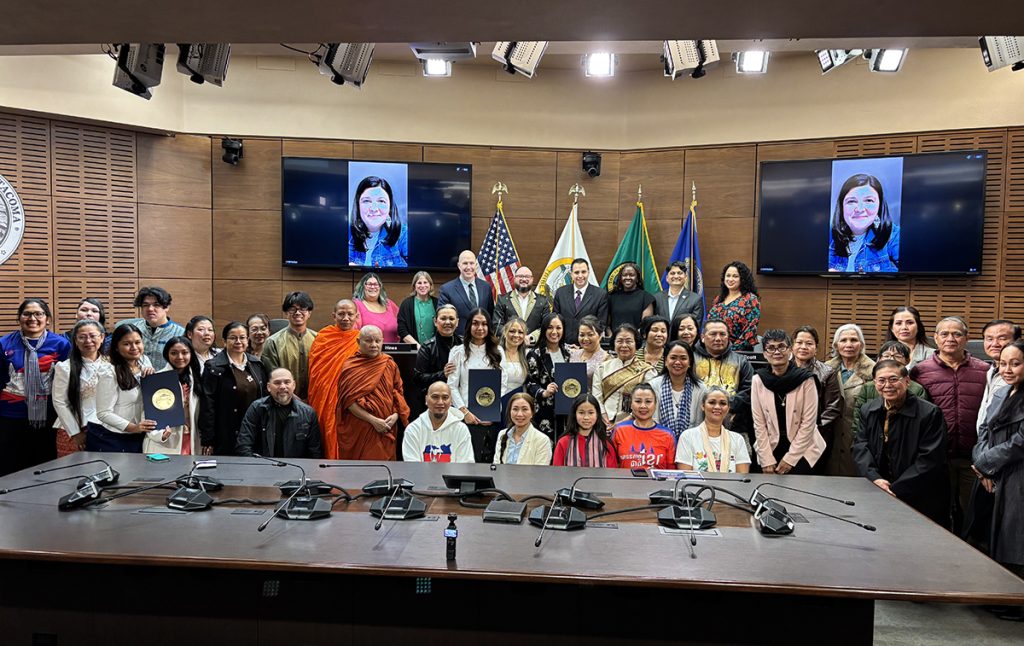
The Cambodian American community state assembled on April 14 at Tacoma City Hall for a proclamation of April 12-18, 2026, as “Cambodian Genocide Remembrance Week.” (Courtesy: City of Tacoma)
The City of Tacoma’s Cambodian Genocide Remembrance Week is complicated for the community. It takes place in mid-April, at the start of the Khmer New Year, Chaul Chnam Thmey. But in 1975, Pol Pot and the Khmer Rouge took over Cambodia during this same time meant to celebrate joy and community. The regime’s takeover marked the beginning of a genocide that resulted in the deaths of between 1.5 million and 3 million people in a four-year timespan, and forced hundreds of thousands to flee for their lives, ultimately ripping families apart.
Tacoma Deputy Mayor Chanjolee “Joe” Bushnell’s mother was one of those people, and her experience, as well as the experiences of the community who helped raise him, is part of why he helped to spearhead efforts to declare the week a remembrance week in 2022. This year, the city council officially marked the week’s fifth anniversary at a ceremony during the council’s regular evening meeting on April 14, as well as a special ceremony earlier in the day.
Surviving genocide
Darachan Ros spoke in both Khmer and English at the ceremony about her and her family’s survival of the genocide.
“All my parents, my brother, my brother-in-law, my sister, my sister-in-law were killed by the Khmer Rouge—about 30 people, because they all have high positions,” Ros said. The Khmer Rouge killed them, she said, because they were government officials and scholars. They even tried to kill her three times, because she was a teacher, but she eventually found herself in a labor camp. “We had to work from the morning until nighttime and we had a little bit of rice, small bowl like this, to eat. We passed a lot [of time], miserable, [starving, and suffering]. And I have only two clothes to wear … and no shoes.”
Ros said that she, her son, and her sister eventually escaped and passed an interview to get into the United States. With community aid, she eventually went on to build a life for herself, but not without significant hardship and difficulty along the way.
“I think English is the barrier for me. So what I had to do, I had to go to school … to [Tacoma Community College], but it was hard for me,” Ros said. “Sometimes I cry, [as] I walk in the rain. I [worry] that I don’t know how to learn English because it’s a hard language that I never [spoke] before.”
It took Ros nine years to get her bachelor’s degree, but she did it.
“But I’m proud of myself that I got a bachelor’s degree [at] over 50 years old,” she said.
“And I try to encourage the other young generation, especially women, to go to school because I think women, we have to be strong.”
Chantha Banks experienced a different, but no less traumatic childhood at the hands of the Khmer Rouge. At 9 years old, she told listeners that she was forced to become a child soldier. Of the 48 people in her family, one seven survived.
“It is not a history, it’s personal. And these tragedies have reminded us every single day that we have to stand up and smile. Our smile is our resilience,” she said. “We have overcome this horrible darkness, tragedy, and I’m happy today standing [in front of] each, every one of you staring at your face, and I know what you’ve gone through, your parents gone through, and I’m still surviving.”
A heavy legacy
“I grew up on the east side of Tacoma—and all over Tacoma, really. I was passed around as a kid to all the different aunties,” Bushnell remembered in a later interview with the Northwest Asian Weekly. “Part of the reason why I got passed around a lot was because everyone was still in survival mode when I was growing up, because [the genocide] was not that long ago.”
Having come to the U.S. with “nothing but the shirt on their back,” and trying to learn a new language and social rules and customs, he said, the community was just trying to get by.
But still, even beneath that, there was something else. Bushnell never heard about the genocide directly from his mother or aunties who helped to care for him, but “when I was in different Cambodian spaces, I felt like there was this really heavy undertone to everything that we were doing.”
“It’s not that I didn’t know what had happened,” he continued. “It’s kind of like whispers around me, so to speak, is the best way I can describe it. And I can feel kind of like this very heavy undertone wherever I went because of that.”
Bellariny Chea touched on this “survival mode,” in her remarks at the April 14 council meeting. She spoke of her two grandmothers’ “unimaginable strength and resilience. They carried so much pain while raising their families alone after both of their grandfathers were taken from them, living through a level of suffering most of us can’t begin to understand.”
Thanks to their sacrifices, she continued, her parents were able to give her the life they didn’t have: “the freedom to grow without the weight of trauma and fear that shaped their childhoods.”
But even though she grew up out of the way of immediate harm, Chea still feels the weight of her parents’ and grandparents’ experiences.
“Second-generation trauma is something not spoken about much as we tend to carry emotions we don’t fully understand, such as anxiety, grief, and fear,” Chea said. “Growing in silence where love is deep and pain is unspoken and expectations are rooted in survival—it’s living between worlds, carrying both pride and pain, feeling the quiet responsibility to make every sacrifice worth it. We need to honor the responsibility we carry to keep these stories alive, to uplift one another, and to ensure that the future we build is one of hope, unity, and peace.”
Ripple effects
The ripple effects of generational trauma express themselves in more than just heavy silences. Bushnell said that, as a young person, even though he conceptually understood what had happened, that didn’t mean he didn’t feel a level of resentment towards his elders for different things connected with his culture, like not teaching him the Khmer language. Now, though, as an adult, he understands the reasons behind this.
“During the genocide, they did kill educators, they did kill dance teachers—they tried to erase Cambodian culture. A lot of the people that would have known these things and how to do the dances, a majority of them were killed,” he explained. “So, trying to reconnect with that culture is almost like restarting, because there weren’t too many survivors that knew every little nuance of all the dances of everything. And so it means trying to rebuild … over the years.”
Bushnell said that he feels it’s taken at least two generations to see a more solid Cambodian community.
“You’ve got to remember that the genocide was Cambodians fighting other Cambodians,” he said. “There’s a lot of mistrust even amongst community members. We’re not a monolith, just like all the other cultures out there. Everybody has different ideas of what things should be or have been or all these different things. I feel like it’s taken a lot of time for us to heal as a community.”
Bushnell also said that even though Washington was a major resettlement area for Cambodian refugees, the Cambodian community in the state is more diffused than it is in other key resettlement states. There is a significant concentration of Cambodians in Long Beach, California, for instance, he said, which is why the city’s government is planning to erect a gate marking the entrance to Cambodia Town.
“There’s definitely a concentration in Tacoma specifically, but we have Cambodians now that live up and down the Puget Sound all the way down to Portland, and we’ve kind of diffused across the Pacific Northwest,” Bushnell said. “Our diaspora is kind of spread throughout.”
Healing through cultural reconnection
But this doesn’t mean that Tacoma’s Cambodian community is any less rich. Bushnell said that the community has created organizations meant to promote healing and wellness through reconnection with their culture, such as the Khmer Language Arts and Culture Academy and Cambodian Classical & Folk Dance of The Northwest. He also highlighted the Tacoma Healing Awareness Community, which focuses broadly on Southeast Asian communities. Vanna Sing, who founded the organization, survived the Khmer Rouge.
Bushnell said both in his interview with the Northwest Asian Weekly that Khmer cultural learning isn’t exclusive to the Cambodian community, and that those who are interested in learning how to practice different aspects, like traditional dance, are welcome.
“Our culture is open. We have different, great cultural arts organizations that would love to teach you our language, that would love to teach you … our dances and our traditional foods,” he said during the meeting. “We are welcoming.”
These organizations have helped community members physically ground themselves in Cambodian spaces, ultimately contributing to the healing process. Chea told listeners at the council’s evening meeting that because of the community’s resilience and threads of strength—however tested, however fragile—she is “able to embrace our culture, carry our traditions, our language that was once nearly lost but still continue to live through all of us.”
“History still lives within us, in our community, in our families, in our memories,” she continued. “What was taken from one generation echoes to the next, but so does their strength.”