

By Kai Curry
NORTHWEST ASIAN WEEKLY
“Agent from Above” is a new Netflix series intended to appeal to viewers in Taiwan and those who want to watch Taiwanese content in the United States. It’s put together by Singapore’s mm2 Entertainment and Taiwan’s Good Films Production and can be described as a modern fantasy that blends contemporary popular culture with traditional Taiwanese folk beliefs. The belief system introduced into the story is a mix of Daoism, Buddhism, and, probably, artistic license, which makes for a somewhat confusing start—but it all comes together by episode two or three.
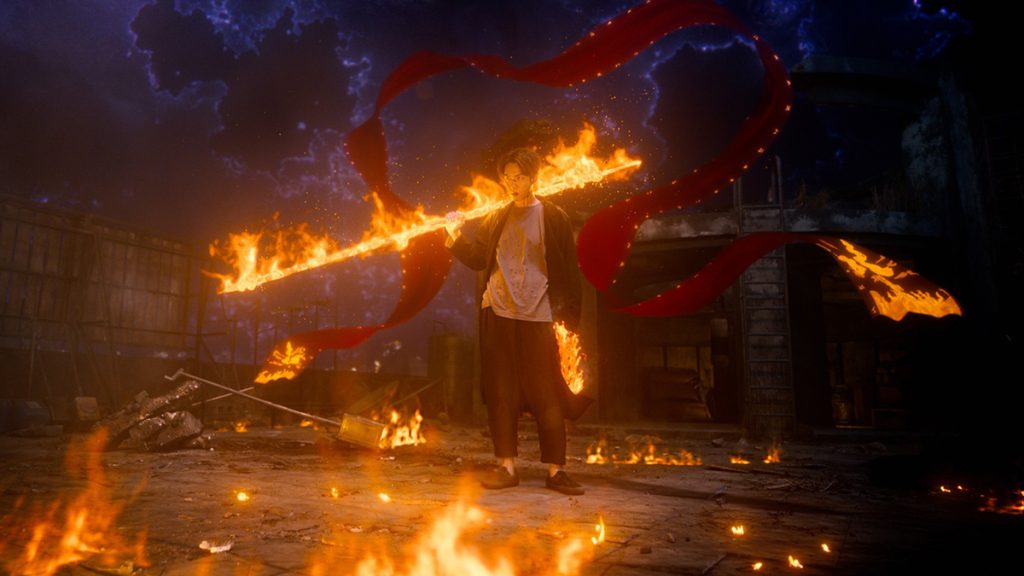
Han Chieh (Kai Ko) has a celestial mission to curb demonic power on earth. (Courtesy of Netflix)
Kai Ko plays the hero, Han Chieh. A well-known actor and singer in Taiwan, with K-Pop-esque good looks, Ko won Best Actor for his role in “You Are the Apple of My Eye.” Along with a policeman (Johnny Yang) and a naif with leukemia (Buffy Chen), Han battles ghosts and demons who have possessed humans as a way to enter the mortal world. Primarily, we are dealing with the Underworld here, or DiYu, which is something like a purgatory where the dead atone for their sins (presumably until they are released to somewhere nicer, heaven, if you will). Because Han killed himself—something to do with betraying his parents—he lands in the Underworld. Not for long, though. Han is immediately recruited by the “Third Crown Prince” (Wang Po-Chieh), who shows himself in a form not so much like that Buddhist statue on the altar, but rather like a cross between a pimp and a gangster (maybe those are the same thing).
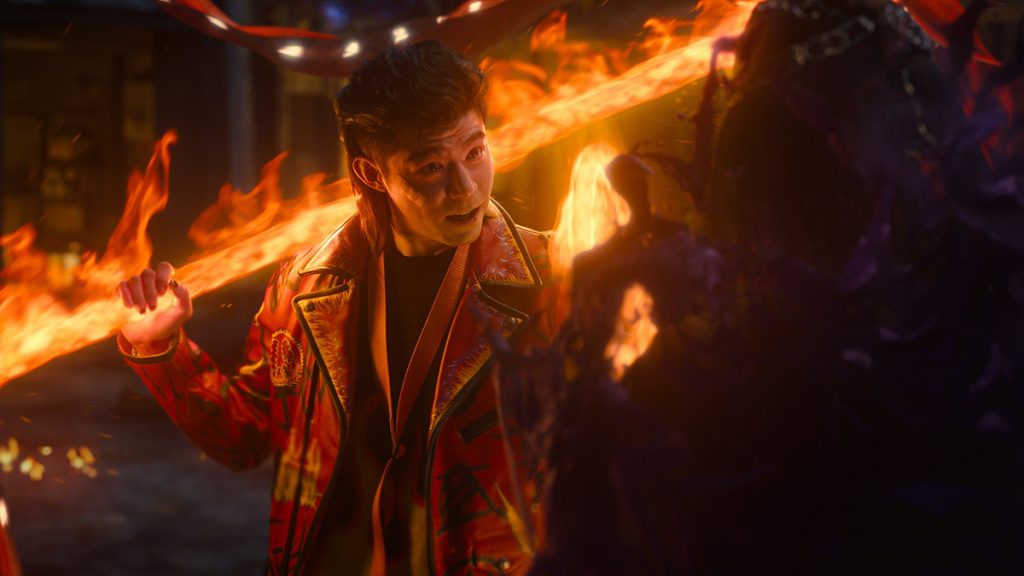
The Third Crown Prince (Wang Po-Chieh) has a penchant for fire. (Courtesy of Netflix)
You might know Wang as Jacob or Edison. He has featured mainly in Taiwanese movies and television, with a small part as a sailor in the English-speaking film, “Life of Pi.” Although possibly based on the Chinese protector god of children, San Tai Zi, the Third Crown Prince as he appears here is described by the show’s creators as a celestial deity and a guardian of balance. Mostly, he is concerned about a particularly powerful Demon King who wants to stir up trouble, as they do, and so the Crown Prince tags Ko to be his “agent” on Earth. He equips him with several “pogs” or small tokens that Ko can convert into weapons as needed. There are a finite amount of pogs and once Ko uses them up, it’s supposed that his contract with the Prince is over.
As one might expect, Ko’s character is somewhat ambivalent about his new job. He spends most of the time in moody contemplation, full of guilt over his parents and also a former lover. But he also does not shirk his duty. The arrangement with the Crown Prince is a way for him to pay his “debt” and be able to actually die in peace (and “save” his parents, I guess, who are not having a great time in the Underworld themselves). Chen’s sweet and vulnerable Yeh Tzu (it’s so great that her first name is Buffy, given the supernatural nature of the show) searches Han out for help with a problem at home. She has seen ghosts in her house, and is worried about her parents.
Han reluctantly follows up on her case, although he initially thinks it’s fake (not her, but the ghosts). After a while, he finds out that Yeh Tzu’s story is linked to the story of the returning Demon King via a quack feng shui expert who is actually the dark-magic wielding maniac Wu Tien-Chi (Hsueh Shih-ling), who in turn is manipulating Han’s former nemesis, the evil sorcerer Chen Chi-Sha (Chen Yi-Wen). Try to keep up, okay? There are a mix of people possessed by demons, people summoning demons, ghosts connected to the people with demons, and just regular nasty ole gangsters. Along the way, we accompany Han on his day-to-day chores for the Crown Prince, which are sometimes wrought with world-ending consequences, and other times are “just” freeing a beleaguered family from some too-possessive godmother spirits, for instance.
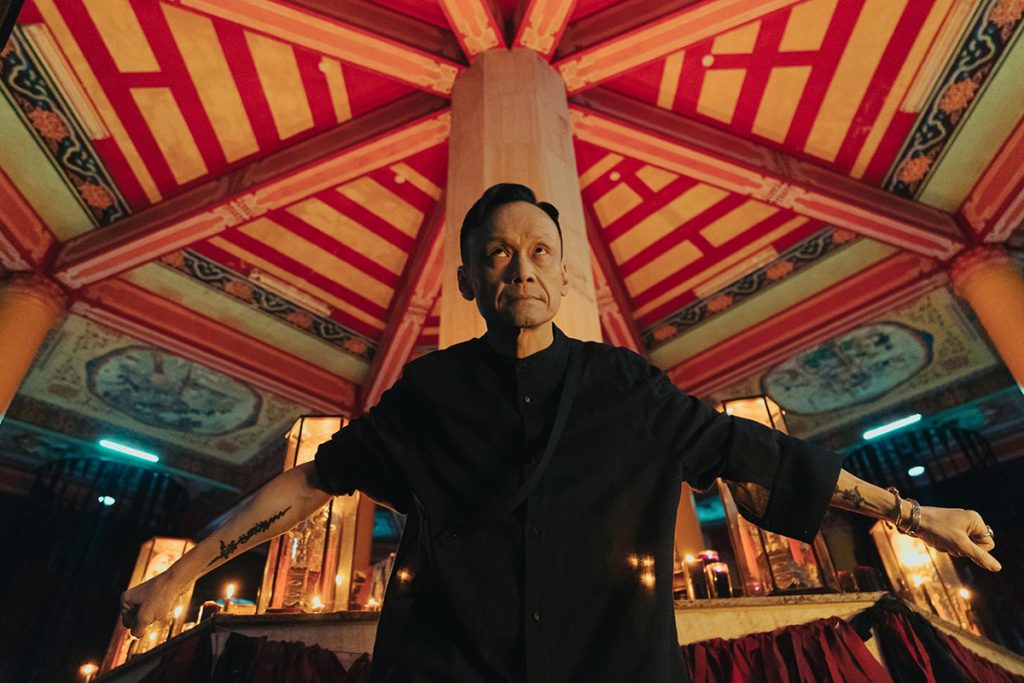
Chen Chi-Sha (Chen Yi-Wen) is Han’s former and current nemesis. (Courtesy of Netflix)
The series’ use of special effects is pretty impressive. It’s cool the way that they superimpose an otherworldly face onto a person’s face, and how it wavers in and out, suggesting the trapped nature of the demon inside the body, but also that it is powerful enough to exert influence. Han’s weapons are flamboyant and gorgeous—often made of fire and traditionally powerful colors such as red. The pace is a bit slow, or drawn out, kind of milking every moment for effect, so you think Han is basically never going to use a pog, until he finally does. It’s a bit confusing as you’d suppose he’d want to use them up as quickly as possible so he can get back to being dead, yet the ground rules are uncertain. Sometimes he banishes evil or frees a ghost from an evil spell; other times, he adopts benign ghosts who are stuck on Earth for whatever unresolved reason, and brings them back to where he lives with one old man and a bunch of other ghosts that died unjustly in the building prior. Han helps the old man, who is like the concierge, and Yeh Tzu “see” ghosts by opening their third eye. The weird thing is that apart from ghosts, the occasional visit by the policeman, and maybe a restaurant owner, the city is nearly 100% empty. It’s kind of hilarious to see Han sucking on bubble tea in the middle of this apocalyptic environment.
The lore is entertaining and interesting, and probably will be familiar to many. It’s sufficiently scary at times, and unexpectedly sweet at other times, when Han has an attack of conscience or Yeh Tzu butts in with some empathy. (Han’s actually a very nice guy.) It’s sad when people are stuck as ghosts because they can’t let go—and so, letting go, or trying to, becomes one theme of the show. It’s natural that it should take a couple of episodes to fully flush out the world building and character building. Meanwhile, “Agent from Above” keeps us intrigued by its Taiwanese-based interpretation of the never-ending battle between good and evil.
Kai can be reached at newstips@nwasianweekly.com.
Leave a Reply