

By Kai Curry
NORTHWEST ASIAN WEEKLY
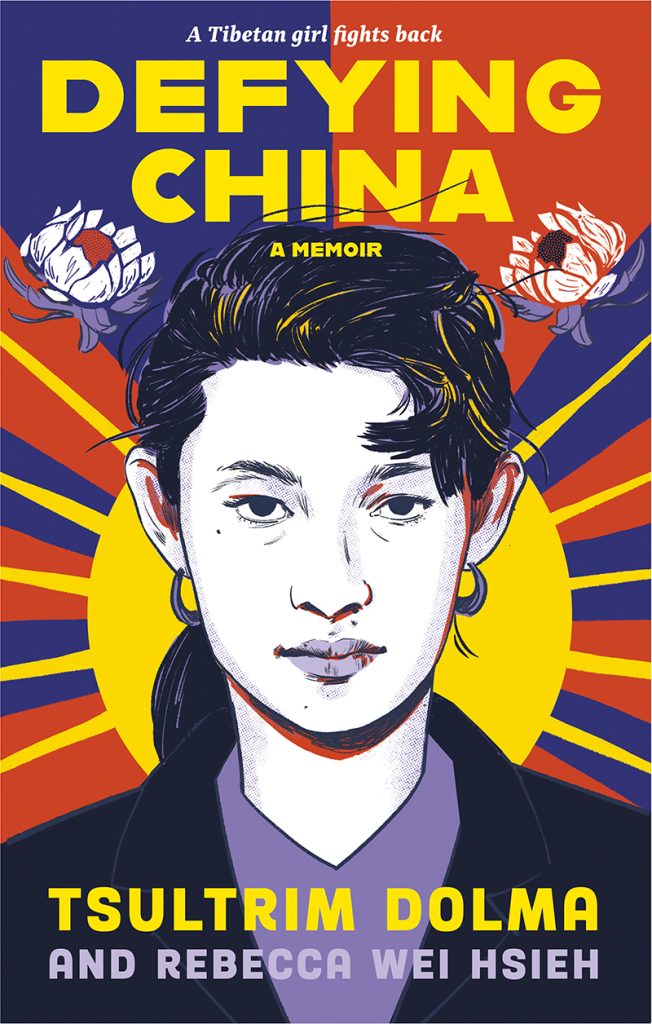
Photo courtesy of Tsultrim Dolma and Penguin Random House.
Tsultrim Dolma knew there was something different about her. At an early age, she defied the expectations of a girl growing up in Tibet. She didn’t want to marry. She didn’t want to stay in one place, although she loved her hometown and her family. As a teenager, the words just came out of her mouth: “I want to be a nun.” She went to Lhasa to join her aunt at Chupzang nunnery. Before long, Dolma was caught up in the Tibetan resistance against the Chinese.
In her new memoir, “Defying China,” Dolma tells the story of her early years. The book encapsulates Dolma’s childhood, her teenage years, and the rising tide of activism inside of her that led to imprisonment and eventually exile to India, and finally to the United States. This “exile” was partly self-imposed and partly forced by circumstance. Staying in Tibet was dangerous—to her and to those who cared about her. Leaving was dangerous, too. The Northwest Asian Weekly communicated with Dolma about her incredible journey so far.
In the Tibet that Dolma grew up in, oppression was felt but not talked about. History, recent and ancient, was mute. The natural curiosity of children was stunted as they were expected to follow along without knowing what was going on. We asked Dolma what it was like growing up with this tense ambiguity, and not being able to ask questions.
“It was frustrating,” she answered. Some children had access to education, and some didn’t, she explained, an inconsistency present in many aspects of Tibetan life. Dolma wasn’t allowed to ask questions about her culture or religion. This led to mishaps, such as jubilantly bringing home artifacts from a destroyed temple, and being greeted with alarm, not joy. “It made no sense to me,” she said. “Not knowing my country’s history made it disorienting as I tried to find my place in life. I had no real political or social context to use as a guidepost. You need to know the context in which you live in order to fully know yourself.”
As in many countries, speaking up came with often deadly consequences. Protests against the changes that the Chinese were making in Tibet led to volatile clashes in the streets of Lhasa, to prison, and torture. Dolma was considered a criminal, effectively on the run. We asked her what she has risked by telling her story in this memoir, what she has risked from the beginning.
“I risked my own safety and that of my family,” she said. “I fled Tibet in the hopes of lessening the surveillance they were under. Some friends and relatives also decided to cut off contact with me out of fear of ‘guilt by association’ or differences in political opinions.” While it was painful, the pain didn’t stop her from being who she was—from being a person that resists. To this day, Dolma is known as the Tibetan American activist who gave testimony before Congress. “I still continue to write essays about Tibet and my own thoughts,” she said.
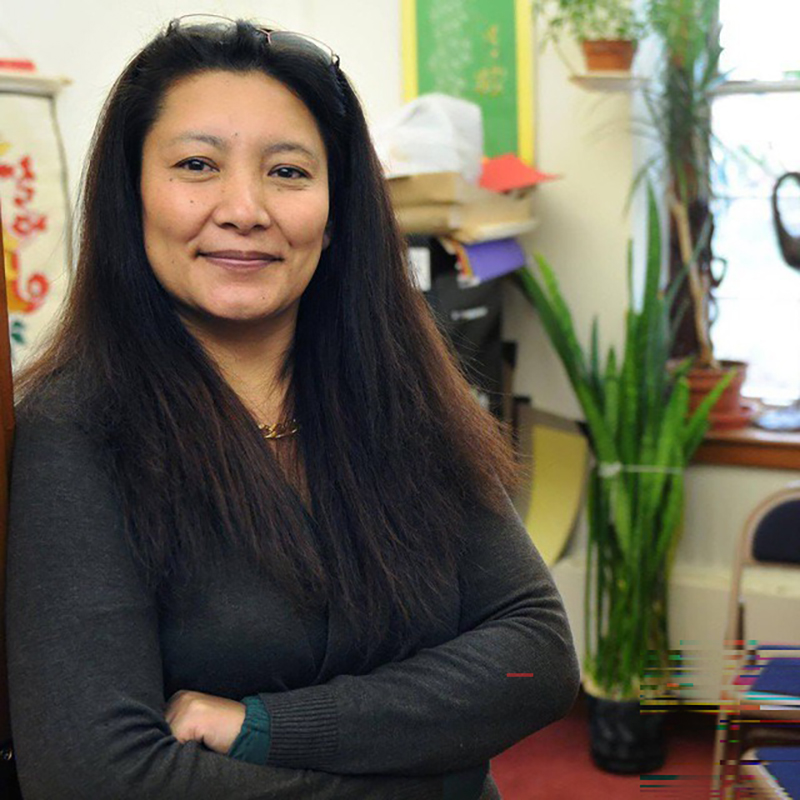
Photo courtesy of Tsultrim Dolma and Penguin Random House.
Why continue? Because somehow Dolma knew it was important to get to the truth herself, and to make others aware of the truth of Tibetan life under China. “It’s not just about Tibet or Tibetan people—we are all interconnected via the environment and economics,” she explained. For instance, there are many rivers that originate in Tibet, and the Tibetan plateau is rich in minerals. “Chinese expansionism and militarism affect other neighboring countries and peoples as well,” she reminded. In her memoir, Dolma notes that she did not hate the Chinese nor the Chinese government. She understood early on that Chinese people, too, were under oppression. She didn’t want revenge but justice, she says, and told us that “it’s important to remember that you have to fight for your rights and to maintain them, regardless of where you’re from.”
Dolma had to leave Tibet, and for now, maybe forever, she can’t go back. It’s a permanent rift with family and home. People she loves have had to block her out of their lives, and censorship within Tibetan has made it hard for those still there, in their turn, to know the real situation for her. What did she think has changed, we wondered, good and bad, in Tibet since she was there?
“My hometown, in particular, has undergone a lot of environmental changes, the biggest of which is the planting of evergreen trees.” Dolma said. ““It seems good in theory, since the land had undergone mass deforestation under Chinese occupation. But instead of planting those trees in deforested areas, the authorities have been taking over our farmland, forcing people and livestock off the land. Villagers are no longer able to live off the land, and have had to then take on low-paying jobs to try to sustain themselves and their families elsewhere.”
Dolma doesn’t expect others to respond to adversity in the same ways as she has. “I know what I’m willing to sacrifice, and you need to decide what you’re willing to risk for yourself,” she commented. For those that want to help the people of Tibet, she advises that they learn more about Tibet by talking to Tibetans, and that they help amplify Tibetan voices. “Contact your representatives, raise awareness and build community,” she suggested.
For herself, she will continue to fight for Tibetan independence. In some ways, Dolma takes a harder line than the Dalai Lama himself. She disagrees with the Dalai Lama’s more recent pursuit of the middle-way approach, she told us. “We all have a lot of different opinions,” she said of Tibetans at home and abroad. Some are secular; some, like herself, are religious. The Dalai Lama is a pillar of that religion and a symbol of hope and guidance for the future, she said.
“As much as I respect the Dalai Lama’s political approach, I still want Tibet to be fully independent,” Dolma concluded. For her, that means no compromise with China and a People’s Republic of China government that she cannot trust due to her own personal experiences. Dolma will keep fighting. She might write another memoir about her life as a refugee in the United States. She has two daughters, both Tibetan American, that she will continue to support as best she can. Her husband, sadly, passed away without ever being able to see Tibet again.
“Never give up,” Dolma said. “We will succeed as long as we have hope. I never received a formal education, but even I have been able to speak out and make change, little by little. Keep living and being who you are. What is yours is yours.”
“Defying China: A Memoir,” by Tsultrim Dolma, with Rebecca Wei Hsieh, is available in bookstores.
Kai can be reached at newstips@nwasianweekly.com.
Leave a Reply