

By James Tabafunda
NORTHWEST ASIAN WEEKLY
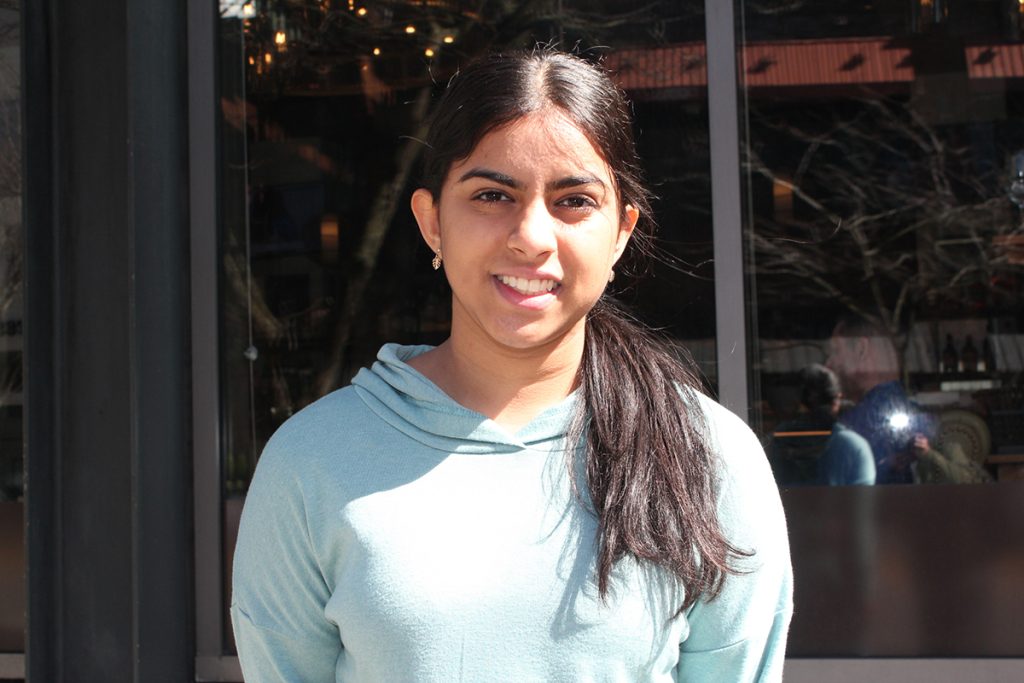
Siddhi Tandon, founder of Cubs of Wall Street (Photo by by James Tabafunda)
Learning from experience can cause a ripple effect. The summer before her sophomore year, Redmond, Wash. student Siddhi Tandon opened an envelope in the mail containing her first paycheck—about $500 she had earned working as a camp counselor.
“I really just didn’t know what to do with the check itself,” she said. “We went to the bank, and I had at that point a banking account under my parents’ names.”
The teller at the bank told her she could not deposit the check into her existing account. She could, however, open a teen checking account. Tandon, then 15, did exactly that.
“I realized I didn’t know anything about what I could do with that money.”
“This is the first time it struck me because it was the first time I’d really had money in my life.”
That moment of financial uncertainty turned into a passion for learning how money works. Tandon spent much of her sophomore year at Lakeside School—a private school in Seattle—teaching herself about personal finance and the stock market through YouTube videos, online articles, and conversations with her parents. By the end of that school year, she had opened a custodial investment account and decided to share what she had learned.
From TEDx stage to library floors
Last June, Tandon walked onto the stage at TEDxDelMar Youth in San Diego, Calif. and delivered a talk titled “The Cubs of Capital Street: Smart Money Starts Young.”
“I wasn’t really sure if this was a message that would resonate with people or they would understand this coming from well, at the time, I was like 16 years old,” she said. “I didn’t really know. Would I be taken seriously? Would this really mean anything?”
The answer came quickly. Adults told her they wished someone had shared this information with them when they were young. Kids said they were inspired to open bank accounts. A promising movement, however modest at first, had begun.
By August 2025, Tandon had founded Cubs of Wall Street, a youth-led financial literacy initiative, and begun hosting free workshops on budgeting, saving, investing, and understanding different types of accounts, including cryptocurrency, at public libraries across Washington state. By early 2026, she had reached more than 4,500 students in library meeting rooms, at school STEAM (science, technology, engineering, art, and media) nights, and at community events from the Eastside to Federal Way.
A pivotal session came in the autumn of 2025 at the Redmond Library.
“One of my early sessions in Redmond had a huge turnout of around 70 people,” she said. “That was our biggest session. That really propelled me when I realized, ‘Oh, like this many people showed up on a Saturday morning to learn about this from me.’”

Siddhi Tandon, founder of Cubs of Wall Street (Photo by by James Tabafunda)
Meeting kids where they are
Tandon, 17, teaches with an interactive and adaptable approach, choosing to read the room instead of lecturing from a script.
“I think the key thing that I’ve learned is to really just go with the group and look into what the kids are interested in,” she said. “One of the things that I do in all my sessions, to show the power of compounding, is I play a little game: ‘Would you rather get $50,000 at the end of a month or a penny that doubles every day throughout the month?’”
Most participants choose the $50,000, but then Tandon shows them that the doubling penny grows to more than $5 million in 30 days. She said the reveal is always a favorite and helps students grasp the power of compound interest.
Tandon also tailors content to what participants know—or don’t. At some libraries, mostly in more affluent communities, students have cited Fidelity research papers at her. At others, they have never heard of a bank account.
“I’ve seen real disparities and how this is necessary everywhere,” she said.
Her partnership with Boeing Employees Credit Union (BECU), Washington state’s largest credit union, has empowered her to go further. At a recent Federal Way public school STEAM night, BECU representatives set up alongside her booth, and four students walked away with newly opened youth bank accounts before the event ended.
“For me, every single instance of that is a win,” she said.
One librarian’s review
Nancy Garrett, the teen services librarian at the Lake City Branch of the Seattle Public Library (SPL), hosted Tandon twice—for a meetup last October and a workshop in January 2026.
“This was a unique program in that we haven’t hosted a financial literacy program for young people at our library in recent years, and it is relevant information that teens need and are interested in,” she said. “Siddhi is very knowledgeable, prepared, and professional. In addition to her presentations and TEDx talk, she has published a book and started her own nonprofit!”
Garrett observed that teens connected with Tandon’s approach in a way that a traditional adult-led workshop might not achieve.
“Siddhi has a warm and knowledgeable presentation style, not only presenting information about saving, investing, compound interest, starting bank accounts, etc., but also incorporating at least one interactive audience element,” Garrett said. “She also shared her own personal journey with financial literacy, which is always interesting and helps to connect to the audience.”
The Lake City Branch serves a diverse neighborhood, where many families may lack access to financial guidance at home or through school. Garrett said programs like Tandon’s fit well with the library’s equity mission.
“Financial literacy education along with other practical skills might not be provided to young people in local schools or other venues and can be quite valuable for youth to be introduced to if they haven’t already,” Garrett said. “Our library programs often focus on equity and access to information and resources for diverse youth and families in our community.”
equity and access to information and resources for diverse youth and families in our community.”

Siddhi Tandon, founder of Cubs of Wall Street (Photo by by James Tabafunda)
A book on the shelf and a goal that’s worthy
In February 2026, Tandon published her first book, “What I Learned About Money: A High Schooler’s Account.” The non-fiction publication, aimed at readers ages 9 to 18, covers earning, budgeting, saving, investing, and taxes—with each section closing on a chapter about a well-known figure, from Warren Buffett to Oprah Winfrey, who has used those financial skills in real life.
The book is now available through both the SPL and the King County Library System, and for sale on Amazon. It was self-published through Kindle Direct Publishing and IngramSpark, with assistance from librarians Tandon had already built relationships with through her workshops.
“The idea of the book really originated when, as I was doing these sessions, I wanted to make it my mission to spread this idea and spread this knowledge to as many people as I can,” she said. “At the end of my sessions, people would often be like, ‘Oh, can you share the slides you used with me?’ … So that’s when I thought, ‘Well, I’m doing all these sessions at libraries. Maybe I can write a book.’”
The gap she’s trying to close
Behind the workshops and the book lies a challenging, longer-term ambition: systemic change in how schools teach—or fail to teach—money.
“I think a concrete change that I would like to see is to have a semester or workshop of mandatory financial literacy education implemented into high schools,” she said.
Research by consulting firm Tyton Partners, in collaboration with the nonprofit Next Gen Personal Finance, found that completing just one semester of personal finance in high school translates to an average lifetime economic benefit of approximately $100,000 per student. Tandon cited that figure in her TEDx talk and has made it central to her advocacy.
“Financial education influences nearly all major decisions individuals make in adult life—from managing income and credit to securing housing and planning for the future,” said National Financial Educators Council CEO Vince Shorb. “Yet it is not taught with the same rigor, standards, or accountability as other subjects.”
The road ahead
Tandon is now recruiting peers in other states to open Cubs of Wall Street chapters, an effort aimed at expanding the organization’s reach.
She said she hopes her work encourages both teens and families to prioritize financial literacy.
“Another thing that I want young people to take away: ‘I’m not too young to think about this. I’m not too young to care about this,’” she said. “There are organizations like mine that can serve as a resource, as a first step.”
Cubs of Wall Street will set up a Money Basics Booth at Wedgwood Elementary School’s STEAM Night on April 24 between 6:00 to 8:00 p.m. For more information, visit www.cubsofwallstreet.info.
Leave a Reply