

By Kai Curry
NORTHWEST ASIAN WEEKLY
“Beyond Mysticism: The Modern Northwest,” a new exhibition at Seattle Art Museum (SAM), explores the works of several artists, including six Asian Americans, who worked in diverse styles in the early- to mid-20th century. None of these styles—Social Realism, Surrealism, Abstraction—were particularly Asian. There might, or just as readily might not, have been any Asian influence. In fact, though rarely recognized, Asian American artists working in the U.S. and Europe during these years were very much aligned with the art trends of the times.
It all started with an article called “The Mystic Painters of the Northwest.” Published in 1953, this influential article defined an entire school of art in the region, which included the artists called “The Big Four” (Mark Tobey, Kenneth Callahan, Guy Anderson, and Morris Graves). When SAM’s Ann M. Barwick Curator of American Art, Theresa Papanikolas, joined the museum, she kept hearing about “the Northwest mystics.” She decided to investigate. Were artists working in the early 20th century around Seattle “mystical”? Or was this just a stereotype that arose due to Seattle’s proximity to Asia and the Pacific, i.e. anything Asia-related must be “mystical,” right? What does “mysticism” even mean? Papanikolas wondered. Sure, there might be some mysticism in some works from those decades; yet there is so much more.
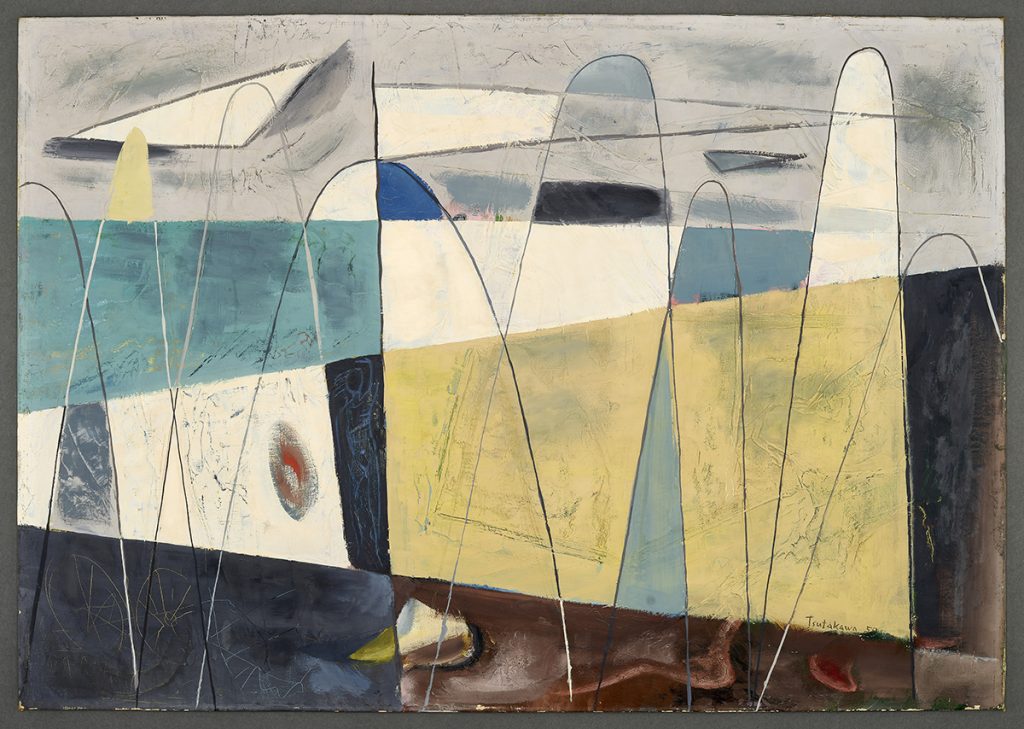
The Ascent, 1950, George Tsutakawa, American, 1910-1997, oil on canvas board, 21 x 30 in. (53.34 x 76.2 cm), Seattle Art Museum, Gift of Mr. and Mrs. Dwight E. Robinson, 54.153, Photo: Scott Leen
Mayumi Tsutakawa, a contributor on two books about local Asian American art, and daughter of George Tsutakawa, an artist represented in this exhibition, told the Northwest Asian Weekly that she was pleased with the diversity of “Beyond Mysticism.” In addition to Mayumi’s father, the following Asian Americans are featured: Fay Chong, Takuichi Fujii, Kenjiro Nomura, Kamekichi Tokita, and Paul Horiuchi. Some of these produced art here in the Seattle area both before and after World War II. Others, particularly the Japanese Americans, moved or stopped producing after the war, due to the interruption of incarceration in internment camps. Many changed styles, a general phenomenon post-war, as artists here and abroad struggled to come to terms with violence.
Although Asian American artists were not rare during the time period the exhibition covers, it is still rare to see them included in an exhibition of American Art. Tsutakawa reminded us that most of the featured Asian American artists were friends with each other, and friends with members of the Big Four and other contemporaries. They attended European art classes, in addition to any background they might have had in Japanese or Chinese art. Were they different from other, non-Asian artists in the U.S. at the time? Not exactly. According to Papanikolas, “they were trying on different art historical styles that were mapping onto what was happening nationally.”
“Beyond Mysticism” is divided into four themed sections. Along the way, there is a “living room” where visitors can take a break and browse books curated by the Seattle Public Library. It’s a lot to see at once, and Papanikolas advises multiple trips to take it all in. One of the themes is “City and Industry.” Here you will see a lot of works done in the Social Realism style. Social Realism was a style that focused on the working class and urban areas where they lived, often with a political, economic, or sociological critic—but not always. Some just enjoyed the shapes and moods that city views offered. Take, for instance, Tokita’s “Bridge” from 1931. Although the Impressionists and the advent of photography had seen an increase in “everyday” scenes since the late 1800s, there was still novelty in choosing an “ordinary” city scene for a painting. Tokita seems to enjoy the line, the shapes, and the interplay of positive and negative space in this view that he chose, not of the topside of a bridge, but its underside.
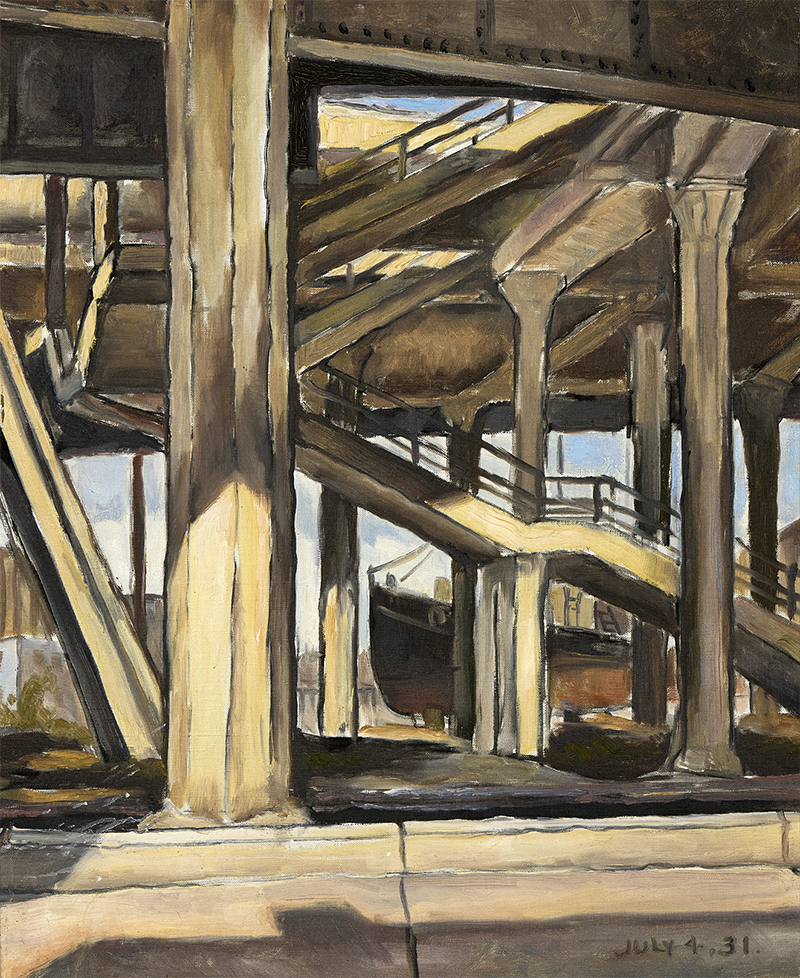
Bridge, 1931, Kamekichi Tokita, American, 1897-1948, Oil on canvas, 23 1/4 x 19 1/16 in. (59.1 x 48.4 cm), Seattle Art Museum, Gift of the artist, 33.230, © Kamekichi Tokita
Tsutakawa commented that, while these types of views might not have been conventionally “pretty” to the viewers of the time, they could inspire emotional responses. This might be a touch of the mysticism previously mentioned. Abstraction, in particular, lends itself to spiritual concepts, while Social Realism is more pragmatic. Tokita’s “Bridge” is almost a combination of both. Surrealism, on the other hand, has been described as an artist’s personal, dream-like view of the world (or of, in fact, their dreams). One correlation between East and West via Surrealism, Papanikolas noted, might be the Surrealist use of “automatic processes.” This is a very “intuitive approach to creating art, where you’re not planning it out, and you’re not pre-thinking it,” she explained. That type of mindset can be found in Zen Buddhism, but is it on purpose from these artists? Did it come naturally to them due to their Asian heritage? That is very hard to say.
A Japanese aesthetic—of not always requiring something to be “pretty,” but rather that it has an emotional message—is something that Tsutakawa believes could have entered the work of Japanese American artists in “Beyond Mysticism.” Asian art, such as calligraphy and ink painting, could have influenced any of the artists in the exhibition, Asian or non-Asian, as many had an interest and education in those areas, and had visited or come from Asia. Abstraction lends itself to use of line in a similar way. Or take raku pottery, Tsutakawa suggested. It’s not perfect, yet it’s beautiful. She believes this type of thinking led to a great acceptance of different forms of art among Asian and Asian American artists, including those in “Beyond Mysticism.”
Tsutakawa enjoyed the diverse views of Seattle shown in the exhibition. It was a new city, burgeoning, and for better or for worse, transitioning through the Industrial Revolution. The “Nature” themed section shows a great deal of concern for the environment in those years. Japantown, Chinatown, views of Yesler Boulevard, all of these and more can be found at “Beyond Mysticism.” It’s also a rare chance locally to view work by artists such as Salvador Dalí, which are included to provide context. “There’s so much to see and discover,” Papanikolas said. “Come see a real slice of what was happening in the Pacific Northwest in the mid part of the 20th century. I think people will be very surprised by what they find.”
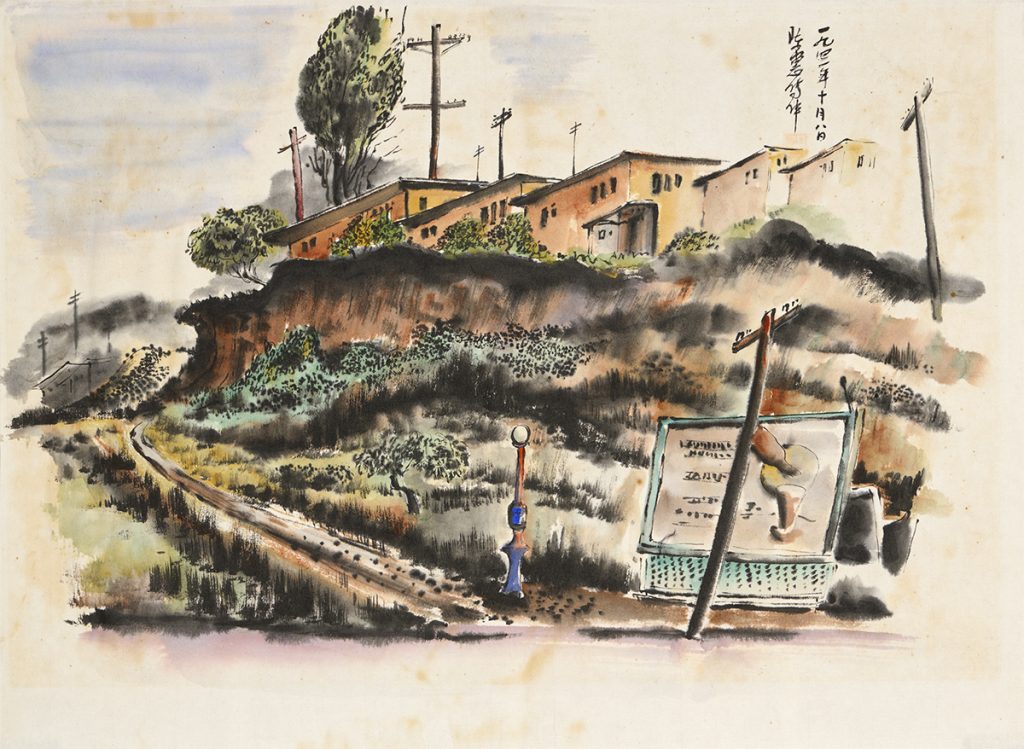
Yesler Housing Project, ca. 1942, Fay Chong, American, 1912-1973, Transparent watercolor, 19 x 25 1/2 in. (48.3 x 64.8 cm), Seattle Art Museum, Eugene Fuller Memorial Collection, 42.24, © Fay Chong Jr., Photo: Scott Leen.
“Beyond Mysticism: The Modern Northwest” runs through Aug. 2, 2026, at SAM. For more information, visit www.seattleartmuseum.org.
Kai can be reached at newstips@nwasianweekly.com.
Leave a Reply