



By Carolyn Bick
NORTHWEST ASIAN WEEKLY
Cora Edmonds struggles to speak for a moment. She is trying not to cry.
“Watching the missiles being intercepted on TV is one thing. I think hearing and feeling the sounds and the vibrations, the booms, like you feel it sort of haptically in your body. It’s really something else,” Edmonds eventually says. It is a Saturday morning where she is—Dubai, in a hotel with her sister and parents. The family has been trapped there for more than a week, while missiles fly overhead, a product of the war President Donald Trump and Israeli Prime Minister Benjamin Netanyahu have started with Iran.
Hotel guests are supposed to stay away from the windows for their own safety, but Edmonds can’t help but look out. She’s always been curious, and it’s part of why she and her family like to travel so much. But she’s never been in this kind of situation. She doesn’t think she’ll be the same.
“The war is at our doorstep. … The sound alone changes you, I believe. It’s like you feel the vibration in your chest, and there’s like a split second wondering what is going on. ‘Am I going to live? Am I going to die? How does this affect you?’” she continues, voice straining. “It makes you feel very fragile. It makes everything feel very fragile. Yeah, we’re in a hotel, but it’s just a structure. It feels a little bit like Titanic—like you’re on a sinking ship, but the music is playing, the dinner’s being served.”
Edmonds and her family are now safely in the United States, after making it to San Francisco on March 8 and back to Seattle by March 9. But when she spoke with the Northwest Asian Weekly at just after 7 a.m. on March 7 in Dubai—7 p.m. Pacific time—the future was anything but certain.
A one-week trip
Edmonds and her family had planned to stay for just a week in Dubai, and leave on March 1. Her family likes to travel, and instilled that love in Edmonds. It’s part of how she cultivated her gallery career. The Hong Kong-born Edmonds owns ArtX Contemporary, a gallery she founded in 1995 in Seattle, after deciding to leave a career in corporate marketing specifically for the art world, sourcing art from creators around the globe. In fact, the day before she spoke with the Northwest Asian Weekly, she was supposed to travel to Australia to meet with Aboriginal artists.
“Edmonds’ lifelong love of art, film, food, photography, and people inspired her to begin supporting global artists by bringing their work back to Seattle,” ArtX Contemporary’s 30-year anniversary post on Instagram reads. “Through a series of small spaces, pop-up exhibitions, and local partnerships, Edmonds and the early ArtX team built a strong following. In 2006, the gallery moved into an expanded space in Pioneer Square where the gallery remains today.”
Edmonds also co-founded Namaste Children’s Fund, an organization that supports education for 120 girls in Nepal’s Humla region. She also supports multiple local organizations, including the Wing Luke Museum, the International Examiner, and the Asian Counseling and Referral Service.
Both Edmonds and her family had thought their travels to Dubai would be like any other travel the family had embarked upon together. They were looking forward to exploring the country together, especially since Edmonds’ father had just been cleared to travel, a year after having had open heart surgery. He had to make sure to take his medications with him, though, and the family decided to pack an extra week’s supply, just in case.
Stranded
It was a good thing they did. Following Netanyahu and Trump’s joint decision to start a war with Iran, the airline canceled their flight—and all other flights—leaving from Dubai. It was (and still is, in many respects) too dangerous to travel.
Edmonds had enrolled the family in the U.S. State Department’s Smart Traveler Enrollment Program (STEP), and, like many other Americans, first turned to the State Department for assistance. She quickly realized that neither would be of much help.
Before leaving for Dubai, Edmonds enrolled herself and her family in STEP, as a regular safety precaution. Though she still decided to re-enroll the family, after finding out their flight back to the U.S. had been canceled, STEP offered little in the way of guidance, except for generic pieces of advice— “shelter in place, stay at your hotel, don’t go out, and so forth,” Edmonds said.
The State Department at first seemed as though it was going to be able to get them out of there. Both Edmonds and her sister told State Department officials that they needed to leave soon, because both of their parents, in their 70’s and 80’s, were running out of necessary medication. Edmonds said that she was particularly worried about her father, who was by then a day away from running out of medication.
“These are blood medications that affect the heart and beta blockers and so forth,” Edmonds explained. “And so we just want to keep him in the best shape. My dad’s an optimist, and so he’s like, ‘Oh, don’t worry, I’ll be fine.’ But we all know medication is there for a reason.”
An official from the State Department eventually called them around 12:30 p.m. on March 5 from a passport office, offering the family a flight out from Abu Dhabi. The official, a woman, told Edmonds and her family to keep an eye on their phones, text messages, and emails for instructions, so the family did just that, quickly packing up and waiting for any message from the department. Edmonds said that she did not get the woman’s name—and kicked herself for it later.
The family sat there for hours, waiting for information that never came. The State Department never got in touch with them.
Through a complicated series of phone calls, emails, and text messages with family and friends in the U.S.—all of whom were trying to get Edmonds and her family information, or get them all back home—the family found out that the State Department claimed to have tried to get in touch with them multiple times, but had failed.
Edmonds said that this is not true. Not only had the family been watching all their devices and modes of communication all day, but because she had re-enrolled them all in STEP, the State Department would have had their up-to-date contact information on hand.
“I was so livid. Here we are already sheltering and cooped up under pressure, and I have been watching my phone for this email and voicemail. And they say, ‘No, we’ve been sending you several messages.’ And there was nothing. There was nothing,” Edmonds said. “I was livid. Because here we are watching the news … and they’re showing U.S. repatriation flights on Thursday, on Friday. And I’m like, ‘Why are we not on that plane?’ These are absolutely healthy young people getting home. And it’s like, ‘What about my parents?’”
“They said that they were going to help us,” she continued. “Someone in the State Department was not doing their job right. There was a lot of chaos. And I know they’re overwhelmed. … Maybe I will call it a mix-up. But we were not contacted when they said we were contacted.”
A bidding war
Fortunately for Edmonds’ parents, the sisters had divided and conquered. Edmonds’ sister had managed to get her parents’ necessary medication prescriptions by taking them to a nearby hospital. But the family still had to find a way home—or even just out of the Middle East—and flight prices anywhere out of the region were jaw-droppingly high.
“I looked at a flight to Frankfurt, and I was about to book four tickets on that flight at an extraordinary cost, because all the flight costs have just skyrocketed. It’s not business as normal,” Edmonds said. “I understand about basic demand. But four, seven-hour flights to Frankfurt would have cost us like $28,000.”
Edmonds said she was set to jump on the tickets and figure out how to fully pay for them later. But she hesitated for just a moment, wanting to speak with her family about it—and lost the tickets to someone else. It was like a bidding war for plane tickets, she said.
“Either the flight changed or somebody else already got the tickets. It’s crazy. So it’s that kind of frustration and that kind of market demand,” Edmonds recalled. “There’s a lot of competition going to Europe. So I thought, ‘Well, why not go to India?’ So we ended up booking a flight from Dubai to New Delhi, which is a three-hour flight. And it cost us, in economy, over $4,500 for four tickets. It’s a crazy price for a three-hour flight.”
Getting out
By the time the Northwest Asian Weekly had gotten in touch with Edmonds, she and her family had three separate options: Istanbul; Hong Kong by way of Dhakar, India, and Bangladesh; or—the best option—San Francisco. The last option was the least certain.
The State Department had finally gotten in touch with them again, and offered them a flight to Istanbul the day Edmonds spoke with the Northwest Asian Weekly, after which the family would have to find their own way home. Edmonds said that, as she spoke with the Northwest Asian Weekly, her sister had just emailed the State Department to refuse that option.
“Istanbul is also affected,” Edmonds said. “I’m already seeing my group with my family, and everybody is saying we are not going to Istanbul.”
Edmonds said that she awakened to the news that Emirates, the family’s original airline, had opened up flights again. She said that her sister’s husband had managed to get them booked on a flight to San Francisco at 8:19 a.m. on March 8. When she first spoke with the Northwest Asian Weekly, that flight had not yet been canceled. Still, just in case, she and her family decided to book flights through India and Bangladesh onward to Hong Kong, a place they knew.
“We had another family meeting,” Edmonds said, “and we said, ‘It wouldn’t be the worst case if we went to Hong Kong, and just took a break from all the stress.’
But later in the day, the family’s plans were disrupted once again. A few hours after speaking with the Northwest Asian Weekly, she sent the publication a couple text message updates.
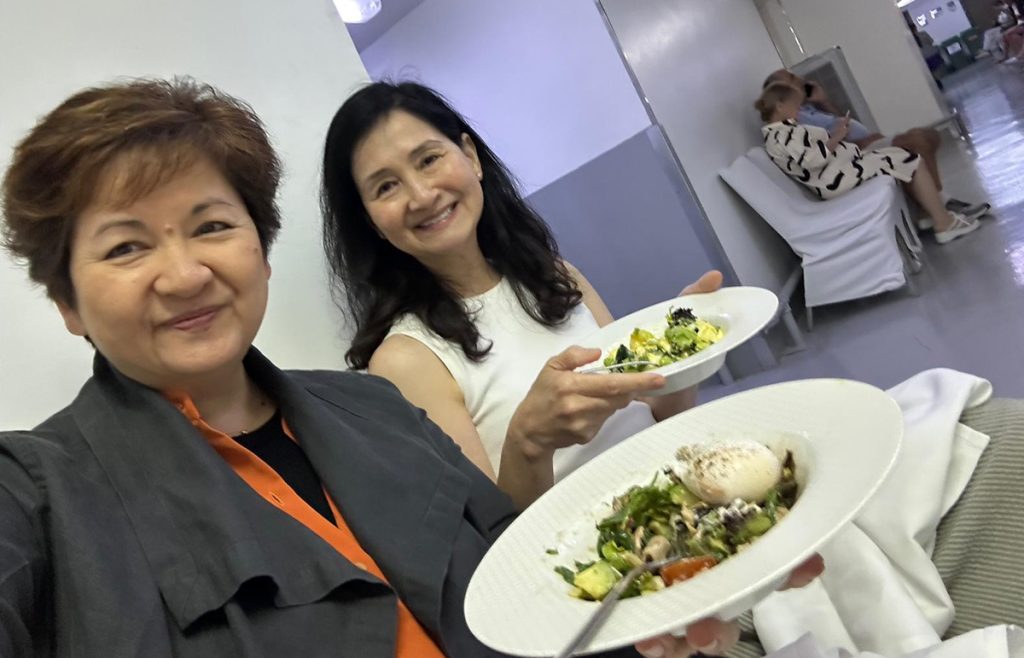
Cora Edmonds, left, and her sister eat breakfast in the basement bunker of their hotel in Dubai, after having to evacuate the hotel restaurant on March 7, 2026. Courtesy of Cora Edmonds.
“Eating breakfast at the hotel basement bunker right now,” one message read. “Had to evacuate from the hotel restaurant yesterday mid-breakfast as well. We got smart today and brought our plates with us to the basement.”
Another read, “Breaking news- missile interceptions just happened at DXB. Airport is closed at the moment. All flight plans cancelled.”
Fortunately, the airport opened up again. Edmonds texted the Northwest Asian Weekly to report that she and her family were waiting to board their plane.
According to a flight tracker, their San Francisco flight did leave on time. On the morning of March 9, this reporter received the following text message: “Yes we are back in Seattle! A long journey and my parents are exhausted but we are home!! Yippee!”
But still, the experience will stick with Edmonds.
“I feel like this experience has opened my heart in a way that I didn’t expect. … Because the empathy … feels very personal now. It’s not an abstract thing at all. It’s not theoretical. But it’s like an embodied empathy for those around the world who can’t defend themselves against these weapons. And it is no fault of their own that they are trapped in countries that they can’t extract themselves from,” Edmonds said just days before, speaking from her hotel in Dubai. “Our situation really is not that bad. There are solutions that we can have. There’s so many people who cannot have solutions. And people have to endure hostilities and fighting as an everyday reality. That’s just unfathomable.”
Leave a Reply